
 Deutsch
 Dansk
Dansk Suomi
Suomi Latviešu
 Lietuvių
 Norsk bokmål
 polski
 Русский
 Svenska
No products in the cart.
Uncategorized
V2C Denka 40kW vs Alpitronic HYC50: Best 40/50kW DC Charger?

20
Aug
Aug
The Rise of the DC Wallbox: Why AC is No Longer Enough
The EV charging landscape is evolving. For years, 22kW AC chargers were the go-to solution for businesses. But customer expectations have changed. Waiting hours for a significant charge is no longer acceptable. Enter the DC wallbox—a compact, high-speed charging solution that delivers a superior customer experience without the massive footprint of industrial fast chargers.
For businesses like hotels, restaurants, retail centers, and private car parks, the 20kW to 50kW DC range is the new sweet spot. It offers a powerful charge that can add significant range during a short stay, turning a simple amenity into a powerful customer magnet. As vehicles with advanced battery technology and higher charging curves become standard by 2026, the shift to DC isn’t just an upgrade; it’s a necessity to stay competitive.
The Efficiency Gap: AC vs. DC Explained
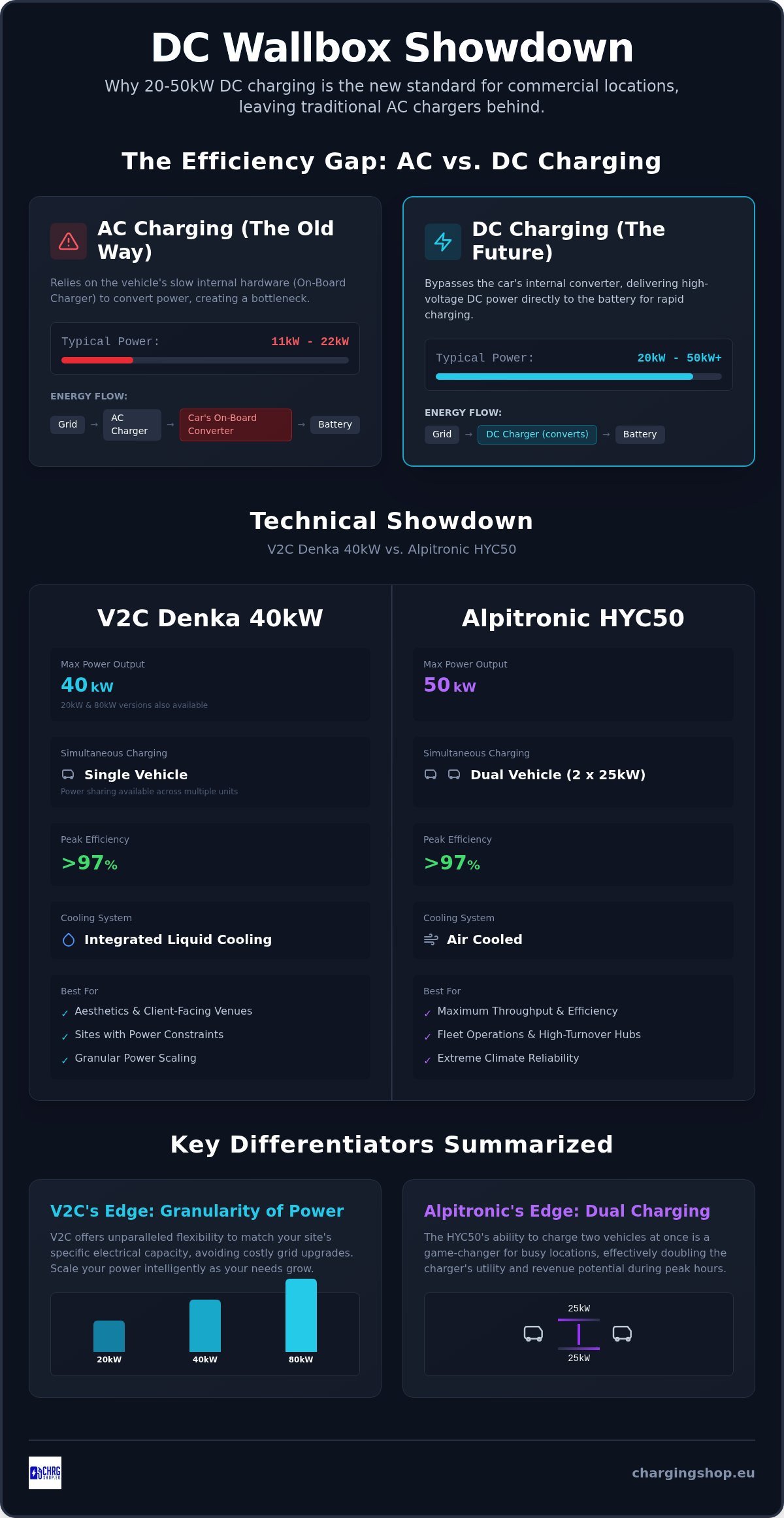
So, what makes DC charging so much faster? It’s all about efficiency. Standard AC chargers rely on a vehicle’s onboard charger to convert AC power from the grid into DC power the battery can store. This process is limited by the car’s internal hardware, often capping out at 11kW or 22kW and introducing energy loss.
A DC wallbox bypasses the vehicle’s onboard converter entirely. It delivers high-voltage DC power directly to the battery, resulting in dramatically faster charging speeds and less wasted energy. For short-stay locations where time is money, this direct-to-battery delivery means happier customers who can get back on the road quickly. At Charging Shop, we simplify this transition by providing professionally curated hardware like the V2C Denka and Alpitronic HYC50, designed for seamless commercial integration.
Commercial ROI: Turning Charging into a Service
Faster charging isn’t just about customer convenience; it’s a direct path to a higher return on investment. A DC wallbox can service multiple vehicles in the time it takes a 22kW AC charger to service one. This increased turnover means more charging sessions per day and, consequently, more revenue.
Modern DC chargers are built for business. With sophisticated management software, you can easily set tariffs, manage users, and automate billing. This transforms your charging station from a cost center into a profitable service. To unlock this potential, a robust management platform is essential. Systems like the CHRG Network provide a unified backend to control hardware, track revenue, and automate payments, ensuring your investment generates predictable income. For a deeper dive into financial modeling, explore our guide to commercial EV charger ROI.
Technical Showdown: Performance and Power Metrics
When choosing a DC wallbox, the technical specifications are paramount. Today, we’re comparing two of the most formidable players in the compact DC market: the Alpitronic HYC50 and the V2C Denka. Alpitronic brings its industrial-grade 50kW power and legendary efficiency, while V2C offers a versatile lineup with 20kW, 40kW, and a future-proof 80kW model planned for late 2026.
The core of the comparison lies in their approach to power and flexibility. The HYC50 is a powerhouse built for high-turnover sites. The Denka, particularly the 40kW model, offers a compelling balance of speed and design, while the 20kW version provides a crucial solution for locations with limited electrical infrastructure. Both units boast impressive efficiency ratings above 97%, minimizing operational costs by reducing wasted electricity and thermal output.
| Feature | V2C Denka 40kW | Alpitronic HYC50 |
|---|---|---|
| Max Power Output | 40kW (20kW & 80kW versions available) | 50kW |
| Simultaneous Charging | Single Vehicle (Power sharing across units) | Yes (2 x 25kW) |
| Output Voltage | 150 – 950 VDC | 150 – 1000 VDC |
| Peak Efficiency | >97% | >97% |
| Cooling System | Integrated Liquid Cooling | Air Cooled |
| Best For | Aesthetics, Client-Facing Venues, Sites with Power Constraints (20kW model) | Maximum Efficiency, Fleet Operations, High-Turnover Hubs |
RRP Price (ecxl VAT) ~9300-9700eur ~18500-19500eur
Power Output and Simultaneous Charging
The Alpitronic HYC50’s standout feature is its ability to charge two vehicles simultaneously at 25kW each. This split-charging capability is a game-changer for commercial fleets or busy retail locations, effectively doubling the charger’s utility during peak hours. It ensures no parking bay is left waiting.
The V2C Denka focuses on delivering its full power to a single vehicle. However, its strength lies in its ecosystem. Multiple Denka units can be linked and managed with dynamic power sharing, allowing a site to scale its charging capacity intelligently. This introduces the concept of "Granularity of Output Power"—the ability to precisely match charger speed to the site’s available electrical capacity. With 20kW, 40kW, and future 80kW options, V2C provides unparalleled flexibility to tailor the installation to your grid connection, avoiding costly infrastructure upgrades.
Efficiency and Thermal Management
Alpitronic is the industry benchmark for efficiency, and the HYC50 is no exception. Its use of advanced Silicon Carbide (SiC) semiconductors allows it to achieve an incredible peak efficiency of over 97%. This means more power goes into the vehicle’s battery and less is wasted as heat. The result is lower electricity bills and enhanced reliability, as components run cooler and last longer.
The V2C Denka also boasts a >97% efficiency rating and tackles thermal management with an innovative integrated cooling system. This design not only protects the internal power electronics but also helps maintain the longevity of the charging cable, a component often susceptible to heat-related degradation. In high-temperature outdoor environments, both units are engineered to perform reliably, but Alpitronic’s reputation for robust thermal management in its larger units gives it a slight edge in extreme climates.
Design and Form Factor: Fitting Your Site Environment
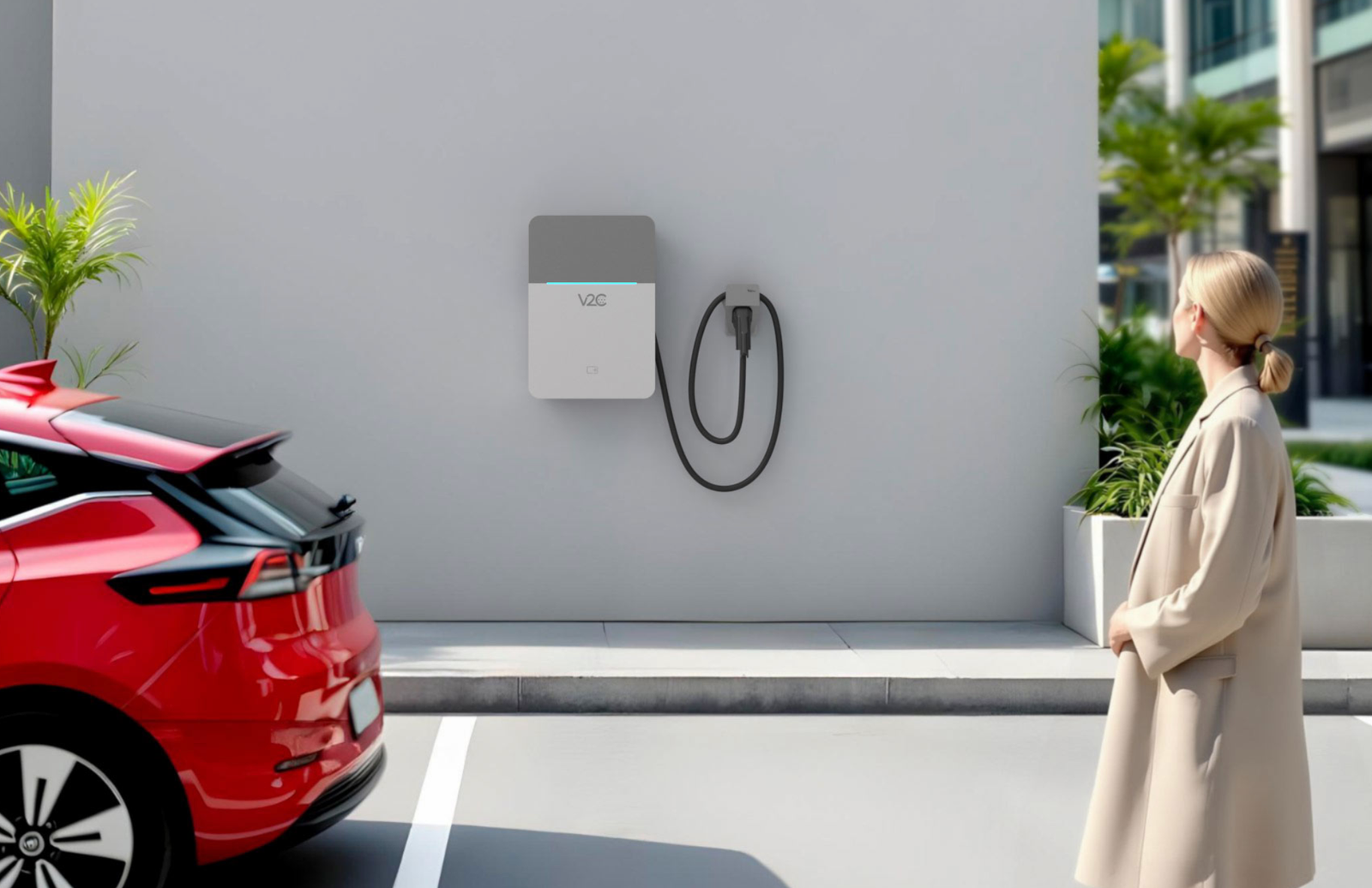
A charger’s physical presence is just as important as its performance, especially in customer-facing environments. The V2C Denka aggressively targets this with its "ultra-compact" and visually striking design. It’s engineered to be a seamless, wall-mounted addition to modern architecture, making it ideal for locations where aesthetics are a priority.
In contrast, the Alpitronic HYC50 has a more functional, industrial look. It’s built for durability and utility, not to win design awards. However, its practicality shines through with options for both wall-mounting and a pedestal stand. A key differentiator is noise. The HYC50 is often marketed as "perfect for residential areas" due to its quiet operation, a critical factor for hotels or mixed-use developments where charging stations are close to guest rooms or apartments.
Aesthetics and Branding Opportunities
The V2C Denka is a charger designed to be seen. Its minimalist, pure-white chassis and interactive LED lighting system create a premium user experience that aligns perfectly with luxury hotels, high-end retail, and corporate offices. The lighting doesn’t just look good; it communicates charging status intuitively, enhancing user trust and ease of use. For more details on its design philosophy, see the official V2C Denka 40/80kW professional guide.
The Alpitronic HYC50 offers a different kind of aesthetic appeal: customization. Its plain front door is a blank canvas for corporate branding. Businesses can apply custom vinyl wraps to display their logo, advertisements, or user instructions, turning the charger into a branded asset. While less elegant than the Denka, this practical approach is highly effective for reinforcing brand identity in commercial or fleet settings.
Noise Levels and Environmental Durability
DC fast charging generates heat, which requires active cooling. The noise from cooling fans can be a significant concern. The HYC50 is engineered for exceptionally quiet operation, making it one of the best choices for noise-sensitive locations. The Denka’s cooling system is also highly efficient, but Alpitronic’s focus on near-silent performance gives it an advantage for installations near residential or quiet zones.
For outdoor reliability, both chargers are built to withstand the elements, with high IP (Ingress Protection) ratings to protect against dust and water. As weather extremes become more common in 2026, this durability is non-negotiable. The HYC50 also features a thoughtful optional cable management system that retracts and protects the cable, reducing wear and tear and preventing it from becoming a trip hazard—a small but crucial detail for public-facing installations.
Software Ecosystem: V2C Cloud vs. Hyper Suite
Hardware is only half the equation. The software that manages the charger is what unlocks its commercial potential. V2C offers its intuitive V2C Cloud and Business Panel, designed for easy remote management, even for non-technical business owners. It allows installers and operators to monitor status, manage users, and set charging rules from anywhere.
Alpitronic’s Hyper Suite is a powerful, enterprise-grade platform designed for operating large-scale charging hubs and fleets. It provides deep analytics and robust tools for maximizing uptime and operational efficiency. Both platforms are fully compliant with OCPP 1.6J and 2.0.1, ensuring they can be integrated into any major third-party charging network.
This is where a universal management solution like CHRG Network Access becomes invaluable. It acts as a bridge, allowing you to manage a mixed fleet of hardware—including V2C, Alpitronic, and other brands—from a single, unified dashboard. This eliminates vendor lock-in and simplifies billing, user management, and revenue tracking across your entire infrastructure.
User Authentication and RFID Management
A seamless user experience starts with easy authentication. Both the Denka and HYC50 feature fast, reliable RFID readers for tap-and-go access, allowing businesses to issue cards to employees, members, or paying guests. They also support mobile app authentication for public use.
The V2C Denka enhances this process with its interactive lighting. The LEDs provide clear visual feedback, confirming authorization and showing the charging status (charging, finished, error) from a distance. This simple feature significantly improves usability and reduces driver confusion, a common pain point at public chargers.
Remote Monitoring and Revenue Tracking
For any commercial operator, the ability to monitor chargers remotely and track revenue is critical. The V2C Business Panel offers granular reporting, making it easy to see usage patterns, energy consumption, and income per charger. This data is essential for automating tasks like employee reimbursement for business mileage or billing hotel guests for charging sessions.
While Alpitronic’s Hyper Suite offers similar capabilities, it’s geared more toward technical operators managing large networks. For the average business owner, a platform like the CHRG Network provides a more accessible interface for managing revenue. It integrates directly with your chargers to automate billing, process payments, and provide clear financial reports, regardless of the hardware you choose.
Final Verdict: Which DC Wallbox Should You Buy?
Both the V2C Denka and Alpitronic HYC50 are exceptional DC wallboxes, but they excel in different scenarios. The right choice depends entirely on your site’s specific needs, priorities, and electrical capacity.
- Choose the Alpitronic HYC50 if: Your top priorities are maximum efficiency and high turnover. The 50kW output and 2x25kW simultaneous charging make it the undisputed champion for busy commercial hubs, fleet depots, and service stations where every minute counts.
- Choose the V2C Denka 40kW if: Aesthetics, user experience, and brand integration are paramount. Its stunning design and interactive lighting make it the perfect fit for luxury hotels, modern offices, and premium retail locations where the charger is part of the customer-facing environment.
- Choose the V2C Denka 20kW if: Your site has limited electrical capacity. This model provides the benefits of DC fast charging without requiring expensive and disruptive grid upgrades, offering a smart, cost-effective entry point into the DC world.
- Standardize on V2C if: You already use V2C’s AC chargers, like the Trydan. Integrating Denka units creates a seamless hardware and software ecosystem managed through a single platform. For those considering a mixed V2C setup, see how their AC products compare in our V2C Trydan vs Alfen Pro Line comparison.
Best for Hotels and Restaurants
For the hospitality industry, the V2C Denka is the clear winner. Its elegant design and ambient lighting enhance the guest experience, reflecting a commitment to premium amenities. The 20kW or 40kW power output is perfectly suited for "dinner-length" or overnight stays, providing a significant charge that leaves guests satisfied. The quiet operation and compact form factor allow for discreet installation near guest areas.
Best for Commercial Fleets and Hubs
For commercial fleets, logistics centers, and public charging hubs, the Alpitronic HYC50 is the superior tool for the job. Its world-class efficiency directly translates to thousands of euros saved in annual electricity costs at scale. More importantly, the ability to charge two vehicles at once maximizes asset utilization, allowing you to service your entire fleet or twice the number of paying customers with a single unit. It’s a workhorse built for maximum ROI.
Ready to upgrade your charging infrastructure? Order your V2C Denka or Alpitronic HYC50 from Charging Shop today and get a personalized quote tailored to your business needs.
Frequently Asked Questions (FAQs)
Can the Alpitronic HYC50 charge two vehicles at the same time?
Yes. The Alpitronic HYC50 is equipped with two CCS2 connectors and can deliver 25kW of power to two vehicles simultaneously, for a total output of 50kW. This feature is ideal for high-traffic locations.
Is the V2C Denka suitable for outdoor installation?
Absolutely. The V2C Denka has a high IP55 rating for protection against dust and water ingress and an IK10 rating for impact resistance, making it robust and reliable for outdoor installation in various weather conditions.
What is the efficiency of the Alpitronic HYC50 compared to the Denka?
Both chargers are at the top of their class, with peak efficiency ratings exceeding 97%. This means very little energy is lost as heat during the charging process, leading to lower operating costs for both units.
Do these DC wallboxes require a special electrical connection?
Yes. Unlike most AC chargers, DC wallboxes require a three-phase electrical supply with significant power capacity (e.g., 40kW or 50kW plus overhead). A professional electrical assessment of your site is essential before installation.
Can I manage billing for customers with the V2C Denka?
Yes. The V2C Denka can be managed via the V2C Business Panel or integrated into a third-party management system like the CHRG Network using its OCPP compliance. This allows you to set pricing, manage users, and automate billing for public or private use.
What is the noise level of the Alpitronic HYC50 during fast charging?
The Alpitronic HYC50 is engineered for very quiet operation, typically below 50 dB(A) at full load. This makes it one of the quietest DC chargers on the market and suitable for installation in noise-sensitive areas like residential complexes or hotels.
When will the 80kW V2C Denka be available?
V2C has announced plans for an 80kW version of the Denka, which is anticipated to be released in late 2026. This will provide an even more powerful option for sites needing higher charging speeds within the same compact design.
Does Charging Shop provide installation for these units?
Charging Shop is a specialized retailer of professional EV charging hardware and does not offer on-site installation services. We recommend working with a certified local electrician to ensure your charger is installed safely and in compliance with all local regulations.
