
 Deutsch
 Dansk
 Suomi
 Latviešu
 Lietuvių
 Norsk bokmål
 polski
 Русский
 Svenska

No products in the cart.
Uncategorized
How to Set a Fair Fee for Airbnb Guest EV Charging
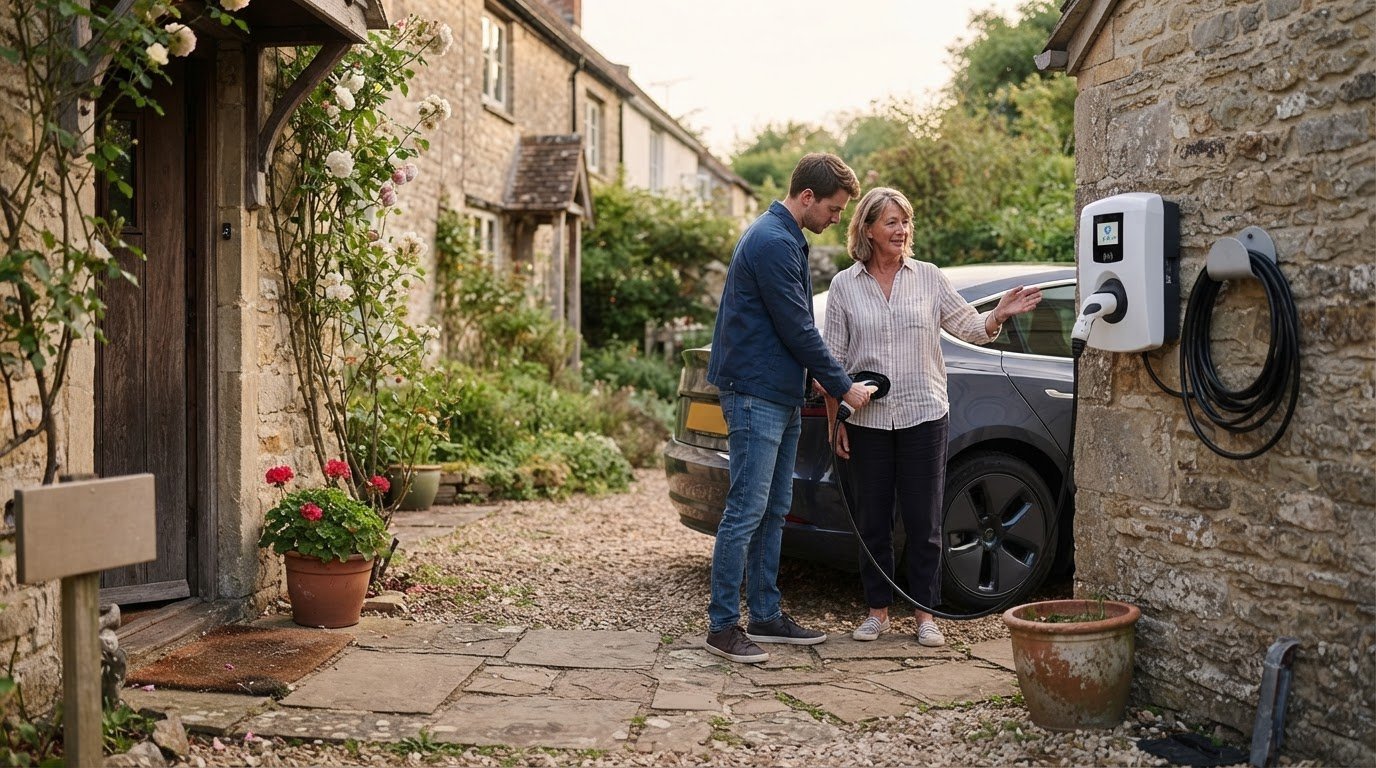
08
Nov
Nov
The simplest fee isn’t always the fairest. You can include EV charging in your nightly rate, but charging separately based on electricity used can make the cost clearer.
It’s reasonable to make charging convenient without absorbing an unexpected energy bill. Choose whether to include the cost in your nightly rate or charge per use, then explain the arrangement in your listing and house manual. Clear pricing helps guests know what to expect before they plug in.
Consider how charging will work at your property, how you’ll measure usage, and how to keep cables and equipment safely out of the way. This guide covers fair fees, site suitability, qualified installation help, and ways to reduce risks while keeping guest safety central.
Key Takeaways
- Choose whether to include charging in the nightly rate or charge by measured use, then state the arrangement clearly in your listing and house manual.
- Assess your parking layout, electrical capacity, and charging needs before choosing equipment; qualified electrical installation help matters for a safe, workable setup.
- Consider guest demand when deciding whether charging belongs in your rental offering, and make convenience and clear pricing part of the experience.
- Plan for safe cable placement and avoid relying on portable chargers as a permanent setup. The Internal Revenue Service describes a maximum credit of $100,000 per charging port under the U.S. Alternative Fuel Vehicle Refueling Property Tax Credit.
What’s the fairest way to charge Airbnb guests for EV charging?
Airbnb hosts can offer EV charging to guests. Decide whether to include the cost in your nightly rate or charge separately for use.
Review Local Rates and Incentives
Start with your electricity bill, available utility rates, and local rules for charging guests. These help you estimate session costs and determine whether a separate fee has specific requirements. Incentives may also affect your equipment budget, so identify any programs that apply to your property before setting a fee.
According to the Internal Revenue Service, the U.S. Alternative Fuel Vehicle Refueling Property Tax Credit has a maximum credit of $100,000 per charging port. Eligibility and local requirements matter, so avoid treating that maximum as a guaranteed credit or using it as a guest fee.
- Estimate charging costs from your utility rate and expected usage. Use that estimate to decide whether a per-use fee or a modest nightly-rate adjustment fits your property.
- Keep the fee tied to your actual charging costs. A flat charge can feel unfair when guests use very different amounts of electricity.
Communicate Charging Availability
Update your listing and house manual with the charging arrangement, access instructions, and any guest-facing fee. Guests can search for suitable stays using Airbnb’s EV charger filter, so describe your amenity accurately. Clear details help travelers who need charging during their stay assess whether your property suits them.
Charging can differentiate a rental and may support booking income, but its value depends on guest demand, electricity costs, and how clearly you present the amenity. Treat it as a practical booking feature, not a promise of extra reservations. Update your listing whenever the setup or fee changes.
- State whether charging is included or billed separately, and explain how guests should access it.
- After changing your offer, update both the Airbnb listing and house manual so guests see consistent details before and during their stay.
Site assessment and installer qualifications
Airbnb hosts can offer a wall-mounted AC charger or a faster DC charging option. Installation costs depend on the equipment, electrical capacity, cable route, and work required at the property.
- Assess the parking area. Identify where guests park, where the charger could sit, and how its cable reaches each vehicle. Note any walls, gates, or shared parking that affect access. A clear route helps determine placement and avoids making the charging point awkward for guests to use.
- Review the electrical supply. Have the property’s existing capacity and wiring considered before choosing charger speed. A site with a suitable supply may need less electrical work than one requiring circuit upgrades or a longer cable route. Those differences affect the installation scope and final cost.
- Use a qualified electrical installer. For a U.S. project, look for a state-issued electrical license designating the installer as a Journeyman or Master Electrician. The assessment should consider charger placement, electrical capacity, cable routing, and the property’s operating needs. Faster charging can require a different setup than a standard wallbox.
- Compare installation scope, speed, and warranty. Ask for a clear breakdown of equipment and labor, and have the proposed charging speed matched to your electrical supply and guests’ likely parking time. Review the warranty terms for the selected charger and the installation work separately. These details help you compare proposals without relying on a headline price alone.
- Review incentives before budgeting. Airbnb properties may qualify for incentives depending on location, equipment, and eligibility rules. Federal, state, and local programs can differ, so include only incentives that apply to your property. To narrow down equipment choices for your site, explore charger options for different properties.
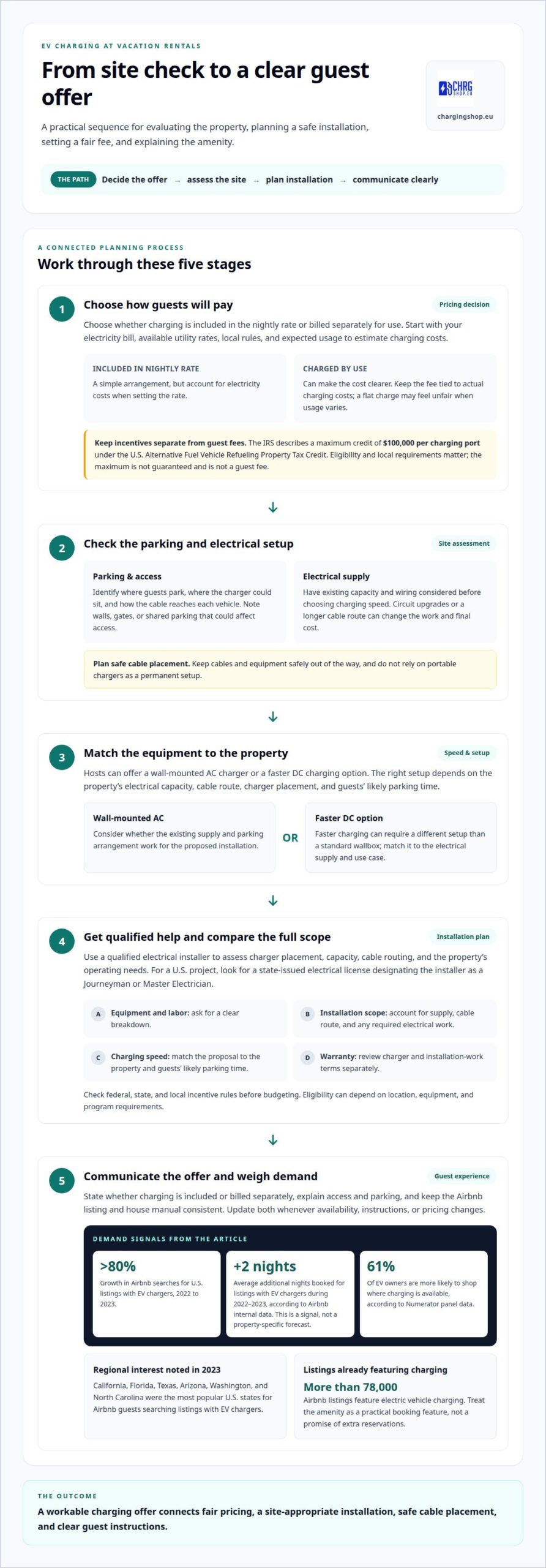
Demand for EV chargers at vacation rentals
Use booking patterns and local interest to assess whether charging fits your rental and its guests.
- Make the amenity easy to find. Airbnb searches for U.S. listings with EV chargers grew more than 80% from 2022 to 2023. Add accurate charging details to your listing’s amenities so travelers using Airbnb’s EV charger filter can find them. Explain where guests park and how they access the charger. Clear details make EV charging for Airbnb guests easier to evaluate before booking.
- Consider booking potential without assuming a result. Airbnb’s internal data indicates that listings with EV chargers averaged two additional nights booked during 2022-2023. Use this as a demand signal, not a forecast for your property. Compare your booking patterns with the needs of travelers who choose your location before deciding how much weight to give the amenity.
- Check regional interest. In 2023, California, Florida, Texas, Arizona, Washington, and North Carolina were the most popular U.S. states for Airbnb guests searching listings with EV chargers. If your rental is in one of these states, make charging details prominent. In other locations, consider nearby attractions and the travel routines of your typical guests.
- Connect charging to guest routines. Numerator panel data indicates that 61% of EV owners are more likely to shop where charging is available. For a rental, consider whether guests can charge while parked overnight or visiting the property. Describe the practical convenience of EV charging for Airbnb guests without promising more bookings.
- Keep your listing current. More than 78,000 Airbnb listings feature electric vehicle charging. Review your amenity details whenever access instructions, pricing, or charging availability changes. Guest feedback can show whether the feature is easy to use and whether your listing explains it clearly.
Guest safety and avoiding portable chargers
- Keep charging cables out of walking paths. A cord stretched across a driveway, entrance, or walkway can become a trip hazard. Position the charging point so guests can connect their vehicles without routing cables across areas people use. If the parking layout forces a cable across a path, change the parking or charging arrangement instead of leaving the hazard in place.
- Make the charging location easy to identify. Give guests clear instructions in the house manual, including which parking space and charging point to use. Label the correct location so a guest doesn’t choose an unsuitable outlet or run a cable through a doorway. Simple directions reduce confusion when guests arrive after dark or unfamiliar with the property.
- Use a fixed setup for regular guest charging. A portable charger may be convenient for occasional personal use, but a cord placed temporarily can create access and trip problems at a rental. A dedicated charging point gives guests a consistent location and lets you plan cable routing around the parking area. Match the setup to the property rather than leaving guests to improvise.
- Schedule a safety inspection. Arrange annual EV charger safety inspections with a qualified electrician. Include the charging point, its visible cable, and the surrounding access area in the review. This gives you a regular opportunity to identify damage or changes that could affect guest use. Also speak with your insurer about considerations for offering charging at a short-term rental.
- Give guests a safe, repeatable routine. Explain how to access the charger, where to park, and how to keep the cable clear after use. Keep the same instructions in your listing and house manual. For help choosing equipment suited to a guest charging setup, explore tailored charging options.
Charging Shop
Charging Shop helps hosts match EV charging hardware to their property and guest needs. If you’re weighing charging speed, parking layout, and how guests will use the charger, a Personalised Charging Offer can help you consider a suitable direction. The available options include the V2C Trydan 22kW, V2C DENKA 20kW DC Wallbox, and Alfen Single Pro Line 22kW. Each has a different role in a charging setup, so choose based on your site assessment rather than the listing amenity alone. Pair your equipment decision with clear guest instructions and a safe charging area. For help exploring a charging setup for your rental, contact Charging Shop.
Make charging part of a better guest experience
Build your charging offer around how guests use your property, then refine it as you learn what works. A clear, dependable setup can make EV charging for Airbnb guests a considered amenity rather than an added complication. Keep the next decision practical: choose equipment suited to your property and make the experience straightforward from arrival through checkout.
Charging Shop can help you explore suitable charging hardware and a Personalised Charging Offer for your rental. Bring your property requirements and charging goals into that conversation, then choose a direction that fits your setup. The V2C Trydan 22kW, V2C DENKA 20kW DC Wallbox, and Alfen Single Pro Line 22kW are among the available options.
Contact Charging Shop about your rental to discuss your EV charging plans and take the next step with confidence.
Frequently Asked Questions
Can I just include EV charging in my nightly rate?
Including charging in the nightly rate keeps the booking price simple, but you absorb electricity costs even when guests use more power. If usage varies, a separate fee can better reflect consumption. For example, state in your listing whether charging is included or billed separately, and keep the house manual consistent.
Ready to make your Airbnb rental property more profitable?
Treat charging as an amenity, not guaranteed extra income. Review guest interest, operating costs, and what your property can support before investing. Then decide how the amenity fits your listing: it may appeal to EV drivers, but occupancy and revenue depend on your property and market. Clear instructions can help make guests’ stays smoother.
How should Airbnb hosts price EV charging for guests?
Base the fee on your electricity rate and how much guests charge. A per-use fee relates more closely to consumption when sessions vary, while including charging in the nightly rate keeps the booking price simple. Explain the arrangement before guests book, and don’t present a flat fee as exact reimbursement if actual usage varies. Revisit your calculation when utility rates change.
Can hosts charge extra for EV charging under Airbnb rules?
Hosts can state a separate charging fee in their listing rules so guests see the arrangement before booking. Explain whether it applies per session or reflects measured electricity use, and how payment works. Keep the wording consistent across your listing, house manual, and guest messages. Clear disclosure helps prevent surprise charges at checkout.
What electrical requirements and permits are needed to install an EV charger?
Requirements depend on the property’s electrical capacity, charger choice, installation route, and local permitting rules. An electrician can assess whether the existing supply supports the planned charger and what installation work is needed. Permit processes vary by location, so follow the relevant local authority’s requirements. For a U.S. installation, a state-issued electrical license identifying a Journeyman or Master Electrician is a useful qualification.
What safety and liability risks come with guest EV charging?
A cable crossing a walkway or driveway can create a trip hazard, and unclear instructions may lead guests to use the wrong outlet or parking area. Keep the charging route clear, identify the designated location, and arrange an annual safety inspection with a qualified electrician. Discuss rental charging with your insurer to understand how your policy treats the setup and guest use.
