
 Deutsch
 Dansk
Dansk Suomi
Suomi Latviešu
 Lietuvių
 Norsk bokmål
 polski
 Русский
 Svenska
No products in the cart.
Uncategorized
Commercial EV Charger ROI: The 2026 Guide to Profitable Fast Charging
13
Aug
Aug
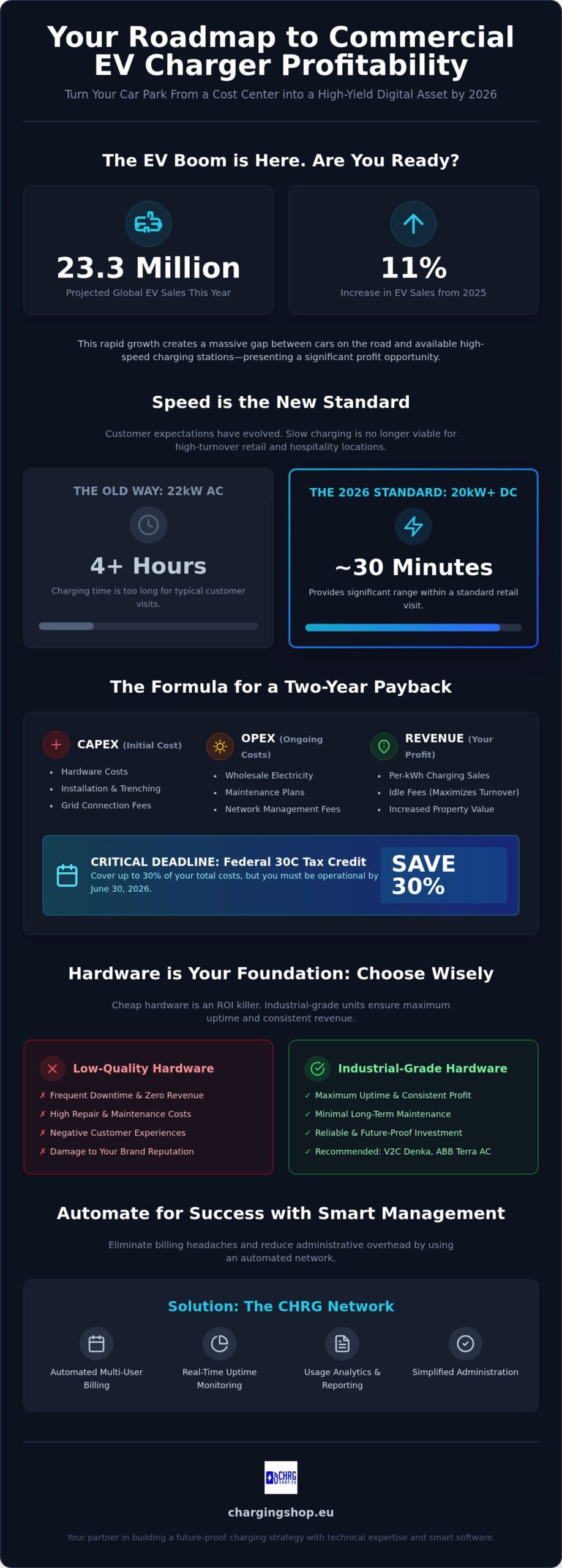
Your car park is no longer just a cost center. In 2026, it is a high-yield digital asset. With global EV sales hitting 23.3 million units this year, the demand for rapid power is surging. You likely worry that high hardware costs or complex multi-user billing will eat your margins. It’s a valid concern. However, mastering your commercial EV charger ROI is the simple difference between a stranded asset and a self-sustaining profit engine.
We’ll show you exactly how to flip the switch on profitability. This guide breaks down the 2026 metrics for DC fast charging hardware like the V2C Denka and reliable AC solutions like the Alfen Single Pro Line. You’ll learn how to leverage the CHRG Network to automate every transaction and eliminate the billing headache for good. We are covering everything from the critical June 2026 tax credit deadline to hardware selection that minimizes maintenance. Stop guessing and start scaling. Let’s build your roadmap to a two-year payback period today.
Key Takeaways
- Learn the exact formula to calculate your commercial EV charger ROI, accounting for site-specific grid upgrades, hardware costs, and wholesale energy rates.
- Understand why 20kW DC hardware like the V2C Denka is the new profitability standard for high-turnover retail and hospitality locations.
- Automate your revenue stream with the CHRG Network to remove the complexity of manual multi-user billing and administrative overhead.
- Select industrial-grade hardware, such as the ABB Terra AC, to slash long-term maintenance costs and maximize station uptime.
- Build a future-proof charging strategy that combines technical hardware expertise with smart management software for maximum site throughput.
The Business Case for DC Fast Charging in 2026
2026 marks a decisive turning point for the industry. Slow charging is no longer an option for businesses that value their customers’ time. While 22kW AC units were once the commercial standard, the market has shifted toward 20kW+ DC hardware for retail and hospitality sites. Your customers do not have four hours to wait for a top-up. They have thirty minutes. Providing that speed is the foundation of a strong commercial EV charger ROI.
The demand is undeniable. Global EV sales are projected to reach 23.3 million units this year, an 11% jump from 2025. This rapid growth has created a massive gap between the number of cars on the road and available high-speed electric vehicle supply equipment (EVSE). Closing this gap is where you find your profit. By providing fast, reliable power, you turn your car park into a destination rather than a utility.
Attracting Premium Tenants and Customers
EV drivers are a high-value demographic. Data consistently shows that EV owners possess higher-than-average disposable income. For hotels and premium office spaces, offering DC fast charging is a critical differentiator. It is the new “free Wi-Fi.” If you don’t have it, they will stay at the property next door that does. This infrastructure also impacts your balance sheet. Commercial properties equipped with modern charging hardware command higher resale prices and attract stable, tech-forward tenants.
The “Dwell-Time” Revenue Multiplier
DC charging aligns perfectly with the “dwell-time” of a typical retail or cafe visit. A 20kW DC wallbox, such as the V2C Denka, can add significant range in the time it takes to grab a coffee and a sandwich. This creates a powerful cross-selling opportunity. You can treat charging as a loss-leader to drive core business sales or as a standalone profit center. Either way, the hardware pays for itself by capturing a captive audience.
- Increased Footfall: Retailers report a noticeable boost in new customer visits after installing DC chargers.
- Secondary Spend: While the car charges for 30 to 45 minutes, the driver is inside your store spending money.
- Brand Loyalty: Drivers return to sites where they know the hardware is reliable and the billing is seamless.
Maximizing your commercial EV charger ROI requires moving beyond basic AC sockets. You need hardware that matches the pace of modern commerce. By installing rapid-turnover units now, you secure your spot in the charging network before the market reaches total saturation.
Calculating Your Commercial EV Charger ROI
Profitable charging starts with a spreadsheet, not a shovel. To master your commercial EV charger ROI, you must separate initial capital expenditure (CapEx) from long-term operational costs (OpEx). CapEx includes your hardware, trenching, and grid connection fees. In 2026, timing is everything. The federal 30C Tax Credit, which covers up to 30% of costs, is set to expire on June 30, 2026. If your hardware isn’t operational by then, you’re leaving money on the table. Crunch the numbers now to ensure you qualify for these significant savings.
Your OpEx is where the battle for profitability is won or lost. This includes wholesale electricity rates, maintenance, and your network management fees. Using a platform like the CHRG Network allows you to automate billing and monitor uptime without hiring extra staff. Don’t forget to leverage state and federal charging incentives to offset these startup costs. Programs like CALeVIP 2.0 or New York’s per-port rebates can cover a massive chunk of your installation, dramatically shortening your payback period.
Direct Revenue vs. Indirect Value
How do you set your price? Charging too much scares drivers away; charging too little kills your margins. Most successful sites set a competitive price per kWh and implement idle fees. Idle fees are essential. They ensure that once a car is charged, the driver moves it, freeing up the port for the next paying customer. This increases your daily throughput. For office buildings, the ROI often comes from a “Green Premium” on lease rates. Tenants in 2026 prioritize sustainable infrastructure, often paying more for sites with reliable power.
The Hidden Costs of Low-Quality Hardware
Cheap hardware is an ROI killer. A charger that is “out of order” earns zero revenue while still costing you in reputation and repair fees. High-traffic areas demand industrial-grade builds like the ABB Terra AC or V2C Denka. These units are designed for heavy rotation and minimal maintenance. Security is another factor. Public units are targets for physical vandalism and digital breaches. Consult our secure EV charging stations checklist to ensure your infrastructure is protected from day one. If you want a tailored look at your potential earnings, get a personalised charging offer to see the numbers for your specific site.
Hardware Selection: V2C Denka vs. ABB Terra AC for ROI
Hardware selection is the pivot point for your commercial EV charger ROI. Pick the wrong unit, and you are stuck with high maintenance or insufficient power. Pick the right one, and you maximize throughput. Your choice must balance initial cost with the speed your customers demand. For 2026, the market has split into two clear winners: compact DC wallboxes for rapid turnover and industrial AC units for long-stay reliability.
The V2C Denka 20kW DC Wallbox is the current “sweet spot” for small to medium businesses. It delivers the fast-charging experience customers expect without requiring the massive, six-figure grid upgrades associated with 150kW ultra-fast stations. It’s efficient. It’s compact. It’s built for the retail pace. If your site handles higher traffic, consider upgrading to a high performance DC wallbox. The 40kW version doubles your charging speed, allowing you to serve twice as many customers in the same afternoon window.
The 20kW DC Advantage for Small Businesses
Grid connection fees are the silent killer of charging profitability. Large DC stations often require new transformers and extensive trenching. The 20kW V2C Denka avoids these hurdles. It typically fits within existing commercial power capacities, slashing your installation timeline and upfront CapEx. In urban locations where space is at a premium, its small footprint allows you to mount it on existing walls rather than losing valuable parking spots to bulky cabinets. Speed to market is a metric; get your station live before your competitors do.
Scalability with Alfen and ABB
- MID-Certified Meters: These are non-negotiable. You cannot legally sell electricity to the public in most regions without one. Both Alfen and ABB units come with these integrated.
- BMS Integration: Connect your chargers to your existing Building Management System to monitor total energy consumption in real-time.
- Future-Proofing: Choose OCPP-compliant hardware. This ensures you can switch software providers in the future without replacing your physical chargers.
Choosing the right hardware is about matching the charger to the driver’s dwell time. If they stay for 30 minutes, go DC. If they stay for 8 hours, go AC. This simple alignment is the fastest path to a positive commercial EV charger ROI.
Maximising ROI Through Smart Management and Billing
Installing the hardware is only half the battle. To secure a high commercial EV charger ROI, you must automate the brain of your operation. Manual billing is a profit killer. If your staff spends hours tracking kilowatt-hours and chasing payments, your margins disappear. Smart management software turns your charging station into a “set and forget” revenue stream. By using OCPP 1.6 or 2.0.1 protocols, you ensure your network is hardware-agnostic. This gives you the freedom to manage different brands from a single dashboard without being locked into one vendor.
Automation isn’t just about convenience; it’s about financial precision. Professional software handles the complex calculations of dynamic pricing. You can charge premium rates during peak demand and offer incentives during off-peak hours. This balances the load on your local grid while maximizing your per-session profit. Don’t let administrative friction stall your growth. Get started with CHRG Network Access to streamline your operations today.
The Role of the CHRG Network
The CHRG Network platform acts as your digital site manager. It provides real-time monitoring and remote troubleshooting, which is critical for maintaining 99% uptime. If a charger goes offline, you often know before the driver does. This proactive approach protects your reputation and your revenue. Additionally, CHRG Network access for EV stations simplifies the heavy lifting of VAT and tax reporting. It generates clean, audit-ready data automatically, removing the headache of manual bookkeeping.
- Seamless Payments: Support RFID cards, mobile apps, and guest checkout to reduce the barrier to entry for new drivers.
- Uptime Assurance: Remote resets solve the majority of common hardware glitches without requiring a costly site visit.
- User Insights: Track which ports are most popular and adjust your site layout or pricing based on real-world usage patterns.
Optimising Energy Costs
Smart management protects your physical infrastructure from damage. Load management is essential when charging multiple vehicles simultaneously. It prevents your building from exceeding its power capacity, which saves you from expensive “demand charges” from your utility provider. By integrating solar or battery storage, you can lower your cost per kWh even further. Using data analytics to predict peak demand allows you to shift usage patterns, ensuring your commercial EV charger ROI remains high even as energy prices fluctuate. Precision management turns a simple plug into a sophisticated financial asset.
The Charging Shop Advantage: Your Partner in Profitability
Success in the EV market isn’t about buying the most expensive hardware. It’s about strategic alignment. Buying professional hardware is only half the battle; the other half is ensuring that hardware works for your specific location. At Charging Shop, we act as your technical guide to ensure your commercial EV charger ROI isn’t just a projection, but a reality. We combine global logistics with deep technical expertise to get your site operational while others are still waiting for parts.
We don’t just ship boxes. We provide the infrastructure for a high-yield revenue stream. From the rapid-turnover V2C DENKA 20kW DC Wallbox to the industrial reliability of the Abb terra ac, we curate hardware that minimizes your maintenance costs. Our focus is on speed, reliability, and automated profitability. You need a partner that understands the 2026 grid constraints and tax deadlines. We are that partner.
Personalised Charging Solutions
Every site has a unique power profile. That’s why we take a consultative approach. We look at your grid capacity before we recommend a charger. This prevents the “sticker shock” of unexpected electrical upgrades. We often recommend a hybrid AC/DC charging hub. This allows you to serve long-stay parkers with the Alfen Single Pro Line 22kW while capturing rapid-turnover revenue with DC units. For larger installations or fleet depots, our 40kW DC wallbox guide provides the technical blueprint you need for high-capacity scaling.
Get Your Professional ROI Assessment
Stop guessing your payback period. Our success formula is simple: Premium Hardware (V2C, Alfen, ABB) plus the CHRG Network management platform. This combination ensures maximum uptime and zero administrative friction. We handle the technical complexity so you can focus on your primary business. Ready to turn your car park into a profit center? Request a quote to see exactly how our hardware fits your site. Get a personalised charging offer for your business today.
The 2026 demand for fast charging is here. Don’t let your commercial EV charger ROI slip away due to poor planning or low-quality hardware. From your initial site assessment to that first revenue-generating charge, we provide the technical support you need for a rapid, successful deployment. Take the first step toward a future-proof revenue stream now.
Scale Your Charging Network with Confidence
The window to secure a high-yield position in the 2026 EV market is closing fast. Success depends on moving beyond basic infrastructure to a strategic, data-driven approach. By matching your hardware to driver dwell times and automating revenue collection through the CHRG Network, you eliminate the administrative friction that kills margins. Your commercial EV charger ROI is a direct result of station uptime and customer throughput. Don’t settle for slow-moving assets when rapid-turnover DC power is within reach.
Charging Shop is your digital-first partner for this transition. We are an official distributor of V2C, Alfen, and ABB hardware, offering global shipping and expert technical support for every deployment. Our full integration with the CHRG Network means your billing is automated and your reporting is audit-ready from day one. Stop managing sockets and start managing a professional revenue stream. Maximise your business ROI with a professional DC charging setup and turn your car park into a self-sustaining profit engine. The demand is surging. It’s time to lead the charge.
Frequently Asked Questions
What is the average payback period for a commercial DC fast charger?
Payback periods for well-sited commercial chargers typically range from 2 to 5 years in high-utilization areas. A DC fast charger generally requires 15% to 25% utilization to cover its operational costs and begin generating profit. Your commercial EV charger ROI will depend heavily on local electricity rates and the daily volume of charging sessions at your location.
Can I charge for electricity if I am not a utility company?
Yes, businesses can bill for charging services in most regions without becoming a utility provider. You are technically selling a “charging service” or “parking with power” rather than reselling raw electricity. Using a management platform ensures your billing is transparent and follows local regulations. Always confirm the specific billing structures allowed by your local energy commission before going live.
Do I need a special permit to install a DC fast charger at my business?
Installation requires electrical and zoning permits from your local municipality. You must verify that your site’s transformer and switchgear can handle the increased load of a DC unit. Your contractor will need to submit load calculations and site plans for approval. Start this process early to ensure your hardware is operational before the June 2026 tax credit deadline.
What is the difference between AC and DC charging for business ROI?
DC charging offers much higher throughput by adding significant range in under 45 minutes. This makes it ideal for retail sites where customers stay for short periods. AC charging involves lower initial costs but requires several hours for a full charge. For the best commercial EV charger ROI, use DC for high-turnover spots and AC for long-stay locations like hotels.
How does the CHRG Network help with billing and revenue?
The CHRG Network automates the entire payment cycle to eliminate administrative overhead. It handles user authentication through RFID or mobile apps and processes payments directly to your business account. The platform also generates automated VAT reports and provides remote troubleshooting. This ensures you capture every cent of revenue without requiring your staff to manage manual transactions or billing spreadsheets.
Is it better to offer free charging or paid charging for customers?
Paid charging is the most sustainable model for long-term profitability and cost recovery. While free charging can drive initial footfall, it often leads to “port squatting” where drivers block chargers for hours without spending money in your store. Implementing a fee structure ensures that your ports remain available for serious customers and provides a direct revenue stream to offset your OpEx.
What are the typical maintenance costs for a commercial EV station?
Maintenance requirements vary by hardware type. AC units are simple and require only basic physical inspections. DC fast chargers require more active care, including cooling system checks and air filter replacements to maintain peak performance. Choosing industrial-grade hardware reduces the frequency of these service calls. Regular maintenance is a small investment that protects your uptime and prevents reputation-damaging hardware failures.
Can I integrate my existing solar panels with a DC fast charger?
Yes, you can integrate solar power to significantly lower your cost per kWh. Smart chargers can prioritize solar energy during peak daylight hours, reducing your reliance on expensive grid power. This integration directly improves your ROI by slashing your monthly operational expenses. Adding battery storage to your solar array allows you to provide clean, low-cost fast charging even during evening hours.
