
 Deutsch
 Dansk
 Suomi
 Latviešu
 Lietuvių
 Norsk bokmål
 polski
 Русский
 Svenska

No products in the cart.
Uncategorized
EV Charging Impact on the Grid and Local Network Capacity
07
Nov
Nov
The grid can support EV charging, but local capacity may become a bottleneck when many vehicles charge at once. EV charging’s impact on the grid depends on where and when demand peaks, and whether charging can shift to quieter hours. Vehicle-to-grid technology adds another option: compatible vehicles can send unused electricity back during periods of high demand.
Focus on local transformers and distribution lines, not just the grid as a whole. A neighborhood can face a sharp load spike even when electricity is available elsewhere.
This guide explains where charging demand tends to build, how smart scheduling can spread it out, and how renewable generation, batteries, and vehicle-to-grid power can help balance supply. It also covers the limits of these strategies, so you can understand what supports a more reliable charging network.
Key Takeaways
- Map when and where vehicles are likely to charge to spot local pressure points on transformers and distribution lines.
- Shift flexible charging away from busy periods to spread demand and reduce peak load.
- Pair charging with renewable generation or stored energy to help align electricity supply with demand.
- Vehicle-to-grid can send power back during peak demand, but its value depends on compatible vehicles, chargers and grid conditions.
When and where will all this EV charging take place?
Forecasting starts with travel patterns, parking locations and the hours vehicles connect. Models can use millions of trips made by today’s mainly gasoline-powered vehicles to estimate where future electric vehicles will charge. That helps planners identify likely demand zones, including homes, workplaces, public charging stations and busy travel corridors. The impact of EV charging on the grid therefore depends partly on where vehicles spend time parked.
Charging locations create different load patterns. Home charging often starts in the evening, when appliances, lighting, and heating or cooling already add demand. Workplace charging tends to happen during the day, while public fast-charging hubs can draw concentrated power when several vehicles arrive together. Simultaneous home charging can stress neighborhood transformers; a fast-charging site can create a sharp, localized peak.
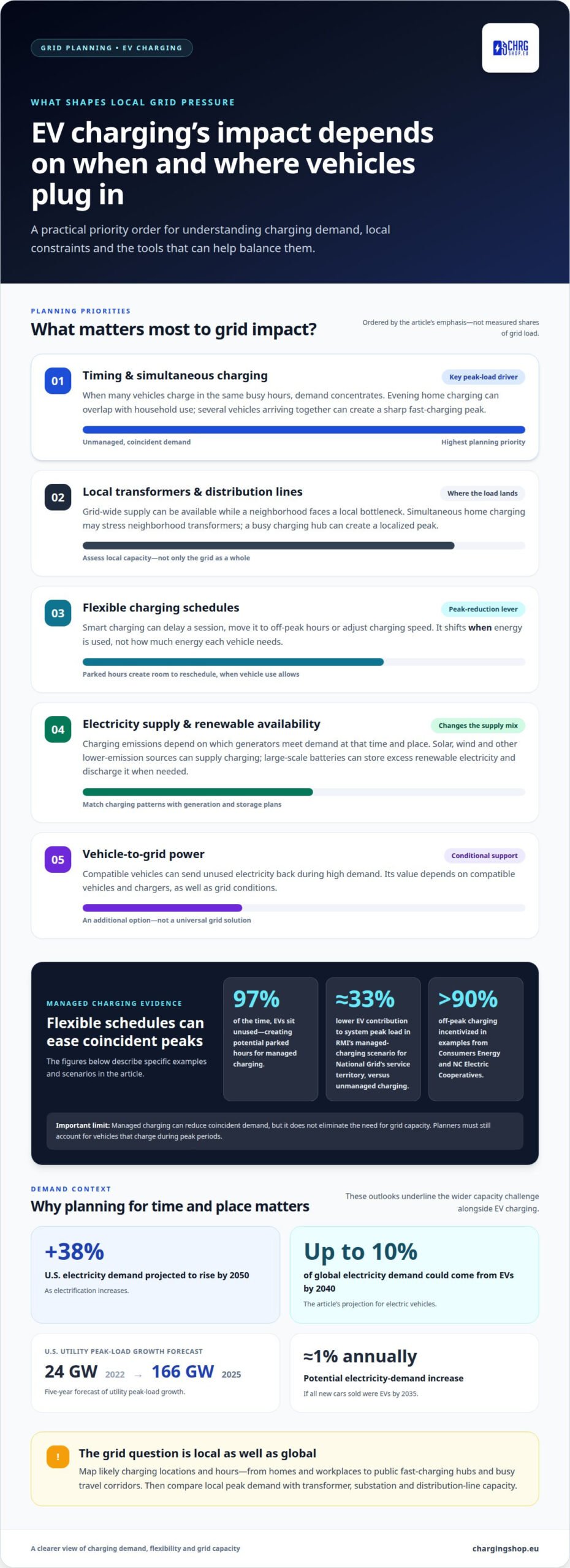
The wider electricity demand picture matters too. U.S. electricity demand is projected to rise 38% by 2050 as electrification increases. Electric vehicles could account for up to 10% of global electricity demand by 2040. At the same time, data centers are estimated to represent 90 gigawatts of expected U.S. peak-load growth. These competing needs make timing and location central to grid planning.
Forecasts also show how quickly utilities may need to plan for more capacity. The five-year forecast of U.S. utility peak-load growth rose from 24 gigawatts in 2022 to 166 gigawatts in 2025. If all new cars sold were electric vehicles by 2035, electricity demand would rise about 1% annually. Meeting clustered demand may require upgrades to transformers, substations and distribution lines. EV charging’s impact on the grid is shaped by both total energy use and local peaks.
For electricity prices and utility bills, the key issue is when demand arrives. Simultaneous charging can raise local peak load and the need for grid capacity, while shifting sessions to off-peak hours spreads use across the system. Your bill also depends on the applicable electricity tariff and charging schedule, so peak demand and per-unit rates are separate factors.
Smart charging and off-peak scheduling
Charging every vehicle as soon as it arrives can concentrate demand in the same busy hours. Evening charging may overlap with household electricity use, putting more pressure on local infrastructure when it is already serving homes and businesses. Smart charging changes the timing, not the energy each vehicle needs: it can delay a session, schedule it for off-peak hours, or adjust charging speed as grid conditions change.
That flexibility matters because electric vehicles sit unused about 97% of the time. Their parked hours give managed charging programs room to shift sessions without removing access to charging. For example, a vehicle plugged in after work may be able to charge later overnight, provided it’s ready when needed. A smart charger can manage that schedule; time-of-use pricing can add an incentive when electricity rates are lower off-peak.
Peak demand is the key planning measure. In RMI’s managed-charging scenario for National Grid’s service territory, EV contribution to system peak load falls by approximately 33% compared with unmanaged charging. This doesn’t eliminate the need for grid capacity. It can reduce coincident demand, giving utilities more flexibility to use existing infrastructure before expanding it.
U.S. utilities use time-of-use rates to encourage off-peak charging by offering lower electricity rates during selected hours. Managed charging programs at Consumers Energy in Michigan and NC Electric Cooperatives have incentivized more than 90% off-peak charging. These examples show how rate signals and coordinated charging can shift energy use. Reaching 100% customer participation in managed charging programs is likely unrealistic, so planners must account for vehicles that still charge during peak periods.
For a household, workplace or fleet, the useful question is how much charging time can move without disrupting vehicle use. A Personalised Charging Offer can help match a charging setup to the requirements of your setting.
Electricity generation and emissions
More EV charging means more electricity must reach chargers, but the emissions impact depends on how utilities generate that power. If demand rises when renewable output is low, utilities may increase fossil-fuel generation. When solar, wind, or other lower-emission sources are available, the electricity mix can be cleaner. The same vehicle can therefore have different charging emissions at different times and in different regions.
North American electricity demand is also growing across several sectors. McKinsey estimates that data centers will generate more than 40% of North American electricity consumption growth by 2050. Industry is estimated to contribute 20-29%, while hydrogen production accounts for 10-19%. Building electrification accounts for less than 10%. These estimates show why EV charging is one part of a broader generation and infrastructure challenge.
Renewables can help supply charging, but their output varies. Solar generation may peak before evening charging demand, while wind output changes with the weather. Utilities and charging-station operators can use large-scale batteries to store excess renewable electricity during low-demand periods, then discharge it when chargers need more power. Rooftop solar and community storage can also bring generation closer to charging locations, easing reliance on centralized supply and potentially reducing distribution congestion.
Planning must connect generation with local delivery. A modeled analysis of Western U.S. grid dispatch in 2035 examined a range of EV charging scenarios. The practical lesson is to evaluate not only how much electricity vehicles use, but also when charging occurs and which generation sources meet it. Utilities can compare charging patterns with renewable availability, then plan storage, generation and distribution capacity around those patterns. A fast-charging site supplied during a renewable surplus may place different demands on the system than one operating during a low-output period. Aligning charging with cleaner available power can support lower-emission operation, while storage helps bridge timing gaps.
Vehicle-to-grid charging and backup power
Vehicle-to-grid (V2G) reverses the usual charging flow. Instead of drawing electricity, a compatible electric vehicle sends stored power back to the power grid during peak demand. A fleet connected through bidirectional charging stations could act as distributed energy storage, supporting grid operators when demand rises. The potential comes from coordinating parked vehicles, not treating each battery as an independent generator.
Timing is central. A V2G system can export electricity during a high-demand period, then recharge vehicles when demand falls. That can help balance supply and demand, but the vehicle owner still needs enough stored energy for the next trip. A managed program must account for departure times, battery reserves, charging access and the amount of power participating vehicles can provide.
Backup power is related, but it serves a different purpose. V2G sends electricity to the wider grid; vehicle-to-home or vehicle-to-building use supplies a specific property. During an outage, backup operation requires compatible bidirectional equipment and a setup that separates the property from the grid. That separation prevents the property from feeding power into lines being worked on. A grid-connected export feature alone doesn’t mean a vehicle can power a home during an outage.
For charging stations, bidirectional capability is the key distinction. A standard one-way charger takes power from the grid, while a V2G-capable setup must also support controlled export. Utilities or program operators then need to coordinate when vehicles discharge and recharge. This coordination matters because unmanaged exports could arrive when the grid doesn’t need them, while a concentrated fleet response may create a new local peak.
The takeaway: V2G can turn parked vehicles into flexible grid resources, but it depends on compatible vehicles, chargers, controls and driver needs. Backup power requires a separate property-level setup. Explore a Personalised Charging Offer to match charging requirements with your environment.
Charging Shop
Charging Shop helps you consider charging equipment in the context of your site and energy needs. For home, workplace, or commercial use, a Personalised Charging Offer helps focus on the requirements that matter for your setup.
The available options include the V2C Trydan 22kW, V2C DENKA 20kW DC Wallbox and Alfen Single Pro Line 22kW. These are distinct charging products, so match your choice to the charging environment and the demand you expect. Product names and power ratings alone don’t determine whether a local grid connection can support charging; local capacity and simultaneous use matter too.
Use this guide’s grid-planning considerations to define your requirements, then contact Charging Shop to discuss your charging needs.
Plan charging around what comes next
EV charging’s impact on the grid is shaped by decisions made before a charger goes live. Treat charging as part of a wider energy plan: consider who will use it, when vehicles need to be ready, and how the site may change. This gives you a practical basis for choosing equipment and managing demand as electric vehicle use grows.
For homes, businesses, and charging locations, the next step is to match your requirements with an appropriate charging setup. A focused discussion can turn grid considerations into an equipment decision without assuming every location has the same needs.
Contact Charging Shop to discuss your charging requirements and explore a suitable direction for your project. With a well-matched plan, you can move forward confidently and make charging work for your setting.
Frequently Asked Questions
Can the distribution system support these loads?
Yes, if local equipment has enough capacity or receives the necessary upgrades. A distribution system’s ability to serve EV charging depends on how many vehicles charge together, their charging rates, and existing use by homes and businesses. For example, a site with several chargers may need a different capacity assessment than one home charger. Utilities can forecast local demand and plan upgrades to transformers, substations, or lines.
How Does EV Charging Challenge the Distribution Network?
EV charging can create concentrated demand that strains local equipment, especially when several vehicles draw power at once. A cluster of chargers may increase transformer loading, contribute to voltage fluctuations, and reduce power quality if local infrastructure is undersized. The challenge is often geographic: available capacity elsewhere cannot automatically serve a constrained neighborhood. Forecasting charger locations and simultaneous charging helps utilities target network planning and upgrades.
How much electricity demand will EV charging add to the U.S. grid by 2030 and 2040?
EVs could account for up to 10% of global electricity demand by 2040, while U.S. electricity demand is projected to rise 38% by 2050 as electrification increases. These figures describe different geographies and timeframes, so they shouldn’t be treated as a U.S. EV-only forecast. The electricity EVs draw depends on vehicle adoption, miles traveled, charging frequency, and charging time.
When do EV owners typically charge, and how does charging time affect peak grid demand?
Many EV owners plug in at home during the evening, when household appliances, lighting, and heating or cooling also use electricity. If vehicles charge simultaneously, they add demand during an already busy period and can raise local peak load. Workplace charging commonly takes place during the day, while public fast-charging demand follows arrival patterns. Shifting flexible sessions can change when the grid faces its heaviest load.
How much grid capacity and investment are needed to support widespread EV charging?
There is no single capacity requirement for every community. The needed investment depends on charger locations, charging rates, simultaneous use, existing equipment headroom, and other local electricity demand. For example, a utility assessing a workplace hub would consider the site’s connection and nearby distribution equipment. Forecasts help identify whether existing capacity can support growth or whether transformers, substations, or distribution lines need upgrades.
How does managed or smart EV charging reduce peak demand and grid costs?
Managed charging shifts or slows charging sessions to avoid adding unnecessary load during system peaks. In RMI’s managed-charging scenario for National Grid’s service territory, EV contribution to system peak load is reduced by approximately 33% compared with unmanaged charging. Smart chargers can schedule sessions around off-peak periods or adjust charging speed. Utilities can then better use existing infrastructure and plan capacity around the remaining demand.
