
 Deutsch
 Dansk
Dansk Suomi
Suomi Latviešu
 Lietuvių
 Norsk bokmål
 polski
 Русский
 Svenska
No products in the cart.
Uncategorized
V2C Denka 40/80kW: The Professional Choice for Rapid Charging
02
Aug
Aug
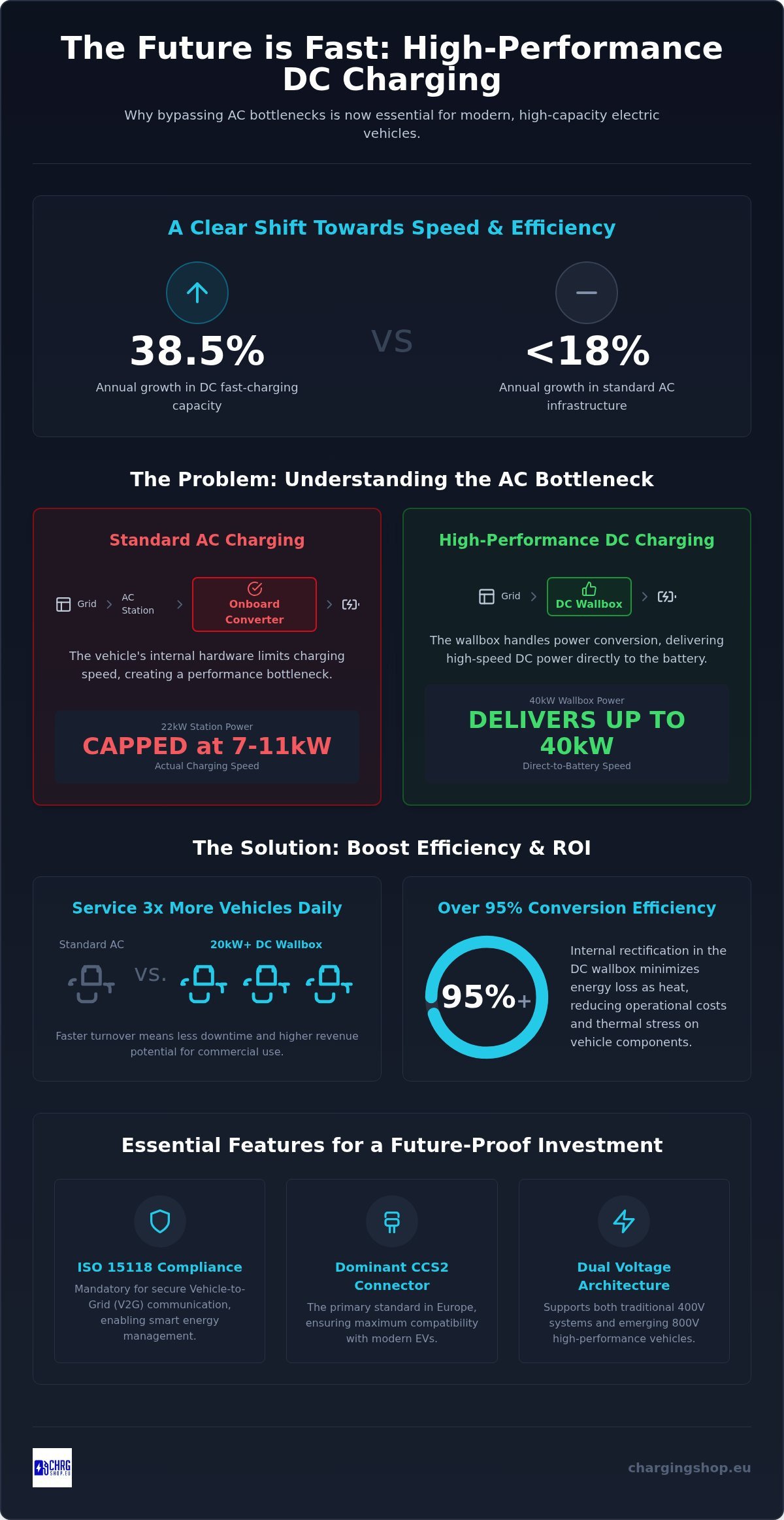
Did you know that DC fast-charging capacity grew by 38.5% last year, more than double the growth rate of standard AC infrastructure? It’s a clear signal that the market is shifting toward speed and efficiency. You’ve likely noticed that standard 22kW AC chargers are becoming a bottleneck for modern, high-capacity EV batteries. Investing in a high performance DC wallbox is the only way to bypass the inefficiency of onboard converters and keep your fleet or customers moving without delay.
The V2C Denka series offers a compact, powerful solution for those who need rapid results without the footprint of a massive pedestal. You’ll gain faster charging times and a future-proof setup that meets 2026 EU standards, including mandatory ISO 15118 compliance for secure vehicle-to-grid communication. This article breaks down why the Denka 40kW and the upcoming 80kW models are the professional choice for smart energy management. We’ll show you how to eliminate charging delays, simplify complex installations, and turn your infrastructure into a high-speed asset that’s ready for the next decade of e-mobility.
Key Takeaways
- Learn why shifting to a high performance DC wallbox is essential for bypassing AC charging bottlenecks in modern, high-capacity electric vehicles.
- Discover how internal rectification achieves 95%+ efficiency by moving conversion stress from the vehicle to the charging station.
- Calculate your ROI by seeing how a 20kW DC unit can service three times more vehicles daily than standard AC alternatives.
- Identify the essential specs for 2026, including grid capacity requirements and the dominance of CCS2 connector standards.
- Explore how the V2C Denka 20kW and CHRG Network platform combine to create a compact, revenue-generating charging infrastructure.
What is a High Performance DC Wallbox and Why Do You Need One?
A high performance DC wallbox isn’t just a luxury; it’s a necessity for anyone managing modern EVs. Unlike traditional chargers that rely on the car’s internal hardware, these units convert power internally. This means you’re feeding DC electricity directly into the battery. It’s the difference between a slow drip and a fire hose. For hotels, small fleets, and premium homeowners, this is the definitive upgrade for 2026. You get faster turnover and less downtime without the need for massive industrial equipment.
The landscape changed in 2025. With Battery Electric Vehicle registrations reaching 11.4 million in Europe, the demand for speed has peaked. Standard 22kW AC stations are hitting a wall. They can’t keep up with the massive battery packs found in the latest premium models. You need a solution that moves as fast as your business. High-performance units provide the reliability and speed that customers now expect as a minimum standard.
Understanding the difference between AC and DC charging stations is key to your investment. AC chargers are essentially smart sockets; the car does the heavy lifting of converting the power. A DC wallbox takes that job away from the car, allowing for much higher speeds in a fraction of the time. This shift is essential as we move toward a more mature, high-demand e-mobility market.
The AC Bottleneck: Understanding the Onboard Converter
Most modern EVs come with a hidden limitation: the onboard converter. Even if you plug into a 22kW AC station, the car’s internal hardware often caps the intake at 11kW or even 7kW. You’re paying for infrastructure power you simply can’t use. A high performance DC wallbox bypasses this bottleneck entirely. By delivering power straight to the cells, you unlock the car’s true charging potential. It’s about efficiency and turnover. Don’t let a car sit for eight hours when it could be ready in two. This direct-to-battery approach also reduces heat generation inside the vehicle, preserving battery health over the long term.
Compact Power: Footprint vs. Performance in 2026
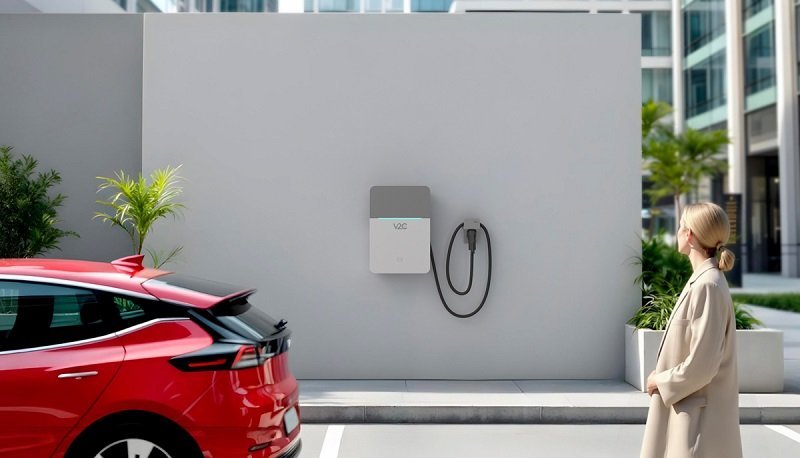
Gone are the days of massive, industrial pedestals. The 2026 market demands performance without the bulk. We’ve seen a massive shift from 50kW towers to sleek, wall-mounted units that fit into tight urban spaces or private garages. This is where the V2C Denka 20kW DC Wallbox excels. It delivers professional-grade speed with a footprint that doesn’t disrupt your architecture. It’s the ideal choice for businesses that value both aesthetics and utility. These units are designed for easy mounting on existing walls, saving you the high costs of ground-breaking and pedestal foundation work. You get the power of a commercial station in a package that fits your space.
The Technical Edge: How DC Wallboxes Maximize Efficiency
Internal rectification is the secret behind the speed of a high performance DC wallbox. While AC chargers force the car to convert power, these advanced units handle the heavy lifting themselves. By moving the conversion process from the vehicle to the wallbox, you eliminate the heat and stress typically placed on the car’s internal components. This design allows for a much higher energy throughput without the thermal limitations of an onboard converter. It’s a cleaner, faster, and more reliable way to move energy from the grid directly into the battery pack.
Efficiency isn’t a vague goal; it’s a measurable standard. Modern high-performance units now deliver 95% efficiency or higher. This means less energy is lost as heat during the conversion process, saving you money on every charge. These units are built to handle the diverse voltage requirements of 2026, supporting both traditional 400V systems and the emerging 800V architectures found in premium performance EVs. To ensure long-term reliability, active thermal management systems use intelligent cooling to protect the internal power modules. This proactive cooling keeps the hardware running at peak performance even during back-to-back charging sessions in high-traffic commercial environments.
Technical precision is vital when selecting DC Fast Charging equipment for your site. You need hardware that communicates flawlessly with the vehicle’s Battery Management System (BMS). This real-time data exchange ensures that the wallbox delivers exactly what the battery can handle at any given moment. If you want to see how these specs translate into a real-world setup, you can explore a personalised charging offer tailored to your specific grid capacity and fleet needs.
Direct Current vs. Alternating Current: The Science of Speed
Energy flows from the grid as AC, but lithium-ion cells only accept DC. A high performance DC wallbox creates a direct highway to the battery. This is why you see such impressive speeds during the “sweet spot” of the charging curve, typically between 20% and 80% capacity. During this phase, the battery can accept a massive surge of power safely. Contrary to old myths, modern DC charging doesn’t “kill” batteries. When managed by a smart controller, it provides a controlled, high-speed top-up that is perfectly safe for daily use in professional fleets.
Safety Protocols and Intelligent Monitoring
Safety is baked into the hardware through the CCS2 connector standard. The wallbox and the car are in constant dialogue, monitoring for any signs of thermal runaway or plug overheating. If the system detects a spike in temperature or a communication error, it shuts down the flow instantly. Durability is equally important for outdoor installations. An IP54 rating ensures protection against dust and water splashes, while IK10 certification guarantees the unit can withstand high-impact physical damage. These standards ensure your investment remains operational and safe regardless of the weather or location.
DC vs. AC: Comparing ROI for Business and Premium Residential
Stop looking at the sticker price. Start looking at the turnover. A high performance DC wallbox represents a higher initial investment than a standard AC station, but the return on investment (ROI) tells a different story. In a commercial setting, time is literally money. An 11kW AC station might take eight hours to fill a modern battery, meaning one car occupies that space for an entire shift. A 20kW DC unit can cycle through three vehicles in that same window. You aren’t just selling electricity; you’re selling time. With DC fast-charging capacity growing by 38.5% in 2025, the market has already decided that speed is the new baseline for value. To understand exactly how to maximize your returns, see our detailed breakdown of commercial EV charger ROI for profitable fast charging in 2026.
Property value is the next frontier. Whether it’s a commercial lot or a premium home, the presence of high-speed infrastructure is a major selling point. For businesses, it’s about staying relevant. For homeowners, it’s about convenience. As batteries get larger, the gap between AC and DC ROI will only widen. You can either invest in yesterday’s slow-drip technology or choose the rapid-turnover solution that pays for itself through efficiency and premium service fees.
Commercial ROI: Why Hotels and Workplaces are Switching
Hotels and workplaces are leading the switch to high-speed hardware. Why? Because guests and employees don’t want to be tethered to a slow charger for half a day. A hotel ev charger with billing system allows you to monetize speed effectively. High-speed charging is a premium service. Drivers are willing to pay more to be back on the road in 90 minutes. This setup also solves the “park and block” issue that plagues AC infrastructure. When sessions are shorter, your parking spots stay fluid and productive. Listings on booking platforms that feature “DC Fast Charging” labels attract high-end travelers who prioritize convenience. If you aren’t offering DC, you’re losing those bookings to the competitor across the street.
Residential Luxury: The Case for Home DC Charging
For the premium homeowner, DC is about lifestyle and absolute reliability. If you have a high daily mileage or manage a household with multiple EVs, a standard charger often fails to keep up. You need a high performance DC wallbox to handle short dwell times between trips. Imagine coming home for a quick 45-minute lunch and adding 150km of range before your next meeting. That’s the freedom DC provides. It also integrates perfectly with large residential solar installations. You can capture peak solar production and move that “green” energy into your car’s battery at speeds AC units simply can’t match. It’s not just a charger; it’s a home energy hub that future-proofs your property value in a market where BEV registrations continue to climb.
Selection Criteria: Essential Specs for Your 2026 DC Wallbox
Selecting your hardware is about balancing ambition with site reality. A high performance DC wallbox delivers incredible speed, but only if your grid can feed it. You need to choose between 20kW, 30kW, or 40kW outputs based on your site’s peak demand. A 20kW unit is often the perfect entry point for hotels, while 40kW models serve high-turnover fleets better. Don’t just look at the max output; look at how the unit manages that power during peak hours. Matching the charger to your available amperage prevents expensive infrastructure overhauls.
Software is just as critical as the silicon inside. OCPP (Open Charge Point Protocol) compliance is your insurance policy. In 2026, 1.6J or 2.0.1 compliance is a strict requirement for connecting to management platforms like CHRG Network. This allows you to set pricing, manage users, and update firmware remotely. Without it, you’re buying a “dumb” box that can’t scale with your business needs. Most professional operators now insist on CCS2 as the standard connector, paired with high-quality cables designed for daily commercial use.
Physical build quality determines your total cost of ownership. High-grade polycarbonates are excellent for weight reduction, but stainless steel remains the king of longevity in salty or high-impact environments. You want a unit that looks professional on day one and day one thousand. A high performance DC wallbox is a long-term asset that should withstand the elements without degrading. If you’re ready to spec your site, get a personalised charging offer to match hardware to your specific grid constraints.
Dynamic Load Balancing and Grid Protection
High-performance units must play nice with your building’s main breaker. Dynamic load balancing ensures the charger scales down when the elevators or HVAC systems kick in. This prevents costly blackouts and avoids the need for expensive grid upgrades. For commercial billing, ensure your unit includes an MID-certified meter. This is a legal necessity for selling electricity to the public in most EU regions under 2026 standards. It ensures that every kilowatt-hour billed is measured with laboratory-grade accuracy.
Hardware Durability: Protecting Your Investment
Public-facing hardware faces risks that private units don’t. Use a secure ev charging station checklist to evaluate vandalism protection and cable management. Integrated cable holsters prevent trip hazards and protect the sensitive CCS2 pins from moisture. Surge protection is critical for DC electronics because high-voltage spikes can instantly fry the expensive internal rectification modules. Investing in IK10-rated housing ensures your station survives accidental bumps or deliberate tampering, keeping your uptime high and maintenance costs low.
Deploying Your Rapid Charging Solution with Charging Shop
At Charging Shop, we don’t just sell boxes. We design end-to-end solutions that fit your specific business goals. Buying a high performance DC wallbox is a significant move, and you need a partner that understands the technical nuances of deployment. We provide the expertise to ensure your hardware integrates perfectly with your existing infrastructure. From the moment you inquire, we’re focused on your ROI and long-term operational success. Our team simplifies the selection process so you can get your station live without the usual headaches.
The V2C Denka 20kW DC Wallbox is our flagship recommendation for those who need power without the bulk. It’s the perfect balance of speed and size. We’ve seen it transform hotel parking lots and small fleet hubs across Europe. Because we manage global logistics, we deliver this premium hardware directly to your site, no matter where your business is located. Our logistics network is built for speed because we know that every day without a charger is a day of lost opportunity. We handle the shipping complexity so you can focus on your core business.
We specialize in OCPP-compliant hardware because it gives you the freedom to choose your management path. You’re never locked into a proprietary system that limits your future growth. By choosing a high performance DC wallbox from our curated selection, you’re investing in an open, flexible ecosystem. This approach ensures your infrastructure remains compatible with new software and vehicle standards as the market matures toward 2033 and beyond.
The CHRG Network: The Brain Behind the Power
Hardware is only half the battle. You need a way to manage your assets efficiently. With CHRG Network Access, you gain a single dashboard to monitor all your DC units in real-time. You can set custom tariffs to turn your charging station into a revenue stream or limit access to specific employees. If a unit goes offline, our remote troubleshooting tools often fix the issue before you even notice. This software ecosystem is what turns a simple charger into a smart, manageable business asset. The dashboard provides granular data on peak usage and energy consumption, giving you the transparency needed to justify your investment and plan for future expansion.
Next Steps: From Inquiry to Activation
Ready to move? The process is simple. Start by requesting a Personalised Charging Offer. We’ll look at your grid capacity and help you decide between 20kW or 40kW units. We don’t believe in one-size-fits-all hardware. Our experts consult on your specific requirements to ensure your installation meets the latest EU standards, including mandatory ISO 15118 compliance. Don’t let your infrastructure fall behind as BEV registrations continue to climb. Get your personalized high performance DC wallbox quote here!
Future-Proof Your Charging Infrastructure Today
The transition to high-speed e-mobility is moving fast. Standard AC units are no longer enough for modern battery capacities. By choosing a high performance DC wallbox, you’re investing in rapid turnover, superior efficiency, and a better experience for your drivers. Whether you’re upgrading a hotel parking lot or a private fleet, the shift to DC is the only way to stay competitive. Don’t settle for slow-drip technology that limits your growth.
We’re here to simplify your deployment. As an authorized distributor for V2C and Alfen, we provide OCPP 1.6/2.0.1 compliant hardware paired with exclusive CHRG Network access. You get the best of both worlds: premium hardware and the software brain to manage it all effectively. It’s time to stop worrying about charging bottlenecks and start scaling your operations with confidence. Your future-proof setup is just one click away.
Shop our range of High Performance DC Wallboxes and get a personalized offer today!
Frequently Asked Questions
Can I install a high performance DC wallbox at home on a standard grid connection?
You can install one, but you must verify your available amperage first. Most high performance DC wallbox units require a three-phase power supply to deliver their full potential. While technically possible for residential use, you’ll likely need to consult with your utility provider to ensure your domestic grid connection can handle the 20kW or 40kW load without tripping your main breaker.
What is the difference between a 22kW AC charger and a 20kW DC wallbox in terms of speed?
A 20kW DC unit is almost always faster because it feeds power directly to the battery. Most EVs limit AC intake to 11kW or 7kW due to the constraints of their internal onboard converters. By bypassing this bottleneck, the DC unit delivers its full power capacity, often doubling or tripling the actual charging speed you get from a standard 22kW AC station.
Does DC charging damage my EV battery if used every day?
Modern battery management systems (BMS) are designed to protect cell health during rapid charging. These systems communicate with the wallbox to adjust power delivery in real-time, preventing excessive heat buildup. Daily use is perfectly safe for professional fleets and high-mileage drivers, especially when you follow the standard practice of charging to 80% for daily trips to maximize longevity.
What is OCPP and why is it necessary for commercial DC wallboxes?
OCPP is the universal communication protocol that allows your hardware to talk to management software. It’s essential for commercial sites because it enables billing, remote monitoring, and user access control. Without OCPP compliance, you’re locked into a single vendor’s ecosystem, losing the flexibility to switch networks or scale your infrastructure as the market evolves and your business grows.
How much does a 20kW DC wallbox cost compared to an AC unit?
DC wallboxes carry a higher price tag because they contain the complex power electronics required to convert electricity internally. While the initial investment is larger than a standard AC socket, the value comes from significantly faster turnover and the ability to offer a premium, billable service. Contact us for a specific quote that reflects current hardware availability and your unique site requirements.
What are the maintenance requirements for a high performance DC charging station?
Maintenance for a high performance DC wallbox is minimal and focuses on cooling and cable health. You should periodically inspect the CCS2 cables for physical wear and check air intake filters to ensure the internal power modules stay cool. Most software-related maintenance, such as firmware updates and diagnostic checks, happens remotely via the OCPP connection to maximize your station’s uptime.
Are DC wallboxes compatible with all electric vehicle models?
DC wallboxes are compatible with any EV that features a CCS2 or compatible DC inlet. This includes the vast majority of modern battery electric vehicles sold in Europe today. If a car only supports Type 2 AC charging, it won’t be able to use a DC station. Always check your vehicle’s port configuration to confirm it has the necessary DC pins for rapid charging.
Do I need a special permit to install a 40kW DC wallbox for my business?
Most commercial installations of 40kW units require a formal notification or approval from your local grid operator. They must verify that the local infrastructure can support the additional power draw without impacting neighboring properties. It’s best to start this process early in your planning phase to ensure your site’s electrical capacity is ready for the high-speed upgrade.
