
 Deutsch
 Dansk
Dansk Suomi
Suomi Latviešu
 Lietuvių
 Norsk bokmål
 polski
 Русский
 Svenska
No products in the cart.
Uncategorized
Advanced EV Charging Management Software: The 2026 Guide to Network Control
21
Aug
Aug
Your EV chargers are just expensive wall ornaments without the right digital brain. You’ve invested in top-tier hardware like the V2C Trydan or Alfen Single Pro Line, but high demand charges and manual billing are still draining your budget. It’s a common frustration. Managing a network shouldn’t mean chasing downtime or wrestling with unreliable reports.
We’re here to fix that. This is where advanced ev charging management software becomes your most valuable asset. This guide reveals how to transform raw hardware into a high-performance, profit-generating infrastructure that works for you. We’ll show you how the CHRG Network provides the vital control needed to automate revenue collection and monitor system health in real-time. Learn to slash energy costs through smart load balancing and eliminate the stress of manual oversight. It’s time to turn your chargers into intelligent, self-sustaining profit centers that deliver results without the friction.
Key Takeaways
- Learn why advanced ev charging management software acts as the essential operating system that turns passive hardware into an active, cloud-managed ecosystem.
- Discover how to protect your grid and avoid expensive infrastructure upgrades using Dynamic Load Management and the latest OCPP 2.0.1 standards.
- Unlock new revenue streams by implementing multi-tier pricing models and automating reimbursement for your remote or home-based employees.
- Follow a streamlined two-step framework to audit your current hardware compatibility and select a software solution that scales with your fleet or public network.
- See how pairing premium hardware like the Alfen Single Pro Line with the CHRG Network creates a reliable, high-performance infrastructure for 2026.
The Brain of the Operation: Why Advanced EV Software is Vital in 2026
Hardware is just the body. Software is the brain. In 2026, plugging in a charger and walking away isn’t enough. You need advanced ev charging management software to turn raw electricity into a controlled, profitable asset. Think of it as the operating system for your infrastructure. It doesn’t just sit there; it actively manages every electron flowing through your station. It’s the difference between owning a piece of equipment and running a professional network.
The industry has moved beyond simple plug-and-play setups. We’ve entered the era of cloud-managed ecosystems where connectivity is mandatory. Manual management is obsolete because today’s grid demands are too complex for human oversight. You need a system that reacts in milliseconds to prevent overloads and optimize distribution. High-performance networks now utilize a Digital Charging Twin. This creates a real-time virtual replica of your physical assets. It allows you to track performance and predict maintenance needs before a charger actually fails.
Passive Monitoring vs. Active Management
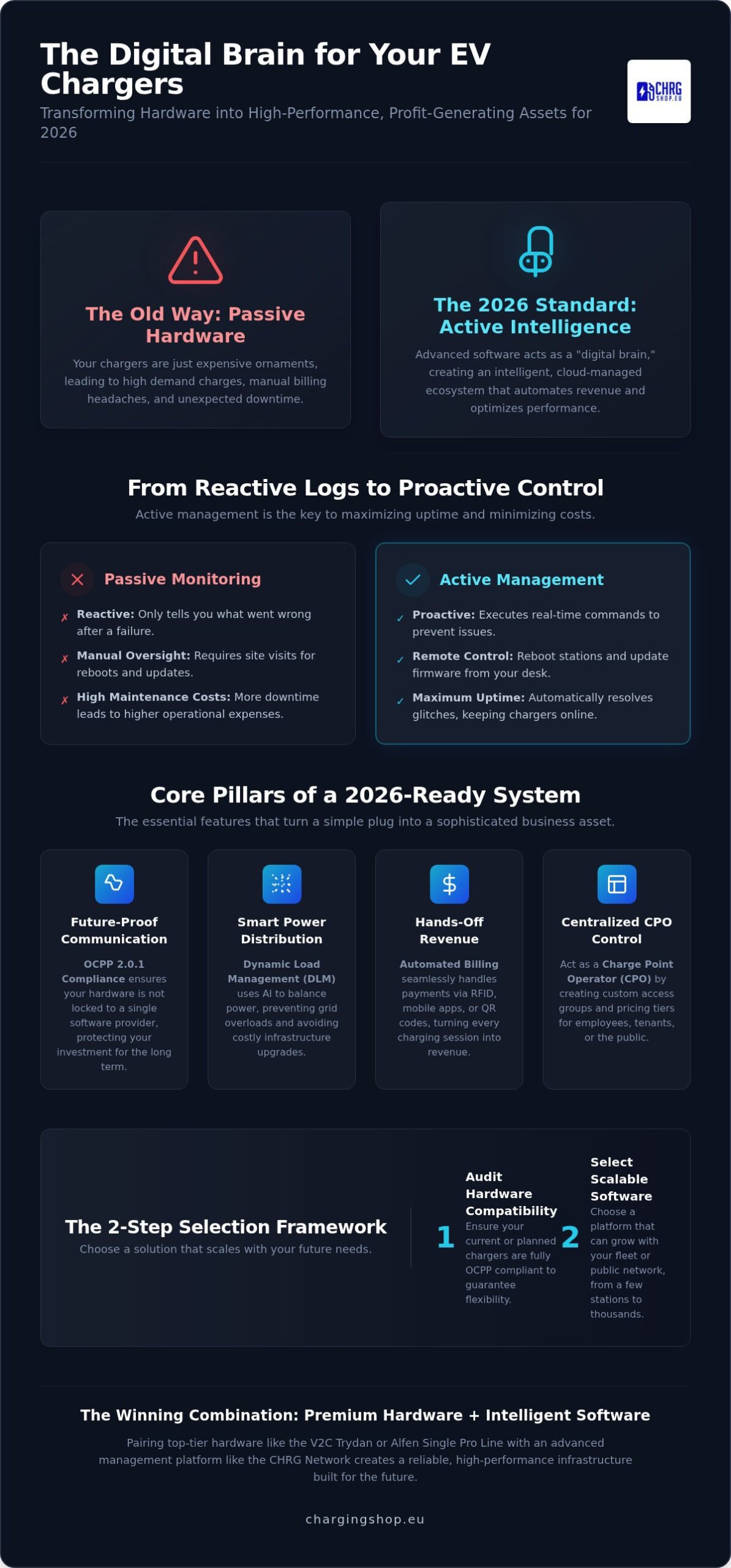
Don’t confuse simple data logs with true control. Passive systems are reactive; they tell you what went wrong after the fact. In contrast, active management systems execute commands in real-time. They adjust power outputs based on demand and resolve minor glitches automatically. This capability is built on the Open Charge Point Protocol (OCPP); this standard allows the software to speak fluently with hardware like the V2C Trydan or Alfen Single Pro Line. Active management eliminates the need for most site visits. You can reboot a station or update firmware from your desk. This keeps your uptime high and your maintenance costs low.
The Role of the Charge Point Operator (CPO)
When you own a charging network, you’re more than just a host; you’re a Charge Point Operator (CPO). This shift in mindset is vital for profitability. Your advanced ev charging management software empowers you to act as a professional service provider. You set the rules. You decide who can charge, what they pay, and how much power they get. Advanced platforms allow you to create custom access groups for employees, tenants, or the general public. It’s about moving from a passive utility role to a proactive business model. You control the revenue, the access, and the limits. You aren’t just providing a plug; you’re managing a high-tech energy service.
Core Pillars of Advanced Management: Beyond Simple Logs
Success in 2026 depends on more than just seeing who plugged in. You need a system that handles the heavy lifting automatically. Using advanced ev charging management software means you’re no longer manually tracking sessions or worrying about grid capacity. It’s about four main pillars: future-proof communication, smart power distribution, hands-off revenue, and frictionless access. These features transform a simple plug into a sophisticated business asset.
OCPP Compliance and Hardware Agnosticism
Don’t get trapped in a walled garden. Buying a “locked” charging system is a legacy mistake that limits your growth. If your hardware only talks to one specific software, you lose all leverage. OCPP is the universal language of EV charging. By insisting on OCPP 2.0.1 compatibility, you ensure you can switch software providers without ripping out your chargers. This hardware-agnostic approach protects your investment. It allows you to mix and match the best tools for your specific site needs. It’s about flexibility and long-term viability.
Dynamic Load Balancing in 2026
Grid upgrades are expensive and slow. Dynamic Load Management (DLM) solves this by using AI-driven algorithms to distribute available power based on vehicle priority. It monitors the building’s total load and adjusts the chargers in real-time. This prevents tripped breakers while maximizing charging speeds for every user. Leading hardware like the V2C Trydan 22kW excels in this area; it offers dynamic power adjustments that integrate directly with solar and battery storage data. You can prioritize clean energy and avoid peak demand charges simultaneously.
Manual billing is a nightmare for commercial hosts. Advanced software turns every charging event into a revenue line item with zero manual input. Whether you’re managing RFID cards for employees, mobile app payments for guests, or guest access via QR codes, the process is seamless. You set the rates. The system handles the collection. If you’re ready to see how this works in practice, explore our personalised charging offer to find the right setup for your business. It’s time to stop managing logs and start managing a high-performance network that pays for itself.
Maximizing ROI: How Software Monetizes Your Infrastructure
Your chargers shouldn’t be a cost center. They should be profit engines. With advanced ev charging management software, you can turn every kilowatt-hour into a measurable return on investment. The key lies in granular control. You don’t have to charge everyone the same rate. Implementing multi-tier pricing allows you to offer free charging to employees, discounted rates to loyal tenants, and premium pricing to the general public. It’s about capturing value where it exists while maintaining your operational goals.
Reimbursement is another area where software pays for itself. If your employees charge company vehicles at home, manual expense reports are a nightmare. Modern systems automate this entire process. They track home charging sessions with precision and facilitate direct reimbursement. This eliminates administrative friction and ensures your fleet stays powered without the paperwork. It’s a professional solution for a growing mobile workforce.
The Power of the CHRG Network
Managing a single station is easy; managing a global network is a challenge. This is where CHRG Network access changes the game. It provides a unified dashboard to oversee multiple sites simultaneously. You can track real-time revenue and generate financial reports for stakeholders with a few clicks. This level of visibility is vital for justifying future infrastructure expansion. When you can prove high utilization rates through data analytics, securing budget for more chargers becomes a simple, evidence-based conversation.
Smart Energy Management and Cost Reduction
Profitability isn’t just about revenue; it’s about controlling costs. High electricity demand charges can wipe out your margins in a single afternoon. Advanced software prevents this through software-defined power ceilings. It automatically shifts heavy charging loads to off-peak hours when rates are lowest. This “peak shaving” protects your bottom line without requiring manual intervention. To ensure your billing is legally compliant for commercial use, look for systems that integrate MID-certified metering. This ensures every transaction is accurate and audit-ready. You reduce overhead through self-healing alerts and automated firmware updates, keeping your stations online and earning without constant human oversight. It’s a hands-off approach to high-performance infrastructure.
The 2026 Selection Framework: Choosing Software That Scales
Picking the right advanced ev charging management software is a high-stakes decision. In 2026, your choice determines whether your network scales effortlessly or stalls under technical debt. Stop guessing and start auditing. Your strategy begins with a hardware check. Verify your stations support the latest OCPP versions. This ensures you aren’t locked into a single vendor’s ecosystem. Next, define your primary use case. A residential complex has vastly different requirements than a high-traffic public hub or a commercial fleet depot.
Evaluate the operator portal with a critical eye. You need a dashboard that makes managing 50 chargers as easy as managing five. Verify that the payment gateway integrates with local banking systems and supports automated tax calculations. Finally, test the reporting depth. If you can’t export detailed energy usage, uptime stats, or user behavior data, the software isn’t ready for a professional environment. You need actionable insights, not just raw logs.
Fleet Management vs. Public Charging Needs
Fleets need more than just power; they need data. You require deep telemetry and vehicle state-of-charge (SoC) information to plan routes and charging windows effectively. This level of detail is vital for maintaining operational uptime. Public networks, however, prioritize map visibility and ad-hoc payments. Drivers need to find your chargers easily and pay without downloading yet another app. Workplace environments often require a hybrid approach. You need restricted access for employees during the day but might want to open the chargers to the public for a fee after hours. Choose software that handles these transitions automatically.
User Experience: The Driver’s Perspective
The driver’s experience is your first line of defense against support tickets. A frictionless app experience reduces frustration and builds brand loyalty. In 2026, real-time availability is the baseline standard. Drivers expect to see if a charger is free before they even arrive at your site. Reservation features are no longer optional for premium locations. Payment flexibility is equally critical. Apple Pay and Google Pay aren’t perks; they’re requirements. If the checkout process takes more than ten seconds, you’re losing customers to the network down the street. High-performance software removes these barriers and keeps vehicles moving.
Ready to build a future-proof network? Secure your personalised charging offer today and get the right tools for your specific infrastructure needs.
Seamless Integration: Powering Your Network with CHRG and Premium Hardware
Hardware and software aren’t separate silos. They’re two halves of a single solution. You can’t run a high-performance network on mismatched gear. Pairing the right hardware with advanced ev charging management software ensures your infrastructure stays online and profitable. The Alfen Single Pro Line is the perfect match for this digital-first approach. It combines industrial-grade reliability with the cloud-based agility needed for 2026 operations. It’s built to communicate. It doesn’t just charge; it provides the deep data required for real-time network control. This synergy eliminates the friction between the physical plug and the digital backend.
The ABB and CHRG Synergy
Large-scale deployments demand industrial-grade data collection. The ABB Terra AC 22kW delivers exactly that. It’s a powerhouse of protection and precision. When you integrate this hardware with the CHRG Network, you get built-in electrical safety combined with advanced software monitoring. It’s reliability at scale. You can manage hundreds of units without losing sight of a single charging event. This combination reduces site visits and maximizes uptime for professional operators. It’s the standard for those who value technical authority and operational efficiency.
Future-Proofing with V2C and Smart Management
Don’t just prepare for today. Build for tomorrow. The V2C Trydan offers native integration with management platforms, making it a favorite for smart home and workplace setups. It’s ready for the next wave of energy tech, including Vehicle-to-Grid (V2G) capabilities. You get direct control from your smartphone, all managed by the robust CHRG backend. It’s a future-proof investment that adapts as your energy needs evolve. Whether you’re balancing solar input or managing fleet schedules, the software handles the complexity while you keep the control.
Stop struggling with fragmented systems. You need a unified solution that just works. Secure your hardware and software in one high-performance package from Charging Shop. We specialize in matching premium hardware with the right digital brain to maximize your ROI. Ready to optimize your infrastructure? Get your Personalised Charging Offer today. It’s time to move from a collection of plugs to a professional, profit-generating charging network that scales with your ambition.
Take Command of Your Charging Future
The era of passive “dumb” chargers is officially over. To stay competitive in 2026, you need a network that works as hard as you do. By implementing advanced ev charging management software, you move beyond simple session logs and start driving serious ROI. You’ve seen how the right digital brain prevents expensive grid overloads, automates complex billing, and scales effortlessly with your business goals. Don’t let your hardware sit idle or drain your budget with manual administrative overhead. It’s time to act now.
Our management solutions are OCPP 2.0.1 ready and offer a truly hardware-agnostic platform. This means you maintain total flexibility while gaining real-time revenue analytics to track every cent across your entire portfolio. You’ve got the hardware; now give it the intelligence it deserves. Ready to transform your infrastructure into a high-performance asset? Get Exclusive CHRG Network Access for Your Stations Today. Build a smarter, more profitable network that’s ready for the road ahead. We’re here to help you lead the charge with confidence.
Frequently Asked Questions
What is the difference between a CMS and a charging network?
A CMS is the technical backend tool you use to control your stations; a network is the broader ecosystem where drivers find chargers. Your CMS acts as the operating system for setting rules and monitoring health. A network like CHRG provides the connectivity and roaming capabilities. You use the software to run your business while the network connects you to the wider world of EV drivers.
Does advanced EV software work with any charging station?
No, your station must be OCPP compliant to communicate with the cloud. Advanced hardware like the V2C Trydan or Alfen Single Pro Line is specifically designed for this. These units use standardized protocols to talk to advanced ev charging management software. If you buy a “closed” or “dumb” charger, you won’t be able to use cloud features. Always check for OCPP 1.6J or 2.0.1 compatibility before you buy.
Can I manage multiple charger brands on the same software platform?
Yes, hardware agnosticism is a major advantage for modern operators. You can manage a mix of ABB Terra AC and V2C units from one unified dashboard. This flexibility allows you to pick the best hardware for different locations while keeping your management centralized. It prevents vendor lock-in. You keep total control over your entire infrastructure regardless of which premium brand you choose for specific stalls.
How much does a monthly subscription for EV management software cost?
Subscription fees typically depend on your network size and the specific features you require. Most platforms charge a flat monthly rate per connector. Since every project has different technical needs, we don’t provide fixed price lists here. To get an accurate breakdown for your specific site, contact us for a personalised charging offer. This ensures you only pay for the management capabilities your business actually uses.
Is it possible to automate billing for tenants in an apartment complex?
Yes, automating tenant billing is a primary function of advanced ev charging management software. You can assign RFID cards or app access to specific residents. The software tracks their exact kilowatt-hour consumption and processes payments automatically. This removes the need for manual meter reading or complex spreadsheets. It’s the most efficient way to manage shared charging in apartment complexes or multi-family dwellings.
What happens to my chargers if the software connection goes down?
Your chargers won’t stop working. Most professional units have a “fallback” mode that allows charging to continue even without a heartbeat from the server. Once the connection returns, the hardware syncs all stored session data to the cloud. You won’t lose your billing records. However, you won’t have real-time visibility or the ability to change settings remotely until the digital link is restored.
Do I need a special SIM card for my EV charger to use management software?
You need a reliable data connection, which often involves an M2M SIM card. These cards are built for industrial data transfer rather than consumer phone use. They provide the stable link required for the management software to function. Alternatively, you can use a hardwired Ethernet connection or stable Wi-Fi. Most commercial operators prefer M2M SIMs because they operate independently of the building’s internal IT network.
Can advanced software help me avoid upgrading my building’s electrical panel?
Yes, Dynamic Load Management (DLM) is designed for this exact scenario. The software monitors the building’s total power draw in real-time. It automatically reduces the output to your chargers when other heavy appliances are running. This prevents you from blowing a fuse or exceeding your peak demand limits. It’s a smart, software-driven way to bypass the high costs and delays of a physical electrical panel upgrade.
