
 Deutsch
 Dansk
Dansk Suomi
Suomi Latviešu
 Lietuvių
 Norsk bokmål
 polski
 Русский
 Svenska
No products in the cart.
Uncategorized
Secure EV Charging Station Checklist: Protecting Your Infrastructure in 2026
01
Aug
Aug
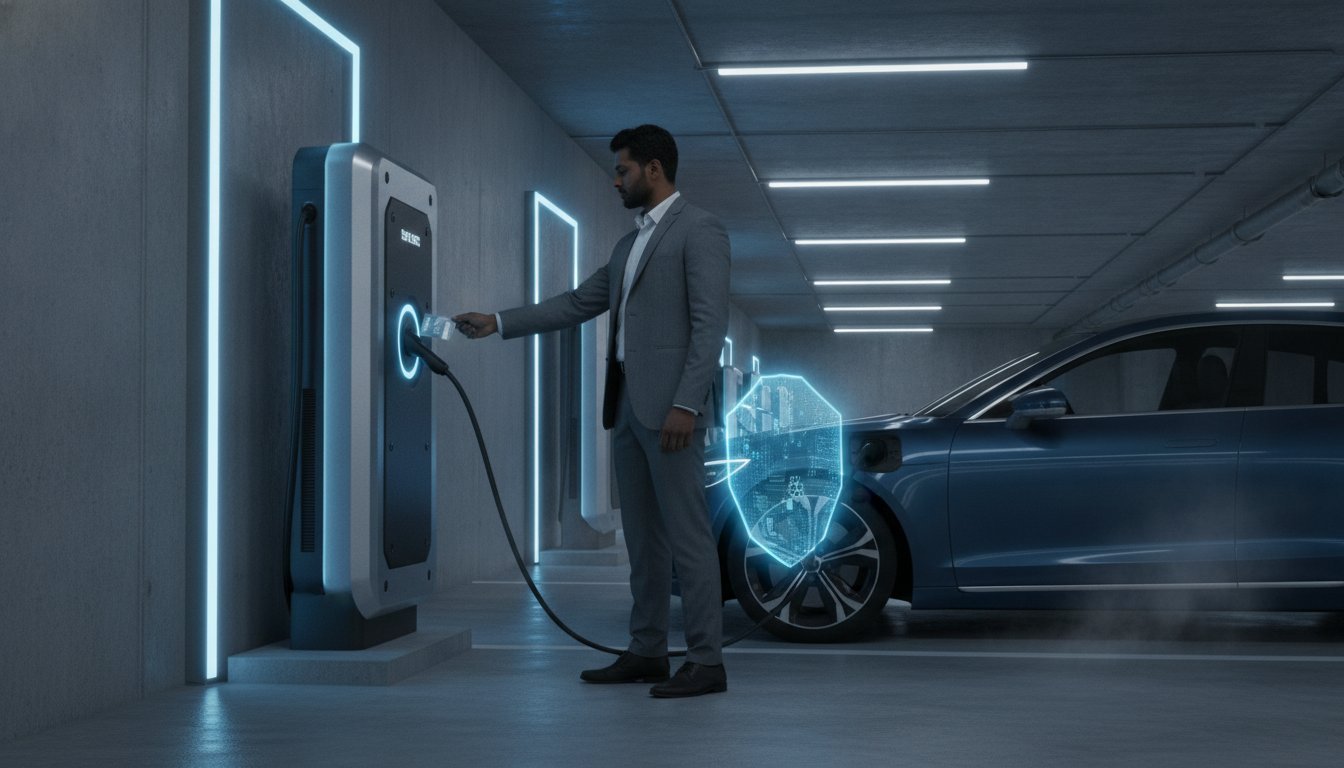
Your EV charger is a high-value target sitting in a public space. In 2026, a basic unit won’t stop sophisticated energy theft or hardware vandalism. You need a secure ev charging station that acts as a fortress for your data and your power. It’s stressful to worry about expensive equipment being damaged or unauthorized neighbors using your charger. You deserve total control without the constant anxiety of a security breach.
We’re here to simplify your security strategy. This article provides a definitive checklist to protect your infrastructure from every angle. You’ll master essential security protocols to prevent vandalism, data leaks, and unauthorized energy theft. We’ll break down the hardware standards you need, like IK10 impact ratings found on the V2C Denka, and how the CHRG Network manages user access remotely. Get ready to select tamper-proof hardware with total confidence.
Key Takeaways
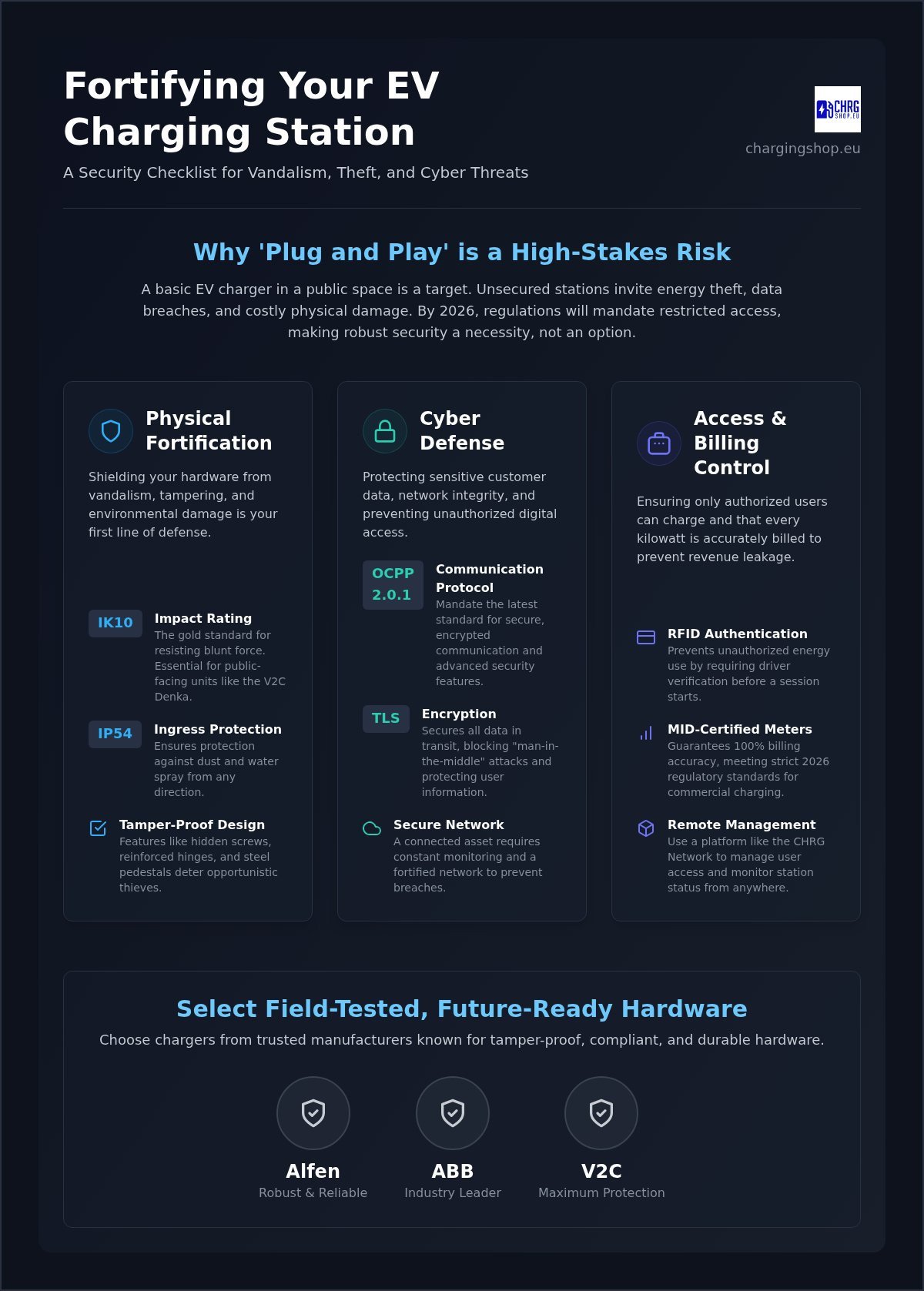
- Prioritize IK10 impact ratings and IP54 protection to shield your infrastructure from physical vandalism and environmental damage.
- Mandate the latest OCPP 2.0.1 standards and TLS encryption to block cyber threats and secure your sensitive customer data.
- Use RFID authentication and the CHRG Network to maintain a secure ev charging station that prevents unauthorized energy use and theft.
- Integrate MID-certified meters to ensure 100% billing accuracy and meet strict 2026 regulatory standards for commercial charging.
- Select field-tested hardware from Alfen, ABB, or V2C to guarantee a tamper-proof, future-ready installation for any site.
The Security Stakes: Why ‘Plug and Play’ is a Risk for Businesses
Installing a basic charger in a public lot is like leaving your cash register unlocked. A secure ev charging station isn’t just a plug. It’s a fortified system where hardware and software work together to stop unauthorized use and damage. While EV charging station basics focus on power delivery, professional security requires active defense. "Plug and play" models invite electricity theft. They leave your business liable for data breaches and hardware downtime. You can’t afford a weak link in your infrastructure.
The hidden costs of open charging are rising fast. You lose revenue every time a non-customer drains your power. You lose even more when a vandal cuts a cable for copper. By 2026, the regulatory landscape is shifting. Updates to the National Electrical Code (NEC) 2026 now mandate that energy management systems have restricted access. This means your secure ev charging station must be an intelligent, network-connected asset. It’s no longer a simple appliance. It’s a high-value target that requires constant monitoring and protection.
Identifying Vulnerabilities in Public Charging
Vandalism trends in 2026 show thieves are getting smarter. They don’t just kick the casing; they target internal components and high-value cables. If your hardware lacks an IK10 impact rating, it’s vulnerable to screen smashing and physical tampering. Digital risks are just as dangerous. Unsecured networks face "man-in-the-middle" attacks. This is where hackers intercept data flowing between the vehicle and your management platform. Finally, you have "parking squatters." These users block your chargers without paying, draining your resources and frustrating genuine customers. You need hardware that identifies every user instantly.
The ROI of Investing in Secure Hardware
Security is a profit protector. Hardened units like the Alfen Single Pro Line or the ABB Terra AC reduce your maintenance costs significantly. When you deploy tamper-proof hardware, you ensure your chargers stay online and generate revenue. Insurance providers are also paying attention. Many now offer lower premiums for sites using protected infrastructure with certified impact and ingress ratings. High uptime leads to consistent customer trust and better reviews. Security ROI is the balance between hardware cost and long-term asset protection. By choosing hardware compatible with the CHRG Network, you get a secure brain that manages access and prevents revenue leakage automatically. To fully understand how to maximize returns on your infrastructure investment, explore our guide to commercial EV charger ROI and profitable fast charging strategies for 2026.
Physical Fortification: Shielding Hardware from Vandalism and Theft
Your hardware is the first line of defense. In high-traffic public areas, a secure ev charging station must withstand more than just the weather. It needs to survive intentional impact and tampering. Don’t settle for flimsy plastic housings that crack under pressure. Invest in professional-grade shells that signal to vandals that your site isn’t an easy target. Robust physical security ensures your equipment stays operational and your maintenance budget stays under control. If the hardware breaks, your revenue stops. It’s that simple.
Start by evaluating the environment. Public streets and unsupervised lots require maximum fortification. Use reinforced steel pedestals instead of standard wall mounts when installing in open areas. These pedestals protect internal wiring from being reached or cut. Additionally, look for integrated cable management systems. Retractable cables don’t just prevent trip hazards; they keep expensive copper leads off the ground and away from opportunistic thieves. While physical armor is your primary shield, remember that physical access often precedes digital attacks. The EV Charging Cybersecurity Guidance from the Joint Office emphasizes that securing the physical port is a critical step in a broader defense strategy.
The IK Rating Guide for Business Owners
Understand the numbers before you buy. The IK rating measures a charger’s resistance to mechanical impact. An IK08 rating might survive a light bump, but it won’t stop a determined vandal with a tool. For public-facing infrastructure, you must demand IK10. This is the gold standard for physical safety. The V2C DENKA’s robust casing is specifically engineered for these exposed locations, offering the highest level of protection against blunt force. If you’re planning a high-capacity site, read our 40kW DC Wallbox Guide: Fast Charging for Businesses to see how high-power units handle these security demands. Choosing IK10 now prevents expensive housing replacements later.
Tamper-Proof Design Elements
Details matter when stopping a thief. Look for hardware featuring hidden screws and reinforced hinges. These small design choices make it nearly impossible for someone to pry the unit open with basic hand tools. High-visibility LED status indicators also play a role in deterrence. A bright, pulsing light shows the unit is active and monitored, which can discourage casual misuse. You also need to decide between physical and digital locks. While a physical key provides a sense of manual control, digital locks managed through the CHRG Network offer better site flexibility. You can grant or revoke access instantly without ever visiting the charger. Combine these elements to build a truly resilient charging hub. Explore our range of vandal-resistant hardware to find the right fit for your location.
Cyber Defense: Securing Data and Preventing Network Breaches
Physical armor is useless if your network is wide open. A secure ev charging station requires a digital fortress to block hackers and protect your revenue. In 2026, cyberattacks on infrastructure are more frequent and sophisticated. You can’t rely on basic firewalls. Your chargers must utilize Transport Layer Security (TLS) encryption for every byte of data moving between the station and your management platform. This ensures that sensitive information, like payment details and user IDs, remains invisible to prying eyes. Lock down your digital perimeter before you go live.
Hardware-level security is your next priority. Mandate "secure boot" technology in your specifications. This prevents unauthorized firmware modifications, stopping hackers from "jailbreaking" your chargers to steal energy or harvest data. Don’t fall into the "set it and forget it" trap. Regular over-the-air (OTA) updates are critical. These patches fix newly discovered vulnerabilities in real-time. If your hardware doesn’t support automatic, secure updates, it’s a ticking time bomb for your business. Stay proactive to stay protected.
OCPP: The Gold Standard for Secure Communication
The Open Charge Point Protocol (OCPP) is the universal language of the industry. For 2026, you should mandate OCPP 1.6J or the newer 2.0.1 version. These protocols prevent hackers from taking remote control of your station. They also ensure you aren’t locked into a single software provider. If one network becomes compromised or changes their terms, you can switch to a more secure management platform like the CHRG Network without replacing your hardware. To see how these protocols work in a smart environment, check out our V2C Trydan 22kW: The Ultimate Smart Home Charging Guide (2026). It breaks down the software integration you need for a truly intelligent system.
Protecting User and Payment Data
If your station accepts credit cards, PCI compliance is non-negotiable. Integrated terminals must meet strict security standards to protect customer financial data. Beyond payments, you must anonymize user data to comply with global privacy regulations like GDPR. This minimizes your risk in the event of a breach. Storing user information on the charger’s local drive creates a massive liability compared to encrypted cloud management. By moving data to a secure cloud, you remove the physical point of failure. You get better oversight and less risk. Protect your customers, and they’ll keep coming back to your secure ev charging station.
Access Control & Billing: Preventing Revenue Leakage
Access control is the final pillar of a secure ev charging station. Physical armor stops vandals, and encryption stops hackers, but access control stops energy theft. Every unmonitored session is a direct hit to your profit margins. You need a system that identifies every user before a single watt flows. Use RFID authentication to lock your chargers to authorized staff or paying guests. This keeps "parking squatters" away and ensures your infrastructure is available for those who actually need it. It’s about protecting your bottom line from day one.
Billing accuracy is just as critical as hardware security. In 2026, regulators are cracking down on uncertified energy measurement. You must utilize MID-certified meters for any commercial application. These meters undergo rigorous testing to ensure they measure energy with absolute precision. When you pair this hardware with the CHRG Network, you get a fully automated billing ecosystem. It tracks every session, calculates the cost, and handles the transaction without you lifting a finger. It’s the most efficient way to scale your charging network while keeping your revenue secure. Eliminate manual errors and focus on growth.
RFID vs. App-Based Authentication
Physical RFID cards offer unmatched reliability in areas with poor cellular service. They’re fast, cheap, and easy to distribute. Many businesses even integrate them with existing office keycards for a seamless user experience. Mobile apps provide deeper data insights but rely on the user having a charged phone and a stable connection. The real power lies in remote management. If a tenant moves or an employee leaves, you revoke their access in seconds via your management dashboard. You don’t need to hunt down a physical card or visit the charger. This level of control is essential for managing "White Lists" of VIP users or fleet vehicles securely.
Secure Billing for Commercial Success
Don’t treat billing as an afterthought. It’s a core security feature. Without MID-certified meters, you can’t legally sell electricity to the public in many jurisdictions. These meters prevent disputes and protect you from liability. For specialized environments like hospitality, the requirements are even more specific. Read our Hotel EV Charger with Billing System: The 2026 Hardware & ROI Guide to learn about managing guest payments and maximizing your investment. Secure systems also feature real-time session monitoring to prevent "ghost charging." This happens when a transaction fails to close properly, leading to billing errors. A secure station detects the vehicle’s departure and ends the session instantly. Secure your revenue streams today by choosing MID-certified charging hardware.
Implementation Guide: Choosing Your Secure Hardware
Selecting the right secure ev charging station requires a clear understanding of your environment. A gated corporate office has different risks than an unsupervised public street. Before you sign any contracts, assess your site’s risk profile. Public street chargers require the highest physical protection available. Gated corporate lots might focus more on user management and cost-sharing. Don’t settle for generic hardware. Look for brands with a proven track record of durability and software stability. A secure ev charging station is only as good as the company that supports it.
Manufacturers like Alfen, ABB, and V2C lead the market for a reason. They don’t just sell hardware; they provide long-term firmware support. This is vital because security threats evolve every day. If your manufacturer stops providing updates, your station becomes a liability within months. Verify their commitment to over-the-air (OTA) updates before you invest. You need a partner that keeps your infrastructure modern and safe. Consult with our team to find the perfect fit. Our experts analyze your site to create a Personalised Charging Offer. This ensures you get the exact hardware and software mix required for your specific risk level.
Top Secure Picks for 2026
Choosing the right model simplifies your security strategy. These units are tested for 2026 standards:
- Alfen Single Pro Line 22kW: This is the gold standard for fleet management. It offers professional-grade security features and seamless integration for businesses.
- Abb terra ac: This unit provides industrial-strength reliability for busy commercial hubs. It’s built to handle high turnover while keeping data and hardware secure.
- V2C DENKA 40kW DC Wallbox: For those needing speed and safety, this is the ultimate vandal-resistant choice. It delivers fast charging in a chassis designed to withstand the toughest public environments. Discover how the V2C Denka series delivers high performance DC wallbox capabilities with ISO 15118 compliance and a compact footprint built for 2026 rapid charging demands.
The Final Security Checklist Before Purchase
Use this checklist to verify any hardware before installation. Don’t compromise on these essential standards:
Hardware Requirements:
- IK10 impact rating for physical durability.
- IP54 or higher ingress protection against water and dust.
- Integrated MID Meter for legal, accurate billing.
- Built-in RFID reader for secure user authentication.
Software and Support:
- OCPP 1.6J or 2.0.1 compliance for flexible, secure cloud communication.
- TLS encryption for all data transmissions.
- Access to the CHRG Network for remote management and monitoring.
- 24/7 remote monitoring and guaranteed OTA update capability.
Investing in a secure infrastructure today prevents expensive breaches tomorrow. Focus on hardware that balances physical armor with digital intelligence. When you’re ready to protect your assets, choose hardware compatible with CHRG Network Access for total control.
Future-Proof Your Charging Site for 2026
You’ve seen the risks. From physical vandalism to sophisticated data breaches, the stakes for EV infrastructure have never been higher. Building a secure ev charging station isn’t a one-time task; it’s a commitment to long-term asset protection. You need hardware that combines IK10 impact resistance with the latest digital encryption to stay ahead of evolving threats. By prioritizing MID-certified billing and robust access control, you transform a simple plug into a reliable, protected revenue engine.
Don’t wait for a security breach to upgrade your standards. Take control of your site’s safety with hardware that’s built for the future. We provide OCPP 2.0.1 Ready Hardware and MID-Certified Billing Solutions that integrate seamlessly with the CHRG Network. This gives you exclusive management access to monitor, update, and secure your chargers from anywhere. Secure your infrastructure with Charging Shop’s premium hardware today! Your investment deserves the best protection on the market. Let’s build a safer charging future together.
Frequently Asked Questions
What is an IK10 rating and why does it matter for my EV charger?
An IK10 rating is the highest international standard for protection against external mechanical impacts. It guarantees that your hardware can withstand a 20-joule impact, equivalent to a 5kg mass dropped from a height of 40cm. For public installations, this rating is non-negotiable. It prevents casing damage from accidental bumps or intentional vandalism, keeping your internal components safe and operational in high-traffic or unsupervised locations.
Can someone steal electricity from my home or business charger?
Electricity theft is a major risk for unmanaged "plug and play" chargers. Without authentication, anyone can pull up and drain your power at your expense. To prevent this, install a secure ev charging station that requires RFID cards or mobile app authorization before dispensing energy. This ensures only authorized users can access the power, protecting your utility budget and preventing revenue loss from unauthorized neighbors or "parking squatters."
Is it possible for an EV charging station to be hacked?
Every network-connected device is a potential target, and EV chargers are no exception. Hackers can attempt to intercept data or take remote control of unsecured stations. You can mitigate this by choosing hardware that supports the latest OCPP 2.0.1 protocols and utilizes TLS encryption for all cloud communications. Regular over-the-air firmware updates are also vital to patch vulnerabilities and keep your digital perimeter secure against increasingly sophisticated cyber threats.
What is an MID meter and is it required for billing customers?
An MID meter is a Measuring Instruments Directive certified device that guarantees high-precision energy tracking. If you plan to sell electricity to customers or bill employees, an MID-certified meter is legally required in many jurisdictions. It ensures that the user is billed only for the exact amount of energy delivered, providing transparency and legal compliance. Without it, you risk billing disputes and potential regulatory fines for your commercial charging site in 2026.
How do I restrict my EV charger to only work for my employees?
Restricting access is simple with the right management software. You can issue RFID cards to your staff and "white-list" their unique IDs in your charger’s backend. Alternatively, use the CHRG Network to manage user permissions remotely. This allows you to grant access to specific employees during business hours and revoke it instantly if someone leaves the company. It’s the most efficient way to keep your private infrastructure truly private and secure.
What happens if the internet goes out at my secure charging station?
Professional chargers include a local authorization cache that allows them to function during temporary internet outages. If a user has a pre-authorized RFID card, the station will recognize the ID and allow the session to start even without a cloud connection. Once the internet returns, the station syncs the session data to your management platform. This ensures your secure ev charging station remains reliable and won’t leave users stranded during unexpected network downtime.
Are wireless chargers more or less secure than cabled stations?
Cabled stations are the current industry standard for security because they use established, encrypted communication protocols. While wireless charging is an emerging technology, it faces challenges in ensuring alignment is precise and the electromagnetic field isn’t tampered with. In 2026, cabled units remain the safer bet for public areas. They allow for physical cable management systems that deter theft while providing a stable, hardwired data connection for secure, real-time management.
Does surge protection count as a security feature for EV chargers?
Surge protection is a form of electrical security rather than access security. It protects your internal hardware from power spikes and lightning strikes, preventing expensive circuit board failures. While it won’t stop vandals or hackers, it’s a critical component of infrastructure resilience. High-quality chargers like the Alfen Single Pro Line include integrated surge protection to safeguard your investment from grid instability, ensuring your station stays online and profitable for the long term.
