
 Deutsch
 Dansk
Dansk Suomi
Suomi Latviešu
 Lietuvių
 Norsk bokmål
 polski
 Русский
 Svenska
No products in the cart.
Uncategorized
Single Phase vs Three Phase EV Charger: The Ultimate 2026 Guide
31
Jul
Jul
Most EV owners are unknowingly throttling their car’s potential by sticking to outdated power standards. You’ve likely felt the frustration of a slow overnight charge or stared at a spec sheet wondering how a single phase vs three phase ev charger actually impacts your daily routine. It’s confusing to balance kW ratings with phase compatibility while trying to avoid a total grid overload. We get it. You want speed. You want reliability. You want a setup that works as hard as you do.
This guide cuts through the noise. You’ll master the technical differences to secure the high-performance hardware your vehicle actually deserves. No more guessing. We’re showing you how to achieve faster charging speeds and a future-proof setup that integrates seamlessly with smart management software. From understanding power loads to selecting professional-grade wallboxes like the V2C Trydan or Alfen Single Pro Line, you’re about to become an expert on your own energy ecosystem. Let’s build a scalable setup that delivers maximum efficiency every time you plug in.
Key Takeaways
- Identify the On-Board Charger (OBC) bottleneck to ensure your hardware matches your vehicle’s maximum intake capacity.
- Compare performance benchmarks from 3.7kW to 22kW to drastically reduce charging times and improve heat management.
- Master the technical choice between a single phase vs three phase ev charger to balance rapid power delivery with grid stability.
- Evaluate the ROI of 3-phase upgrades for residential future-proofing and essential commercial scalability.
- Discover how premium hardware like the V2C Trydan and Alfen Single Pro Line integrate with smart software for professional energy control.
Understanding Electricity Phases: Why Your EV Charger Choice Matters
Power delivery isn’t just about the plug at the end of the cable. It’s about the volume and speed of energy moving from the grid into your battery. To master your setup, you must understand the core distinction: single phase vs three phase ev charger technology. One is a standard stream; the other is a high-speed torrent. Choosing the wrong one leads to expensive bottlenecks and wasted hardware potential.
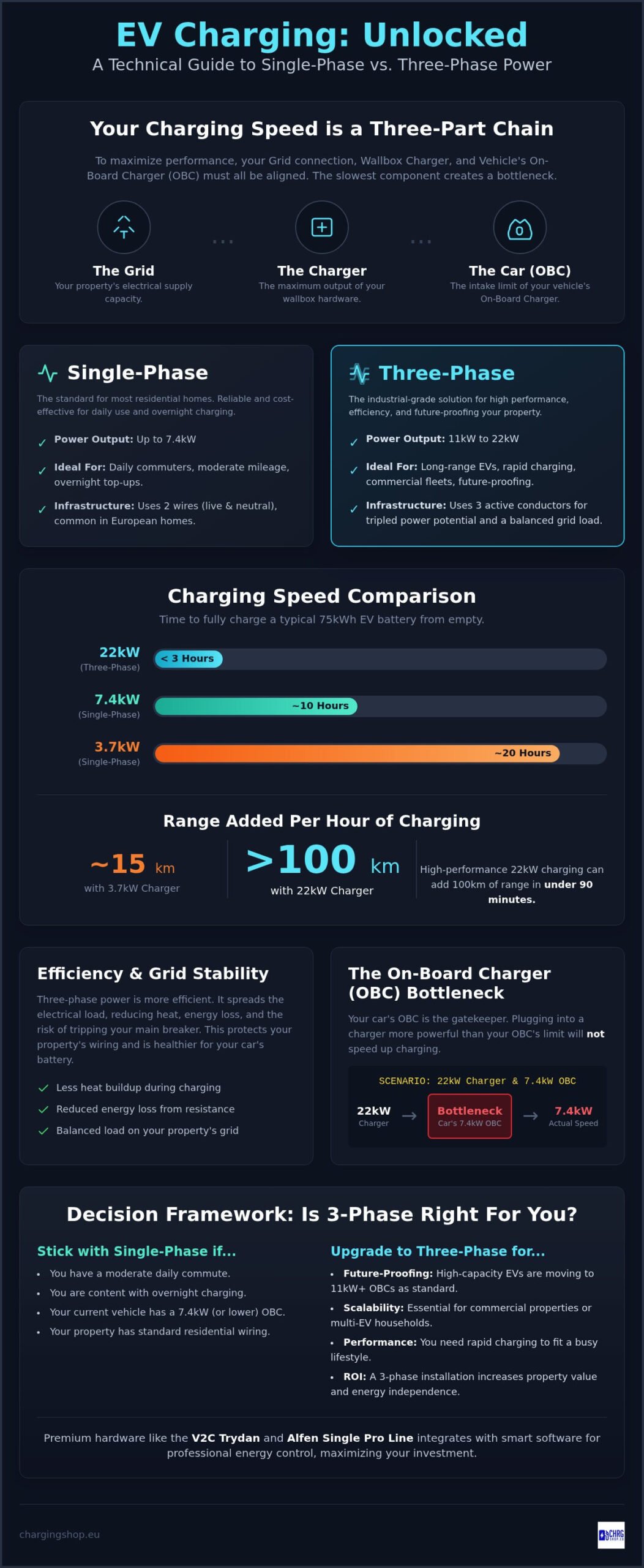
Your car’s On-Board Charger (OBC) is the ultimate gatekeeper. This internal component converts AC power from your wallbox into DC power for the battery. If your vehicle has a 7.4kW OBC, plugging it into a 22kW three-phase station won’t make it charge faster. The car simply ignores the extra capacity. By 2026, manufacturers are shifting. High-capacity batteries now require faster replenishment, making three-phase compatibility the new professional standard for premium EVs.
Think of your charging speed as a chain. It’s only as strong as its weakest link. To get the performance you’re paying for, three elements must align:
- The Grid: What your property’s electrical panel can actually supply.
- The Charger: The maximum output capacity of your wallbox hardware.
- The Car: The intake limit set by your vehicle’s internal OBC.
What is Single-Phase Power?
Single-phase is the standard for most European residential homes. It uses two wires: a live and a neutral. In a typical 230V setup, this peaks at 32 amps, delivering a maximum of 7.4kW. It’s reliable and cost-effective for daily commuters with moderate mileage. If you’re looking for a simple home solution, this setup often pairs perfectly with a type 2 ev charger. It gets the job done overnight, but it lacks the punch needed for rapid turnarounds or massive SUV batteries.
The Power of Three: Why 3-Phase Wins
Three-phase power is the industrial-grade solution for high-performance charging. By using three active conductors instead of one, it triples the power potential without requiring massive, thick cables. This unlocks 11kW and 22kW speeds, which are essential for modern long-range vehicles. Beyond raw speed, three-phase systems are more efficient. They reduce heat buildup during the transfer process and provide a more balanced load on the electrical grid. For anyone planning a future-proof home or a commercial fleet, three-phase hardware is the only logical path forward.
Performance Benchmarks: Charging Speeds and Efficiency Compared
Speed is the primary driver for most hardware upgrades. When you weigh the pros and cons of a single phase vs three phase ev charger, the data reveals a massive performance gap. A entry-level 3.7kW charger is essentially a trickle. It can take nearly 20 hours to fill a 75kWh battery. Moving to a 7.4kW single-phase unit cuts that to roughly 10 hours. However, the three-phase 22kW standard changes the game entirely. It can complete a full charge in under 3 hours. This isn’t just a minor tweak; it is a total transformation of how you use your vehicle.
Efficiency is the secret advantage of three-phase power. By spreading the electrical current across three conductors, the system generates significantly less heat than a single-phase line pushed to its limit. Lower heat means less energy is lost to resistance. This creates a more stable charging environment that protects your home’s internal wiring. It also aids in battery thermal management. A consistent, high-speed flow is often easier for modern battery management systems to handle than a prolonged, heat-heavy single-phase session.
The 22kW Standard: Speed for the Modern Driver
The Alfen Single Pro Line 22kW is the current benchmark for high-performance hardware. It offers a massive leap in miles-per-hour delivery compared to standard residential units. While a 3.7kW plug adds about 15km of range per hour, a 22kW station delivers over 100km in the same window. High-performance 22kW charging can add 100km of range in under 90 minutes. For drivers with long commutes or limited downtime, this level of throughput is non-negotiable. It ensures your car is always ready for the next leg of your journey.
Efficiency and Grid Load
Grid stability is a major concern for 2026 property owners. Three-phase chargers excel here by balancing the energy draw across your property’s entire electrical system. Instead of pulling 32 amps from a single line, an 11kW three-phase charger pulls roughly 16 amps per phase. This dramatically reduces the risk of tripping your main breaker when you use other high-draw appliances like heat pumps or electric ovens. If you use solar PV arrays, three-phase systems allow for more precise phase-matching. This ensures you consume more of your own green energy rather than exporting it. To find the right fit for your property’s capacity, check our personalized charging offer for a tailored hardware recommendation.
Compatibility Guide: Does Your EV Need Three Phases?
Buying the wrong hardware is a costly mistake. Before you commit, you must verify what your vehicle can actually handle. The debate of single phase vs three phase ev charger performance doesn’t matter if your car is the bottleneck. Most modern EVs are cross-compatible, meaning a three-phase car can charge on a single-phase station and vice versa. However, you will always be limited by the lowest common denominator in the chain. If you plug a high-performance Tesla into a single-phase wallbox, you’re voluntarily cutting your charging speed by two-thirds.
For those seeking maximum flexibility, the V2C Trydan 22kW is the premier choice. It handles different phase configurations with ease, ensuring you get the fastest possible charge whether your current car is a single-phase hybrid or a three-phase powerhouse. It’s about removing guesswork from your daily routine. Invest in hardware that adapts to your needs, not the other way around.
The On-Board Charger (OBC) Bottleneck
Your car’s technical specifications hold the answer. Look for the “AC Charging” or “On-Board Charger” rating. Entry-level models and older plug-in hybrids often feature a 7.4kW OBC, which only utilizes a single phase. In contrast, 2026 performance models from Audi, Porsche, and Tesla typically ship with 11kW or 22kW three-phase systems. Even if your current vehicle is limited to 7.4kW, we recommend installing a three-phase charger now. Future-proofing is cheaper than a second installation. Your next EV will almost certainly demand the higher throughput that only a single phase vs three phase ev charger comparison can highlight.
Cables and Connectors
The cable is often the forgotten link. A standard Type 2 cable might look the same on the outside, but the internal wiring tells a different story. Single-phase cables only have three wires connected, while three-phase cables utilize all seven pins. This makes 22kW-rated cables significantly heavier and thicker. Don’t compromise here. Charging Shop recommends 22kW-rated cables for every three-phase installation. This ensures your cable can handle the maximum current without overheating or throttling your speed. It’s a non-negotiable investment for anyone serious about high-performance charging.
- 1-Phase Car + 3-Phase Charger: Charges at 7.4kW max.
- 3-Phase Car + 1-Phase Charger: Charges at 7.4kW max.
- 3-Phase Car + 3-Phase Charger: Unlocks 11kW to 22kW speeds.
Decision Framework: Residential vs. Commercial Scenarios
Your environment dictates your hardware requirements. For a single-car household with low mileage, a standard setup might suffice. However, the decision between a single phase vs three phase ev charger becomes critical when you scale. Commercial properties and multi-car homes face unique pressures that a basic single-phase line cannot handle. You need to look beyond the raw hardware and consider the energy management software that keeps the whole system running without a hitch.
Dynamic Load Balancing is your secret weapon for grid management. If your property has a restricted grid capacity, smart software prevents you from blowing a fuse. It monitors real-time consumption and throttles the charger when you turn on heavy appliances. For commercial sites, CHRG Network Access is the professional standard. It allows you to manage multiple three-phase stations, track usage, and bill users with zero friction. This level of control is essential when deciding on a single phase vs three phase ev charger for a business park or multi-unit building. It ensures your infrastructure remains stable even when multiple vehicles plug in at once. For a deeper look at turning your charging infrastructure into a managed revenue asset, our guide to commercial ev charging station management covers the full technical and commercial requirements for 2026.
Home Charging: Is the Upgrade Worth It?
Daily mileage is the best metric for calculating your ROI. If you drive over 100km a day, the speed of three-phase power saves you hours of daily waiting. The dual-car problem is another factor. Charging two EVs simultaneously on a single-phase line is painfully slow. By upgrading, you can run two stations at full speed without compromising. Integrating the ABB Terra AC 22kW charger provides a high-safety, smart-ready solution for residential garages. It ensures your home remains safe while delivering maximum throughput. This hardware is built for durability and handles the higher current of 3-phase power with ease.
Commercial and Multi-Unit Buildings
Turnover is everything in business environments. A three-phase 22kW setup allows visitors to gain significant range during a brief meeting or a lunch break. For high-traffic areas or fleet management, even faster solutions are required to maintain productivity. Leveraging 40kW DC wallbox technology provides the rapid turnaround that employees and customers expect in 2026. This isn’t just a convenience; it’s a competitive advantage for your property. It allows you to serve more vehicles per day, increasing the utility of every square meter of your parking area. To secure the right hardware for your specific site, explore our pro-grade charging solutions today.
Future-Proof Your Property with Premium 3-Phase Hardware
Stop settling for entry-level hardware. The electrical infrastructure you install today determines your property’s value and utility for the next decade. When evaluating a single phase vs three phase ev charger, the winner is clear for anyone prioritizing speed and long-term scalability. You need a system that doesn’t just charge your car but manages your entire energy load with technical precision. Moving to a three-phase setup is the only way to ensure you aren’t left behind as battery capacities continue to grow in 2026.
The V2C Trydan 22kW stands as the premier smart home solution for modern drivers. It bridges the gap between raw power and intelligent control. For professional or commercial environments, the Alfen Single Pro Line delivers a data-driven approach that handles high-traffic demands without breaking a sweat. If you need even more velocity, the V2C DENKA 20kW DC wallbox leverages three-phase AC input to provide rapid DC speeds. This hardware bypasses the vehicle’s internal AC bottleneck entirely, offering a professional-grade solution for those who cannot afford to wait. Don’t let yesterday’s standards slow your progress. Invest in a three-phase ecosystem today.
The Smart Choice: V2C Trydan and Alfen
These units are more than just power points; they are sophisticated energy computers. They feature dynamic power management to protect your property’s grid from overloads during peak hours. Full OCPP compliance ensures you can integrate with various management platforms without needing to replace your hardware later. A key advantage of these premium units is automatic phase switching. This feature allows your charger to drop to single-phase charging when solar production is low and automatically ramp up to three-phase when your panels are at peak output. This maximizes your use of free, green energy while maintaining the fastest possible charge when you need it most.
Take Control with the CHRG Network
Hardware is only half of the equation. You need total visibility into your energy usage. CHRG Network Access allows you to monitor your three-phase energy consumption in real-time from any mobile or desktop device. For businesses, this software is a game-changer. It provides automated billing and granular user access management. You can set specific charging rates for employees versus visitors while ensuring your local grid remains balanced. It removes the administrative burden of managing a multi-phase installation. Whether you are managing a single home station or a fleet of commercial chargers, professional software is the key to a seamless experience. Pairing your three-phase setup with smart scheduling tools lets you reduce EV charging costs through NordPool price tracking and integrated solar charging, automating your savings without manual effort.
- Real-time Monitoring: Track every kilowatt-hour consumed across all phases.
- Automated Billing: Simplify reimbursement for employee charging at home or at the office.
- Access Control: Secure your hardware with RFID or app-based authentication.
- Load Management: Prevent expensive peak-demand charges with smart scheduling.
Ready to secure the high-performance hardware your EV deserves? Shop the full range of 3-phase EV chargers at Charging Shop and future-proof your property today.
Secure Your High-Performance Charging Setup Today
You now have the technical blueprint to master your energy ecosystem. Understanding the single phase vs three phase ev charger debate is the first step toward eliminating charging bottlenecks for good. Remember that your vehicle’s On-Board Charger and your property’s grid capacity must align with your hardware to unlock true 22kW speeds. By choosing three-phase technology, you’re not just buying a charger; you’re investing in a scalable, efficient asset that adds real value to your property.
Don’t settle for slow, outdated standards. Charging Shop provides OCPP 1.6 and 2.0.1 compliant hardware designed for the demands of 2026 and beyond. As an authorized distributor for V2C and Alfen, we offer global shipping on all high-performance chargers to keep you moving. It’s time to take control of your energy management and get the speed your EV deserves. Your future-proof setup is just one click away.
Upgrade your charging speed with a premium 3-phase wallbox from Charging Shop
Frequently Asked Questions
Can I charge a single-phase car on a three-phase charger?
Yes, it’s fully compatible. Your vehicle’s on-board charger will simply draw power from one of the three available phases. You won’t damage the car, but your speed will be capped at the car’s maximum intake, which is typically 7.4kW. It’s a smart way to future-proof your home for your next EV while maintaining total safety for your current one.
Is three-phase charging faster than single-phase?
Yes, three-phase power is up to three times faster than standard setups. While a single-phase unit peaks at 7.4kW, a three-phase system unlocks 11kW and 22kW performance. This reduces your waiting time from 10 hours to under 3 hours for a full charge on high-capacity batteries. It’s the professional choice for drivers who need a rapid turnaround between trips.
Do I need a special cable for a three-phase EV charger?
Yes, you must use a dedicated three-phase Type 2 cable to get the best results. These cables contain extra internal wiring to handle all three active conductors. Standard single-phase cables only utilize one conductor and will throttle your speed. Invest in a 22kW-rated cable to ensure your hardware delivers its full potential without overheating or bottlenecking your system.
How much does it cost to upgrade to a three-phase electrical supply?
Costs vary significantly based on your local grid operator and property location. You’ll need to pay for a new meter installation and potentially a larger service fuse from your utility provider. Check with a certified electrician to assess your current panel capacity. While the initial investment is higher, the long-term value and increased charging speed often outweigh the setup fees.
Can I use a 22kW charger if my car only supports 11kW?
Yes, you can use a 22kW wallbox without any issues. Your car’s on-board charger acts as a regulator and will only draw the 11kW it can safely handle. This is a brilliant strategy for future-proofing your property. You’ll have the overhead capacity ready when you eventually upgrade to a vehicle that supports higher intake speeds without needing a second installation.
What happens if I plug a 3-phase cable into a 1-phase car?
The car will charge safely at its maximum single-phase speed. The extra wires in the three-phase cable simply remain inactive during the session. There is no risk of electrical damage to your vehicle. Using a three-phase cable is actually recommended because it allows you to charge any EV at its highest possible AC rate, regardless of the single phase vs three phase ev charger configuration.
Is a three-phase charger safer than a single-phase one?
Both are safe when installed correctly, but three-phase systems offer better electrical efficiency and stability. By spreading the load across three conductors, the system generates less heat per wire than a single-phase line pushed to its limit. This balanced distribution reduces the stress on your home’s main breaker. It provides a more stable energy flow for long, high-power charging sessions.
Do all electric cars support three-phase charging in 2026?
Not every model supports it, but the industry is shifting rapidly toward higher standards. Most 2026 performance and long-range EVs now feature 11kW or 22kW three-phase on-board chargers as standard equipment. Budget models or small city cars might still stick to 7.4kW single-phase to save on costs. Always verify your vehicle’s specific technical data before finalizing your hardware choice to avoid bottlenecks.
