
 Deutsch
 Dansk
 Suomi
 Latviešu
 Lietuvių
 Norsk bokmål
 polski
 Русский
 Svenska

No products in the cart.
Uncategorized
EV charging for multi-unit dwellings: tenant rights and setup options
09
Nov
Nov
A tenant’s request for an EV charger isn’t automatically a yes or a no. Rules for EV charging for multi-unit dwellings vary by location. Right-to-charge laws may limit a landlord’s ability to refuse, while the building’s parking and electrical setup help determine what installation is practical.
It’s frustrating when home charging seems out of reach, especially when your parking space is part of the property. The key is to separate your legal rights from the installation plan. A request for a dedicated charger may involve different considerations from a shared community charging hub.
This guide explains how right-to-charge rules may apply, what can affect a landlord’s decision, and how individual chargers and shared hubs work. It also covers how electrical capacity, access, and billing shape the options, helping you understand the steps from a tenant request to a workable charging setup.
Key Takeaways
- Dynamic load management can help allocate available electrical capacity across chargers instead of requiring every charger to draw power at once.
- Right-to-charge protections vary by location; incentives and third-party ownership can also shape how a property funds and operates charging.
- Parking layout, electrical service access, billing, and legal considerations all affect the choice and rollout of charging infrastructure.
- Shared community hubs can give residents access to chargers without assigning a dedicated unit to every parking space.
What if the building doesn’t have enough electrical capacity?
Limited electrical capacity can restrict how many charging stations operate at once. In multifamily housing, load management, electrical upgrades, and clear billing arrangements shape the practical options.
Smart Load Allocation
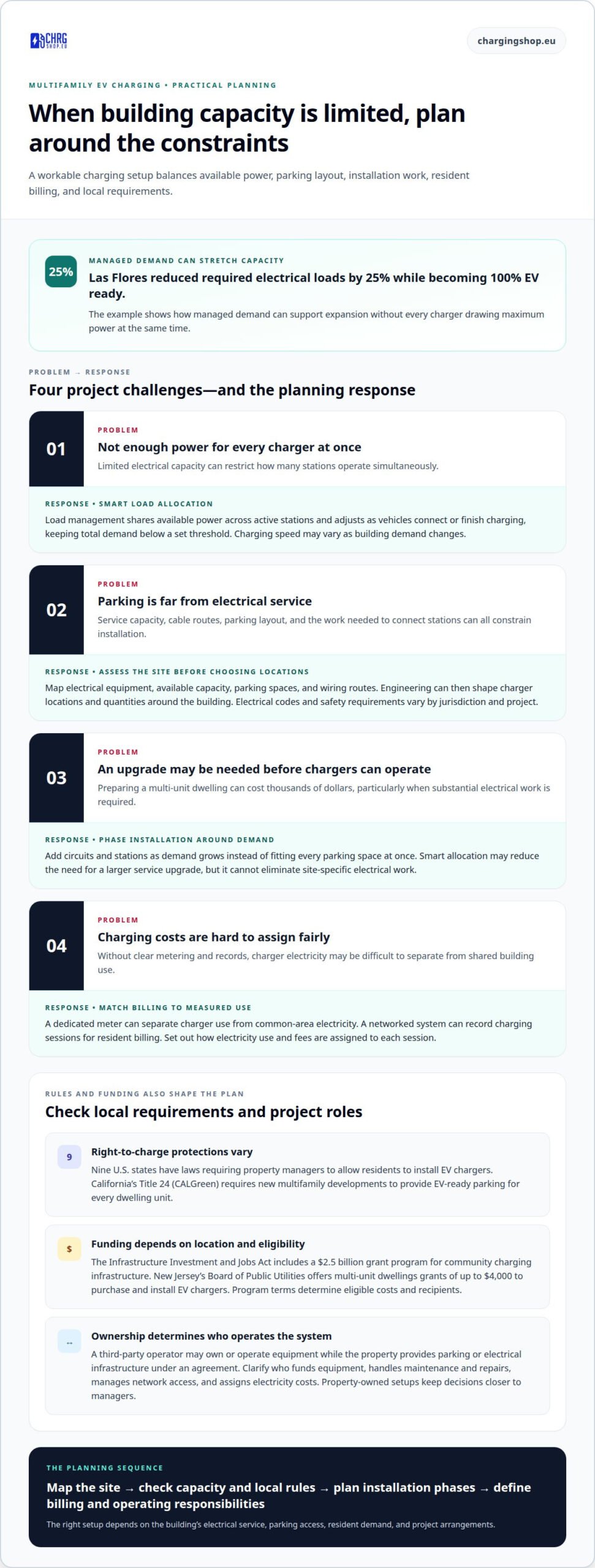
Smart load management adjusts charging power across connected stations to keep the building’s total demand below a set threshold. That can let managers serve more electric vehicle drivers without every charger drawing maximum power at the same time. For residents, the trade-off is that charging speed may vary as building demand changes. A system can allocate available power among active vehicles, then adjust as vehicles connect or finish charging. Las Flores reduced required electrical loads by 25% while becoming 100% EV ready, showing how managed demand can support expansion.
Capacity and Installation Barriers
Electrical capacity is the power the building’s service and distribution equipment can safely supply to existing uses and new chargers. Common installation barriers include limited service capacity, the route from electrical equipment to parking, and the work required to connect stations. A site assessment maps these constraints before managers decide on charger locations or quantities. Electrical codes and safety policies also guide equipment, wiring, protection, and installation approval. Requirements depend on the jurisdiction and project, so plans need to suit both the building and local rules.
Installation Costs and Capacity
Capacity affects installation costs because an electrical upgrade may be needed before new charging equipment can operate. Preparing a multi-unit dwelling for EV charging can cost thousands of dollars, particularly when the electrical infrastructure needs substantial work. A phased plan can add circuits and stations in line with demand instead of fitting every parking space at once. Smart allocation may reduce the need for a larger service upgrade, but it cannot eliminate site-specific electrical work.
Metering matters, too. A dedicated meter can separate charger use from common-area electricity, while a networked system can record sessions for resident billing. Managers need a clear way to assign electricity use and fees to each session. This ties costs to actual use rather than spreading them across residents who may not charge.
Do Right to Charge laws apply to multifamily housing?
Rules vary by state and locality. Nine U.S. states have right-to-charge laws requiring property managers to allow residents to install EV chargers. California’s Title 24 (CALGreen) requires new multifamily developments to provide EV-ready parking for every dwelling unit. Federal support focuses on funding: the Infrastructure Investment and Jobs Act includes a $2.5 billion grant program for community charging infrastructure. Local codes can add requirements; Austin’s 2024 Energy Code applies EV-readiness requirements to new multifamily construction and took effect in July 2025.
Funding can make stations easier to plan, but programs differ by location and eligibility. The New Jersey Board of Public Utilities offers multi-unit dwellings grants of up to $4,000 to purchase and install EV chargers. State and utility incentives may also support charging infrastructure, while grants and rebates can reduce owners’ project costs. Funding may support equipment, installation, or shared network infrastructure, depending on program terms. Treat incentives as one part of the project plan, not as a substitute for parking access, electrical planning, or resident billing arrangements.
Third-party ownership is another model: an outside operator owns or operates the charging equipment, while the property provides parking or electrical infrastructure under an agreement. This affects how stations are funded, maintained, and billed. The agreement should specify who handles maintenance and repairs, manages network access, and assigns electricity costs. Liability depends on equipment ownership, operating control, parking arrangements, and the written terms. Residents and owners should understand these responsibilities before charging begins.
For a property, compare the practical roles: who funds the equipment, who controls the parking spaces, and who bills each session. A shared network can simplify resident access and usage records, while a property-owned setup can keep decisions closer to managers. Incentives may support either model, but the program’s rules determine eligible costs and recipients. For a closer look at charging network options, consider how network access could fit the property’s operating model.
Charging infrastructure procurement and installation
Planning EV charging for multi-unit dwellings starts with the property’s needs, not a charger catalogue. Property owners can map parking spaces, access to electrical service, resident demand, billing, and legal considerations before defining the project. These details shape the number and placement of stations, wiring routes, and plans for future expansion. A convenient space near an electrical connection may simplify the layout, while a distant garage level can require more extensive electrical work.
Engineering turns the project scope into a workable plan. The design connects chargers to the building’s electrical system, accounts for available capacity, and shows how cables will reach parking areas. Permits and inspections are part of the process where local rules require them; requirements vary by jurisdiction. A turnkey arrangement can coordinate design, equipment procurement, permitting, and installation through one project plan, giving managers a clear view of stages, dependencies, and decisions.
Third-party installation is another arrangement: the property procures equipment, while an outside installation contractor carries out the site work. Responsibilities should be defined for electrical connections, commissioning, records, and required inspections. For example, an agreement can distinguish equipment supply from installation labor and specify who coordinates access to garages or electrical rooms. Clear responsibilities help prevent gaps between delivery, installation, and resident use.
For EV charging for multi-unit dwellings, choose access levels with actual parking patterns in mind. A city representative estimated that a Level 1 charging access point at a multi-unit dwelling costs about one-sixth as much as a Level 2 access point. Level 1 may suit slower overnight charging, while Level 2 can serve drivers needing faster charging. The Legacy condominium building added 80 charging stations and 67 charger-ready circuits, balancing active charging with future equipment. This shows how procurement can support current needs and planned growth. Charging infrastructure can make home charging more convenient and help attract residents when installation matches the property’s needs.
Shared community charging hubs for multi-unit dwellings
Shared hubs give apartment and condominium residents access to communal charging stations instead of assigning a charger to every parking space. They can work well when parking is shared or individual electrical connections are difficult to provide. A shared hub offers flexible access; dedicated chargers may suit spaces with consistent, assigned use.
Hub planning starts with where vehicles park and how residents will reach the stations. Building owners can locate chargers in convenient shared areas, then set access rules for resident eligibility and parking. A network can identify and authorize residents, record charging sessions, and bill users. This creates a clearer operating model than splitting electricity costs across all residents.
Availability matters. Too few stations can create queues during busy periods, so the design should account for when residents need to charge and how long vehicles remain parked. A hub can be designed to minimize total waiting time. Access rules, session records, and clear billing help managers coordinate shared use without assigning each station permanently to one vehicle.
California offers a useful example of how shared charging can scale: Sharon Park increased its EV charging equipment count from 6 to 64 within 4 months. The project shows that a hub can expand as resident demand grows, rather than requiring every parking space to receive a charger immediately. For building owners, shared infrastructure can also support residents who lack home charging while making better use of common parking areas.
The takeaway: choose a shared hub when residents need flexible access and the property can manage shared parking, authorization, and billing. Define how residents gain access and how charging sessions are assigned before installing equipment. Explore charging options for shared hubs and match the hardware plan to your building’s needs.
Charging Shop
Charging Shop helps property teams connect their building’s charging plan with suitable hardware and a Personalised Charging Offer. Once you’ve considered parking access, electrical capacity, and whether residents need dedicated chargers or shared access, compare options against the project’s intended use. The range includes the V2C Trydan 22kW, V2C DENKA 20kW DC Wallbox, and Alfen Single Pro Line 22kW. Each property has its own layout and charging requirements, so a clear plan helps narrow the equipment choices without confusing charger procurement with installation responsibilities. For a shared hub or individual parking spaces, identify the operating model first, then consider which hardware fits that setup. Contact Charging Shop to discuss charging options for your building.
Make your building’s next move
Turn the charging idea into a plan that residents and property decision-makers can act on. Start with the parking arrangement, who will use the chargers, and how access and electricity costs will be handled. A concise project brief keeps equipment choices focused on the building’s real operating needs, rather than features that do not support the planned setup.
For EV charging for multi-unit dwellings, the next step is matching the charging approach to the property’s priorities. Charging Shop offers options including the V2C Trydan 22kW, V2C DENKA 20kW DC Wallbox, and Alfen Single Pro Line 22kW. Share the project’s needs to explore a suitable hardware direction.
Contact Charging Shop to discuss charging options for your property. A clear plan can help you move forward with confidence and make charging more accessible for residents.
Frequently Asked Questions
Can a landlord or property owner deny a tenant’s request to install an EV charger?
Sometimes, but a blanket refusal may conflict with a right-to-charge law where one applies. Nine U.S. states have laws requiring property managers to allow residents to install chargers. The applicable law and its conditions matter, including the property’s location and parking arrangement. If no such protection applies, the decision may depend on local rules, the lease, and the building’s electrical and parking constraints.
Do Right to Charge laws apply to unassigned or shared parking?
They may, but coverage depends on the law and the resident’s parking rights. A law designed around an assigned space may not apply in the same way to a shared lot where no tenant controls a specific spot. In that situation, a community charger can be a practical alternative: residents use common stations under building access rules instead of installing equipment in an exclusive space.
How can property developers capitalize on EV charging mandates?
Developers can plan EV-ready parking into building designs, reducing the need to retrofit electrical routes after construction. California’s Title 24 (CALGreen) requires new multifamily developments to provide EV-ready parking for every dwelling unit. Developers can also assess incentives and design shared charging access for residents. Treating charging as part of the parking plan can help make the property more useful to EV-driving residents.
How do Right to Charge laws differ from EV-ready building codes?
Right-to-charge laws address a resident’s ability to request charger installation at an existing property. EV-ready building codes set requirements for new construction, such as preparing parking spaces for future charging. For example, nine U.S. states have right-to-charge laws, while California’s Title 24 (CALGreen) sets an EV-ready parking requirement for new multifamily developments. One focuses on tenant access; the other shapes building design.
What is Multi-Unit Dwelling EV Charging?
EV charging for multi-unit dwellings means providing charging access to residents of apartments, condominiums, and similar shared housing. It can involve chargers assigned to individual parking spaces or shared stations in common parking areas. This distinction affects access: a dedicated charger serves a specific space, while a community setup lets eligible residents share charging locations under building rules.
What is a Right to Charge law?
A Right to Charge law is a state-level protection requiring property managers to allow residents to install EV chargers, subject to the law’s requirements. Nine U.S. states have such laws. Rules are not identical nationwide; location and parking arrangements matter. The term describes a tenant’s ability to pursue charging access, not a universal guarantee of a particular installation.
