
 Deutsch
 Dansk
Dansk Suomi
Suomi Latviešu
 Lietuvių
 Norsk bokmål
 polski
 Русский
 Svenska
No products in the cart.
Uncategorized
How to Reduce EV Charging Costs with CHRG Network
06
Aug
Aug
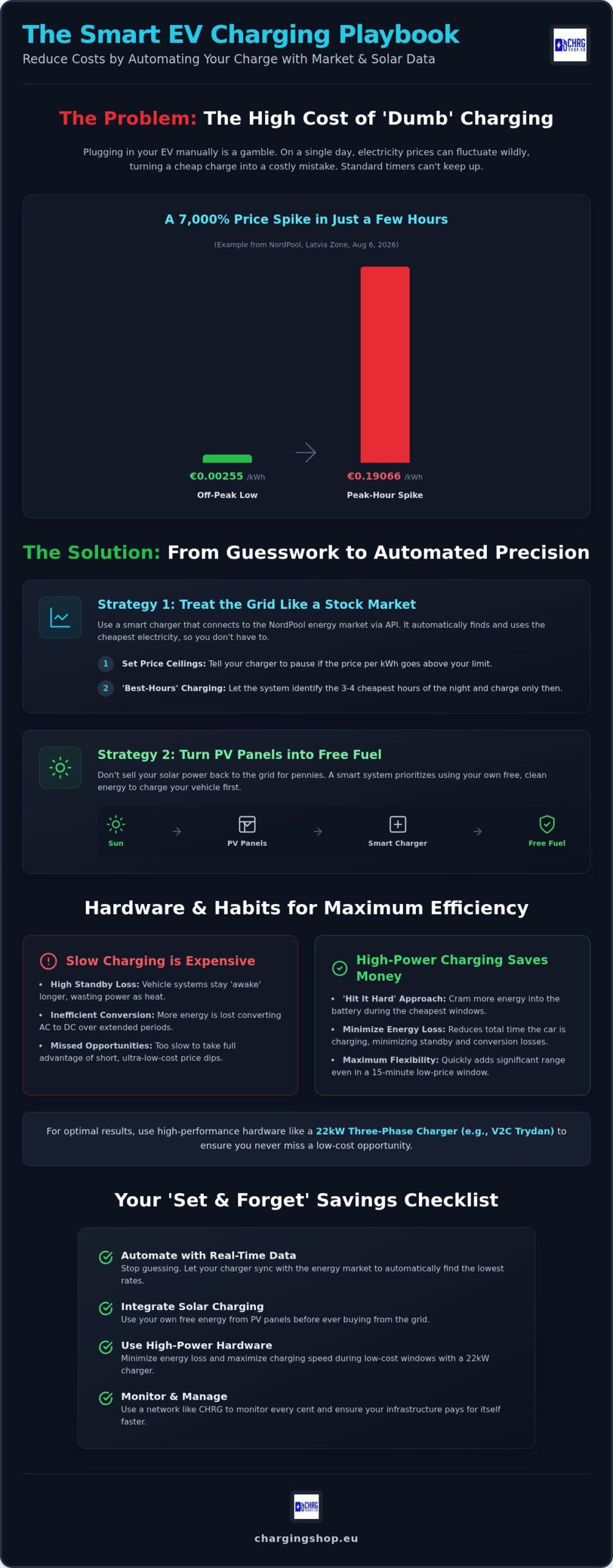
On August 6, 2026, NordPool prices in the Latvia zone swung from €0.00255 to €0.19066 per kWh in just a few hours. If you’re still manually plugging in your vehicle and hoping for the best, you’re throwing money away. It’s time to reduce ev charging costs by leveraging real-time NordPool price tracking and integrated solar charging to treat the energy grid like a high-frequency stock market.
You’re likely frustrated by unpredictable monthly bills and the sting of seeing your solar panels generate power that gets sold back to the grid for next to nothing. You don’t have time to refresh price apps every night before bed. We’ll show you how to end the guesswork with seven high-impact strategies designed to automate your savings using dynamic pricing and the latest smart hardware. It’s about moving from manual labor to digital automation.
This guide breaks down how to establish a ‘set and forget’ routine that targets the lowest rates automatically. We’ll explore how to read market trends, maximize your Enova grants, and use the CHRG Network to ensure you never pay a premium for a full battery again. Stop overpaying for power and start charging with technical precision.
Key Takeaways
- Stop guessing and start automating with real-time data integration to target the lowest market rates.
- Learn how to reduce ev charging costs by utilizing solar charging and NordPool price tracking for a ‘set and forget’ routine.
- Unlock the efficiency secrets of 22kW hardware like the V2C Trydan to minimize energy loss during every session.
- Master battery preconditioning to protect your vehicle’s health while maximizing your daily range.
- Use the CHRG Network to monitor every cent spent and ensure your infrastructure pays for itself faster.
The True Cost of ‘Dumb’ Charging: Why Your EV Bill is Spiking
Plugging in your car and walking away is a gamble you’ll likely lose. In the volatile 2026 energy market, electricity prices aren’t static. On August 6, 2026, NordPool prices in the Latvia zone spiked from a low of €0.00255 to over €0.19 per kWh. That is a 7,000% difference in just a few hours. If your charger doesn’t know the difference, you’re paying a massive premium for the same electrons. Standard timers are no longer enough. They operate on a ‘best guess’ basis, while the grid operates on real-time demand. To effectively reduce ev charging costs, you must move beyond basic scheduling.
The ‘Dumb’ charger trap is real. Most entry-level units lack the connectivity required to pull live data. They can’t see the price spikes coming. If you charge during peak hours, your cost per mile can triple compared to off-peak windows. This lack of smart charging capability means your hardware is blind to the market. Systems that lack NordPool price tracking and solar charging logic are essentially money pits. You need hardware that treats the grid like a stock market, not a faucet.
The Shift to 15-Minute Settlement Periods
The energy market is moving faster than ever. Many regions have transitioned to 15-minute settlement periods. This means your billing cycle is now granular and hyper-sensitive to volatility. Your old ‘night rate’ isn’t a safe haven anymore. A sudden drop in wind or a spike in demand at 2:00 AM can send prices soaring for a 15-minute window. Without minute-by-minute control, your charger will happily pull expensive power. You need a digital-first partner like the CHRG Network to manage these micro-fluctuations automatically.
Standby Loss and Conversion Inefficiency
Slow charging is expensive charging. When you use a basic Level 1 charger, your car stays ‘awake’ longer. This results in significant standby power loss. The vehicle’s onboard systems, cooling pumps, and battery management units consume energy the entire time the plug is active. Much of that power is lost as heat rather than range.
The solution is to ‘hit it hard’ during the cheapest windows. High-performance hardware, such as a three phase EV charger, allows you to cram more energy into the battery during those ultra-low-cost NordPool dips. By reducing the total time the car is charging, you minimize conversion losses and keep more money in your pocket. Efficiency isn’t just about the price per kWh; it’s about how much of that kWh actually reaches the wheels.
Leveraging NordPool Price Tracking: Automate for the Lowest Rates
NordPool is the leading power market in Europe. It’s where the hourly spot price for electricity is determined based on supply and demand. If you want to reduce ev charging costs, your hardware must treat this market like a live stock exchange. By utilizing NordPool price tracking and solar charging logic, you can move away from static “night rates” and target the absolute lowest points on the daily price curve. This isn’t just smart; it’s essential for anyone looking to optimize their energy spend in 2026. Much like how Helsinki-based Doubleclap Radio helps listeners navigate the nuances of various electronic music genres, NordPool data helps your charger distinguish between high and low-cost energy windows.
The secret weapon here is the ‘API Advantage.’ High-performance wallboxes act as IoT devices that pull real-time data directly from energy exchanges. Instead of you checking an app at midnight, the charger does the heavy lifting. You can set a price ceiling, telling the system never to buy power above a specific cent-per-kWh threshold. If the market spikes, the charger pauses. When the price dips, it resumes. You can also configure ‘Best-Hours’ charging, where the hardware identifies the three cheapest hours of the night and concentrates the power delivery into that window.
How Smart Chargers Sync with NordPool
To make this work, your charger needs a stable connection via Wi-Fi or Ethernet. Hardware like the V2C Trydan excels here because it has native integration for these data streams. It doesn’t rely on third-party apps that might lag or fail. Dynamic Pricing is a market-responsive rate that changes hourly based on supply. By syncing directly with the source, your charger responds to market shifts in seconds, not hours. For a truly integrated experience, you might consider a V2C Trydan 22kW to handle these high-speed data exchanges natively.
Avoiding the ‘Peak-Hour’ Penalty
Visualizing your data is the first step toward savings. Most smart systems provide clear charts showing upcoming price dips and peaks. Research into the synergies of coupling EV charging with PV highlights how these automated systems drastically cut operational expenses by avoiding grid congestion. You can set ‘Must-Charge’ buffers, ensuring you always have enough range for an emergency, but the system will wait for the cheapest possible moment to top off the rest of the battery. The ROI of switching to a dynamic tariff is often realized in months, not years, when paired with the right hardware.
Solar Charging Mastery: Turning PV Panels into Free Fuel
While NordPool price tracking helps you find the cheapest grid power, solar charging gives you the power for free. If you really want to reduce ev charging costs, you need to look up. Your roof is a power plant. Stop selling your excess solar energy back to the grid for pennies. Instead, divert every spare watt directly into your car’s battery. This is the difference between simply owning an EV and running a zero-cost commute.
Mastering this requires moving from ‘Solar-Aware’ to ‘Solar-Direct’ charging. A solar-aware system might tell you the sun is shining, but a solar-direct system only triggers the charger when your home produces more than it consumes. This PV surplus is the holy grail of efficiency. To maximize this, you need Dynamic Load Balancing. This technology monitors your home’s total energy draw in real-time. It protects your main fuse by automatically throttling the charger when the oven or heat pump kicks in, then ramps it back up the second the load drops. It’s about safety and speed combined.
How many panels do you actually need? For a typical daily commute of 40-50 km, you need roughly 8-10 kWh of energy. In a modern setup, 4 to 6 high-efficiency panels—like those available through MacSell Solar Outlet—can generate this in just a few hours of peak sun. If you have a larger array, you aren’t just charging for free; you’re building a massive energy buffer for the week ahead.
V2C Trydan and Solar Integration
The hardware you choose dictates your success. The V2C Trydan 22kW is the industry leader for a reason. It connects directly to your solar inverter via Wi-Fi or Ethernet. You don’t need extra clamps or complex wiring. Through the app, you can master two critical modes:
- Full Solar: The car only charges using 100% green, surplus energy. If a cloud passes, the charging pauses.
- Solar + Grid: The system uses all available solar first and pulls the minimum necessary from the grid to maintain a steady charge rate.
Storage vs. Direct Charging
A common mistake is charging a home storage battery and then using that battery to charge the car later. This ‘double-cycling’ leads to significant energy loss. Every time you move energy into or out of a battery, you lose about 10-15% through heat and conversion. If you work from home, daytime charging is your best financial move. By plugging in during peak sun, you bypass the home battery entirely and push raw PV power straight into the vehicle. It’s the most efficient way to keep your fuel costs at absolute zero.
Efficiency Hacks: Hardware and Habits That Save Pennies
Saving money is about more than just finding cheap power. It’s about how effectively you use every kilowatt. To truly reduce ev charging costs, you must optimize your hardware and your habits. While NordPool price tracking and solar charging get you the best rates, efficiency hacks ensure that energy actually moves the wheels. If your setup is inefficient, you’re bleeding money through heat and resistance.
Start with the 80% rule. Charging an EV battery is like filling a theater with people. The first 80% find seats quickly. The last 20% wander around looking for a spot. This final stretch is the slowest and most energy-intensive phase. Your car’s cooling systems work overtime during this period, consuming power just to manage the heat. Unless you need the full range for a long trip, stopping at 80% saves time and reduces thermal stress on the cells.
Maintenance also plays a critical role. Dirty or corroded connectors increase electrical resistance. This resistance turns electricity into wasted heat before it even reaches the vehicle. Keep your equipment clean. A quick wipe-down of the connector pins once a month prevents this invisible energy drain. Since Enova provides grants of up to NOK 5,000 for smart home chargers as of May 2026, there’s no reason to settle for ‘dumb’ hardware that lacks these monitoring capabilities.
The 22kW Efficiency Paradox
Many users assume 7kW is ‘safer’ or ‘better’ for the battery. This is a myth. Charging at 22kW is often more efficient for the overall system. Every time your car charges, its onboard computer, cooling pumps, and battery management systems stay active. If you charge at 7kW, these systems run three times longer than at 22kW. By using a high-quality Type 2 EV charger, you get the car back into sleep mode faster. This reduces the total energy consumed by the vehicle’s own overhead.
Preconditioning and Scheduling
Don’t waste range on heating. Use your app to set a departure time. This allows the charger to warm the battery and the cabin using grid power instead of the car’s internal battery. Preconditioning is vital in colder climates. A cold battery has a harder time accepting a charge and is less efficient on the road. By pre-warming, you increase your initial range and reduce the ‘fuel’ consumption of your first few miles. Small details like checking tire pressure also matter. Low pressure increases rolling resistance and eats into your charging ROI. Every bit of friction you eliminate makes your automated charging strategy more effective. Ready to upgrade your setup? Explore our full range of high-performance chargers to start saving today.
Building Your Low-Cost Infrastructure: The Charging Shop Strategy
Success in 2026 isn’t just about the right app; it’s about the right iron. You’ve learned how to reduce ev charging costs through NordPool price tracking and solar charging, but software is only as good as the hardware executing the commands. Investing in professional-grade infrastructure ensures these savings last for years. Cheap chargers often fail under the stress of daily high-amperage cycles. Industrial units like those from Alfen or ABB are built to endure, typically paying for themselves through consistent performance and zero downtime within 24 months.
Future-proofing your investment requires OCPP compliance. This open standard ensures you aren’t locked into a single software provider. If a more efficient price-tracking service emerges, you can switch without replacing your wallbox. You’re building a long-term energy asset, not just buying a plastic plug. Take control of your energy future by choosing hardware that treats your driveway like a high-performance utility hub.
Professional Hardware vs. Budget Alternatives
Reliability is a financial metric. The Alfen Single Pro Line 22kW stands as the gold standard for heavy users. It features industrial-grade components that handle heat better than budget alternatives. Similarly, the Abb terra ac utilizes robust internals to prevent costly hardware failures that leave you stranded with an empty battery. Don’t buy more power than your grid can handle. A Personalised Charging Offer ensures your setup matches your home’s capacity perfectly, avoiding unnecessary grid upgrade costs.
Software-Led Savings with CHRG Network
Monitoring is the final piece of the puzzle. CHRG Network Access centralizes your data, allowing you to find consumption patterns that even basic smart apps might miss. If you manage multiple chargers or need to track costs for a company car, this software layer is essential. It provides automated reporting for tax rebates and company reimbursement, ensuring you get back every cent you’re owed. For those scaling beyond a single vehicle or property, understanding commercial ev charging station management becomes critical to turning your infrastructure into a measurable revenue asset.
Data visualization helps you understand exactly how much you save during those ultra-low NordPool windows. It turns your energy bills from a mystery into a manageable business expense. Stop guessing and start measuring. Get your Personalised Charging Offer today and deploy a charging strategy that pays you back every time you plug in.
Take Control of Your Energy Future
Manual scheduling is a relic of the past. You now have the blueprint to reduce ev charging costs by integrating NordPool price tracking and solar charging into a single, automated ecosystem. By moving away from “dumb” timers and embracing dynamic pricing, you ensure your vehicle always draws power at the market’s lowest points. Whether you’re capturing PV surplus or hitting the grid during a midnight price dip, the savings are immediate and measurable.
We provide the tools to make this transition seamless. From the V2C Trydan with its native solar API to the CHRG Network for real-time monitoring, our solutions are built for maximum ROI. Don’t settle for generic hardware that leaves money on the table. We offer personalized charging offers tailored to your specific grid and energy needs. It’s time to stop overpaying for every mile.
Upgrade to a Smart Wallbox and Start Saving Now. Your future self and your bank account will thank you for the technical upgrade. Start charging smarter today.
Frequently Asked Questions
Is it really cheaper to charge an EV at home than a gas car?
Yes, charging at home is significantly cheaper than refueling a petrol or diesel vehicle. Even at standard electricity rates, the cost per kilometer is a fraction of fossil fuel prices. When you use smart automation to reduce ev charging costs by targeting off-peak windows, the savings become even more dramatic. You’re effectively buying your fuel at wholesale prices rather than paying retail markups at a pump.
How does NordPool price tracking actually work with my wallbox?
Your smart wallbox uses an internet connection to pull real-time data from the NordPool API. It monitors the hourly spot prices for your specific region and compares them against your pre-set limits. This NordPool price tracking allows the charger to automatically start or stop sessions based on market volatility. It ensures you only draw power when the grid is under-utilized and prices are at their lowest.
Can I charge my EV using only solar panels without grid power?
You can achieve 100% solar charging if your PV array produces enough surplus energy. Most electric vehicles require a minimum current of 6 Amps to initiate a charge. Hardware like the V2C Trydan monitors your home’s consumption and only directs power to the car when your solar production exceeds your household needs by that 6A threshold. This ensures your commute is powered entirely by green, zero-cost energy.
Does charging at 22kW damage my battery compared to a slower charger?
Charging at 22kW is perfectly safe and won’t damage your battery. Modern battery management systems are designed to handle AC charging at these speeds without significant thermal stress. In fact, 22kW charging is often more efficient than 7kW because the vehicle’s internal computers and cooling pumps run for a much shorter duration. You get the car back into its efficient ‘sleep’ mode faster, reducing total energy overhead.
What is the best smart charger for solar integration in 2026?
The V2C Trydan 22kW is widely considered the top choice for solar integration this year. It features a built-in API that communicates directly with most major solar inverters without the need for additional clamps or complex wiring. This native integration allows for seamless switching between ‘Solar Only’ and ‘Solar + Grid’ modes, giving you total control over your energy source via a simple smartphone app.
How much can I save annually by switching to a dynamic energy tariff?
Annual savings vary based on your driving habits and local market volatility, but the impact is usually substantial. By shifting your heavy charging sessions to the cheapest NordPool hours, you avoid the peak-hour penalties that can triple your energy costs. For high-mileage drivers, this strategy turns the EV into a tool for energy arbitrage, consistently hitting the lowest price points every single night.
Do I need a special meter to track NordPool prices for my EV?
You don’t need a special physical meter on the charger itself, but you do need a dynamic tariff from your energy provider. The charger pulls the price data from the cloud via its internal software. Your utility provider then uses your home’s smart meter data to bill you at the hourly rates. Pairing a dynamic contract with a smart wallbox is the most effective way to automate your savings.
What happens if the sun goes down while I’m in ‘Solar Only’ mode?
The charger will automatically pause the session the moment your solar production drops below the minimum charging threshold. It won’t draw expensive power from the grid unless you manually override the setting or switch to a hybrid mode. This ‘set and forget’ logic ensures that your ‘Solar Only’ sessions remain 100% green and don’t accidentally inflate your next electricity bill.
