
 Deutsch
 Dansk
Dansk Suomi
Suomi Latviešu
 Lietuvių
 Norsk bokmål
 polski
 Русский
 Svenska
No products in the cart.
Uncategorized
How to Balance EV Charging Load: A Practical Guide

14
Oct
Oct
Adding more EV chargers doesn’t always mean a property needs a larger power supply. A well-planned charging setup can share available capacity across chargers and other equipment. If you’re working out how to balance ev charging load, start by identifying what else draws power on-site and when several vehicles are likely to charge at once.
Simultaneous charging can push a home, building, or commercial site beyond its practical electrical limits if demand isn’t managed. The first step is to set a charging limit that respects available capacity. Then decide how power should be allocated as demand changes. Static limits use a fixed allocation, while dynamic management can adjust charging power as site demand shifts.
This guide explains how load balancing works, what to assess before choosing an approach, and how to compare options for different sites. You’ll also learn what to consider when matching charging hardware and management tools to your requirements, including residential and commercial hardware and CHRG Network access from Charging Shop.
Key Takeaways
- Learn how to balance ev charging load by setting a power ceiling that accounts for chargers and other equipment using electricity on-site.
- Use a measure, compare, allocate, and reassess process to guide charging output as site demand changes.
- Compare static and dynamic load balancing to choose a control approach that fits your site’s charging patterns.
- Gather supply details, peak loads, charger count, and expected schedules before setting operating limits.
- Match hardware and management choices to your power needs, charger count, control approach, and compatibility requirements.
How to balance EV charging load: what the problem means
EV charging load balancing is the managed allocation of a site’s available electrical capacity among EV chargers and other electrical loads. It coordinates charging with the power the property can use, rather than treating each charger as if it has the whole supply to itself.
Keep three terms distinct. Electrical capacity is the practical power limit available to the property or the part of its electrical system serving the chargers. Charger power is the rate a charger can deliver, subject to its setup. Vehicle charging demand is what a connected car can accept at that moment. These limits can differ, so a charger’s rated output alone doesn’t tell you how quickly a vehicle will charge when the site is busy.
The important figure is aggregate demand: the combined power used by chargers and other equipment at the same time. Several cars might be plugged in while a building’s heating or production equipment is running. Load management uses a configured limit to control the charging share as other demand changes. This is one part of Smart charging, a broad term for coordinating EV charging with available power and other needs.
What competes with EV chargers for available power?
Chargers share a property’s electrical supply with everyday and operational equipment. At home, heating, cooking appliances, and lighting contribute to demand. In a workplace, computers, machinery, kitchen equipment, and climate control may also be running. The combination varies throughout the day: an overnight period can look very different from a busy evening or working day.
There’s no universal charging allowance that fits every property. The supply and electrical configuration set practical limits, while existing equipment and its usage affect how much capacity remains for charging. A home, shared building, and commercial site each need a picture of their own simultaneous demand.
What load balancing can, and cannot, do
Managed allocation can help keep combined demand within a configured limit by adjusting the power available to chargers as site conditions change. If other equipment draws more power, charging may receive a smaller share. When demand eases, more capacity may become available, depending on the system’s settings and capabilities.
Balancing doesn’t create extra grid capacity or guarantee faster charging. It distributes the capacity that’s available. Charging speed also depends on the charger and vehicle capabilities, as well as the power each can use in current conditions. So, learning how to balance ev charging load starts with understanding the site’s real limits, not simply choosing chargers with higher output.
How EV charging load balancing works in practice
Load balancing follows a control loop: establish what the site is using, compare that demand with a configured power ceiling, then allocate the remaining capacity to EV charging. A controller may use site measurements and system settings to guide charger output. The meters, controller, and communication path vary by design, but the basic process is the same.
The available power pool is shared, not increased. If building demand rises, less capacity may be available for charging under the same ceiling. If demand falls, the system may be able to make more available to connected vehicles, depending on its configuration.
From site measurement to charger adjustment
First, the system needs relevant information about site demand. Depending on its design, this may come from measurement equipment monitoring the supply or another configured input. The controller compares the reported load with the site’s operating limit. That limit defines the boundary for the allocation; it doesn’t expand the property’s electrical capacity.
Next, the system determines or estimates how much capacity remains for charging and guides charger output accordingly. If several vehicles are connected, the charging share may be distributed among them according to the system’s control logic. Setups don’t all measure, communicate, or divide power in the same way, so the devices and communication paths depend on the system design.
What happens when demand changes?
Picture a home where charging is underway and cooking or heating equipment switches on. At a workplace, equipment may start or stop during the day. These changes affect the power available for charging while vehicles remain plugged in. A managed system can reassess the allocation and adjust charger output as conditions change, subject to its settings and capabilities.
The adjustment isn’t necessarily identical across chargers or vehicles, and it shouldn’t be assumed to happen instantly. The vehicle must be able to accept the power offered, and the charger and control system must respond as designed. Actual charging can therefore vary even when several cars are connected to the same managed supply.
A controller can only act on the measurements and signals its setup provides. If measurement data or communication is interrupted, the system’s response depends on its configured behavior. Understand that fallback behavior as part of the system design, rather than assuming every setup handles interruptions in the same way or guarantees a particular charging rate.
To understand how to balance ev charging load, focus on the complete control loop, not just a charger’s maximum output. The site limit, measured demand, allocation rules, and response to changing conditions all shape the result. If you’re matching charging equipment to a project, explore residential and commercial EV charging hardware alongside your site’s power and management requirements.
Static vs dynamic EV charging load balancing: which fits?
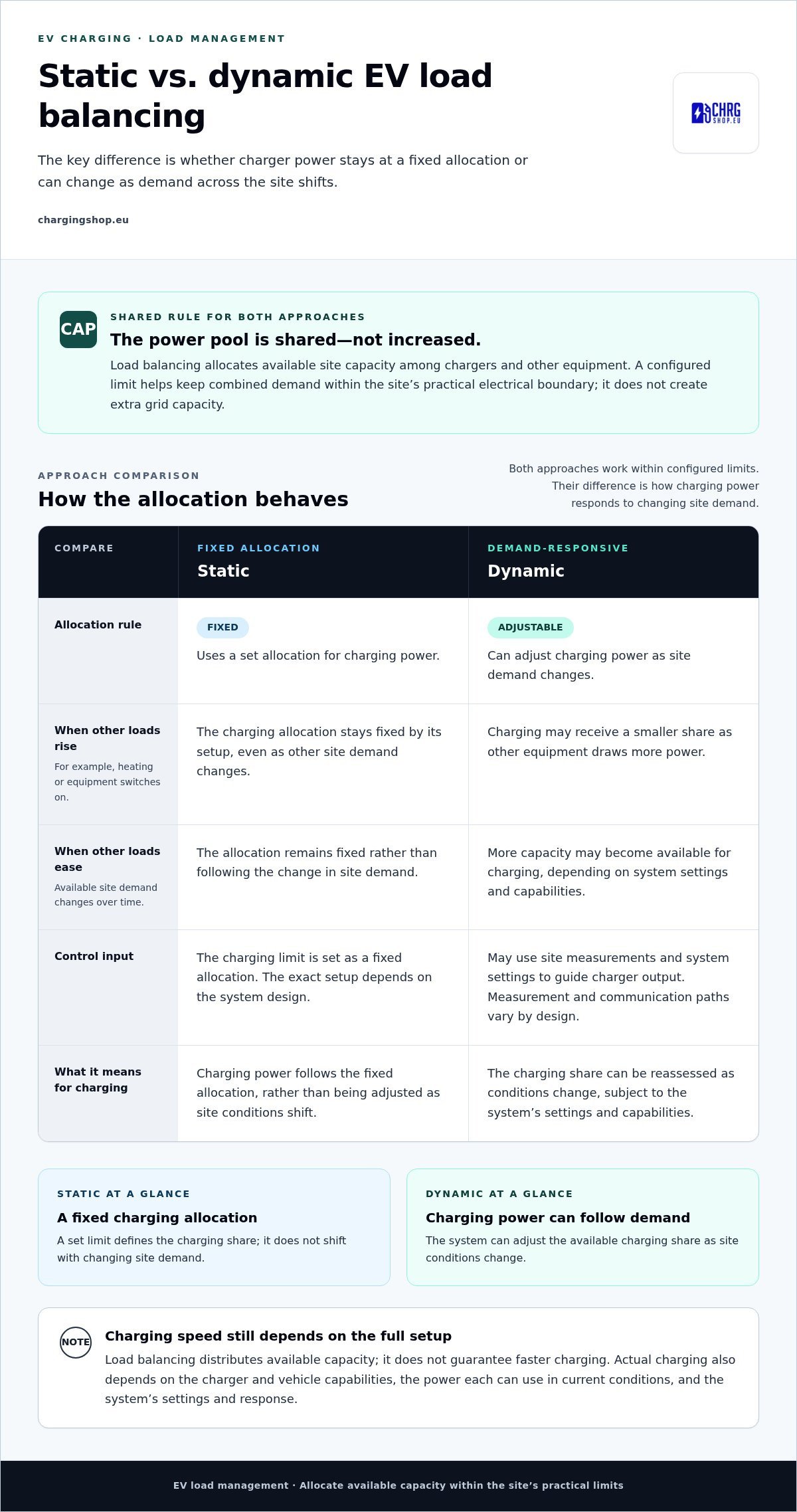
Choose between a planned limit and an allocation that responds to changing demand. Static and dynamic balancing both manage charging within defined conditions, but use different control approaches. The right fit depends on how predictable site demand is, how vehicles are used, and whether the chargers and management system are compatible.
| Comparison | Static balancing | Dynamic balancing |
|---|---|---|
| Control method | Uses a predefined allocation or ceiling, based on system configuration. | Adjusts charger allocation in response to changing measured demand, where supported. |
| Response to demand changes | The set limit stays in place as other site loads rise or fall. | Allocation can change as measured site demand changes, within configured limits. |
| Possible planning fit | May suit predictable charger use and relatively stable site demand. | May suit sites where building demand varies while several vehicles charge. |
When a fixed allocation may be enough
A fixed allocation can work well when charging schedules and other electrical demand are fairly predictable. For example, a property with consistent overnight charging may be able to plan around a set charging limit. The trade-off is less flexibility: if site demand drops at quieter times, the predefined allocation may not make use of all the capacity that could otherwise be available.
Static control isn’t automatically unsafe or unsuitable. Its effectiveness depends on setting the allocation around the site’s operating conditions and configuring the system accordingly. For a shared property or workplace, consider whether the fixed limit remains workable during the busiest expected charging period, not just when few vehicles are connected.
When real-time adjustment may be useful
Dynamic balancing may be useful when demand shifts during a charging session. A home’s heating or cooking use can change, while equipment at a workplace or commercial site may switch on and off. If the system measures relevant demand and supports responsive control, it can adapt the available charging allocation as conditions change.
That flexibility depends on the whole setup. The measurement method, control system, communication path, and charger compatibility all matter. Don’t assume a charger provides dynamic balancing on its own. Assess the system as a complete arrangement before choosing this approach.
To decide how to balance ev charging load, compare a typical day with the periods of highest demand. If use is steady and schedules are easy to predict, a fixed allocation may meet the planning need. If demand varies alongside charging, consider a compatible dynamic approach. For homes, shared properties, and commercial sites, base the choice on actual operating patterns and configured limits, not simply the number of chargers.
How to balance EV charging load: a site-planning checklist
A useful load plan starts with site facts, not charger ratings or rough guesses. Use this checklist to build a clearer picture of available capacity, competing demand, and charging needs. Keep measured or documented information separate from assumptions, then have a qualified electrical professional review the site-specific electrical design and applicable requirements before operating limits are set.
Collect the information needed to set a load limit
Build a site record covering the supply, electrical configuration, existing demand, and how vehicles will use the chargers. Include the busiest expected periods, not only an average day. If a figure is estimated or unavailable, label it as an assumption so it isn’t mistaken for confirmed capacity.
- Record supply details. Gather available documentation about the property’s supply capacity and relevant electrical configuration. Mark unclear or estimated details for professional assessment rather than using them as a firm basis for a charging limit.
- Map existing demand. List major loads such as heating, cooking, workplace equipment, and other substantial building systems. Note when each typically operates and identify periods when several may run together.
- Describe charging use. Record the number of chargers, how many vehicles may connect at once, expected vehicle dwell times, and likely charging windows. A home with overnight parking and a workplace with daytime turnover have different patterns to plan around.
- Separate facts from assumptions. Note the source of each figure, such as a site record, an observed operating pattern, or an estimate. Highlight gaps, especially around peak demand or available supply, for qualified review before translating them into limits.
Test, monitor, and revisit the operating plan
Use reviewed site information to set a conservative operating ceiling and define how chargers should share available charging capacity. Then observe performance during busy periods. Check whether allocations behave as intended and whether actual usage differs from the schedules or loads you recorded.
- Review busy-period operation. Compare observed charging and site demand with the configured plan. If charging doesn’t behave as expected, record what was happening and have the system settings and design reviewed rather than assuming the limit is correct.
- Reassess after changes. Repeat the review if charger quantities, building equipment, operating hours, or vehicle schedules change. A plan based on past usage may no longer reflect the site’s current demand.
These steps make how to balance ev charging load a practical planning task: document the site, validate assumptions, set limits, and check how the plan performs. Charging Shop offers residential and commercial charging hardware alongside personalised charging offers. Explore EV charging options to compare equipment with your site requirements.
Choose EV charging hardware and management for your site
Turn your site assessment into a shortlist. Start with the work the equipment needs to handle, then consider available power, the number of charging points, usage patterns, and the control approach you plan to use. A charger’s power rating is only one selection factor. It doesn’t show how multiple chargers and building loads will be coordinated across the property.
Match hardware choices to the site’s charging requirements
Residential and commercial sites often have different operating patterns. A home may have one or a few vehicles parked for long periods, while a shared property or workplace may need to accommodate several vehicles and varied arrival times. Identify how many chargers you need, when they’re likely to be used, and how much capacity the site can allocate to charging. Then assess the hardware and any management system as a compatible whole.
Charging Shop’s catalogue includes the V2C Trydan 22kW, Alfen Single Pro Line 22kW, and ABB Terra AC. Their inclusion doesn’t establish that any specific model supports a particular load-balancing method. Review the product information alongside your control requirements before treating a charger as part of a balancing setup. The stated power rating alone can’t determine site-wide behavior: configuration, other site loads, and compatibility with the management system also matter.
For a closer look at one catalogue option, use the V2C Trydan 22kW guide as a product-specific reference while keeping your site’s capacity and intended use in view.
Connect charging hardware with ongoing management
For multi-charger sites, plan how charging assets will be managed after selection, not just how each unit will be powered. Consider who needs an overview of the setup and how your chosen management approach fits the hardware and the site’s operating needs. Compatibility and system design matter, so don’t assume that management access automatically provides a specific control or load-balancing function.
Charging Shop offers access to CHRG Network for charging infrastructure management. Consider it alongside your hardware shortlist, without assuming particular controls or capabilities. The Alfen Single Pro Line 22kW review and CHRG Network management guide can help you explore those topics in more detail.
Before choosing, compare your required charger quantity, available capacity, expected charging windows, control approach, and system compatibility. That turns how to balance ev charging load from a general question into a practical selection brief. Charging Shop’s residential and commercial hardware and personalised charging offers give you options to assess against that brief. Base the final choice on the site’s reviewed electrical requirements and the documented capabilities of the complete setup.
Turn your site assessment into a charging plan
Your next step is to turn the site requirements into a clear hardware and management brief. Use it to compare options against the way your property operates, and account for potential changes in charging demand. The best fit isn’t simply the charger with the highest rating; it’s an arrangement that matches your needs and electrical setup.
As you decide how to balance ev charging load, explore Charging Shop’s residential and commercial charging hardware, including V2C, Alfen, and ABB models, alongside CHRG Network access for EV charging infrastructure management. Consider each option in the context of your site, rather than assuming a particular charger delivers load balancing on its own.
Explore EV charging hardware and management options at Charging Shop to find options for your charging plan.
Frequently Asked Questions
Can EV load balancing work without a smart meter?
It depends on the system design. A fixed charging limit may work without live site measurements, while dynamic control needs suitable measurement and communication components to respond to changing demand. A utility smart meter records energy use for billing or monitoring, but it isn’t automatically the dedicated measurement device a load-management system needs. Review the system architecture, including what it measures and how that information reaches the charger or controller.
Does EV load balancing make charging faster?
Not necessarily. Balancing allocates available power; it doesn’t add capacity to the property’s supply. A vehicle may receive more power when other loads are low, then less as demand increases. For example, a charger’s output may be constrained during a busy period even if it could deliver more under different conditions. Actual charging speed also depends on the vehicle, charger, supply, and charging conditions, so balancing can’t guarantee a shorter session.
What happens if several EVs charge at the same time?
A suitable load-management system can allocate charging capacity among connected vehicles according to its configuration. The share may change as more vehicles begin charging or other site demand shifts. Equal distribution isn’t guaranteed: one vehicle may be offered a different amount of power from another, depending on system rules and what each vehicle can accept. For a shared parking area, base the arrangement on expected simultaneous use, not just the total charger count.
Is load balancing only useful for commercial charging sites?
No. It can also matter at homes and shared properties where charging draws power alongside other equipment. A single charger doesn’t automatically need dynamic control, though. A home with predictable charging and ample available capacity may have different needs from a property where several high-demand appliances run at the same time. Assess site capacity, demand patterns, charging routines, and equipment compatibility before deciding which control approach makes sense.
Can load balancing eliminate the need for an electrical upgrade?
Not in every case. Load management may help a site use its existing capacity more efficiently, but it can’t raise the supply limit or resolve every electrical constraint. Whether current capacity can meet charging needs depends on measured demand, the planned charging setup, system design, and applicable requirements. Treat balancing as one planning option, not a guaranteed substitute for an electrical assessment or a capacity change. Have the site’s needs reviewed before settling on a plan.
What is the difference between load balancing and load shedding?
Load balancing shares available power across charging demands or other managed loads. Load shedding generally reduces or disconnects selected loads when a limit is reached. The terms can overlap in product or system descriptions, so focus on the actual behavior: which loads can change, under what conditions, and whether charging is reduced or paused. That distinction matters because sharing power and switching a load off aren’t the same operating outcome.
How do I know what load limit my EV chargers should use?
Base the limit on documented site capacity, existing loads, charger configuration, and applicable requirements, not a vehicle’s battery size or a charger’s headline rating. Gather supply records and information about peak demand, then separate confirmed figures from estimates. A qualified electrical professional should review the site-specific design before operating limits are set, especially at shared or commercial properties where simultaneous use and future expansion may affect the plan.
