
 Deutsch
 Dansk
Dansk Suomi
Suomi Latviešu
 Lietuvių
 Norsk bokmål
 polski
 Русский
 Svenska
No products in the cart.
Uncategorized
Safe Home EV Charging Station: A Practical Safety Checklist for 2026
15
Oct
Oct
What if the charger itself isn’t the whole safety story? A safe home ev charging station depends on how the equipment, home circuit and installation work together. That matters whether you charge overnight, plug in during wet weather or want to distinguish a meaningful safeguard from a marketing claim.
It’s reasonable to want clear answers before making charging part of your daily routine. A feature or label alone can’t guarantee a safe setup. Uncertainty about circuit capacity or protective devices can also make choosing feel harder than it needs to be.
This practical checklist will help you assess safety features, understand what to look for in the equipment and spot warning signs that deserve attention. You’ll also learn how to consider circuit compatibility, installation, outdoor exposure and routine checks, so you can make a more informed hardware shortlist. Start with the complete setup, not just the charger, and use clear criteria to guide your decision.
Key Takeaways
- A safe home ev charging station depends on compatible equipment, a suitable home circuit, appropriate protection and correct use working together.
- The EV, charger and circuit each play a role in managing electrical risks. No single device is a complete safety solution.
- Compare documented safety information, connector compatibility, enclosure ratings and regional requirements instead of relying on marketing claims.
- Use a simple checklist before purchase, before first use and during routine charging, and follow the charger and vehicle manuals.
- Use your vehicle, home supply and charging routine to build a practical hardware shortlist. Check verified specifications rather than making assumptions from model names or power ratings.
What makes a safe home EV charging station setup?
A safe home EV charging station is a system in which compatible charging equipment, a suitably designed supply circuit, appropriate electrical protection and correct everyday use work together. Safety isn’t determined by the charger alone. The circuit must support the equipment, protective devices must suit the setup, and the equipment must be used according to its instructions.
It’s understandable to think about electrical faults, overnight charging or changing weather. Those concerns don’t mean routine home charging is inherently dangerous. They’re reasons to assess the complete setup rather than rely on a product claim or one impressive specification. A suitable charger can still be paired with an unsuitable circuit, just as a well-prepared circuit can’t make damaged equipment safe to use.
Which parts of a home charging setup affect safety?
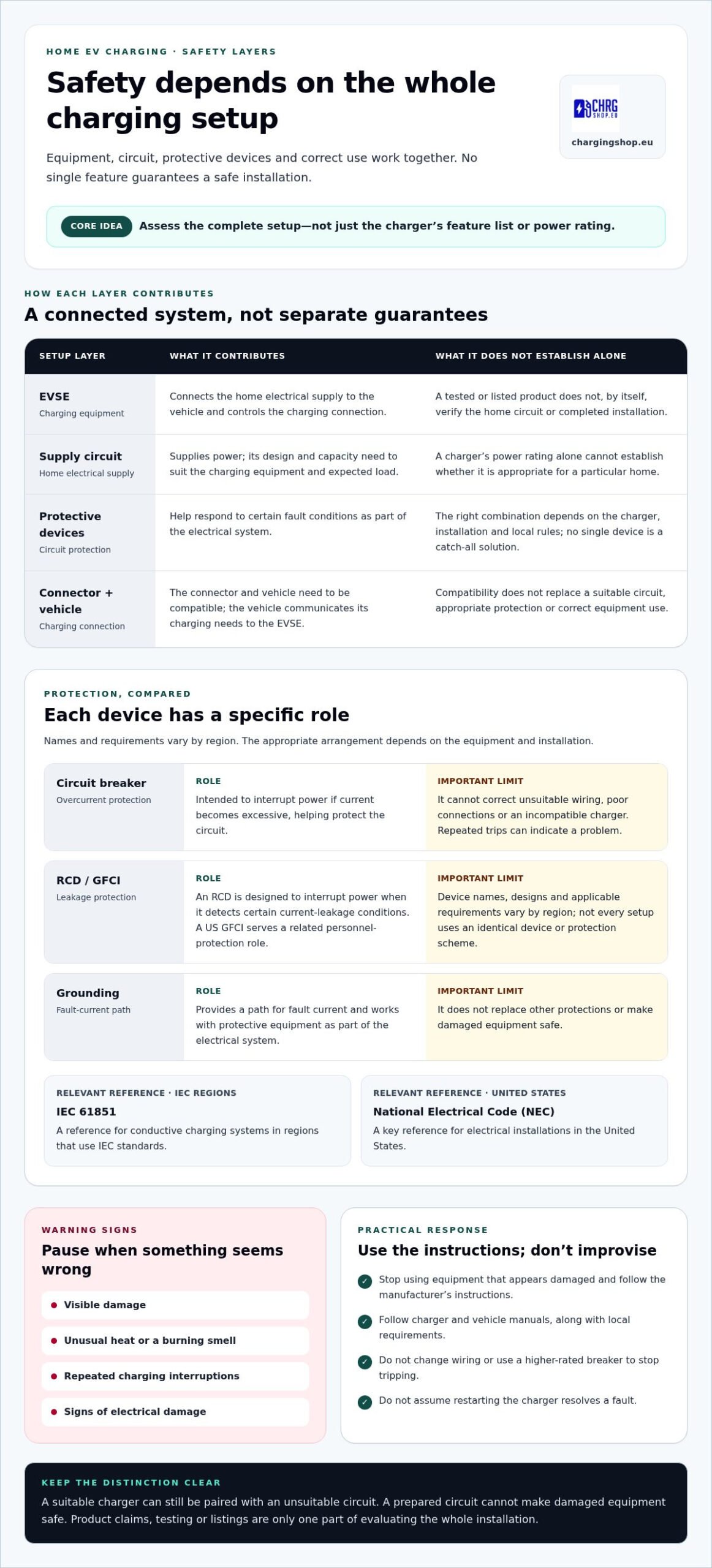
An EVSE, or electric vehicle supply equipment, connects the home’s electrical supply to the vehicle and controls the charging connection. It works alongside the supply circuit, protective devices, charging connector and vehicle. These are connected parts of the setup, not independent guarantees of safety.
For example, the vehicle and EVSE need to be compatible, while the circuit and its protection need to suit the equipment and installation. A damaged connector, unsuitable circuit or problem with protective equipment can affect the wider setup. The EV Charging Station Overview provides broader context on station types, standards and residential charging.
- EVSE: The charging equipment and its documented instructions.
- Supply circuit: The home electrical supply serving the charger.
- Protective devices: Equipment intended to reduce electrical risks as part of the installation.
- Connector and vehicle: The physical connection and the vehicle’s charging compatibility.
Is home EV charging safe when the setup is suitable?
Home charging can be part of a safe routine when the equipment suits the vehicle and supply, the installation meets local requirements, and you follow the charger and vehicle manuals. The right setup depends on the home and equipment, so a general statement can’t replace checking those details.
Distinguish ordinary use from warning signs. Charging overnight, by itself, doesn’t mean something is wrong. Visible damage, unusual heat, a burning smell, repeated interruptions or signs of electrical damage call for caution. Stop using equipment that appears damaged and follow the manufacturer’s instructions. Don’t improvise electrical changes or assume restarting the charger resolves a fault.
How does a safe home EV charging station manage electrical risks?
Charging is a coordinated process. The vehicle communicates its charging needs to the EVSE, while the circuit supplies power and protective devices help respond to certain fault conditions. The exact protections depend on the equipment and installation. Don’t assume every charger detects the same problems or includes the same safeguards.
The home circuit must be suitable for the charging load it is expected to carry. A charger’s power rating alone can’t establish whether it’s appropriate for a particular home. The supply, wiring and protection all matter.
What do circuit capacity and overcurrent protection do?
A circuit has limits. Its suitability depends on the charging equipment and the home’s electrical setup, including how the circuit is designed and what else it supplies. Overcurrent protection, such as a correctly selected circuit breaker, is intended to interrupt power if current becomes excessive. It helps protect the circuit, but it can’t correct unsuitable wiring, poor connections or an incompatible charger.
Think of the breaker as one layer, not a catch-all safety device. Its rating and the rest of the circuit must suit the charging load. Don’t use a higher-rated breaker or change wiring to stop tripping. Repeated trips can indicate a problem that needs assessment. Follow the charger instructions and local requirements rather than relying on a generic size chart.
What do RCDs, GFCIs, and grounding contribute?
An RCD, or residual-current device, is designed to interrupt power when it detects certain current leakage conditions. In the United States, a GFCI, or ground-fault circuit interrupter, serves a related personnel-protection role. Device names, designs and applicable requirements vary by region, so the terms don’t mean every setup uses an identical device or protection scheme.
Grounding provides a path for fault current and works with protective equipment as part of the electrical system. It doesn’t replace other protections or make damaged equipment safe. Some protective functions may be built into the EVSE; others may depend on equipment elsewhere in the circuit. The appropriate combination depends on the charger, installation and local rules.
When comparing a safe home ev charging station, treat product safeguards and upstream circuit protection as connected but separate parts of the decision. Charging Shop’s EV charging hardware range includes options to explore. Evaluate each model against your vehicle and home supply requirements.
Which safety features and standards should you compare?
Compare what the manufacturer documents, not what a product name or sales phrase seems to imply. A useful safety review covers the charger’s stated protective functions, connector compatibility, enclosure rating and approval or compliance information for your market. These details help you assess the product, but they don’t verify the wiring, circuit or completed installation.
A rating describes performance under the test conditions and within the scope stated for that rating. Don’t treat an enclosure rating as a promise of protection in every location or weather condition.
How should you interpret charger certifications and standards?
Standards address different parts of charging. IEC 61851 covers conductive charging systems, while IEC 62196 covers plugs, socket outlets, vehicle connectors and inlets. A reference to one standard doesn’t automatically establish compliance with every rule that applies to a particular installation.
UL marks are one example used in the North American market; other regions use their own approval or conformity marks. Requirements vary by market and may depend on local rules. Look for documentation that identifies the relevant standard or mark, and don’t assume a charger sold for one region meets another region’s requirements.
Which product details are meaningful safety checks?
Start with the manufacturer’s documentation. Check the stated operating conditions, connector type, enclosure information and any protective functions the manufacturer describes. Treat an IP rating as information about the enclosure under defined tests, not proof that the equipment suits every outdoor exposure or installation location.
Use this comparison table to distinguish product claims from installation checks:
| What to compare | What to look for | What it tells you |
|---|---|---|
| Documented protection | Manufacturer-stated protective functions and supporting product documentation | Which safeguards are described for the charger, not necessarily the whole circuit |
| Connector compatibility | Connector and vehicle inlet types stated in the specifications | Whether the physical connection is intended to match your vehicle |
| Enclosure rating | Declared IP or other enclosure rating and stated operating conditions | Defined enclosure performance, not suitability for every weather condition |
| Regional compliance | Relevant standards, approval marks and local installation rules | Whether the product and setup align with requirements for your market |
A tested or listed charger isn’t the same as a verified complete installation. Product evidence relates to the equipment; the circuit, protection and installation must be considered separately. That distinction matters for any safe home ev charging station.
If you’re comparing higher-rated wallboxes, separate power selection from safety verification. The 22kW home wallbox guide explores the power question. Use the manufacturer’s documentation and local requirements to assess safety for your setup.
Use this safe home EV charging station checklist
Turn safety criteria into repeatable checks. Before purchase, confirm the equipment fits your vehicle and planned installation. Before the first charge, review the completed setup and instructions. During regular use, look for changes. This routine helps you notice visible problems without diagnosing or modifying electrical equipment yourself.
Before purchase
- Match the connector. Compare the charger connector with your vehicle’s charging inlet and intended setup. Check the manufacturer’s documentation rather than relying on a product photo or model name.
- Consider the home supply. Make sure the planned charger and charging load suit the home’s electrical setup. The installation may need assessment against local requirements.
- Review the documentation. Look for stated operating conditions, protective functions, connector details and environmental limits. These are product details, not proof that the complete installation is suitable.
- Plan for the location. Consider where the equipment and cable will sit, and whether the manufacturer’s stated conditions suit that spot. Don’t assume an enclosure rating covers every exposure.
Before the first charge
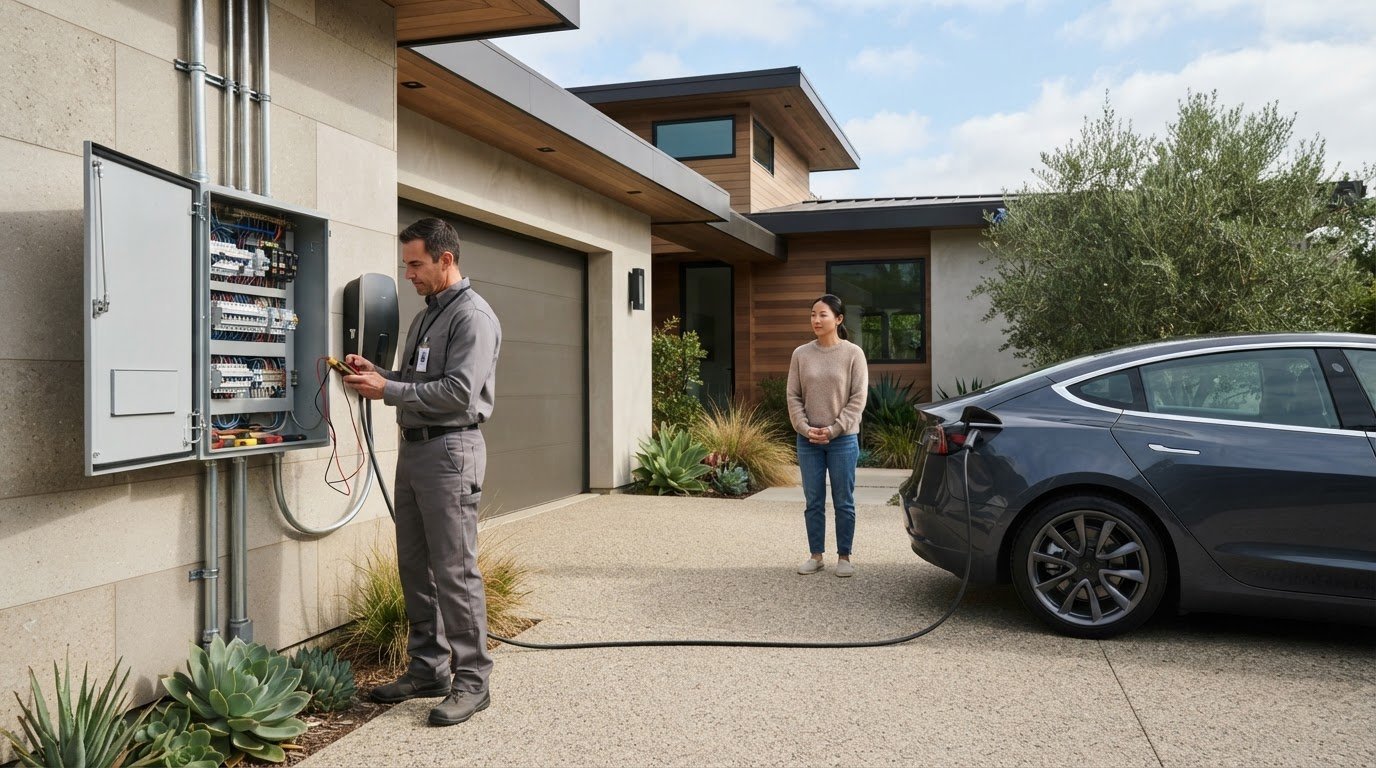
- Check the installation. Confirm that the circuit and protective equipment have been assessed against applicable local requirements by a certified contractor such as D C Electrix Ltd. Don’t change wiring, breakers or protective devices yourself.
- Read both manuals. Follow the charger’s and vehicle’s instructions for commissioning, operation and environmental limits. If their directions differ or you’re unsure how to proceed, pause and seek qualified guidance.
- Inspect the connection. Look over the charger, cable and connector before plugging in. Don’t use equipment that appears damaged or has loose or exposed parts.
- Understand normal operation. Learn what the manufacturer says about indicators, interruptions and fault messages. This gives you a reference if something changes later.
During regular charging
- Inspect before use. Check cables and connectors for visible cuts, cracks, deformation or other damage. Keep the charging area clear, and avoid pulling, pinching or straining the cable.
- Watch for warning signs. Stop charging if equipment appears damaged, becomes unusually hot or repeatedly interrupts charging. Don’t keep resetting it or continue using a suspect cable.
- Get faults assessed. If damage, unusual heat or repeated faults occur, stop using the equipment and seek qualified assessment. Follow the manufacturer’s guidance. Don’t open the charger or improvise a repair.
For product-specific context, the V2C Trydan 22kW home charging guide can help you review information about that charger. Keep the broader checklist in view: choosing a safe home ev charging station means considering the equipment and setup together.
Ready to compare hardware against your checklist? Explore EV charging hardware and use the documented specifications to shape your shortlist.
Choose a safe home EV charging station for your setup
Build your shortlist around the vehicle, home supply and charging routine, then compare documented product details. A higher power rating doesn’t prove a charger is a better fit, and a model name doesn’t tell you which safeguards it includes. Treat compatibility, charging speed, connectivity and safety as separate questions.
How can you match charger options to your home?
Start with the vehicle’s charging acceptance limits and inlet type. Then consider the available home supply, installation location and how you expect to charge. A suitable setup depends on the charger’s specifications aligning with both the vehicle and electrical supply. Use product documentation to compare options such as the V2C Trydan 22kW and ABB Terra AC, without assuming their names or ratings establish compatibility or safety.
- Vehicle: Check the inlet, connector compatibility and charging limits in the vehicle documentation.
- Home supply: Match the charger’s published requirements to the planned electrical setup.
- Location and routine: Consider where the charger will be used and how the cable will reach the vehicle.
- Separate criteria: Compare speed, connectivity and documented safety information independently.
This keeps the decision practical. A charger’s maximum rating doesn’t mean your vehicle can accept that rate or your home supply can support it. A connectivity feature may suit your routine, but it doesn’t replace product documentation or a suitable installation.
What should you do before making a final choice?
Read the manufacturer’s documentation for the exact model you’re considering. Compare its stated protective functions, connector information, operating conditions and approval or compliance details for your market. Then consider those product facts alongside the requirements of the home installation. Product evidence and installation suitability are related, but they answer different questions.
A personalised charging offer can help narrow hardware choices around your project, rather than choosing by rating alone. Charging Shop lists options for different charging contexts, including V2C, ABB and Alfen hardware. Keep your shortlist focused on documented specifications, vehicle fit and supply compatibility. Don’t infer protections from a feature label or treat one specification as proof that the complete setup is safe.
A safe home ev charging station is a considered match between equipment, vehicle, supply and correct use. Use the criteria in this guide to make an evidence-based choice, then explore EV charging hardware and find the right setup.
Make your next charging decision with confidence
Turn the safety criteria into a decision that fits your vehicle and home, rather than choosing a charger based on one headline feature. A safe home ev charging station depends on a suitable match, product details considered in context and a charging routine that works for you.
Charging Shop’s hardware range includes home and professional EV charging products, and a personalised charging offer can help narrow the options around your project. Use that shortlist as a practical starting point, while keeping the manufacturer’s documentation and your home’s requirements central to the decision.
Explore Charging Shop’s EV charging hardware and find the right setup. Take the next step at your own pace, with clear criteria and greater confidence in your choice.
Frequently Asked Questions
Is it safe to leave an electric car charging overnight at home?
Yes, overnight charging can be part of normal use if the charger and installation are suitable and you follow the vehicle and charger manuals. A safe home ev charging station shouldn’t rely on unattended use to compensate for damaged equipment or recurring faults. Before leaving a charging session running overnight, check that cables aren’t pinched by a door or exposed to vehicle traffic, and make sure you understand the charger’s indicators.
Can I charge my EV in the rain with a home charging station?
Rain doesn’t automatically rule out charging, but the equipment and location must suit the conditions. Follow the manufacturer’s instructions for outdoor use, and don’t charge if a connector or cable is damaged or water is collecting around electrical connections. Handle connections as directed, and avoid placing charging equipment where it can sit in standing water. If conditions exceed the stated operating limits, wait until they improve.
Can I use an extension cord with a home EV charger?
Don’t add an extension cord unless the charger manufacturer explicitly permits that specific arrangement. An extra connection can introduce a mismatch or damage risk, and a household extension lead shouldn’t be assumed suitable for sustained EV charging. If the standard cable won’t reach, don’t daisy-chain leads or use an adapter as a workaround. Reconsider the planned charger location and follow the manufacturer’s guidance for approved cable arrangements.
What safety features should a home EV charging station have?
Look for clear manufacturer documentation describing protective functions, operating conditions, connector compatibility and relevant approval information for your market. Depending on the equipment and setup, protection may involve overcurrent and residual-current measures, along with grounding. Check how the charger is intended to work with the home circuit. A label or single built-in feature doesn’t establish that the complete installation is suitable.
Does a surge protector make home EV charging safer?
A surge protector may address voltage surges, but it doesn’t replace the circuit protection required for the charging setup or verify that the circuit is suitable. Don’t plug an EV charger into a household surge strip unless the charger instructions specifically allow it. If you’re exploring dedicated power quality options, resources from providers like ecsintl.com can help you learn more about electrical surge protection, though any setup should still be assessed for compatibility by a qualified professional.
What should I do if my EV charger or cable feels unusually hot?
Stop the charging session and don’t continue using equipment that feels unusually hot. Avoid touching a visibly damaged connector or cable, and follow the manufacturer’s instructions for ending the session safely. Don’t try to cool, open or repair the equipment yourself. Have it assessed by a qualified professional before using it again, especially if heat returns, charging repeatedly stops, or you notice a burning smell or visible damage.
Do home EV charging safety requirements vary by country?
Yes. Electrical codes, installation rules, connector standards and approval marks can differ between countries and may also vary locally. Don’t assume a charger suitable for one market is compliant in another. Use documentation relevant to your location and follow the applicable requirements. Check the vehicle connector too, since charging compatibility is market-dependent.
