
 Deutsch
 Dansk
Dansk Suomi
Suomi Latviešu
 Lietuvių
 Norsk bokmål
 polski
 Русский
 Svenska
No products in the cart.
Uncategorized
V2C Trydan 22kW Wallbox: Is It the Right Fit for Your EV?
13
Oct
Oct
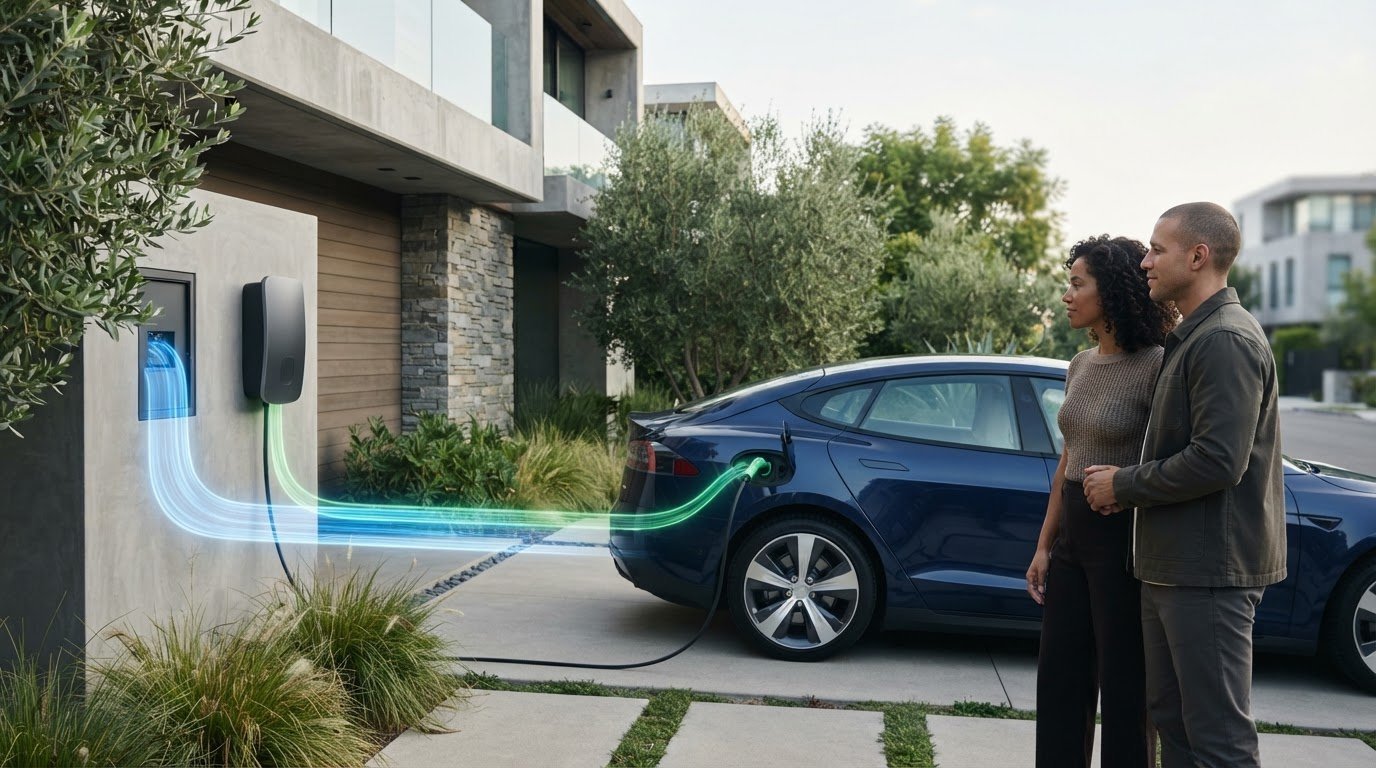
What if a 22kW wallbox never charges your car at 22kW? The V2C Trydan 22kW wallbox has a maximum rated output, but your EV’s onboard AC charging capacity and your site’s electrical supply determine the charging speed you can actually use.
The number on a charger is not a promise of faster charging. Your vehicle may accept less power, and your home or site may not have the electrical capacity needed to reach the wallbox’s rated output. Checking those limits before you choose can help you avoid paying for capacity that does not suit your setup.
This guide explains what the 22kW rating means, how vehicle and electrical limits affect charging, and what to consider when evaluating the Trydan. Use the practical checks below to assess whether it fits your EV, power supply and charging routine.
Key Takeaways
- Separate the wallbox’s rated output from your EV’s onboard AC charging limit to set realistic expectations.
- Use your vehicle’s maximum AC charging rate and typical parking duration to judge whether higher-power charging suits your routine.
- Compare the V2C Trydan 22kW wallbox with lower-power options by vehicle acceptance, site capacity and buyer fit, not headline output alone.
- Review your electrical supply and the exact product specifications as part of a practical pre-purchase checklist.
- Explore the Trydan and Charging Shop’s personalised charging offers with your vehicle and site requirements in mind.
V2C Trydan 22kW wallbox: what the rating means for your charging choice
A 22kW wallbox is rated to deliver up to 22 kilowatts of AC power under suitable conditions; it does not guarantee that your vehicle will charge at that rate. That distinction is central to deciding whether the V2C Trydan suits your needs. The rating describes the wallbox’s maximum output, while your EV and electrical supply determine how much of that capacity you can use.
What does 22kW mean on an EV wallbox?
Kilowatts measure power, or the rate at which energy can flow. A wallbox’s rated output indicates its potential charging power. It does not describe your car’s battery size or predict the speed of every charging session.
For AC charging, the vehicle’s onboard charger accepts power from the wallbox and converts it for the battery. The car may have a lower AC charging limit than the wallbox, and the site’s available electrical supply can also restrict delivery. The number on the unit is therefore a maximum, not a guaranteed charging rate. For an overview of charging methods and terminology, see Electric vehicle charging standards and types.
Keep that ceiling in mind when comparing products. The V2C Trydan 22kW smart home charging guide gives a broader product overview, while this buyer’s guide focuses on whether its rated capacity fits your circumstances.
Who should consider the V2C Trydan 22kW?
Higher AC capacity may be useful if your vehicle can accept it, your site can support the required output, and you want to make better use of a limited parking window. It may also matter if you are choosing hardware with a future vehicle change in mind. Future flexibility is only valuable, however, if the vehicle and electrical supply can use the capacity.
Start with your routine. If your car is parked for a long charging window, a lower charging rate may already meet your needs. If it has less time to charge, available capacity could matter more, provided the vehicle and site are compatible. Check your vehicle’s AC charging capability and note how long it typically stays connected before focusing on the 22kW label.
The practical question is whether the Trydan’s maximum rating can serve your setup now or as your needs change. Match the wallbox to your car, site and routine first. Treat higher capacity as an option, not a promise of faster charging.
V2C Trydan 22kW specifications and vehicle compatibility
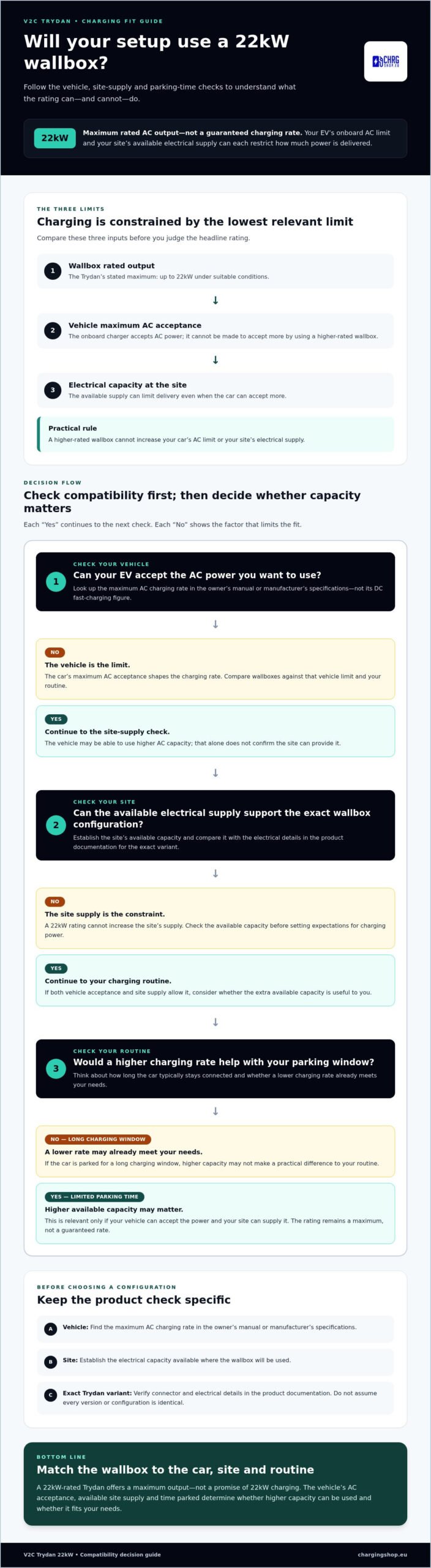
To estimate charging power, compare three limits: the wallbox’s rated output, the vehicle’s maximum AC charging acceptance and the electrical capacity available at the site. The lowest relevant limit constrains the power delivered during a session. A higher-rated wallbox cannot make a car accept more AC power or increase the site’s supply.
For example, if a vehicle’s AC limit is below the wallbox’s available output, the car is the limiting factor. If the vehicle can accept more power than the site can provide, the electrical supply is the constraint. These are general EV charging principles, not additional specifications of the Trydan.
Can your EV accept 22kW AC charging?
Vehicle AC charging capability varies by model and configuration. Check the owner’s manual or manufacturer’s specifications for the maximum AC charging rate. Do not rely on a general statement about the model or its DC fast-charging capability, because those figures describe different charging methods.
Wallbox output cannot override your vehicle’s maximum AC charging acceptance. If the car accepts less power than the wallbox can provide, the vehicle’s limit shapes the charging rate. Use the manufacturer’s AC figure as a key input when deciding whether a 22kW-rated wallbox fits your needs.
Which Trydan specifications should buyers check?
The 22kW rating in the V2C Trydan 22kW wallbox name is the starting point, not a promise about the rate your vehicle will receive. For the exact variant you are considering, review its product specifications for connector and electrical details, then compare those requirements with the site’s supply.
Keep product facts separate from general compatibility checks. Use this checklist:
- Vehicle: Find the maximum AC charging rate in the owner’s manual or manufacturer’s specifications.
- Site supply: Establish what electrical capacity is available where the wallbox will be used.
- Exact variant: Match its connector and electrical specifications to your vehicle and site using the product documentation for that configuration.
Do not assume that every version or configuration has the same connector or electrical details. Use the product documentation for the exact variant, then compare the vehicle, site and wallbox limits together. That gives you a more useful expectation than the headline rating alone.
With those details in hand, explore the V2C Trydan at Charging Shop as part of your hardware decision.
V2C Trydan 22kW versus lower-power wallboxes: compare real-world fit
A higher wallbox rating provides more available AC capacity, but does not automatically make every charging session faster. Your vehicle must be able to accept the power, and the site must be able to supply it. Compare wallboxes against those conditions and your charging routine, rather than the headline rating alone.
Use this framework to assess a 22kW-rated wallbox against a lower-power option. The table compares decision factors, not fixed specifications for every charger or vehicle.
| Decision factor | 22kW-rated wallbox | Lower-power wallbox |
|---|---|---|
| Rated output | Offers a higher maximum AC output, subject to the exact product configuration. | Has a lower maximum AC output, as stated in its product specifications. |
| Vehicle acceptance | Useful only to the extent that the EV’s onboard charger can accept the available AC power. | May already align with a vehicle whose AC limit is lower. |
| Site capacity | Its rated capacity matters only if the electrical supply can support it. | May fit a site where a higher output is not available or needed. |
| Likely buyer fit | Could suit a buyer with a compatible vehicle, suitable supply or a reason to plan for future flexibility. | Could suit a buyer whose vehicle, supply and regular charging routine do not call for higher output. |
For more context on how power ratings shape a home charging decision, explore this 22kW home wallbox guide.
When can a 22kW wallbox provide a practical advantage?
A 22kW-rated unit may be worth considering if your EV can use more AC power, your electrical setup can provide it, and reducing charging time matters to your routine. Each condition counts. If the vehicle or site sets a lower limit, the wallbox’s additional rated capacity may not change your actual charging rate.
Consider changing needs, too. A household with more than one EV, or a driver expecting to change vehicles, may value capacity that could suit a compatible future car. That is a planning scenario, not a guarantee that every vehicle will benefit or that charging times will fall by a particular amount.
When might a lower rating be enough?
If your EV’s AC acceptance is below the output available from a higher-rated wallbox, the extra capacity may not improve charging for that car. If the vehicle usually stays parked overnight, a longer charging window may also make maximum power less important. Consider whether your regular routine leaves the battery ready when you need to drive.
Before choosing the V2C Trydan 22kW wallbox or a lower-rated alternative, compare your vehicle’s AC capability, your site’s supply and your typical parking time. The right fit is the one that works with all three, not automatically the unit with the largest rating.
V2C Trydan 22kW buying checklist: check your setup before ordering
Make the decision in sequence. Start with the vehicle, consider your daily charging routine and site supply, then match those needs to the exact product variant. This turns the 22kW rating into a practical fit test rather than an assumption about the charging speed you will get.
Four checks to complete before choosing the wallbox
Work through these checks in order. Keep the details together so you can compare the vehicle, site and product against the same set of needs.
- Check the vehicle. Use the owner’s manual or manufacturer’s specifications to find its maximum AC charging capability. Do not substitute a DC fast-charging figure, which describes a different charging method.
- Map your routine. Note when the vehicle is usually parked and how long it remains connected. Include how much charging you typically need between drives, not just the shortest possible parking window.
- Assess the site. Use reliable information about the electrical supply available where the wallbox will be used. If the available capacity is unclear from site records, arrange an appropriate electrical assessment before deciding what output the site can support.
- Match the product. Compare the exact Trydan variant’s documented electrical and connector specifications with your vehicle and site information. Do not assume details are identical across versions or configurations.
This sequence helps identify the limiting factor before you choose. Your vehicle’s AC acceptance, parking routine and site supply each affect whether higher rated output has practical value.
Confirm product details and plan the purchase
Review the documentation for the specific V2C Trydan 22kW wallbox variant you are considering. Match its connector and electrical requirements to your setup using the product specifications, rather than relying on the model name alone. Apply the same approach to connectivity or energy-management functions: include them in your decision only if they are documented for that exact variant and relevant to how you will charge.
Keep product selection separate from site preparation. Choosing a wallbox does not establish that the site can support its rated output. Use the site information to plan electrical requirements, then select the product configuration that fits.
If you are weighing another 22kW option, a review of the Alfen Single Pro Line 22kW can help you compare products while keeping your vehicle and site requirements central.
Ready to match your checklist to the product? Explore the V2C Trydan 22kW wallbox at Charging Shop with your vehicle, routine and site details in hand.
Explore the V2C Trydan 22kW through Charging Shop
The right choice comes down to fit, not the number on the casing. Compare your EV’s maximum AC charging capability with the electrical capacity at your intended charging location. Then consider whether the V2C Trydan 22kW wallbox suits your routine and priorities. Its 22kW rating describes maximum output, not a guaranteed charging rate for every car or site.
Charging Shop offers the V2C Trydan 22kW alongside personalised charging offers. Use the details below to make your product exploration focused and practical. There is no need to guess from the rating alone.
What to have ready when exploring the product
A few details will help you assess whether the Trydan fits your situation. Gather this information before comparing product specifications:
- Your vehicle model and AC limit: Keep the model name and its maximum AC charging capability from the owner’s manual or manufacturer’s specifications close by.
- Your charging location: Note where you intend to use the wallbox and what reliable information you have about the site’s electrical supply.
- Your usual routine: Record when the vehicle is typically parked, how long it stays connected and how much charging you usually need before the next drive.
- Your product priorities: Identify the connector and electrical details you need, then compare them with the documentation for the exact Trydan variant you are considering.
These notes ground the decision in your circumstances. A vehicle parked for a long period may have different priorities from one that needs to be ready after a shorter charging window. In either case, the vehicle’s AC limit and the site’s available supply shape what the wallbox can deliver.
Take the next step with Charging Shop
Keep the key facts together as you explore the product: your vehicle’s AC capability, intended charging location, typical parking pattern and the relevant specifications for the Trydan variant. This gives you a clearer basis for evaluating the wallbox than the 22kW label alone.
If you are also considering a personalised charging offer, use the same information to assess your needs. Charging Shop provides personalised charging offers alongside its wallbox selection. Focus on your vehicle and charging context as you review the product and available charging options.
Ready to take a closer look? Explore the V2C Trydan 22kW wallbox at Charging Shop.
Take the next step toward a charging setup that fits
Use what you have learned to make a decision grounded in your day-to-day needs. Keep your vehicle’s AC charging details and information about your charging location at hand as you explore the V2C Trydan 22kW wallbox. A considered choice starts with matching the product to your circumstances, not chasing a headline rating.
Charging Shop offers the V2C Trydan 22kW and personalised charging offers as you plan your EV charging setup. Review the product with your requirements in mind, then decide whether it belongs on your shortlist.
Explore the V2C Trydan 22kW at Charging Shop and take your next step with confidence.
Frequently Asked Questions
Can the V2C Trydan 22kW charge every electric car at 22kW?
No. The V2C Trydan 22kW wallbox cannot make every electric car accept 22kW of AC power. The vehicle’s onboard charger sets its own acceptance limit, and the electrical supply can also affect what is available. A car may connect and charge while drawing less than the wallbox’s maximum. Check your specific vehicle’s AC charging capability before treating the headline rating as a real-world charging rate.
What determines the actual charging speed of a 22kW wallbox?
Actual AC charging speed depends on the limits of the wallbox, the vehicle and the site’s available electrical supply. The vehicle’s onboard charger controls how much AC power it can accept, while site conditions may constrain delivery. Charging can also vary over time, so a single wallbox rating does not tell you exactly how quickly your battery will charge. Compare the relevant specifications for your setup.
Is a 22kW wallbox worth it if my car accepts less AC power?
It may still suit you if your charging routine works well at the vehicle’s lower AC limit, or if you are considering a future vehicle that could use more capacity. Extra wallbox output will not raise your current car’s acceptance limit. Consider how long your car is usually parked and whether its regular charging needs are met. Choose based on practical value, not capacity you cannot use.
How do I find my electric car’s maximum AC charging rate?
Look in the owner’s manual or manufacturer’s specifications for your exact vehicle model and configuration. Find the figure identified as maximum AC charging power, rather than a DC fast-charging figure, which refers to a different charging method. If specifications vary by trim or version, use the details that match your car. Keep the information handy when comparing wallbox ratings and product documentation.
Does a 22kW wallbox require a particular electrical supply?
To deliver its full rated output, a wallbox needs a site supply that supports the requirements of the exact product variant. Do not assume your property has the necessary capacity based on the charger rating or building type. Use reliable information about the site’s electrical supply and compare it with the product documentation. If capacity is unclear, get an appropriate assessment before making plans around the maximum output.
Can I use the V2C Trydan 22kW with a plug-in hybrid?
A plug-in hybrid can charge from an AC wallbox if its charging connection and the wallbox configuration are compatible. The hybrid’s onboard charger still determines how much AC power it accepts, so the vehicle may use less than the wallbox’s rated maximum. Check your car’s manual for its connector and AC charging capability, then compare those details with the specifications for the exact Trydan variant.
What should I check before buying the V2C Trydan 22kW wallbox?
Start with your vehicle’s maximum AC charging rate, then consider your typical parking duration and charging routine. Next, review reliable information about the electrical supply at the intended location. Finally, match the exact Trydan variant’s documented connector and electrical specifications to your vehicle and site. Keep those details together as you evaluate the product, and plan site requirements separately from your wallbox selection.
