
 Deutsch
 Dansk
Dansk Suomi
Suomi Latviešu
 Lietuvių
 Norsk bokmål
 polski
 Русский
 Svenska
No products in the cart.
Uncategorized
EV Charger Surge Protection: The 2026 Guide to Safeguarding Your Investment
16
Sep
Sep
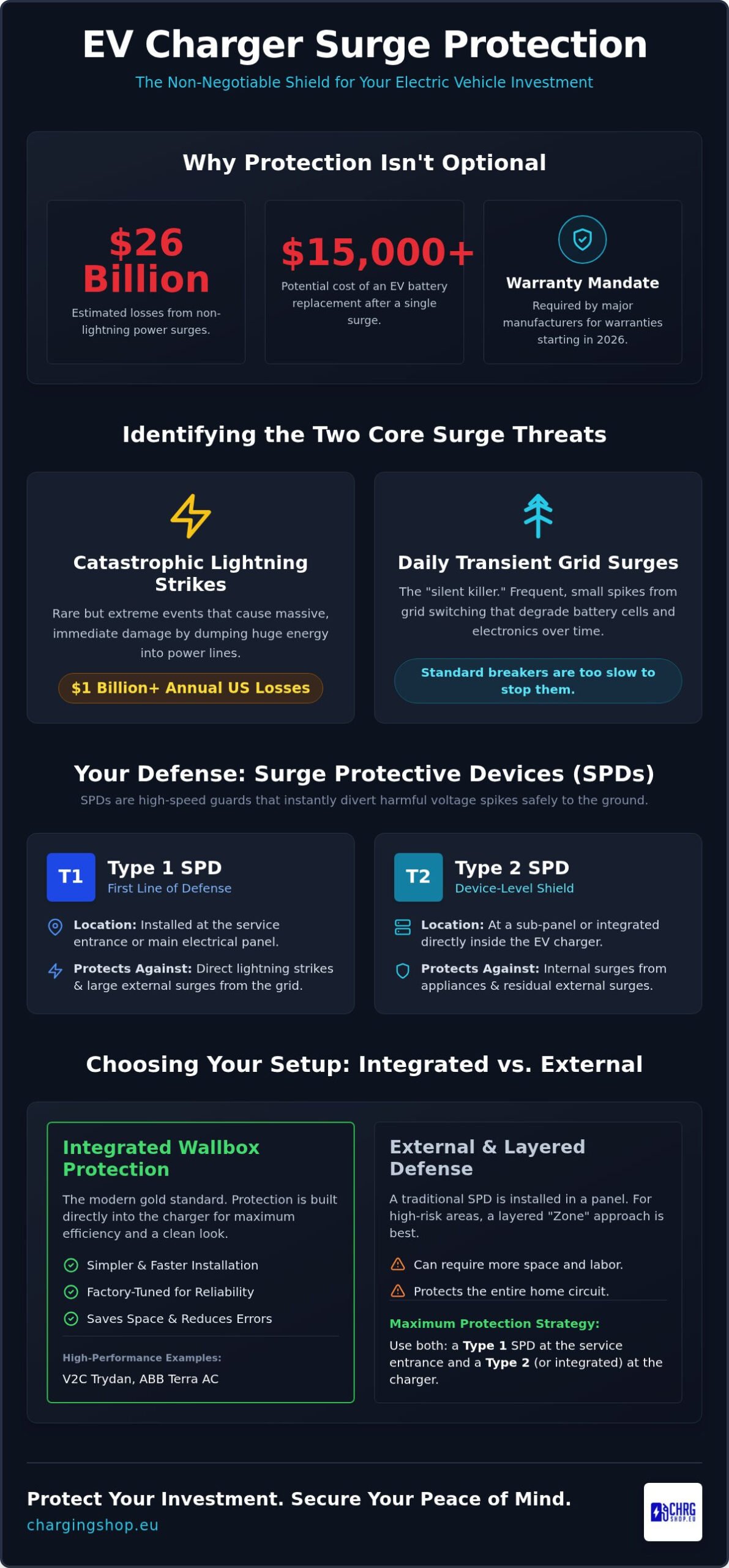
Did you know that non-lightning power surges have caused an estimated $26 billion in losses? You’ve invested thousands into your electric vehicle; don’t let a single grid spike turn that investment into a paperweight. It’s natural to feel uneasy about lightning strikes or confused by technical terms like SPD Type 1 and Type 2. Many owners are rightfully uncertain if their home insurance even covers EV-related surges. In 2026, several major manufacturers have even made ev charger surge protection a mandatory condition of their warranty.
This guide proves why surge protection is the non-negotiable insurance policy for your vehicle. We’ll simplify the complex hardware choices and clarify the latest NEC safety requirements. You’ll get a clear breakdown of SPD types and a shortlist of high-performance wallboxes, including the V2C Trydan and ABB Terra AC, that offer the best integrated defense. It’s time to strip away the technical fluff and secure your home with professional-grade reliability. Get the facts you need to protect your car and your peace of mind today.
Key Takeaways
- Protect your car battery by understanding why ev charger surge protection is now a mandatory warranty requirement for major manufacturers in 2026.
- Differentiate between Type 1 and Type 2 SPDs to shield your property from both direct lightning strikes and common grid switching surges.
- Simplify your installation process by choosing high-performance wallboxes like the V2C Trydan or ABB Terra AC with built-in industrial-grade defense.
- Ensure your hardware meets the latest NEC 2026 safety regulations to avoid insurance complications and costly battery replacements.
- Use the CHRG Network to monitor your charger health remotely and maintain peak performance during periods of grid instability.
Understanding Surge Risks: Why Your EV Charger Needs Protection
Think of a Surge protector as a high-speed security guard for your electrical system. It acts as a hardware barrier that monitors incoming voltage; when it detects a spike, it instantly diverts the excess energy to the ground. Without dedicated ev charger surge protection, your wallbox is just a conduit for electrical instability. High-voltage transients don’t just stop at your garage wall. They hunt for the path of least resistance, which often leads straight through your charging cable and into your vehicle’s expensive powertrain.
The path of a surge is direct and unforgiving. It enters from the utility grid, passes through your home’s main panel, and hits the charger. From there, it reaches the EV’s DC bus, where it can wreak havoc on the vehicle’s electronic control units. The cost of failure is staggering. An unprotected surge can easily void your vehicle warranty, leaving you responsible for a battery replacement bill that could exceed $15,000. Protecting this investment is a matter of simple logic and professional-grade hardware.
The Difference Between Lightning and Grid Surges
Lightning strikes are the “headline” threats. They are rare but catastrophic events that dump massive amounts of energy into the local power lines. While the US sees up to $1 billion in annual losses from lightning, it’s the transient surges you should worry about daily. These smaller, frequent spikes happen when the utility company switches grid loads or when heavy machinery cycles on nearby. Your standard home circuit breakers are designed to stop sustained overcurrent to prevent fires. They aren’t fast enough to catch a microsecond voltage spike. You need an SPD that reacts in nanoseconds to keep your hardware safe.
How Surges Impact Your EV Battery
Your car’s On-Board Charger (OBC) is the most vulnerable point in the system. It contains sensitive semiconductors that manage the AC-to-DC conversion process. Even if a surge doesn’t cause immediate “smoke and fire” failure, repeated minor spikes cause long-term cell degradation. This silent damage reduces your total driving range and shortens the lifespan of the battery pack. Safe home charging requires more than a standard plug; it demands a proactive defense. By installing ev charger surge protection, you ensure that your car’s OBC only ever sees clean, stable power, preserving your range for the years to home.
Built-in vs. External Surge Protection: Which Is Better?
Choosing the right location for your safety hardware is the first step in 2026. Traditional setups often rely on external Surge Protective Devices (SPDs) installed inside your home’s main electrical panel. These components protect the entire circuit but require extra space and labor. Modern ev charger surge protection has evolved. Premium wallboxes now feature integrated defense systems. This all-in-one approach is the gold standard for efficiency and reliability. It saves physical space on your wall and ensures the protection is perfectly tuned to the charger’s specific internal circuitry.
Consider the cost-benefit ratio. Buying a separate SPD, an additional enclosure, and paying for the extra wiring time often exceeds the price of a high-end integrated unit. For compact driveways or modern homes with limited fuse box space, an integrated solution is the only logical choice. It keeps your installation clean and avoids the cluttered look of multiple external boxes. If you want a streamlined setup, explore our premium wallbox range to find the perfect fit for your home.
The Case for Integrated Wallbox Protection
Integrated protection simplifies everything. Your electrician doesn’t need to wire up multiple separate components; they just mount the unit and connect the supply. This reduces the margin for human error. Hardware like the V2C Trydan or the ABB Terra AC comes with factory-tested reliability. The manufacturers have already calibrated the Type 1 & Type 2 SPDs to trigger at the exact threshold required to save the charger’s sensitive logic boards. It’s a plug-and-play safety suite that looks as good as it performs.
When to Use Both External and Internal Defense
Sometimes, one layer isn’t enough. We recommend a “Zone” approach for high-risk environments. If you live in a rural area with overhead power lines or a region prone to frequent lightning, use a layered defense. This involves a Type 1 SPD at your service entrance and a Type 2 ev charger surge protection system at the wallbox. Commercial sites with large fleets should also adopt this central-plus-local strategy. It ensures that if a massive surge bypasses the main panel, the individual charger still has a final line of defense to keep the vehicle safe. This tiered strategy is the ultimate insurance policy for your 2026 EV investment.
Surge Protective Device (SPD) Types: Type 1 vs. Type 2 Explained
Understanding the hierarchy of protection is critical for any 2026 installation. Surge Protective Devices (SPDs) are classified into three main types based on where they sit in your electrical system and the level of energy they can handle. For most residential and commercial setups, ev charger surge protection relies on a specific combination of these technologies to meet modern EV charging safety protocols. Don’t settle for generic components; you need hardware designed for the specific demands of high-voltage vehicle charging.
Type 1: The First Line of Defense
Type 1 SPDs are the heavy hitters of the electrical world. You install these at the service entrance, usually between the secondary of the utility transformer and the line side of your main service equipment. They are built to withstand the massive, high-energy discharge of a direct lightning strike. If your building has an external lightning protection system, like a lightning rod, a Type 1 SPD is mandatory. This is essential for industrial-grade EV charging hubs where total infrastructure failure isn’t an option. It diverts the bulk of the energy away from your entire building before it even reaches your internal circuits.
Type 2: The EV Charging Standard
This is the most common form of ev charger surge protection used in homes today. Type 2 SPDs protect against indirect lightning effects and the frequent “switching surges” caused by the utility grid. These devices work by “clamping” the voltage. They monitor the electrical sine wave and instantly divert any excess voltage to the ground before it can reach the charger’s sensitive logic board. Premium wallboxes prioritize this type of defense because it handles the 80% of surges that originate from within the grid itself.
Maintenance is vital for continued safety. Most Type 2 units use Metal Oxide Varistors (MOVs) that degrade every time they absorb a spike. You must check your hardware regularly for the following:
- Status Indicators: Look for green lights or windows on the SPD module.
- Spent Modules: If the indicator has turned red, the SPD is “spent” and no longer offers protection.
- Replacement: Replace spent modules immediately to maintain your warranty and safety standards.
Type 3: Point-of-Use Protection
Type 3 SPDs are the final, most sensitive layer of defense. These are typically point-of-use devices, similar to the high-end power strips used for home theaters. While they offer excellent filtering for sensitive electronics, they lack the capacity to protect a high-draw EV circuit on their own. Most premium home chargers, such as the ABB Terra AC or V2C Trydan, bypass the need for separate Type 3 units by integrating robust Type 2 protection directly into the wallbox hardware. This creates a streamlined, professional-grade defense system for your vehicle.
Choosing Hardware: Top Wallboxes with Integrated Surge Protection
Selecting the right hardware is where your research pays off. Many entry-level models ignore advanced protection, forcing you to buy and install external components separately. Focus on premium wallboxes that offer ev charger surge protection as a core design feature. This ensures your vehicle and home remain safe without the need for additional clutter in your electrical panel. By choosing hardware with built-in defense, you simplify your installation and guarantee that the protection is factory-calibrated for the charger’s specific electronics.
ABB Terra AC: The Safety Benchmark
The ABB Terra AC 22kW charger stands as the industrial gold standard for a reason. It features built-in ground fault and surge protection as standard equipment. ABB subjects its hardware to extensive testing against global electrical safety standards to ensure it survives the harshest conditions. It’s the primary choice for high-reliability commercial environments where equipment failure is not an option. You get a safety suite that is built to industrial standards but packaged for easy home use.
V2C Trydan: Smart Safety for the Modern Home
The V2C Trydan 22kW redefines home safety through smart integration. It provides advanced ev charger surge protection without the need for bulky external enclosures that ruin your home’s aesthetics. Use the V2C app to monitor your electrical health in real-time and get alerts if the grid becomes unstable. This wallbox is particularly effective at managing voltage fluctuations during peak solar production. It’s a proactive, tech-savvy partner for your smart home ecosystem.
Alfen Single Pro Line: Professional Grade Protection
For those seeking uncompromising quality, the Alfen Single Pro Line 22kW is the definitive answer. It uses ruggedized, professional-grade components designed for 24/7 operation. Its internal safety protocols exceed standard residential requirements, offering a deeper layer of defense for your car’s battery. This makes it ideal for multi-vehicle homes following the 22kW Home Wallbox standard. You’re investing in hardware that handles heavy loads and grid spikes with absolute ease.
Don’t leave your vehicle’s health to chance. Browse our safety-first wallbox collection today and find the perfect match for your home.
Future-Proofing Your Setup with Charging Shop Solutions
Grid stability is evolving rapidly. In 2026, the massive influx of decentralized power sources and high-demand EV charging cycles creates a more volatile electrical environment. This shift makes ev charger surge protection an essential requirement rather than an optional upgrade. Grid transients are now a daily reality. Protecting your vehicle means staying ahead of these shifts with hardware that can react in milliseconds to divert harmful energy. Don’t wait for a grid failure to realize you’re under-protected. Secure your infrastructure today.
Remote Monitoring and Maintenance
Software is your first line of intelligence. Access the CHRG Network to manage your charging station health from anywhere. This platform detects subtle electrical anomalies that standard physical inspections often miss. It allows for real-time firmware updates that constantly refine your charger’s safety protocols as grid conditions change. Proactive management ensures your infrastructure stays resilient against the unpredictable nature of modern power distribution. It’s about data-driven safety and professional-grade reliability.
Get Your Personalized Charging Offer
Stop guessing your safety requirements. Every home and commercial site has a unique electrical profile. You need a tailored hardware recommendation that fits your specific environment, local regulations, and budget. We help you select the right Type 2 integrated charger from our premium lineup, ensuring it matches your vehicle’s specific needs. Get rid of the confusion and start charging with absolute confidence. Request your Personalized Charging Offer today!
The final step in your journey is clear. Take the technical data sheets for your chosen V2C, Alfen, or ABB hardware to your qualified electrician. Ensure they understand the integrated SPD specs to confirm your home’s main panel is fully compatible. Remember, ev charger surge protection is a small, one-time investment that prevents a $15,000 battery disaster. It’s the only way to guarantee total peace of mind for your high-value investment. Secure your home, your car, and your financial future with a professional-grade setup that’s built for 2026 and beyond.
Secure Your Charging Future Today
Protecting your electric vehicle isn’t just about finding a plug; it’s about building a resilient infrastructure that survives the grid’s unpredictability. You’ve learned that ev charger surge protection is the only way to shield your battery from massive grid losses and catastrophic lightning strikes. By choosing hardware with integrated Type 2 defense, you eliminate the need for bulky external boxes and simplify your entire installation process. Whether you need the industrial reliability of ABB, the smart features of V2C, or the professional grade of Alfen, the right choice is now clear.
Charging Shop is your authorized partner for the world’s most trusted wallboxes. We offer expert technical support to help you navigate hardware selection and provide global shipping to ensure your home is ready for 2026. Don’t leave your car’s range to chance. Shop Premium EV Chargers with Integrated Surge Protection and lock in total peace of mind. Your high-performance vehicle deserves a high-performance defense. Take the final step toward a safer, smarter home charging experience today.
Frequently Asked Questions
Do all EV chargers come with built-in surge protection?
No. Many entry-level wallboxes omit this feature to keep retail prices low, leaving your car vulnerable to grid spikes. Premium hardware sold by Charging Shop, such as the V2C Trydan and ABB Terra AC, includes integrated ev charger surge protection as a core design feature. Always verify the technical specifications before purchasing. Integrated defense simplifies your installation and ensures the safety components are factory-calibrated for your specific charger.
Is an external surge protector required by law for EV charger installation?
Regulatory requirements vary, but modern standards like the 2023 NEC Article 230.67 mandate surge protection for all dwelling unit services. By 2026, states like Massachusetts have already adopted even stricter standards for new installations and major electrical upgrades. Even if your area hasn’t adopted the latest code, most major manufacturers now require ev charger surge protection to maintain your hardware warranty. It is a professional necessity for any high-voltage setup.
Will a surge protector save my EV battery if lightning hits my house?
A Type 1 SPD is your primary defense against the massive energy of a direct lightning strike. While no device can offer a 100% guarantee against a direct hit, a professional-grade surge protector diverts the majority of the energy to the ground. This significantly reduces the chance of high voltage reaching your car’s battery. Most damage actually comes from secondary grid transients, which integrated Type 2 protectors handle with ease.
How do I know if my EV charger’s surge protection has been triggered?
Check the status indicators on your hardware. Most integrated SPD modules feature a small window that stays green during normal operation and turns red when the device is “spent.” Smart wallboxes like the V2C Trydan also report electrical health through their mobile apps. If your charger fails to start after a storm, the internal protection has likely triggered to save your car. You must replace the spent module to restore your safety shield.
Does surge protection affect the charging speed of my 22kW wallbox?
Surge protection has no impact on your charging speed. These safety devices operate in parallel with your electrical circuit, meaning they don’t restrict the flow of current during normal use. They only activate the moment voltage exceeds a safe limit to protect your electronics. You can enjoy the full power of an Alfen or ABB 22kW wallbox while maintaining a constant, invisible defense against unpredictable grid instability.
Can I add surge protection to an older EV charger?
Yes. You can upgrade any older setup by having an electrician install an external Type 2 SPD in your main service panel or a dedicated sub-panel. This provides the same critical defense as modern integrated units. While adding external components takes up more space in your fuse box, it is a vital investment for older hardware that lacks built-in safety logic. It effectively future-proofs your existing equipment against 2026 grid volatility.
Is Type 1 or Type 2 surge protection better for home EV charging?
They work together as a layered defense. A Type 1 SPD is better for stopping massive external surges at your home’s entry point. However, Type 2 is the standard for ev charger surge protection because it manages the smaller, frequent voltage spikes that happen within the grid. For the highest level of safety, use a Type 1 at your main panel and a wallbox with integrated Type 2 protection, like the V2C Trydan.
How much does it cost to add surge protection to an EV charger setup?
Costs depend on whether you opt for integrated hardware or external components. Purchasing a standalone Type 2 SPD and the required enclosure for your panel adds both material costs and extra labor hours to your installation. Many owners find that investing in a premium wallbox like the ABB Terra AC is more economical. These units bundle the safety technology into the hardware, simplifying the setup and providing professional-grade defense without extra parts.
