
 Deutsch
 Dansk
Dansk Suomi
Suomi Latviešu
 Lietuvių
 Norsk bokmål
 polski
 Русский
 Svenska
No products in the cart.
Uncategorized
Home EV Charger Electrical Requirements: The 2026 Technical Guide
15
Sep
Sep
Your electrical panel isn’t just a metal box in the garage; it’s the high-stakes bottleneck of your entire EV lifestyle. Most homeowners prioritize the sleek aesthetics of a V2C Trydan or an Alfen Single Pro Line, but they often ignore the grid foundation that actually drives performance. It’s a valid concern. You want 22kW speeds, but the fear of improper wiring or the shock of unexpected panel upgrade costs can stall your progress. We understand the need for speed and safety in a rapidly shifting market.
This guide masters the home ev charger electrical requirements you need to deploy high-performance wallboxes with total confidence. We’ll cut through the confusion surrounding 1-phase versus 3-phase power and the latest 2026 NEC safety mandates, such as the 5-milliamp GFCI trip threshold. You’ll walk away with a precise checklist for your electrician, a clear path to choosing between 7kW and 22kW units, and an honest look at bidirectional charging possibilities. Secure your home’s electrical future and start charging at peak efficiency today.
Key Takeaways
- Learn why 240V is the mandatory standard for Level 2 charging and how amperage dictates your real-world charging speed.
- Master the 2026 safety standards and home ev charger electrical requirements to ensure your dedicated circuit meets the new 5-milliamp GFCI trip threshold.
- Discover the specific hardware needed for bidirectional charging, including the role of Automatic Transfer Switches for Vehicle-to-Home power.
- Understand how Dynamic Load Management (DLM) protects your grid from overloads without requiring expensive main panel upgrades.
- Match your home’s electrical profile to the right hardware, from the ABB Terra AC for limited panels to the Alfen Single Pro Line for 3-phase setups.
Understanding the Fundamentals: Amps, Volts, and Phases
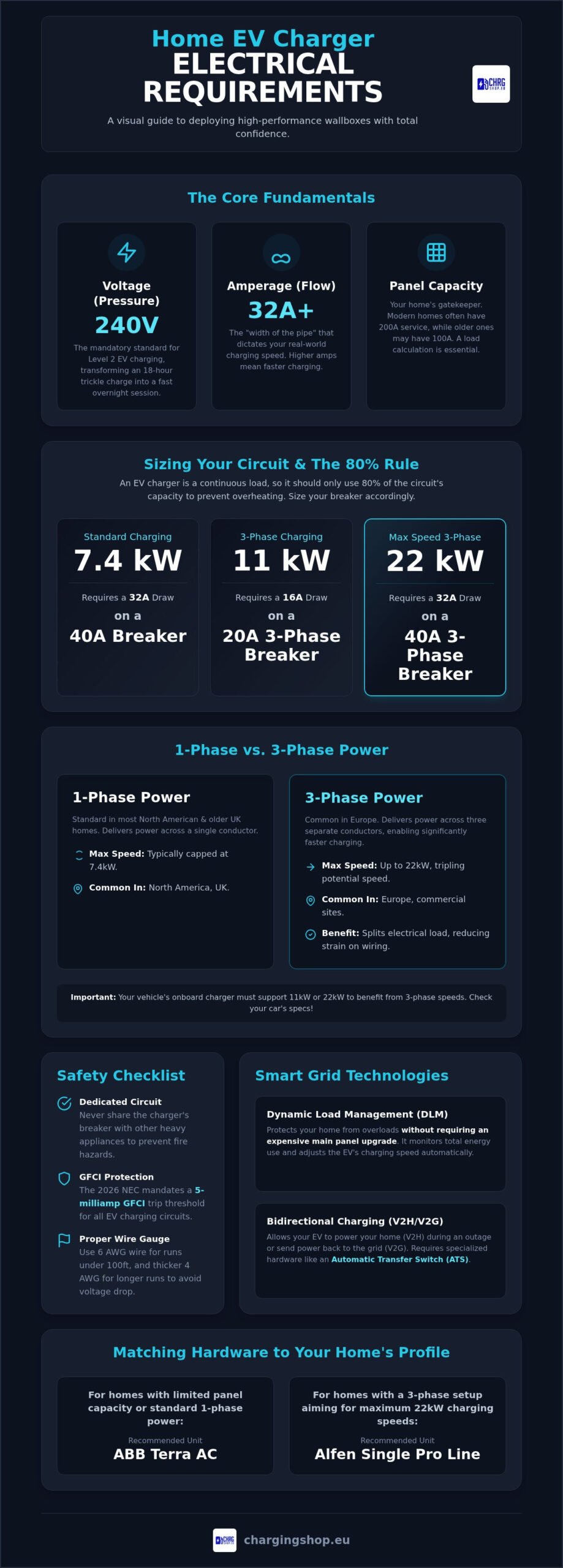
Think of your home’s electrical system as a plumbing network. Amperage is the width of the pipe, while voltage is the pressure pushing the current through. To satisfy modern home ev charger electrical requirements, you can’t rely on a standard wall socket. You need a dedicated electric vehicle supply equipment (EVSE) setup. Level 2 charging is the industry baseline, requiring a 230V or 240V connection. This jump in voltage is what transforms an 18-hour “trickle” charge into a manageable overnight session.
Your main service panel is the ultimate gatekeeper. While many modern homes boast 200A service, older properties often operate on a 100A limit. If you’re running a heat pump, an electric oven, and a clothes dryer simultaneously, your panel is likely near its ceiling. Adding a high-performance wallbox without a load calculation is risky. You must determine your spare capacity before selecting hardware. It’s the difference between a seamless install and a dark house when the car starts drawing power.
Amperage and Circuit Breaker Sizing
Electrical codes mandate the 80% rule for continuous loads. This means an EV charger, which draws heavy current for hours, should only utilize 80% of the circuit breaker’s rated capacity. If you want a 32A charge (standard for 7.4kW), you must install a 40A breaker. For high-speed 48A charging, a 60A breaker is mandatory. Don’t cut corners here; undersized breakers lead to heat buildup and nuisance tripping.
- 7kW Charging: Requires a 32A draw on a 40A breaker.
- 11kW Charging: Requires a 16A draw across a 3-phase setup.
- 22kW Charging: Requires a 32A draw across a 3-phase setup.
The 3-Phase Power Advantage
The real divide in charging speed comes down to phases. Most North American and many older UK residential grids use 1-phase power, typically capping AC charging at 7.4kW. European grids frequently offer 3-phase power, which delivers energy across three separate conductors. This allows hardware like the ABB Terra AC 22kW to charge at triple the speed of a standard 1-phase unit. It splits the electrical load, reducing the strain on any single wire while maximizing throughput.
Before you buy, whether exploring options on a global marketplace like AutoDream or through a local dealer, check your vehicle’s onboard charger. Many EVs are limited to 7kW or 11kW AC intake. If your car can’t handle 22kW, installing a 3-phase 22kW station won’t speed up your charge, though it does future-proof your garage for your next upgrade. Wiring for 3-phase requires a five-core cable and a compatible 3-phase meter from your utility provider. It’s a more complex home ev charger electrical requirements profile, but for high-mileage drivers, the speed is non-negotiable.
Circuit Requirements and Safety Standards
Safety is your first priority. Your home ev charger electrical requirements start with a dedicated circuit. Never share a breaker with heavy appliances like a dryer or oven. This is a significant fire hazard. EV charging is a continuous load, meaning it pulls maximum current for hours at a time. To prevent overheating, circuits must be sized for 125% of the charger’s rated output. For a 32A charger, this means a 40A breaker is the bare minimum. The 2026 NEC also requires that all hardwired chargers be installed by a qualified person, usually a licensed electrician. This ensures that grounding and weatherproofing meet local building codes.
Wire gauge directly impacts performance and efficiency. If your charger is far from the panel, you face voltage drop. For a standard 32A charger, 6mm² or 6 AWG is the industry baseline. If the run exceeds 100 feet, you must step up to 10mm² or 4 AWG to maintain voltage integrity. Use rigid conduit for all outdoor installs to prevent physical damage from gardening tools or pests. Ensure all connections are weatherproofed to IP54 or higher. Proper grounding and bonding are essential to protect against chassis faults and stray currents.
GFCI and RCD Protection
Modern hardware like the Alfen Single Pro Line 22kW includes advanced safety features that simplify installation. The 2026 National Electrical Code (NEC) now mandates a 5-milliamp GFCI trip threshold for all EV charging circuits. High-end chargers often feature built-in Type B RCD protection. This technology detects DC leakage, which standard household breakers might miss. By choosing a unit with integrated protection, you save on the cost of expensive external breakers. Check your Home’s Electrical Capacity to see if your current panel can support these professional-grade safety upgrades.
Wire Sizing for Efficiency
Stick to copper conductors. Copper has superior conductivity and durability compared to aluminum. Aluminum expands and contracts significantly with heat, which can lead to loose connections and arcing over time. Increasing the cross-sectional area of a wire reduces electrical resistance, which directly lowers heat generation during long charging sessions. This is critical for wires running inside wall cavities where ventilation is limited. High-heat environments degrade insulation faster, so oversized wiring is a smart investment in longevity. If you’re ready to upgrade, browse our certified hardware selection for a safer, more efficient home setup.
Bidirectional Charging: V2H and V2G Electrical Needs
Your electric vehicle is no longer just a mode of transport. It’s a massive mobile battery. Bidirectional charging unlocks this potential, allowing you to power your house during a blackout or sell energy back to the grid. However, these advanced home ev charger electrical requirements go far beyond a standard plug-and-play setup. You need hardware that supports the ISO 15118-20 protocol. This ensures seamless communication between the car and your home’s infrastructure. While most chargers only pull power, bidirectional units manage a complex two-way flow of electricity. As of late 2026, there are now 16 V2H-capable EV models in the US, making this technology a practical reality for many homeowners.
The choice between AC and DC bidirectional charging is critical. AC bidirectional systems rely on the car’s internal inverter, which is often a performance bottleneck. The V2C DENKA 20kW DC Wallbox changes the game. It handles the power conversion inside the wallbox itself. This allows for higher discharge rates and broader vehicle compatibility. It’s an industrial-grade solution designed for residential reliability. By bypassing the car’s onboard limits, you get faster, more efficient energy transfer when your home needs it most.
Grid Isolation and Safety
Safety is paramount when your house starts feeding the grid. You must install an Automatic Transfer Switch (ATS) or an islanding device. This prevents “backfeeding,” where your car accidentally sends power into the utility lines during a grid outage. Backfeeding is lethal for utility workers trying to repair lines. These components ensure your home becomes a self-sustaining island when the main grid fails. According to the U.S. Department of Energy guidelines on home charging installation, your electrical panel must be robust enough to handle these simultaneous loads. This often requires a dedicated sub-panel for critical circuits like your fridge and lighting.
The Role of Smart Software
Hardware is only half the battle. You need a digital brain to manage the energy flow. Use CHRG Network Access to monitor your electrical load in real-time. This software lets you set state-of-charge (SoC) limits. You don’t want to wake up to a powered home but a dead car. The V2C Trydan acts as the perfect hub for this integration. It balances solar input, home demand, and vehicle storage. It turns your garage into a high-performance energy node. Master these technical specifications now to avoid costly retrofits later. Secure your energy independence with the right digital tools.
Dynamic Load Management: Protecting Your Home Grid
Dynamic Load Management (DLM) is the smartest way to bypass restrictive home ev charger electrical requirements without expensive panel upgrades. Think of it as a digital traffic controller for your electricity. It monitors your home’s total power draw in real-time. When you turn on the oven or a heat pump, the charger automatically scales back its intake. This prevents your main breaker from tripping during peak usage. It ensures the car gets the maximum available power without ever compromising your household comfort.
Hardware selection is key for a successful setup. Most systems use current transformer (CT) clamps that wrap around your main incoming power lines. These clamps send a signal to the wallbox, telling it exactly how many amps are available. More advanced setups integrate directly with smart meters via Modbus protocols for even higher precision. This constant handshake between your appliances and your charger is what makes high-speed residential charging safe for older grids. You don’t need to change your lifestyle; you just need your hardware to be smarter.
Installing Load Management Hardware
Reliability matters most when wiring these systems. While wireless options are hitting the market, we recommend a hardwired data cable, like a Cat5 or Cat6, between your meter and the wallbox. This eliminates signal interference and connection drops. When you configure the V2C Trydan 22kW, you can set specific priority levels for your charging sessions. Wired solutions provide the low-latency response needed to protect sensitive electrical components. It’s a small technical investment that offers massive peace of mind.
Solar Integration Requirements
If you have solar panels, DLM becomes even more powerful. It allows your charger to communicate with your PV inverter to soak up every drop of surplus energy. Instead of sending excess power back to the grid for a pittance, your car consumes it directly. This requires a compatible handshake between the inverter and the EVSE to maintain balance. Dynamic Load Balancing automatically throttles the charging current to ensure the total household draw never exceeds the main fuse’s rated capacity. Ready to optimize your grid? Browse our load-management compatible wallboxes and take control of your energy.
Hardware Selection Based on Your Electrical Profile
Your hardware choice must align with your home’s reality. Don’t fall for the trap of buying a unit your grid can’t support. Matching your purchase to specific home ev charger electrical requirements ensures you don’t waste money on speeds you’ll never reach or safety features you’ve already installed. Your panel is the boss of this operation. Listen to it before you click “buy.”
If you’re working with a low-capacity panel, such as a 60A or 100A service, the ABB Terra AC 22kW is your best move. It’s built for resilience. Its native load balancing allows it to operate safely even when your home’s electrical headroom is tight. For homes lucky enough to have high-performance 3-phase setups, the Alfen Single Pro Line 22kW is the undisputed heavy hitter. It delivers industrial-grade reliability directly to your driveway, maxing out your charging potential with professional-grade components.
Think long-term. Investing in a 22kW wallbox today prevents expensive electrical retrofits tomorrow. Even if your current EV only accepts 7kW, your next vehicle will likely demand more. If you want the absolute cutting edge of home energy, the V2C Denka 20kW DC Wallbox represents the ultimate electrical investment. It bypasses the car’s internal limits and prepares your home for the bidirectional future we discussed earlier.
The Premium Comparison: Alfen vs. V2C
Alfen excels in professional-grade environments. It features high-end internal protection that reduces the need for complex external breakers. The Alfen Single Pro Line is built for those who value industrial durability in a residential setting. On the other hand, the V2C Trydan 22kW wins on smart home integration. It’s the better choice if you want your charger to talk to your solar array or home automation system. Choose Alfen for rugged, set-and-forget durability. Choose V2C for a tech-forward, integrated ecosystem that fits your existing amperage profile.
Final Pre-Purchase Checklist
For drivers of premium Chinese EVs in the UAE, matching this infrastructure with proper vehicle care is vital; TheChiDrive offers specialized accessories and interior protection to complement your high-performance setup.
Before you commit, run through this final technical scan. It saves time, money, and frustration during the installation phase. Don’t guess; verify these facts with your electrician first.
- Verify Spare Capacity: Confirm your main fuse can handle the additional 32A or 16A (3-phase) draw.
- Tethered vs. Socketed: Decide if you want a permanent cable or the flexibility of a socket.
- Cable Management: Plan your mounting height to avoid trip hazards and cable strain.
- Future-Proofing: Ensure your wiring (AWG/mm²) can handle 22kW even if you install a 7kW unit today.
Ready to get specific? Take the next step by requesting a Personalised Charging Offer from Charging Shop. We’ll help you map these home ev charger electrical requirements to the perfect hardware for your specific grid. Secure your high-performance setup today.
Secure Your High-Performance Charging Future
Mastering your home ev charger electrical requirements is the only way to guarantee a safe, rapid charging experience. You now understand that panel capacity dictates your hardware choice, whether you need the load-balancing intelligence of an ABB Terra AC or the 3-phase power of an Alfen Single Pro Line. By adhering to 2026 NEC safety standards and planning for bidirectional growth, you’re transforming your garage into a sophisticated energy hub.
Don’t let technical complexity stall your transition. We provide global shipping on elite V2C, Alfen, and ABB hardware to get you moving faster. With CHRG Network access for precision load monitoring and personalized charging offers tailored to your specific home setup, we ensure your infrastructure is built to last. Upgrade your home grid with premium EV hardware from Charging Shop and take full control of your energy today. Your high-performance lifestyle starts with a rock-solid electrical foundation.
Frequently Asked Questions
Do I need to upgrade my electrical panel for an EV charger?
Not necessarily, but it depends on your existing spare capacity. If your home has a 100A service and runs high-load appliances like heat pumps, you might be at your limit. However, hardware like the V2C Trydan uses dynamic load management to avoid upgrades by throttling the charger during peak usage. Always have a professional perform a load calculation to see if your current panel can handle the extra 32A to 48A draw safely.
What is the difference between a 40-amp and 50-amp circuit for EV charging?
The main difference lies in the maximum continuous charging speed allowed by the 80% rule. A 40-amp circuit safely delivers 32 amps of power, while a 50-amp circuit provides 40 amps. Choosing a 50-amp setup allows for faster charging, adding roughly 30 miles of range per hour compared to 25 miles on a 40-amp circuit. Ensure your wire gauge matches the higher amperage to prevent overheating and comply with safety standards.
Can I install a 22kW charger on a single-phase home connection?
No, a 22kW charger requires a 3-phase electrical connection to reach its full potential. On a standard single-phase home connection, even a 22kW unit like the Alfen Single Pro Line will be limited to 7.4kW. To achieve 22kW speeds, your home must have three live wires delivering power. Most residential properties require a utility upgrade to 3-phase service before they can support these ultra-fast home ev charger electrical requirements.
What wire gauge is required for a 48-amp EV charger?
For a charger drawing 48 amps, you must use at least 6 AWG copper wire. This draw requires a 60-amp circuit breaker to satisfy the 125% safety margin required for continuous loads. If the distance between your panel and the wallbox exceeds 100 feet, you should step up to 4 AWG wire to account for voltage drop. Using the correct thickness is vital for efficiency and preventing dangerous heat buildup in your walls.
Is a neutral wire required for all home EV charging stations?
Not for every model, but it is becoming a common requirement for modern smart chargers. Most Level 2 stations operate on two hot wires and a ground wire. However, some advanced wallboxes require a neutral wire to power internal electronics, touchscreens, or specific communication modules. Always check the technical manual for your specific hardware, like the Abb terra ac, to ensure your electrician pulls the correct number of conductors during installation.
How much does it cost to add a dedicated 240V circuit for an EV?
Costs vary significantly based on the distance from your panel and local labor rates. A short run in a garage is typically straightforward, while long distances or trenching for outdoor pedestals increase the investment. Factors like panel capacity and the need for new sub-panels also influence the total. Instead of guessing, we recommend requesting a Personalised Charging Offer to get hardware that fits your specific infrastructure and minimizes unnecessary electrical work.
What is the “80% rule” in EV charging electrical requirements?
The 80% rule is a safety standard stating that a circuit should only handle 80% of its maximum rated capacity for continuous loads. Since EV charging lasts for several hours, it qualifies as a continuous load. This means a 40-amp breaker is required for a 32-amp charger. Following these home ev charger electrical requirements prevents the breaker from overheating and tripping prematurely during long overnight charging sessions in your driveway.
Can I use an existing NEMA 14-50 outlet for a hardwired wallbox?
No, you cannot simply plug a hardwired wallbox into an existing outlet. Hardwiring requires a direct, permanent connection from the circuit breaker to the charger’s internal terminals. Additionally, the 2026 NEC mandates that receptacles used for EV charging must be specifically listed for that purpose. If you are switching from a portable charger to a permanent station like the V2C DENKA, your electrician must remove the outlet and wire the unit directly.
