
 Deutsch
 Dansk
Dansk Suomi
Suomi Latviešu
 Lietuvių
 Norsk bokmål
 polski
 Русский
 Svenska
No products in the cart.
Uncategorized
22kW Home Wallbox: 2026 Guide to Ultra-Fast Charging
18
Aug
Aug
Why wait eight hours for a full charge when your lifestyle demands instant readiness? Many drivers assume a standard charger is enough. As EV batteries grow, your current setup will eventually become a bottleneck. Installing a 22kW wallbox for home isn’t just about raw speed. It’s about building a professional energy hub that handles multiple vehicles without breaking a sweat.
You’re likely concerned about 3-phase power upgrades or the risk of tripping your main house fuse. It’s a common worry. This guide clears the confusion. You’ll learn to master technical hardware requirements and smart load balancing. We’ll explore the top 2026 hardware options like the V2C Trydan and Alfen Single Pro Line to ensure your setup stays ahead of the curve. You’ll discover how to integrate ultra-fast charging with your solar array and smart energy management systems for maximum efficiency. Get ready to transform your garage into a high-performance charging station.
Key Takeaways
- Understand the 3-phase power requirements and why a 3x32A dedicated circuit is essential for peak performance.
- Discover why a 22kW wallbox for home is the superior investment for multi-EV households compared to standard 11kW units.
- Compare leading 2026 hardware like the V2C Trydan and Alfen Single Pro Line to find your perfect technical match.
- Master smart integration techniques to sync your charging with solar surplus and prevent home power overloads.
- Learn how the CHRG Network platform provides professional-grade management for your private charging setup.
What is a 22kW Wallbox and Why Does Your Home Need One?
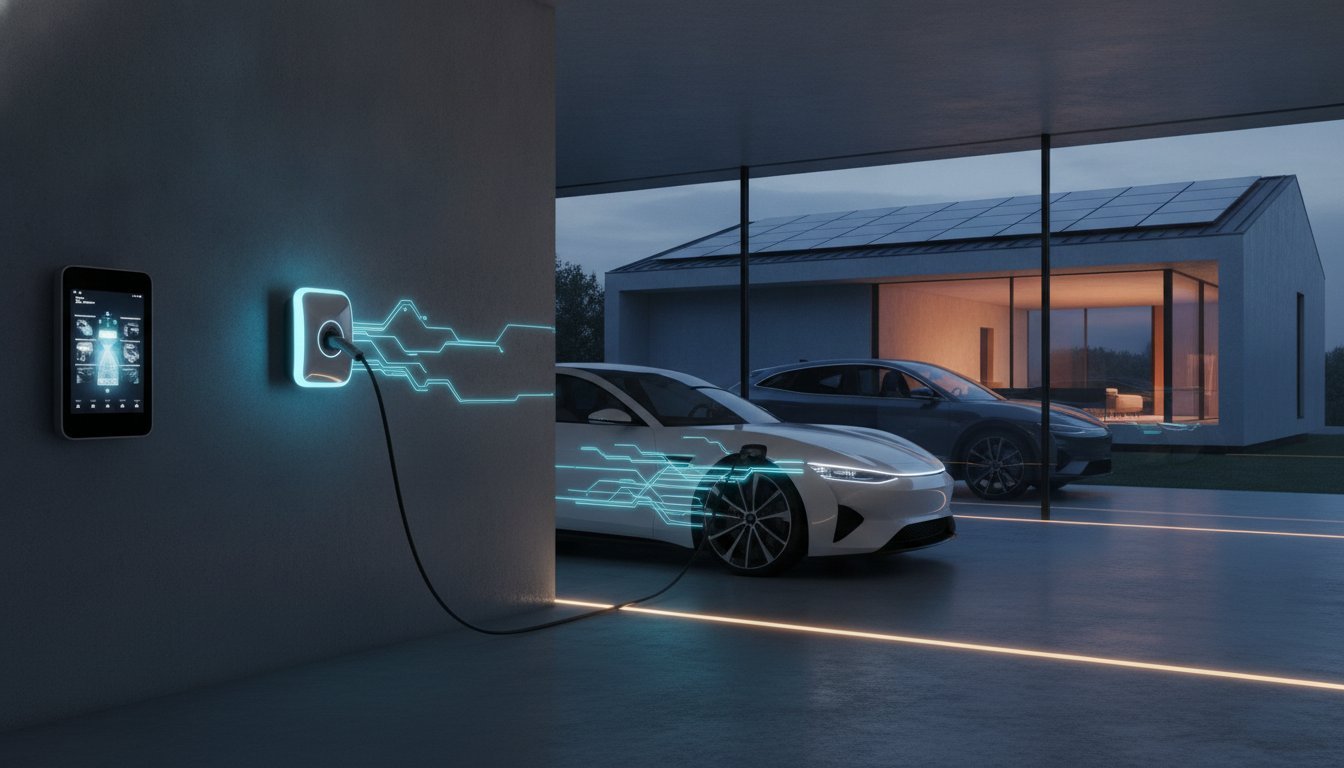
A 22kW wallbox for home is a high-performance Level 2 AC charging station. It delivers 32 Amps across three separate power phases. This isn’t your standard plug-and-play setup. It’s a professional-grade energy solution designed for 2026 standards. While most homes rely on slower single-phase units, the 22kW variant provides the throughput needed to charge a 60kWh battery in under 3 hours. It’s the ultimate tool for drivers who refuse to wait. If your household manages two or more electric vehicles, a single 22kW point becomes the essential anchor for your garage. It allows you to cycle multiple cars through a single charger in one evening without logistical headaches.
The 22kW Advantage: Speed vs. Utility
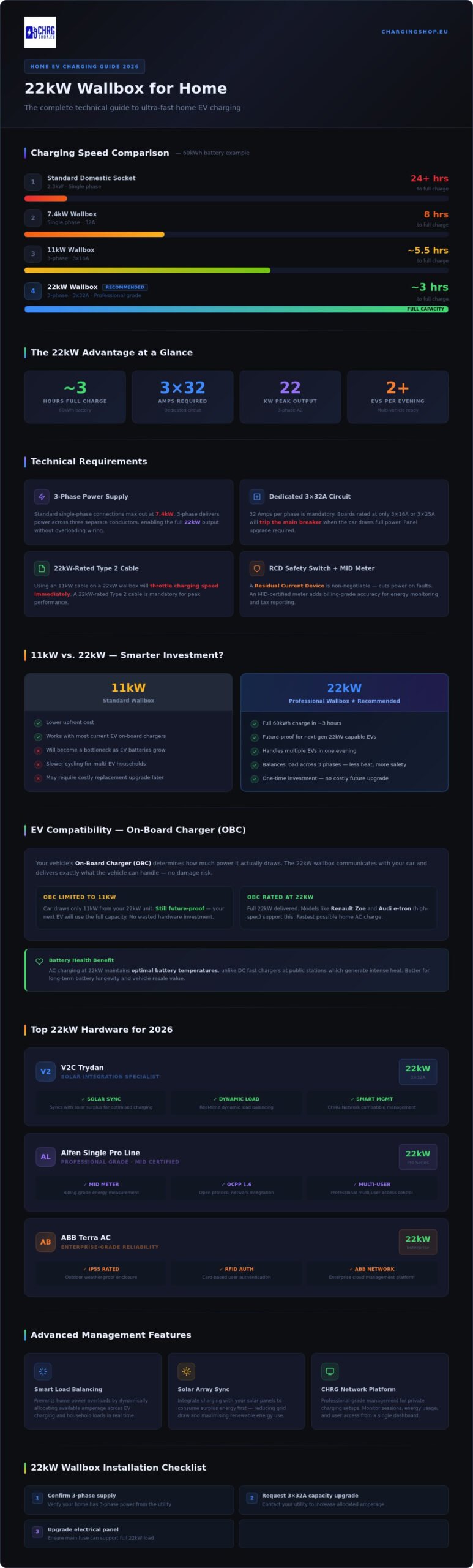
Compare the performance levels to see the real value. A standard domestic socket provides roughly 2.3kW. It takes over 24 hours to fill a modern EV. Stepping up to a 7.4kW single-phase charger brings that down to 8 hours. But a 22kW wallbox for home changes the game entirely. You get full capacity in about 180 minutes. This speed makes “top-up” charging viable. You can add significant range in the time it takes to eat dinner. It’s also better for your car’s long-term health. Frequent DC fast charging at public stations generates intense heat. AC charging at 22kW offers high speed while maintaining optimal battery temperatures, preserving your vehicle’s resale value and battery longevity.
Is Your EV Compatible with 22kW Charging?
Your vehicle’s On-Board Charger (OBC) is the gatekeeper. It converts the AC power from your wallbox into DC power for the battery. If your OBC is rated at 11kW, your car will only draw 11kW from a 22kW unit. Don’t worry about damage. The hardware is smart. It communicates with the car and delivers exactly what the vehicle can handle. Many 2026 models like the Renault Zoe and high-spec Audi e-tron variants come equipped to use the full 22kW capacity. Even if your current car is limited to 11kW, installing a 22kW station is a strategic move. You’re building a future-proof infrastructure. Your next EV will likely have higher intake capabilities, and you’ll already have the hardware to support it. It’s a one-time investment that saves you from costly upgrades later.
Technical Requirements: Preparing Your Home for 3-Phase Power
High speed requires high power. You cannot run a 22kW wallbox for home on a standard single-phase residential line. It’s physically impossible. Single-phase connections hit a ceiling at 7.4kW. To unlock ultra-fast charging, your home needs a 3-phase supply. This setup delivers power through three separate conductors instead of one. It allows for a massive jump in energy delivery without overloading your internal wiring. If you’re serious about 2026 charging speeds, the transition to 3-phase is your first step.
Think in numbers. A 22kW station requires a dedicated 3x32A circuit. This means 32 Amps per phase. If your current electrical board is only rated for 3x16A or 3x25A, you’ll trip the main breaker the moment your car starts drawing full power. You also need the right hardware to carry that current. Specifically, a 22kW-rated Type 2 EV charger cable is mandatory. Using a cheaper 11kW cable will throttle your charging speed immediately. For those who want professional tracking, an MID-certified meter is a vital addition. It provides billing-grade accuracy for energy monitoring and tax reporting.
Upgrading Your Electrical Panel
Start with an audit. Look at your main fuse. Most modern homes have 3-phase capability, but the allocated amperage is often too low for high-performance hardware. You’ll likely need to contact your utility provider to request a capacity increase. This isn’t just a suggestion; it’s a safety requirement. Your panel also needs a dedicated RCD (Residual Current Device). This safety switch prevents electric shocks and fire hazards by cutting power instantly if a fault occurs. It’s a non-negotiable part of a high-power installation.
Single Phase vs. Three Phase: The Real Difference
Understanding the split is crucial. Our Single Phase vs Three Phase EV Charger Guide breaks down the technical specifics in detail. Even if your current car only accepts 7.4kW, a 22kW 3-phase unit is the smarter choice. It balances the load across all three phases, reducing the strain on any single wire. This prevents localized overheating and prepares your garage for the high-capacity batteries coming in 2026. If you’re ready to upgrade, explore our 22kW hardware collection to find your perfect match.
11KW vs. 22kW Wallbox: Which is the Smarter Investment?
Choosing between 11kW and 22kW isn’t just about your current car. It’s about your home’s infrastructure for the next decade. Many buyers fall for the “Overnight Myth.” They assume 11kW is plenty because the vehicle sits for ten hours. This logic fails the moment you add a second EV to the driveway. A 22kW wallbox for home allows you to swap vehicles and still hit full charge by morning. The hardware price gap is surprisingly narrow; the real cost lies in the labor and cabling. If you’re already paying for a 3-phase installation, choosing the lower power limit is a strategic mistake. Upgrading later will cost triple the initial difference.
Quick Comparison: 11kW vs. 22kW
- Charging Speed: 11kW fills a standard battery in 6 to 8 hours. 22kW cuts this to under 3 hours.
- Installation Complexity: Both require 3-phase power. 22kW requires 32A fuses; 11kW needs only 16A.
- Hardware Cost: Minimal difference. Most premium units are 22kW by default and can be software-limited if needed.
- Property Value: A 22kW station is a high-end asset that boosts property appeal for future EV owners.
Think about resale value. By 2026, home seekers will prioritize high-speed charging infrastructure. A house limited to 11kW feels dated. A 22kW setup signals a premium, future-proof property. You aren’t just buying a charger; you’re upgrading your real estate. It’s a one-time investment that pays dividends in convenience and home equity. Don’t let a small fuse limit your home’s potential.
When 11kW is Enough
Low-power setups work in specific niches. If your daily commute is under 50km, you’ll never feel the speed of 22kW. Some older urban grids also have strict limitations where a 3x32A connection is physically impossible without massive infrastructure fees. If you’re on a tight budget and your current wiring is capped at 16A, 11kW is a respectable compromise. It still beats a standard socket by a wide margin.
The Case for 22kW Dominance
Modern EVs are changing. High-capacity batteries exceeding 100kWh are becoming the standard for SUVs and trucks. These “mega-batteries” demand the higher throughput of a 22kW wallbox for home. You also gain the benefit of “opportunity charging.” This allows you to add significant range during a quick lunch break or a short stop at home between errands. Furthermore, many 22kW units support dynamic power sharing. This feature splits the 22kW output between two 11kW vehicles simultaneously. It ensures both cars are ready for the morning commute without manual intervention. For enthusiasts looking to optimize their vehicle’s performance alongside their charging setup, you can find out more about the professional ECU tuning services offered by StageX Performance OÜ.
Top 22kW Hardware for 2026: V2C, Alfen, and ABB
Selecting the right 22kW wallbox for home isn’t just about picking a brand. It’s about matching technical specs to your specific energy ecosystem. By 2026, the market has consolidated around three heavyweights. Each offers a distinct advantage depending on whether you prioritize smart home fluidity, industrial reliability, or professional billing. Don’t settle for generic hardware. Your choice impacts your charging speed, solar efficiency, and long-term grid stability. High-performance hardware is a strategic investment in your home’s infrastructure.
V2C Trydan: The Smart Home Champion
The V2C Trydan 22kW is the undisputed leader for tech-focused households. It stands out by offering built-in dynamic load balancing. You don’t need expensive external kits to protect your house fuse. It’s ready out of the box. This unit excels in solar synchronization. It communicates directly with your inverter to ensure you’re using 100% green energy. You can control your sessions via Alexa or Google Home, making it the most integrated 22kW wallbox for home on the market today. It’s fast, smart, and incredibly intuitive for the modern user.
Alfen and ABB: The Professional Standards
For those who need a workhorse, the Alfen Single Pro Line 22kW is the gold standard. It’s the preferred choice for company car drivers. It features an integrated MID meter for pinpoint billing accuracy, making tax reporting effortless. If you want industrial-grade safety in a sleek, residential package, the ABB Terra AC 22kW charger is your best bet. It’s rugged and built to handle extreme environments. Both units are fully OCPP compliant. This ensures they can connect to any management software, including the CHRG Network, for seamless updates and remote troubleshooting.
Choosing between these powerhouses requires a deep understanding of your home’s electrical capacity and your driving habits. A V2C might be perfect for a solar-equipped villa, while an Alfen is better for a professional who needs to report energy costs to an employer. We don’t believe in one-size-fits-all solutions. You need hardware that scales with your needs. Get a Personalised Charging Offer today to ensure your hardware choice matches your 2026 energy goals perfectly. Our experts help you navigate these technical choices with speed and clarity.
Advanced Management: Load Balancing, Solar, and CHRG Network
Hardware is only half the story. A 22kW wallbox for home pulls a massive amount of current. Without a smart management layer, you risk overloading your electrical system during peak hours. Advanced management tools ensure your charging station works in harmony with your household appliances and the local grid. It’s about moving from a simple plug-and-charge mentality to a sophisticated energy hub that prioritizes safety, sustainability, and cost efficiency. By 2026, these features are no longer optional extras; they’re the foundation of a professional home setup.
Protecting the Grid with Dynamic Power
Dynamic Load Balancing is your first line of defense. It prevents total blackouts by monitoring your home’s real-time energy draw. If you switch on the oven or the air conditioning, the system detects the surge. It instantly throttles the charger to stay within your main fuse’s limits. This proactive management allows you to install a high-power charger without the massive expense of a utility-side grid upgrade. You get the speed of a 22kW wallbox for home while keeping your lights on and your installation costs low. It’s technical precision working for your wallet.
The CHRG Network Advantage
Your hardware needs a brain. Solar surplus charging is the ultimate goal for many owners. It allows you to sync your charging sessions with your solar production, turning your car into a battery for your home’s green energy. To manage this complexity, we provide CHRG Network Access. This isn’t just for commercial operators. It brings professional-grade tools to your private garage. You can start, stop, and monitor sessions from anywhere via the cloud.
Efficiency matters. Learn how to reduce EV charging costs with CHRG Network. The platform integrates with NordPool price tracking. This means your charger waits for the lowest electricity rates before drawing power. You also benefit from automated reporting. If you need to claim tax deductions or get reimbursed by an employer, the software generates the necessary data with a single click. It’s a complete management solution that simplifies the logistics of ultra-fast charging.
Secure Your High-Performance Charging Future
The transition to electric mobility is accelerating. You’ve seen why a 22kW wallbox for home is the only logical choice for a multi-EV household in 2026. By securing a 3-phase connection and choosing hardware with dynamic load balancing, you eliminate the fear of grid overloads while slashing your charging times. Whether you prioritize the smart integration of the V2C Trydan or the industrial reliability of Alfen and ABB, your infrastructure is now ready for the next generation of high-capacity batteries.
Don’t wait for your current setup to become obsolete. We are an authorized V2C and Alfen dealer, offering expert technical support to guide your hardware selection. We provide global shipping on all hardware to ensure you get professional-grade equipment regardless of your location. It’s time to build a reliable energy hub that handles your daily needs with speed and precision. You’ve got the knowledge; now get the power.
Browse our Premium 22kW Wallbox Collection and take control of your home energy today.
Frequently Asked Questions
Do I need a special permit to install a 22kW wallbox at home?
Yes, usually. In many EU markets in 2026, a 22kW installation requires notification and approval from the Distribution Network Operator (DNO). Because it draws 32A per phase, it impacts the local grid more than a standard 11kW unit. Always check local grid regulations before purchasing. A professional electrician handles the notification process, but the homeowner is responsible for ensuring the connection capacity exists at the main panel before the hardware arrives.
Will a 22kW charger work if my car only supports 11kW?
Absolutely. The 22kW wallbox for home is fully backwards compatible. It communicates with your vehicle’s On-Board Charger (OBC) to deliver the maximum current the car can safely accept. If your car is capped at 11kW, the wallbox will simply deliver 11kW. You get the benefit of future-proofing your garage for your next vehicle purchase without any risk to your current car’s battery. It’s a smart, safe, and efficient investment.
What is the best cable for a 22kW home charging station?
You must use a 3-phase Type 2 cable rated for 32 Amps. A standard 16 Amp cable will limit your charging speed to 11kW, regardless of the wallbox’s power. Ensure the cable is high-quality and weather-resistant if used outdoors. Using a 22kW-rated cable ensures zero bottlenecks in your energy delivery. Most premium hardware like the V2C Trydan or Alfen units require this specific gauge to function at peak capacity and safety levels.
Can I use a 22kW wallbox with a single-phase solar system?
Yes, but you won’t reach 22kW using only solar power. A single-phase solar inverter typically caps out at 7.4kW. When the sun is shining, the wallbox will pull what it can from the panels and supplement the rest from the grid. For a true 22kW green charging experience, you would need a large 3-phase solar array. Smart units like the V2C Trydan manage this balance automatically to prioritize your free energy and reduce grid costs.
How much faster is 22kW compared to 7.4kW charging?
It’s exactly three times faster. A 7.4kW charger provides roughly 35-45 km of range per hour. A 22kW wallbox for home delivers approximately 100-120 km of range in the same sixty minutes. This massive jump turns a full overnight charge into a quick afternoon top-up. For drivers with high daily mileage or large battery SUVs, this speed difference is the key to maintaining total vehicle readiness and eliminating any range anxiety during the day.
Is it safe to leave my car plugged into a 22kW charger overnight?
It’s perfectly safe. Modern chargers and EVs use sophisticated handshake protocols to stop energy flow once the battery reaches its target level. Leaving the car plugged in actually allows the vehicle to precondition the cabin using grid power instead of the battery. This preserves your range for the morning commute. High-end hardware also includes thermal monitoring to shut down if any overheating is detected in the circuit, protecting both your car and your home.
Does a 22kW wallbox require a specific type of RCD?
Yes, you typically need a Type B RCD or a Type A with integrated DC leakage protection. Standard household RCDs cannot detect the specific smooth DC faults that can occur during EV charging. Using the wrong protection risks blinding your home’s safety switches, potentially preventing them from tripping during a real emergency. Always verify that your chosen hardware, like the ABB Terra AC, meets these specific 2026 safety standards to ensure full protection for your family.
Can I manage multiple 22kW chargers on one home network?
You can, provided you use dynamic load management. If you plug in two cars simultaneously at 22kW, you’d need a massive 64 Amp supply, which most homes don’t have. Smart management software like the CHRG Network allows you to daisy-chain chargers. It splits the available power between vehicles, ensuring both charge efficiently without tripping the main breaker. This is the professional way to manage a multi-EV household without expensive and unnecessary infrastructure upgrades.
