
 Deutsch
 Dansk
 Suomi
 Latviešu
 Lietuvių
 Norsk bokmål
 polski
 Русский
 Svenska

No products in the cart.
Uncategorized
Cost of Home Charging vs Public Stations: How to Compare in 2026
19
Oct
Oct
Could home charging cost more than a public station for your driving? It depends on the rate you actually pay, not a headline average. The cost of home charging vs public station charging can look very different once you factor in your electricity tariff, public-session fees and how much energy each session delivers.
Simple price comparisons can be misleading. A home bill may include changing rates, taxes and grid charges, while public charging may add session, connection or time-based fees. Comparing a short public top-up with a much larger home charge won’t give you a useful answer either.
This guide shows you how to compare equivalent amounts of energy using your own electricity rates and charging habits. You’ll see which tariff details and public fees to include, how to account for different sessions, and how regular home charging could fit your routine. You can then decide whether home charging hardware makes sense for your use, including whether solar-compatible charging is relevant to your setup.
Key Takeaways
- Compare the cost of home charging vs public station charging using the same amount of energy or distance.
- Estimate home charging costs with your actual electricity rate and the energy your EV uses.
- Include public charging’s per-kWh price and any session or time-based fees that apply.
- Choose a charging mix that fits your parking access, driving routine and need for public charging on trips.
- Consider home charging hardware for regular at-home charging, and assess solar compatibility separately.
Home charging vs public stations: what drives the cost difference?
A useful comparison starts with the same measure on both sides: the cost of adding comparable energy to your car or covering comparable distance. The cost of home charging vs public station isn’t simply your household price per kWh set against a station’s headline rate. Your home tariff, the station’s pricing rules and the amount of energy involved all affect the result.
Home charging may cost less when your household electricity rate, particularly an off-peak rate, is below the public rate. But there’s no universal answer. Household prices vary by region and tariff, while public prices can differ by operator, location, charger type and payment arrangement. The wider electric vehicle charging network includes different operators and payment systems, so one public price won’t represent every session.
Base your comparison on the tariff and fees you actually pay. That’s more useful than relying on a published average that may not match your bill or charging habits.
What counts as the cost of an EV charging session?
Separate the energy from the total charge. At home, the electricity drawn from your property may be higher than the energy added to the battery because charging involves losses. A public charging receipt may show energy delivered plus other charges. Check what each figure measures before comparing them.
For example, compare two sessions that add the same amount of energy to the car, rather than a brief public top-up with a full home charge. Include a public session fee or time-based fee only if that operator applies one. Those charges can change the total even when the per-kWh rate looks competitive.
Keep one-off and recurring ownership costs separate. Home charger equipment and installation are not part of the electricity cost of an individual session. Treat them as separate costs when assessing the broader value of home charging. Likewise, account for a public-network subscription separately from the session price if you use one.
Why can public charging cost more, or sometimes less?
Public tariffs aren’t uniform. Operators may set different rates by location, charger type or pricing structure. A station’s price may combine energy charges with a connection, session or time-based fee. Read the full tariff rather than relying on the per-kWh figure alone.
Discounts, employer benefits or free charging can also change your personal comparison. If a subscription reduces the rate, include its cost in proportion to how you use it. If a particular charging session is free, it may cost less than charging at home, but that doesn’t mean every public stop will be free.
Avoid blanket conclusions. Compare the same energy or travel, use your actual home tariff and include the public fees that apply. That gives you a practical baseline for deciding how each option fits your routine.
How to calculate home charging cost from your electricity bill
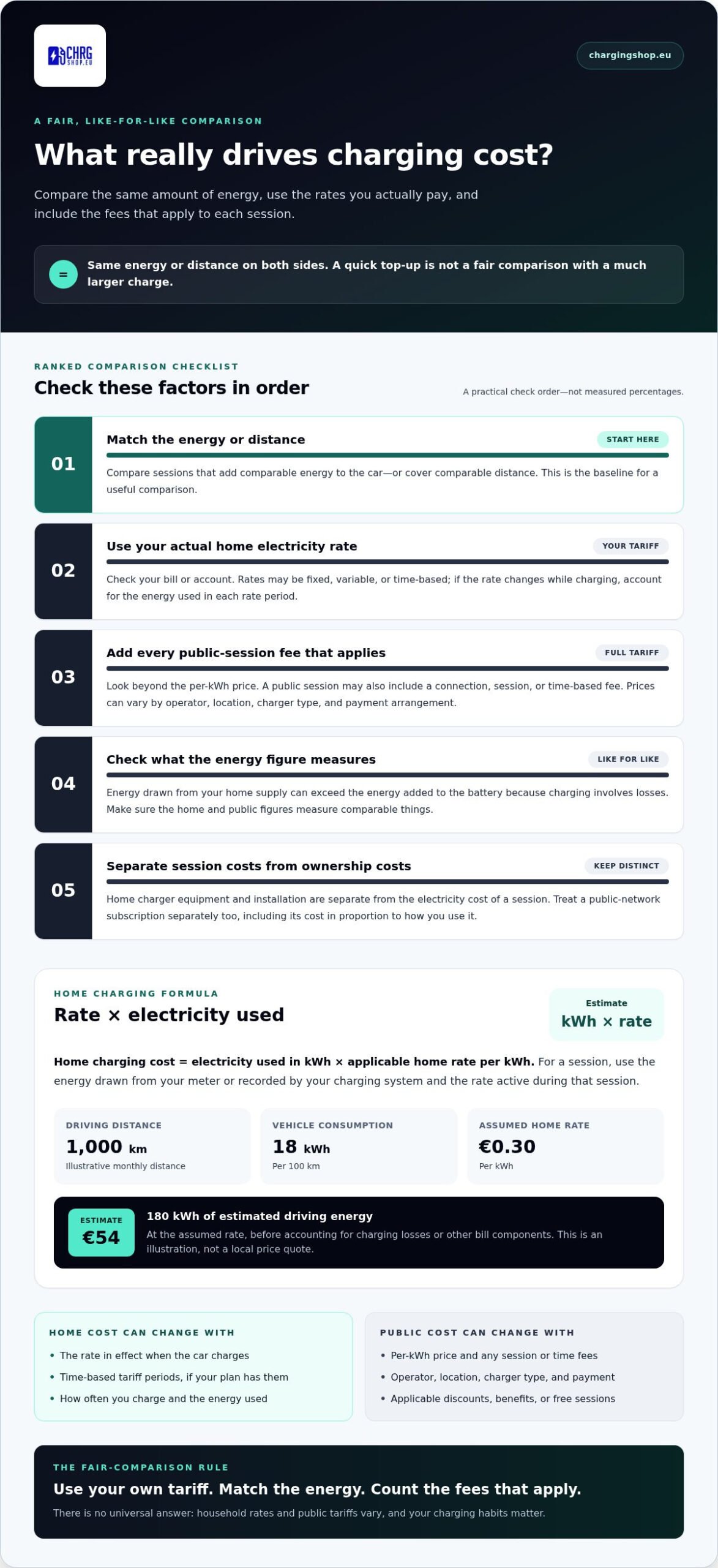
Use the rate you actually pay, not a national or regional average. The calculation is simple: home charging cost = electricity used in kWh × applicable home rate per kWh. This gives you a repeatable estimate for a session or month, and a fairer starting point for the cost of home charging vs public station comparison.
Which electricity rate should you use?
Check your latest bill or electricity account for the rate that applies to your home. Note whether it’s fixed, variable or time-based, and whether the rate changed during the billing period. A published benchmark can offer context, but it won’t replace your own tariff. For U.S. comparisons, the EIA electricity price data shows averages by state and sector. Use your bill for your personal calculation.
If your plan has different rates by time, use the rate that applies when the car charges. If charging spans more than one rate period, calculate the cost of the energy used in each period and add the amounts. Don’t assume an off-peak rate applies unless your tariff actually offers one.
How to estimate a monthly home-charging total
Start with your typical monthly distance and the vehicle’s energy consumption, usually shown in kWh per 100 km. Multiply the monthly kilometres by that figure, then divide by 100 to estimate the energy used for driving. For an approximate monthly bill, multiply that energy by your home rate. If you know the energy drawn from the household supply, use that figure instead: it accounts for charging losses that a vehicle’s driving-consumption figure may not include.
Here’s an illustrative calculation, not a local price quote. Suppose you drive 1,000 km in a month, your vehicle uses 18 kWh per 100 km, and your applicable home rate is €0.30 per kWh. The driving-energy estimate is 180 kWh. At that assumed rate, the estimate is €54 before accounting for charging losses or other bill components. Replace both inputs with your own figures to make the result useful.
For a session estimate, use the energy drawn from your meter or recorded by your charging system and multiply it by the rate active during that session. To estimate a monthly total, multiply a typical session cost by how often you charge, or add the actual session amounts for the month. Frequency matters: the same tariff produces different monthly spending for different driving patterns.
- Vehicle consumption: energy used for driving, often stated per distance.
- Energy drawn at home: electricity charged to the household supply, including charging losses.
- Applicable tariff: the rate in effect during charging, or a weighted rate if it changes.
Use this calculation to set a clear baseline before comparing charging options. If regular home charging suits your routine, explore home charging hardware as a separate equipment decision. The hardware doesn’t set your electricity tariff.
Compare public station fees with home charging on equal terms
To compare the cost of home charging vs public station charging, choose one measure and apply it to both: the same amount of energy delivered or the same distance driven. A short public top-up and a full home charge aren’t equivalent. Set the comparison basis first, then add the charges that apply to each option.
Public tariffs can use different billing structures. A May 2026 European Parliament study reported average public prices of €0.27-€0.65 per kWh for AC charging and €0.32-€0.85 per kWh for DC fast charging. These ranges provide context, not a quote for a specific station or a substitute for your local tariff. Your actual cost depends on the rate and fees in effect for your session.
Which public charging fees belong in the comparison?
Check how the station bills: by energy, time, session or a combination. Add a session fee or time charge only when it applies to the scenario you’re comparing. Include parking or idle fees if they’re charged, and a network subscription if you use one. Keep recurring subscription costs distinct from the per-session total, especially if you use that network for other trips.
Use a consistent comparison sheet. Enter your home rate and the public rate for the same energy amount, then add any applicable fees. Leave fee fields at zero when they don’t apply.
| Cost item | Home charging | Public station |
|---|---|---|
| Energy rate | Your applicable home tariff per kWh | Station price per kWh, if billed by energy |
| Session or time charge | Include only if your home plan applies one | Include only if the operator applies one |
| Other applicable charges | Separate equipment or installation costs from session energy | Add relevant parking, idle or subscription costs |
Don’t present one-off equipment and installation costs as recurring electricity charges. If you’re assessing total ownership cost, show them separately and choose a time period for the comparison. That keeps the session calculation clear.
How to compare cost per kilometre fairly
Use the same vehicle-consumption figure for both options, expressed in kWh per 100 km. Multiply it by each option’s applicable energy rate, then divide by 100 to estimate the energy cost per kilometre. Add relevant fees separately, spreading them across the distance only if they’re part of the scenario being assessed.
For example, if your vehicle uses 18 kWh per 100 km, calculate the home and public energy costs with that same consumption assumption and your actual rates. Label the result with the vehicle, tariff, station and fees used. It’s a comparison for those inputs, not a universal ranking. Change the rate, fee structure or driving consumption and the result changes too.
Choose the charging mix that fits your driving and access
The lowest session price isn’t always the best fit. Your charging routine also depends on where the car sits for hours, how predictable your weekly driving is and whether a charger is practical where you park. Balance cost with access and convenience rather than assuming one charging option must cover every journey.
Start with a normal week. Note where the car is parked overnight, how often it returns there and the distance you typically drive between stops. Then identify when that routine changes, such as longer trips or days when home charging isn’t available. This gives you a realistic picture of how often each option could serve you.
When does regular home charging make practical sense?
Home charging can fit well if you have reliable access to a parking space near a suitable charging point and the car stays there long enough to charge. Compare your regular driving needs with how often the vehicle is parked at home. Treat the charger and installation as separate upfront costs, not part of the recurring electricity price per session.
Access matters as much as distance. A driveway, garage or assigned parking space may make charging at home straightforward. A vehicle parked on the street or in shared parking may make it less practical. Don’t base the decision on a theoretical daily routine. Consider who uses the car, when it’s usually parked and whether the charging spot is consistently available.
Then weigh the setup against your actual use. If the car returns to the same parking place regularly, home charging hardware may support a dependable routine. If it’s rarely parked within reach of a suitable charger, a favourable estimated energy cost alone may not make home charging practical.
For a broader look at how charging equipment and charging habits can work together, see our guide on how to reduce EV charging costs with smart hardware.
When should public charging remain part of the plan?
Keep public charging in the mix for longer journeys, limited home access or occasional charging needs outside your normal routine. Before relying on a station for a trip, review its current tariff and billing structure. Rates, session or time charges, payment options and subscriptions can vary, so don’t assume every station on a route works the same way.
Use a simple decision check before settling on a charging mix:
- Home access: Can you regularly park near a suitable charger?
- Routine: Does the car spend enough time there to meet your typical driving needs?
- Exceptions: Which trips or days will likely require public charging?
- Convenience: Does the option fit your schedule, parking and route?
This routine-based view makes the cost of home charging vs public station more useful in real life. A lower estimated session total won’t help if the location or timing doesn’t work. Many drivers will find a combination more practical: charge at home when access and routine support it, then use public stations when travel or circumstances call for them.
If home charging fits your parking setup, explore home EV charging hardware from Charging Shop to see what could support your routine.
When home charging hardware can support a lower-cost routine
Once you’ve compared your home estimate with local public tariffs, consider whether home charging fits your parking and driving routine. A charger can support regular charging at home, but it doesn’t set your electricity rate. Your bill still depends on the tariff that applies when you charge, the energy your vehicle uses and any relevant fees.
That distinction matters when assessing the cost of home charging vs public station. Hardware is a separate equipment decision, not a promise of a lower bill. Consider whether a home charger suits your vehicle, electrical setup and parking location. If the setup doesn’t match your day-to-day needs, even a favourable energy tariff may not make home charging practical.
Which home-charging features matter to a cost comparison?
Start with compatibility and routine. Consider whether the charger is suitable for your vehicle and electrical setup, and whether it supports the way you expect to charge. Your vehicle’s charging capability and the available electrical supply also affect the power you can use. A charger rated up to 22 kW won’t make a vehicle charge at that rate if the vehicle or supply has a lower limit. Keep equipment and installation costs separate from recurring electricity costs so you can see both the per-charge estimate and the broader upfront investment.
Solar is a separate consideration. It’s relevant if your home has suitable solar generation and a compatible setup. The V2C Trydan 22 kW Solar supports charging from solar inverters, which may make it worth exploring for homes with that configuration. It is compatible with a range of solar inverters and also supports dynamic power balancing. Solar compatibility alone doesn’t guarantee a specific saving. The solar generation available and how charging fits your household’s energy use affect how much electricity you draw from the grid.
Keep the comparison practical: first calculate your home charging estimate using your actual tariff, then consider whether the hardware’s features fit your setup. Don’t treat a feature as a bill reduction unless your own usage and energy costs support that conclusion.
Explore home charging options after calculating your costs
Your next step is to compare your home estimate with the public tariffs and applicable fees you’re likely to use. If home charging suits your routine, match hardware to your vehicle, electrical setup, parking access and any compatible solar generation. That keeps the financial estimate grounded in your situation rather than a general claim about what a charger can save.
For more detail on the V2C Trydan and its role in a home setup, read the V2C Trydan 22 kW home charging guide. Charging Shop also offers a personalised charging offer to help you explore suitable EV charging hardware for your setup.
Make your next charging decision with confidence
Your best charging setup is the one that fits your home, driving pattern and available rates. Use your own figures to make the cost of home charging vs public station comparison personal, then choose hardware based on the routine you want to support. If you have suitable solar generation, the V2C Trydan supports charging from solar inverters. Charging Shop provides free access to the CHRG Network, which gives station owners access to a station-management system.
Compare your costs, then explore Charging Shop’s EV charging hardware and personalised charging offer to find an option that fits your plans.
Frequently Asked Questions
Is home EV charging cheaper than using public charging stations?
Often, but not in every situation. The cost of home charging vs public station charging depends on your actual household tariff, the station’s full price structure and any discounts or free charging available to you. A driver with a low home rate may pay less for regular charging at home, while a discounted public session could be cheaper on a particular day. Compare your own usage rather than relying on a blanket rule.
How much does it cost to charge an EV at home?
It depends on how much electricity your car draws and the rate charged on your bill. For a quick session estimate, take the kWh drawn from your household supply and multiply it by the applicable rate. For example, a 12 kWh session uses 12 times your rate per kWh. Check whether your bill has a separate standing charge, which may not increase simply because you charge the car.
How do I compare home electricity rates with public charging prices?
Compare the total cost of adding the same energy to your car, using the rate that applies during home charging and the public station’s full tariff. If public pricing includes a session or time charge, include it for the scenario you’re assessing. Use the final amount on a charging receipt where possible, and check whether the displayed price includes applicable taxes. This avoids comparing a headline rate with an all-in bill.
Can public EV charging ever cost less than charging at home?
Yes. A workplace or destination may offer free charging, or a network discount may lower a public session’s price. For example, if a driver can charge at work during the day, that session could cost less than using a higher-priced home tariff. Compare the specific terms, including any parking cost or access requirement. A low-cost public opportunity may suit some sessions without changing the economics of your regular charging pattern.
What fees can make a public charging session more expensive?
Depending on the operator, the total may include a connection or session charge, time-based billing, parking, an idle fee or a network subscription. Some tariffs combine more than one charge. Check the station’s pricing details before you plug in, and review your receipt afterward to see what was actually billed. Include only fees that apply to your session, rather than assuming every station adds the same charges.
Does solar charging reduce the cost of charging an electric car?
Solar charging can reduce the amount of electricity drawn from the grid when solar generation is available and used to charge the car. The effect on your bill depends on when the vehicle is plugged in, your household’s solar output and your electricity arrangement. The V2C Trydan supports charging from solar inverters, but that capability doesn’t guarantee a particular saving. Compare your actual solar use and tariff to understand the potential impact.
Is a home charger worth it if I still use public charging stations?
It can be, if you have convenient parking access and expect to charge at home regularly. Public stations can remain useful for longer journeys or days when home charging isn’t practical. To judge the equipment’s value, consider its upfront cost separately from electricity spending, then assess how much of your usual charging could happen at home. Using both options doesn’t rule out a home charger; your routine determines whether it makes sense.
