
 Deutsch
 Dansk
 Suomi
 Latviešu
 Lietuvių
 Norsk bokmål
 polski
 Русский
 Svenska

No products in the cart.
Uncategorized
Best Time of Day to Charge an Electric Car: A Practical Guide
20
Oct
Oct
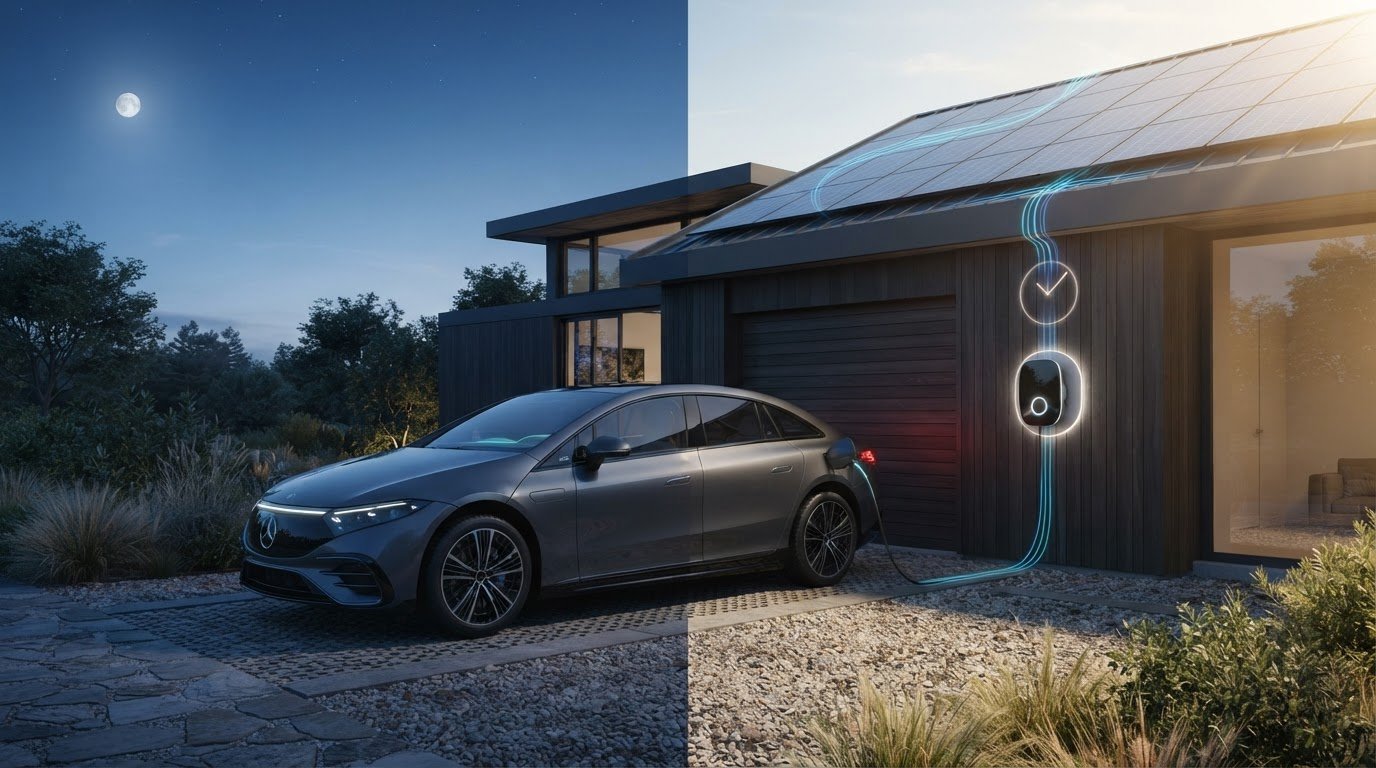
The best time of day to charge electric car isn’t automatically overnight. If your electricity tariff has cheaper off-peak hours, charging during that window may lower your costs. But daytime charging could be a better fit if your plan offers a lower rate then or your solar panels are generating electricity.
Charging at the “wrong” hour doesn’t necessarily harm your car or increase your bill. The practical answer depends on your electricity plan, when you drive, and how much charge you need. Off-peak pricing only helps when those hours apply to your tariff, and your car still needs to be ready when you set off.
This guide shows you how to find a useful charging window in your own plan and build a routine around your driving. You’ll learn when overnight charging makes sense, when solar-aligned or midday charging may work better, and how to balance cost with convenience and your vehicle’s charging guidance.
Key Takeaways
- The best time of day to charge electric car depends on your tariff, solar generation, driving routine, and next departure.
- Compare your plan’s actual peak and off-peak periods with your plug-in and departure times before setting a schedule.
- Choose overnight or daytime charging based on your tariff and solar availability, not a one-size-fits-all rule.
- Build a four-step routine around your next journey and the charge you need, then review how it works in practice.
- Scheduling-capable hardware can help align charging with your tariff. The V2C Trydan 22 kW Solar supports solar-inverter integration and peak-shaving charge scheduling.
Why the Best Time of Day to Charge an Electric Car Depends on Your Priorities
The best charging window depends on your electricity tariff, solar availability, driving routine, and departure time. There isn’t one hour that works for every driver. If your priority is a lower bill, start with the cheapest periods in your plan. If you have solar panels, you may want to charge while they are generating power. If your schedule changes often, having the car ready when you need it may matter more than chasing the lowest rate.
Your electricity plan, not a universal clock time, sets the cheapest window for charging. On a time-based plan, peak hours are periods when electricity costs more, while off-peak hours have a lower rate. A time-of-use (TOU) tariff sets different rates at different times. The hours and rates vary by supplier, location, and plan, so check your own tariff rather than relying on a general schedule.
Decide what you want your charging routine to achieve:
- Lower bills: Shift charging into the lower-rate periods your tariff actually offers.
- Use more solar energy: Align charging with available generation when your panels and driving schedule make that practical.
- Make charging convenient: Use the hours when the car is parked and easy to plug in.
- Be ready to drive: Plan around your next departure, especially if you rely on the car early in the day.
Charging time is only one part of the decision. Your vehicle, charger, and home setup also affect how you plan a session. For a useful foundation, see the Electric Vehicle Charging Overview, then focus on the tariff periods and daily routine that apply to you.
What do peak and off-peak charging hours mean?
On a time-of-use plan, the price per unit of electricity changes according to the schedule in your tariff. A lower-rate window might fall overnight, during the day, or at another time. Peak periods may also vary by hour or day. Don’t assume a schedule you’ve seen elsewhere applies to your home. Find the current tariff details in your account or plan documents and note the exact rates and time windows before setting a charging routine.
Why overnight charging is common, but not universal
Overnight charging can fit naturally when the car is parked at home and your plan offers a lower rate during those hours. You can plug in after your last trip and schedule charging while the car is not in use. Daytime charging may suit you better if the car is home while your solar panels are generating power, or if your tariff has a discounted daytime period. Compare the actual rates with your parking and departure times before choosing a window.
How Tariffs, Charging Schedules, and Battery Needs Shape the Best Time
To find the best time of day to charge electric car, compare your plan’s rate periods with the hours your vehicle is usually parked and the time you need to leave. The lowest-cost window is useful only if it also gives you enough time to charge for your next journey. A cheaper period won’t help if the car can’t charge for long enough before you set off.
Start with the schedule, then consider how much charging time is available within it. Charging time means when a session happens; charging duration means how long it takes. Duration depends on factors such as the vehicle and charger, so don’t assume every car can add the same amount of charge in the same window.
If your vehicle or home charger supports scheduled charging, set a start time that moves the session into a lower-rate period. For example, if you arrive home before a higher-rate period and the lower rate starts later, scheduling can prevent charging from starting immediately. Leave enough time before departure for the charge you need. Background on how demand and supply relate to electricity use is available from the U.S. Energy Information Administration’s Understanding Electricity Demand and Tariffs.
How to find your lowest-rate charging window
Use your current tariff documents or electricity account to find the full rate schedule. Look for peak, shoulder, and off-peak periods, including any rates that differ by day. Then compare those periods with your usual plug-in time and the hours the car stays home. A low-rate window only helps if the car is connected during it and has enough time to charge before you leave.
Map a typical weekday and a less predictable day separately. If you’re usually home throughout a lower-rate period, scheduled charging may fit easily. If you leave before that window ends, prioritize the charge needed for your trip rather than following a schedule that leaves you short.
What battery care changes about charging time
Tariff timing is a cost decision, not a universal battery-health rule. The clock alone doesn’t determine how to care for every EV battery. Follow your vehicle maker’s guidance for charging limits and battery care, then use your tariff and routine to choose a practical time within those recommendations. Keep the decisions separate: a lower rate may reduce charging costs, but it doesn’t replace vehicle-specific battery guidance.
Scheduling-capable charging hardware can help you put a tariff-based routine into practice. Explore EV charging hardware as you consider which charging setup fits your home and schedule.
Night vs. Day: Which EV Charging Window Fits Your Situation?
Choose a night or daytime window based on your tariff, where the car is parked, and when you need to drive. Nighttime isn’t automatically the cheapest, greenest, or most convenient option. Overnight charging may suit a time-of-use plan, while daytime charging may work for a solar household or a driver whose car is home during the day. On a flat-rate plan, the clock alone won’t change the electricity rate.
Use this comparison to narrow down your options, then check your electricity plan and usual routine.
| Charging window | When it may fit | What to check |
|---|---|---|
| Overnight on a time-of-use plan | Your car is parked at home overnight and your plan offers a lower rate during those hours. | Confirm the actual off-peak window and whether there’s enough time to charge before departure. |
| Daytime on a flat-rate plan | Your car is home during the day, and you prefer charging while it’s parked rather than overnight. | Check whether the rate is genuinely flat. If it is, daytime may offer convenience, not a lower unit rate. |
| Daytime with home solar | Your vehicle is at home while your panels are producing electricity, and charging can fit around that generation. | Consider when solar output is available, when you need the car, and whether your plan makes using or exporting that energy more suitable. |
| Daytime on a discounted time-of-use plan | Your tariff specifically has a lower-priced daytime period that fits your parking schedule. | Check the period’s exact hours and rates. Don’t assume daytime is discounted simply because solar generation is high. |
When overnight charging may make the most sense
Overnight charging can be practical if the car is parked at home and your plan offers a lower rate while it’s connected. For example, if you return home in the evening and leave after the lower-rate period, you can schedule charging to fit that window. Tariff hours vary, so check your own plan instead of copying example times. Make sure the session can provide the charge you need before departure.
When daytime or solar-aligned charging may be a better fit
Daytime charging can work well if the car is home while your solar panels are generating power. The more closely your parking hours overlap with available solar generation, the easier it may be to use that energy for charging. A flat-rate plan can also make daytime convenient, but not cheaper. Count on a daytime price advantage only if your tariff explicitly offers a discounted period.
To identify the best time of day to charge electric car for your situation, match three things: the rate or energy source you want to use, the hours the car is available, and your next departure. If those don’t line up, prioritize having the car ready. Treat “charge at night” as one possible routine, not a universal rule.
How to Set a Practical EV Charging Schedule in Four Steps
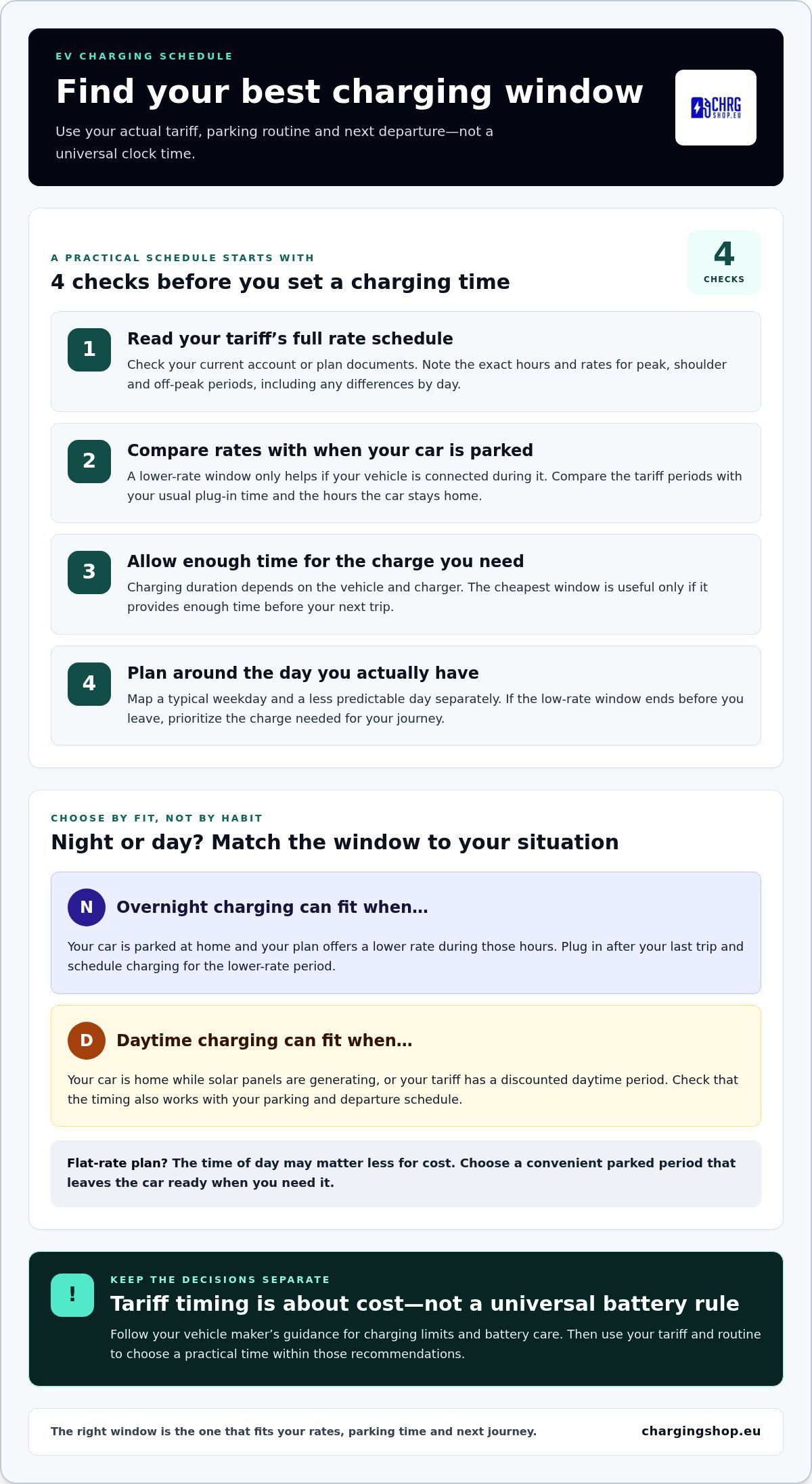
Turn your tariff and driving routine into a repeatable plan, then adjust it when your week changes. The best time of day to charge electric car is the window that supports your next journey while making use of your electricity rate or available solar power.
Use this checklist: rate, parking window, solar availability, and departure time. Work through the steps in order:
- Check the tariff. Find the rates and time periods in your current electricity plan. Mark the lower-rate windows, if your plan has them, and note any conditions that affect when they apply.
- Map your routine. Identify when the car is usually parked at home and when you normally leave. Include differences between weekdays and days off, as well as regular trips that change your plug-in window.
- Set the target. Decide how much charge you need for your next planned journey, following your vehicle maker’s charging guidance. Avoid making “charge to full” the automatic target if a smaller amount will meet the trip’s needs.
- Review the results. After using the schedule, check whether the car was ready when needed and whether charging took place in the intended rate window. Adjust the plan if the routine didn’t work as expected.
Match charging to your tariff and weekly routine
Compare your home-parking hours with the lower-rate periods in your tariff. The most useful overlap is a window when the car is connected, charging can take place at the applicable rate, and the vehicle is ready before you leave. Don’t assume the lower rate starts at night. If an unexpected journey shortens your usual charging window, prioritize the next trip and revisit the schedule afterward.
For example, if your car is normally home during a daytime lower-rate period, a night-only routine may miss a useful opportunity. If the car is away during that period, the same rate window may not be practical. Let your actual parking pattern guide your plan.
Use scheduled charging without losing flexibility
Where your vehicle or charger supports scheduling, use its controls to choose a start time or charging window that fits your tariff and departure. Follow the relevant instructions to set or change the schedule. Leave room for one-off trips: a routine should make regular charging easier, not prevent you from preparing for an earlier departure.
Review the settings when your tariff changes, solar availability shifts, or your driving pattern changes. The V2C Trydan 22 kW Solar supports solar-inverter integration and peak-shaving charge scheduling, helping align charging with solar generation or tariff periods. Explore scheduling-capable EV chargers to find hardware that fits the routine you’ve built.
Choose Charging Hardware That Fits Your Schedule
Choose hardware after you know what your routine requires. Scheduling options are useful only if they support the timing you want. The complete setup also depends on your vehicle’s charging limits, tariff terms, and installation conditions. Start with the essentials: can the charger help you use your preferred rate window, work with your home energy setup, and provide charging that fits your parking and departure times?
Keep these decision points in view:
- Schedule: Does the charging setup support the timing you need to use your tariff periods?
- Vehicle: What charging limits and guidance apply to your specific EV?
- Solar: Do your generation hours overlap with the time your vehicle is at home?
- Home setup: Do the charger’s capabilities suit your electrical supply and installation conditions?
A higher charging-power figure doesn’t automatically mean every vehicle will charge at that rate. Vehicle limits and the wider setup matter too. Use the 22 kW home wallbox guide to understand charging-power considerations, then compare them with your vehicle’s specifications and everyday needs.
When solar integration or peak-shaving scheduling is relevant
Solar integration is worth considering if your car is usually home while your panels generate electricity. The V2C Trydan 22 kW Solar supports solar-inverter integration, making it relevant for households looking to align charging with solar generation. Its peak-shaving charge scheduling can shift charging according to tariff periods to help reduce electricity costs. Neither feature guarantees a particular bill outcome; results depend on your tariff, energy use, and schedule.
If your car is away while your panels are producing power, solar alignment may be less practical for your routine. If your main goal is charging during a lower-rate period, focus on whether scheduling supports that window. Choose features that fit how you actually use the car.
Explore a charger that supports a smarter routine
For product-specific context, read the V2C Trydan 22 kW home charging guide. Use it alongside your tariff and vehicle information to assess how the charger’s solar-inverter integration and peak-shaving charge scheduling fit your plans. The goal is a setup that supports your routine, not a feature list you won’t use.
Choose charging hardware around your vehicle, tariff, and home conditions, then set a schedule that keeps the car ready. Explore Charging Shop’s EV charging hardware to find a setup that fits your charging routine.
Build a Routine That Can Adapt
Your charging routine doesn’t need to be perfect on day one. Treat it as a practical starting point, then adjust it as your calendar, energy setup, or priorities change. The best time of day to charge electric car is the window that works for your real life, not just an ideal week.
Choose a schedule that’s easy to maintain and leave room for unexpected trips. Revisit your settings whenever your routine shifts. If your driving takes you beyond home charging, Charging Shop offers free access to the CHRG Network as another part of your charging setup.
Ready to plan your setup? Explore EV chargers and smart charging solutions at Charging Shop and find hardware to match your routine.
Frequently Asked Questions
Is it cheaper to charge an electric car at night?
It can be cheaper if your electricity plan charges a lower rate overnight, but the best time of day to charge electric car depends on your actual tariff and charging needs. Check the rate periods in your account or tariff documents, including any differences between weekdays and weekends. If your plan has one flat rate, charging at night may not reduce the price. Also check that the lower-rate window leaves enough time to prepare for your next trip.
Can I charge my electric car during the day if I have solar panels?
Yes, daytime charging may suit you if the car is home while your solar system is generating electricity. For example, a vehicle parked at home during a sunny workday may be available to charge while solar energy is being produced. Solar output and your household’s other electricity use affect how well the timing lines up. Your charging setup matters too, so don’t assume every session will use only solar energy or produce a fixed saving.
Should I charge my electric car every night?
No, charging every night isn’t automatically necessary. Consider how much you drove, the battery level, and what you need for your next trip. If you’ve only made a short journey and have no long drive planned, you may not need to start a session that night. Follow the vehicle manufacturer’s guidance for charging limits and regular use. If you schedule charging, base it on your needs and the rates in your plan.
Does charging an electric car overnight damage the battery?
Charging overnight by itself doesn’t establish that a battery will be harmed. Battery-care recommendations and charging limits vary by vehicle, so follow the manufacturer’s instructions for your model rather than relying on a universal rule. Also separate two questions: whether the car remains plugged in and what charge target you select. The time of day doesn’t replace model-specific guidance. If you’re unsure how to set a target, consult the vehicle manual.
What are off-peak hours for EV charging?
Off-peak hours are periods when an electricity plan may apply a lower rate, but there’s no universal schedule for every EV driver. The hours depend on your supplier, plan, and location, and some tariffs distinguish between days or time bands. Check your current tariff details for the applicable schedule rather than relying on a general example. The useful charging window is the lower-rate period your plan actually applies and your routine can use.
Can I schedule my electric car to charge at a certain time?
A compatible vehicle or charger may let you schedule a start time or charging window, though the controls differ by model. You can use that setting to begin charging during a lower-rate period or while solar energy is available. Allow enough time to reach the charge level needed for your next journey. Follow your vehicle or charger instructions to set the schedule, and review it if your driving pattern or tariff changes.
Is it better to charge an EV before or after driving?
Neither timing is always better. Choose based on your battery level, next journey, and when your tariff or solar setup makes charging practical. If you need the car early, plan ahead so there’s enough charge for that departure. You can plug in after a drive if it suits your routine, but that doesn’t mean every trip needs an immediate charging session. Follow your manufacturer’s battery-care guidance when choosing a target.
