
 Deutsch
 Dansk
Dansk Suomi
Suomi Latviešu
 Lietuvių
 Norsk bokmål
 polski
 Русский
 Svenska
No products in the cart.
Uncategorized
Wallbox with Load Balancing: The 2026 Guide to Protecting Your Home Grid
15
Aug
Aug
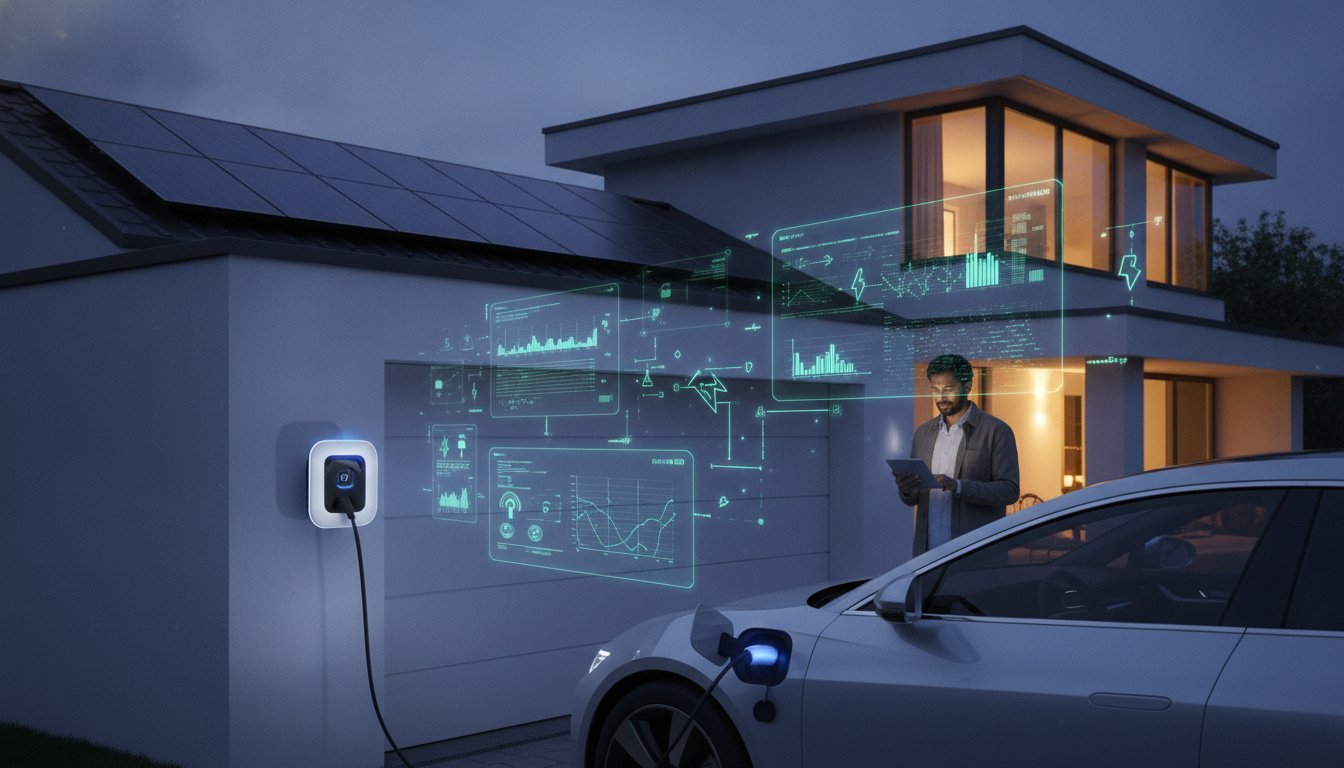
Your new electric vehicle is a powerhouse. But is your home’s electrical grid ready for it? Plug in a high-speed 22kW charger at the wrong time, and you could trip your main breaker, plunging the house into darkness right as you’re making dinner. This is the #1 fear for new EV owners.
The solution isn’t a costly, slow, and disruptive utility upgrade. It’s a wallbox with load balancing.
This technology acts as an intelligent traffic controller for your home’s electricity. It constantly monitors your total power usage and dynamically adjusts your EV’s charging speed. This ensures you never exceed your grid’s limit, preventing blackouts while still charging your car as fast as possible. Forget expensive grid upgrades—master how dynamic load balancing protects your home and saves you thousands.
What is a Wallbox with Load Balancing?
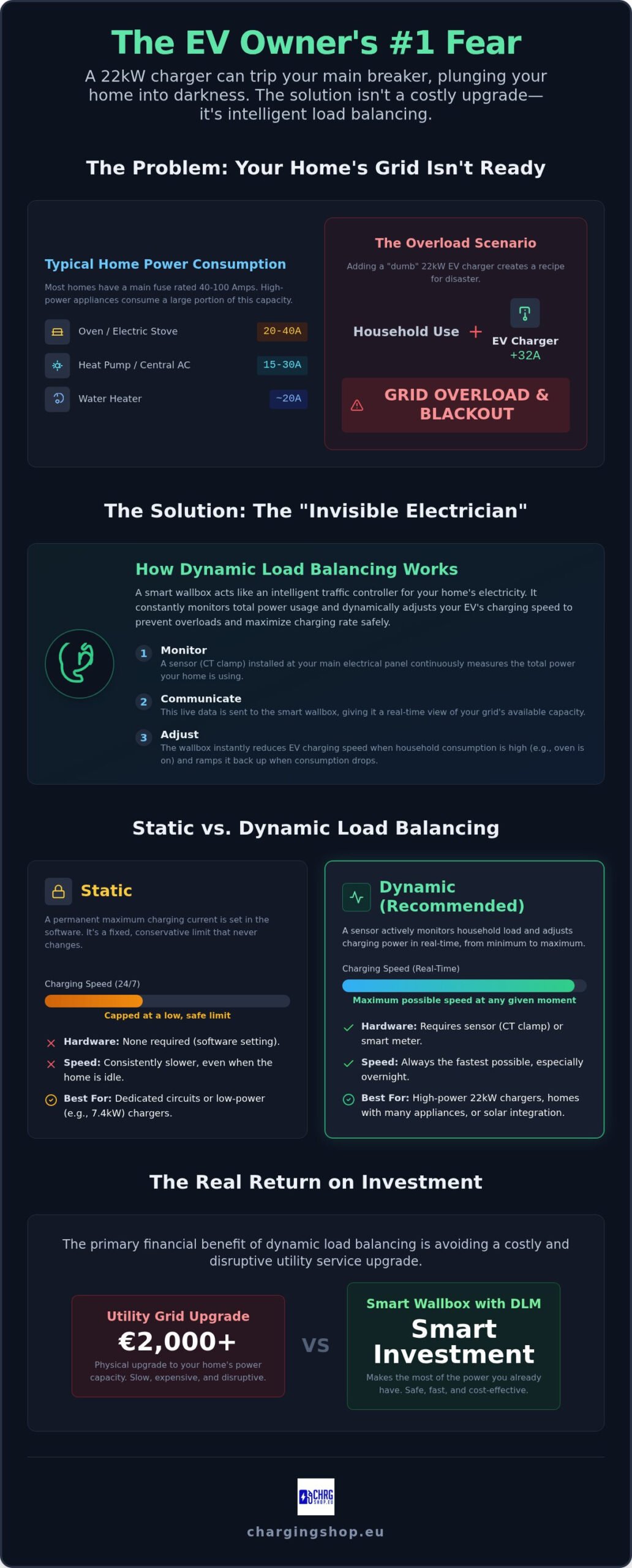
A wallbox with load balancing is a smart EV charging system that monitors your property’s total energy consumption in real-time. When it detects that your household is using a lot of power—for example, when the air conditioning, oven, and washing machine are all running—it automatically reduces the charging speed of your EV to prevent an overload. When household consumption drops, it instantly ramps the charging speed back up.
Think of it as an “Invisible Electrician” working 24/7. It prevents your main circuit breaker from tripping by intelligently managing the single largest electrical load in your home: your car. This is especially critical for powerful 22kW chargers, which on their own can consume more electricity than many entire households. For most residential grids, installing a 22kW charger without load balancing isn’t just risky; it’s practically impossible.
- Standard Charger: Delivers a fixed amount of power, regardless of what else is happening in your home. It’s a “dumb” connection that can easily cause an overload.
- Load-Managed Station: A “smart” system that communicates with your home’s grid, adjusting power in milliseconds to maintain stability and maximize charging speed safely.
The Problem: Why Your Grid Isn’t Ready for EV Charging
Most homes are built with an electrical capacity designed for traditional appliances. A typical household might have a main fuse rated between 40 and 100 Amps. A high-power EV charger can draw 32 Amps all by itself. Now, add your other heavy hitters:
- Oven or Electric Stove: ~20-40 Amps
- Heat Pump or Central AC: ~15-30 Amps
- Water Heater: ~20 Amps
Running these simultaneously with an EV charger is a recipe for disaster. A “dumb” charger doesn’t know or care about the other appliances. It will pull its full rated power, pushing your home over its limit and causing a trip. The hidden costs are frequent blackouts, potential damage to your fuses, and the constant worry of managing your energy use.
The Solution: Real-Time Amperage Adjustment
A wallbox with load balancing solves this problem with elegant simplicity. It “talks” to your home’s electrical system through a sensor, usually a Current Transformer (CT) clamp, installed at your main electrical panel or smart meter. This sensor gives the wallbox a live feed of your home’s total power draw.
The millisecond-response time of modern sensors allows the charger to react instantly to changes in demand. If you turn on the oven, the charger throttles down before the main fuse is ever at risk. When the oven turns off, that power is immediately reallocated to your car. This provides complete safety and grid stability without you ever having to think about it—no manual intervention or rigid charging schedules required.
Static vs. Dynamic Load Balancing: Which One Do You Need?
Load balancing isn’t a one-size-fits-all feature. The two main types are Static and Dynamic, and choosing the right one is crucial for performance and cost-effectiveness. Many online listings confuse the two, but the difference is simple: one is a fixed limit, and the other is a fluid, intelligent system.
The real return on investment (ROI) for dynamic balancing comes from avoiding the €2,000+ fee for a utility service upgrade. Instead of paying an electrician and your utility company to physically increase your home’s power capacity, you install a smart system that makes the most of the power you already have.
Here’s a quick breakdown:
| Feature | Static Load Balancing | Dynamic Load Balancing (DLM) |
|---|---|---|
| How it Works | A permanent maximum charging current is set in the software (e.g., “never exceed 16A”). | A sensor actively monitors household load and adjusts charging power in real-time. |
| Hardware Required | None. It’s a software setting. | Requires an external sensor (CT clamp) or smart meter integration. |
| Charging Speed | Consistently slower, as it’s capped at a low, safe limit 24/7. | Maximum possible speed. Charges fast overnight when house demand is low. |
| Best For | Dedicated circuits with no other loads, or low-power (7.4kW) setups. | Homes with 22kW chargers, multiple high-draw appliances, or solar panels. |
When to Choose Static Load Management
Static load management is the most basic form of protection. It involves telling your charger, “Never draw more than X amps.” This is done by a certified installer during setup. It’s a viable option in a few specific scenarios:
- Dedicated Circuits: If your charger is on a completely separate circuit with no other appliances, you can set a static limit that matches the circuit’s capacity.
- Low-Power Setups: For 3.7kW or 7.4kW chargers in modern homes with ample grid capacity, a static limit can be sufficient if you don’t have other major electrical loads like a heat pump or sauna.
The major limitation? Your charging is always capped. Even if your house is completely “asleep” at 2 AM with zero other power usage, the charger will stick to its conservative static limit, resulting in unnecessarily slow charging.
The Power of Dynamic Load Management (DLM)
Dynamic Load Management (DLM) is the true smart solution. This is where the magic happens. DLM is essential for users of high-performance chargers like the V2C Trydan 22kW, as it unlocks their full potential without compromising your home’s stability.
With DLM, your wallbox knows the difference between midday on a summer Saturday (AC on, pool pump running) and the middle of the night. When your house is idle, it unleashes the full 22kW charging power. The moment household demand increases, it gracefully dials back. This is achieved by connecting the wallbox to your grid via a smart meter or, more commonly, a set of CT clamps that measure the real-time flow of electricity.
Advanced Features: Solar Integration and Multi-EV Setups
Modern load balancing goes beyond just preventing overloads. It’s a cornerstone of a fully integrated smart home energy ecosystem. Advanced systems can integrate with solar panels, manage complex 3-phase power, and even orchestrate charging for multiple vehicles on a single grid.
This is also how you future-proof your setup. As technologies like V2G (Vehicle-to-Grid) and V2H (Vehicle-to-Home) become mainstream, a charger with sophisticated load balancing will be the central hub for managing your home’s energy flow, turning your EV into a home battery.
For a more permanent solution, homeowners often turn to dedicated home energy storage systems like those from Texas Lithium Batteries to complement their smart charging setup.
Balancing with Solar Power
For homes with a photovoltaic (PV) system, load balancing is a game-changer. When combined with a solar-integrated EV charger, it allows you to use 100% of your self-generated green energy.
Here’s how it works: the system monitors your solar production and your home’s consumption. Any surplus solar power is directed straight to your EV. Critically, the load balancing feature prevents your car from pulling expensive power from the grid during cloudy intervals or when a large appliance kicks in. It ensures that charging only occurs when there is genuine excess solar, maximizing your energy independence and savings.
Multi-Charger Load Sharing
What if you have two EVs? Or you’re a small business owner with a few chargers for a small fleet? Multi-charger load sharing, also known as load grouping or daisy-chaining, is the answer. This system extends the principle of load balancing across multiple wallboxes.
A designated “master” charger monitors the total available amperage for the entire circuit and distributes it intelligently among the “slave” units. For professional or high-traffic environments, a robust and reliable charger is paramount. The ABB Terra AC is a top choice for these multi-unit hubs, known for its industrial-grade build quality and stable performance under pressure. It ensures that all connected vehicles get a safe and equitable charge without overwhelming the site’s electrical infrastructure.
Top Wallboxes with Load Balancing: 2026 Comparison
Not all load balancing systems are created equal. The intelligence, ease of setup, and sensor requirements vary significantly between brands. Here, we compare two of the best-in-class options for 2026, each excelling in a different domain.
- V2C Trydan: The king of smart home integration and user-friendly dynamic power.
- ABB Terra AC: The robust, safety-first choice for industrial-grade reliability.
The sensor implementation is a key differentiator. Some systems require hardwired connections back to the main panel, while others offer more flexible wireless solutions. Always verify the specific requirements for your chosen model.
V2C Trydan: Built-in Intelligence
The V2C Trydan is designed from the ground up for the modern smart home. Its dynamic load management is not an afterthought; it’s a core feature that integrates seamlessly with its powerful app and cloud platform. This makes it the top smart EV charger with an app for home users who demand control and visibility.
Setup is streamlined via the V2C Cloud, allowing for easy configuration of the load balancing parameters. The V2C Trydan’s system is renowned for its responsiveness and compatibility with solar inverters, making it the ultimate choice for a fully connected, energy-efficient home. To see how it stacks up against the competition, read our detailed V2C Trydan vs Wallbox Pulsar comparison.
ABB Terra AC: Safety and Stability
ABB brings its legacy of industrial engineering to the residential charging market with the Terra AC. This wallbox is built like a tank and prioritizes safety and stability above all else. Its load management system excels at “peak shaving”—proactively limiting power during high-demand periods to protect older or more sensitive electrical panels.
The Terra AC features built-in surge protection and other safety mechanisms that you’d expect from a global leader in electrical equipment. It’s the ideal choice for users who value industrial build quality, long-term reliability, and a “set it and forget it” approach to grid protection. It’s a workhorse designed for maximum uptime and safety.
Implementation: How to Get Started with Load Balancing
Ready to protect your grid and unlock maximum charging speed? Getting started is a straightforward process. Follow these steps to ensure a safe and effective setup.
- Check Your Main Fuse Rating: Before you buy anything, know your home’s limit. Look at your main circuit breaker to find its amperage (e.g., 63A, 80A, 100A). This number is the absolute maximum your load balancing system will be configured to protect.
- Select the Right Hardware: Choose the wallbox that fits your needs. For ultimate smart home control and solar integration, the V2C Trydan is the clear winner. For maximum durability and safety in a high-traffic or demanding environment, the ABB Terra AC is the professional’s choice.
- Find a Certified Installer: This is critical. Installing a wallbox and its CT clamps involves working with your main electrical panel. This is not a DIY job. You must hire a qualified, certified electrician. Please note: Charging Shop is a specialized hardware retailer and does not provide on-site installation services.
- Manage Your Assets: Once installed, connect your charger to a management platform like the CHRG Network to monitor performance, track energy usage, and manage costs.
Professional Management with CHRG Network
For those who want ultimate control and visibility over their charging infrastructure, the CHRG Network is the definitive tool. Accessing the CHRG Network for your EV stations transforms your charger from a simple appliance into a managed asset.
You can remotely monitor your grid’s health, view detailed charging histories, and see exactly how the load balancing is performing. For home-office users or small businesses, it also enables automated billing and reporting, simplifying expense reimbursement and financial tracking.
Get Your Personalized Charging Offer
Don’t guess what your home needs. Get a hardware package tailored to your specific vehicle, grid capacity, and future goals. We specialize in high-performance 22kW solutions that future-proof your investment, ensuring you’re ready for the next generation of EVs.
Let our experts configure the perfect kit for you, including the right charger and all necessary load balancing components. Get your personalized offer today and start charging smarter, faster, and safer.
Frequently Asked Questions (FAQ)
- Do I need a special smart meter for a wallbox with load balancing?
- Not necessarily. While some wallboxes can integrate with specific smart meters, most modern dynamic load balancing systems use a dedicated Current Transformer (CT) clamp. This small sensor clips around your main power line and is generally easier and more universal to install than relying on utility-provided meters.
- Will load balancing slow down my car charging significantly?
- No, it actually enables the fastest possible charging. It only slows down charging when necessary to prevent a blackout. Without it, you would have to permanently set your charger to a very low, slow speed (static balancing) to be safe. Dynamic balancing ensures you get maximum power whenever it’s available.
- Can I add load balancing to my existing EV charger later?
- It depends entirely on the charger. Premium models like the V2C Trydan and ABB Terra AC are designed for it, and you can add the sensor module at any time. However, most basic or “dumb” chargers lack the necessary communication ports and software to support external sensors, making a retrofit impossible.
- Is a hardwired sensor better than a wireless one for load management?
- A hardwired sensor (connected via a data cable) is generally considered more reliable and responsive, as it is not susceptible to wireless interference. Wireless sensors offer more installation flexibility but can be a potential point of failure. For a mission-critical function like grid protection, a hardwired connection is the professional standard.
- How does load balancing work with solar panels?
- It uses a sensor to measure solar production and household consumption. The system prioritizes powering your home first, then directs any excess solar power to the EV. The load balancing component ensures the EV never draws power from the grid unless you specifically command it to, such as during off-peak hours.
- What is the difference between power sharing and load balancing?
- Load balancing refers to managing the EV charger’s load against the entire house’s consumption. Power sharing (or multi-charger load sharing) refers to distributing a fixed amount of power among multiple EV chargers on the same circuit.
- Does the V2C Trydan include a load balancing sensor in the box?
- The V2C Trydan is designed for seamless integration with a compatible CT clamp for dynamic load balancing. This sensor is often included as part of a complete charging package. Always check the specific product listing on Charging Shop to confirm the exact contents of the 2026 model kit you are purchasing.
- Can I manage multiple chargers with one load balancing system?
- Yes. This is called multi-charger load sharing. A “master” charger with a single load balancing sensor can control multiple “slave” chargers, ensuring the total power drawn by the group never exceeds the circuit’s capacity. This is ideal for households with two EVs or small business parking areas.
