
 Deutsch
 Dansk
Dansk Suomi
Suomi Latviešu
 Lietuvių
 Norsk bokmål
 polski
 Русский
 Svenska
No products in the cart.
Uncategorized
Solar Integrated EV Charger: The Ultimate How-To Guide for 100% Sun-Powered Driving (2026)

18
Jul
Jul
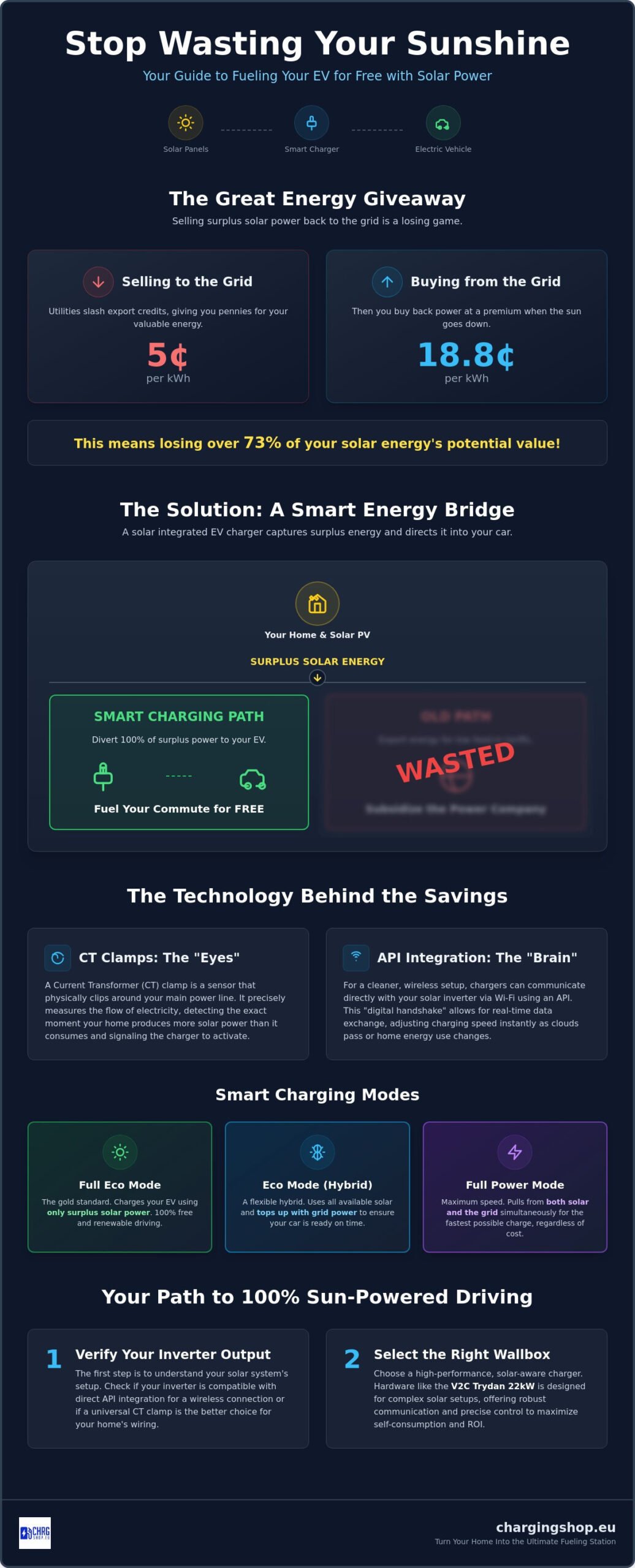
Your roof is a goldmine of free fuel, but right now, you’re likely giving most of it away for pennies. With utility companies in states like California slashing export credits to as little as 5 cents per kWh, sending surplus energy back to the grid is a losing game. You bought solar panels to achieve independence, not to subsidize the power company. It’s time to stop the waste and start fueling your commute for free.
Integrating a solar integrated ev charger into your home system is the most effective way to lower the total cost of EV ownership. We’ll show you exactly how to bridge the gap between your panels and your car battery for 100% sun-powered driving. Whether you’re looking at the high-performance V2C Trydan or another solar-aware wallbox, the goal is simple: zero-cost mobility.
In this guide, you’ll learn about the latest 2026 NEC installation requirements, how to navigate the end of federal tax credits, and the hardware needed to automate your charging. We’ll simplify the technical jargon and provide a clear path to full energy autonomy. Let’s turn your home into the ultimate petrol station.
Key Takeaways
- Understand how a solar integrated ev charger prioritises your free energy over expensive grid power to maximise self-consumption.
- Discover the role of CT clamps and communication protocols in creating a seamless link between your solar panels and your vehicle.
- Identify why high-performance hardware like the V2C Trydan 22kW offers the best long-term compatibility for complex solar setups.
- Learn to leverage the CHRG Network for advanced monitoring and prepare your home for future-ready technologies like Vehicle-to-Home (V2H).
- Follow a streamlined two-step process to verify your inverter output and select the right wallbox for 100% sun-powered driving.
What is a Solar Integrated EV Charger?
A solar integrated ev charger is far more than a simple power outlet for your car. It’s a sophisticated energy management hub that acts as a bridge between your solar panels and your vehicle. Unlike a standard wallbox that blindly pulls power from whichever source is available, an integrated unit communicates directly with your solar PV system. It monitors exactly how much energy your roof produces in real time. Its primary mission is simple: prioritise your free, self-generated “green” electricity and keep expensive grid power at bay. By doing this, you aren’t just charging a car; you’re optimising your entire home’s energy ecosystem.
Standard chargers are often “dumb” devices. They operate at a fixed speed, regardless of whether your solar panels are peaking or if the sun has gone down. This lack of communication causes a massive waste of resources. When your panels produce more than your home needs, that excess energy usually flows back to the grid. In 2026, with many utilities offering measly export credits of just 5 to 8 cents per kWh, selling your power back is a bad deal. An integrated charger stops this leak by diverting that surplus directly into your EV battery, ensuring your solar investment pays for itself years faster.
Why ‘Excess Solar’ Charging is the Gold Standard
Charging from the grid means paying the national average of 18.8 cents per kWh. Charging from your roof costs you nothing. The “Gold Standard” of EV ownership is “Full Eco” mode, where the charger only activates when it detects surplus solar generation. This prevents you from exporting energy for low feed-in tariffs and then buying it back later at a premium. Beyond the financial wins, the environmental impact is massive. While true Solar-powered vehicles are still a niche technology, using your home array to fuel your commute achieves the same goal: 100% renewable mobility with zero tailpipe emissions.
The ROI of Solar-EV Integration in 2026
The financial landscape changed significantly after the expiration of major federal tax credits in mid-2026. Now, the fastest path to a return on investment is through self-consumption. Every kilowatt-hour you keep for yourself is money saved on your utility bill. Smart hardware, like the V2C Trydan 22kW, pays for itself by automating this logic. It “follows the sun” by adjusting its charging speed to match your solar output. This precision ensures you never pull more from the grid than necessary. Simply put, every mile driven on solar is a mile driven for free.
How Solar-to-EV Integration Works: The Mechanics
Your solar integrated ev charger doesn’t just guess when the sun is shining. It relies on precise hardware and software to monitor every watt. The most common tool for this is the Current Transformer (CT) clamp. This small sensor clips around your main incoming power cable and acts as the “eyes” of the system. It detects the exact moment your solar panels produce more than your home consumes. When it sees energy heading toward the grid, it signals the wallbox to divert that power into your car instead.
Communication is the engine behind this process. Modern units use protocols like Modbus or Wi-Fi APIs to create a digital handshake with your solar inverter. This allows for real-time adjustments. If a thick cloud passes over your roof, the charger immediately modulates its amperage to match the lower output. This prevents the system from accidentally pulling expensive power from the grid. For homeowners exploring advanced energy management, research into solar energy storage for EV charging shows how integrating batteries can further stabilise this flow, ensuring your car stays topped up even during intermittent sunlight.
Hardware Integration: CT Clamps vs. Direct API
CT clamps are the universal choice. They work with almost any inverter brand because they measure physical current. They are reliable but often require a wired connection back to the charger. Wireless or API integration is the cleaner alternative. It uses your home Wi-Fi to sync the charger and inverter data. While this eliminates messy cabling, it depends heavily on your signal strength. If your Wi-Fi drops, the charger may lose its “solar awareness” and revert to standard grid charging. If you’re unsure which setup fits your home, you can browse our solar-ready hardware to see which models support your specific inverter.
Charging Modes: Eco, Eco+, and Full Power
Smart chargers offer three distinct modes to manage your energy. Eco Mode is a hybrid approach. It uses all available solar power and tops it up with grid electricity to ensure your car is ready by a specific time. Eco+ is the “Solar Only” setting. In this mode, charging only happens when there is a surplus. If the sun goes down or you turn on a high-power appliance, the charging stops instantly. Full Power mode ignores the sun entirely. It pulls from all sources to charge at maximum speed, which is essential when you have a long trip planned and need a full battery fast. Using high-performance hardware like the V2C Trydan 22kW allows you to toggle these modes via an app, giving you total control over your mobility costs.
Choosing Your Hardware: Why the V2C Trydan Leads
Hardware choice defines your success. A mismatched wallbox turns your high-performance solar array into a bottleneck. While many manufacturers force you into proprietary ecosystems, the best solar integrated ev charger for 2026 is one that remains brand-agnostic. This flexibility ensures your charging setup survives even if you upgrade your solar panels or swap your inverter later. You need a bridge, not a barrier. Investing in the right hardware now prevents costly retrofits when technology evolves. This principle of choosing the right equipment for the task applies to more than just energy; for instance, healthcare professionals who need reliable support for long hours on their feet often check out Sygeplejebutikken for specialized orthopedic footwear.
The V2C Trydan 22kW stands out because it prioritises this open compatibility. It doesn’t require expensive, brand-specific communication modules to function. Instead, it uses advanced firmware to sync with the equipment you already own. In a market where some brands charge extra for “solar features,” the Trydan includes them as standard. This direct approach simplifies your installation and reduces the total cost of ownership from day one.
Capacity is the second pillar of a smart choice. During peak summer afternoons, a large solar array can easily exceed the 7kW limit of standard home chargers. If your charger can’t keep up, that extra energy gets exported to the grid for a fraction of its value. Opting for a 22kW model allows you to capture every available photon. It provides the headroom needed to soak up high-yield solar spikes, turning a sunny afternoon into a full battery without spending a cent on grid power.
V2C Trydan: The Best Solar Integrated EV Charger
Integration should be invisible. The V2C Trydan excels here by offering built-in support for major inverters like Huawei, Fronius, and Kostal. You don’t need external control boxes or hidden subscriptions. Simply connect it to your home network and use the intuitive app to schedule “Sun-only” sessions. This ensures your car only sips power when your roof is producing a surplus. It’s a clean, efficient, and professional solution for the modern home. To get the most from this level of hardware, pairing it with a smart EV charger with app control strategy lets you manage solar scheduling, real-time monitoring, and dynamic load balancing all from your pocket.
Comparing Premium Options: Alfen vs. ABB
While the Trydan leads in connectivity, other premium options serve specific needs. The Alfen Single Pro Line 22kW is the industrial-grade choice. It’s designed for high-usage sites where durability is the top priority. If you have a massive solar array and multiple EVs, Alfen offers the reliability you need. Alternatively, the Abb terra ac provides a robust, space-saving design for standard residential setups. It is a dependable alternative that balances performance with a compact footprint. Match your choice to your inverter brand and daily mileage for the best results. Before finalising your decision, reviewing a detailed V2C Trydan vs Wallbox Pulsar comparison can help you understand exactly how these premium wallboxes stack up against each other on solar integration, dynamic load balancing, and 2026 EPBD IV compliance.
How to Set Up Your Solar Integrated Charging System
Setting up your solar integrated ev charger requires a methodical approach to ensure every watt of sunlight reaches your battery. First, verify your solar PV system’s maximum output and inverter type. Knowing whether you have a 5kW single-phase or a 22kW three-phase system is vital for hardware matching. Next, select a compatible wallbox like the V2C Trydan 22kW to serve as your energy hub. Since the 2026 National Electrical Code now requires hardwired chargers to be installed by a licensed professional, you should coordinate with an electrician who understands solar logic. The national effective date for these stricter installation rules was September 1, 2026, so professional compliance is no longer optional.
The physical heart of the setup is the Current Transformer (CT) Clamp. Position these clamps correctly at the grid connection point, usually right after your main utility meter. This placement allows the charger to see the “net” energy flow of your entire home. Once the hardware is live, configure the charger’s “Solar Mode” via the mobile app. Finally, perform a live test during peak sunlight hours. Watch your app’s dashboard to confirm that the charging amperage increases as the sun hits its zenith. If you’re ready to start your installation, secure your solar-ready wallbox here to begin the process.
Configuring the App for Maximum Efficiency
Efficiency lives in your software settings. You must set your “Surplus Threshold” to dictate exactly when the car should start charging. Most EVs require a minimum of 6 Amps to begin a session. If you set this threshold too low, the charger might start and stop too frequently on a day with passing clouds. Use the scheduling tools to prioritise solar during the day and low-rate grid power during off-peak night hours. This dual strategy ensures your car is always ready without ever paying peak utility rates. Modern apps now track “Solar Miles,” giving you a concrete look at how much free fuel you’ve harvested each month. For a deeper look at how to unlock precision scheduling, peak-rate avoidance, and real-time consumption dashboards, the complete guide to smart EV charger with app control in 2026 walks you through every feature available on today’s top wallboxes.
Common Setup Pitfalls to Avoid
Precision is the difference between free driving and a high utility bill. Incorrect CT clamp orientation is the most frequent reason solar integration fails. If the clamp faces the wrong way, the system will misread your solar export as grid consumption, causing the charger to shut down. Also, check your Wi-Fi signal strength at the charging point. Garages and driveways are often signal dead zones, which can break the digital link between your inverter and the charger. Improper configuration can lead to unintentional grid usage that spikes your monthly costs when you least expect it.
Maximising ROI with Smart Energy Management
Installation is just the beginning. To truly squeeze every cent of value from your solar integrated ev charger, you must move from passive charging to active energy management. Hardware like the V2C Trydan or Alfen Single Pro Line provides the muscle, but software provides the brain. Access to the CHRG Network allows you to monitor real-time consumption patterns and track exactly how much grid power you’ve displaced. This data isn’t just for show. It helps you refine your “Surplus Threshold” settings to ensure your car captures every available drop of sunlight before it leaks back to the grid for a low credit.
Future-proofing is the secret to long-term ROI. The energy landscape is shifting toward Vehicle-to-Home (V2H) and Vehicle-to-Grid (V2G) technologies. These systems allow your EV to act as a massive backup battery for your house during peak evening hours or grid outages. By investing in high-spec, OCPP-compliant hardware now, you ensure your system is ready for these updates without needing a total teardown. Charging Shop focuses on providing this future-ready gear so your investment remains relevant well into the 2030s.
Maintenance for these systems is remarkably simple but vital. Keep your charger’s firmware updated to the latest 2026 standards to ensure compatibility with new EV models and inverter software. Periodically check the physical CT clamp connections at your meter box. Vibration or thermal expansion can occasionally loosen these sensors, leading to inaccurate solar readings. As your household grows and you add more EVs, we help you scale by integrating additional wallboxes that share your solar harvest through intelligent load balancing. To ensure your growing list of home assets and digital records are properly managed, read more about IronClad Family’s secure storage solutions.
The Future: Vehicle-to-Grid (V2G) and Beyond
Your car is more than a vehicle; it’s a mobile power plant. The next generation of solar charging relies on OCPP 2.0.1, the latest communication standard that enables deeper integration with the utility grid. This protocol allows for “smart discharging,” where you can sell power back to the grid during high-demand spikes for a premium price. Buying high-spec hardware like the V2C Trydan 22kW today saves you money later. You won’t have to replace your charger when these grid-services programs become standard in your area.
Get Your Personalised Charging Offer
Every home is unique. Your roof orientation, inverter brand, and daily mileage all dictate which hardware will deliver the fastest payback. Don’t waste money on a “one size fits all” solution that might not talk to your specific solar array. We simplify the procurement process for global customers by matching you with the exact technical specifications you need. Get your Personalised Charging Offer today! and start driving on 100% sun-power.
Take Control of Your Energy Future
The transition to 100% sun-powered driving is no longer a luxury; it’s a strategic necessity. By installing a solar integrated ev charger, you reclaim the power your roof produces and eliminate the sting of rising utility rates. You’ve learned how to bridge the gap between your panels and your car, from correctly positioning CT clamps to selecting high-performance 22kW hardware that captures every available photon. Stop donating your surplus energy to the grid for pennies and start fueling your mobility for free.
Charging Shop is your technical partner in this transition. We provide expert hardware selection, featuring premier brands like V2C and Alfen that are built for the complex demands of solar integration. Our global shipping ensures you get the world’s most reliable wallboxes delivered directly to your door, backed by our authority in smart energy management. Shop Solar-Ready EV Chargers at Charging Shop today and secure your energy independence. The road to zero-cost driving starts with the right hardware.
Frequently Asked Questions
Do I need a specific brand of solar panels to use a solar integrated EV charger?
No, you don’t need a specific panel brand. Most high-performance units use CT clamps or API connections to monitor energy flow at your main meter. This makes the hardware compatible with any photovoltaic array regardless of the panel manufacturer. Your focus should be on the inverter’s communication capabilities rather than the panels themselves.
Can I charge my EV using solar panels if I don’t have a home battery?
Yes, you can charge directly from your panels without a stationary home battery. The solar integrated ev charger detects when your roof is producing a surplus and diverts that power straight into your car. While a home battery helps for overnight charging, the charger handles real-time solar diversion perfectly during daylight hours.
How much solar power do I need to actually charge an electric car?
Most electric vehicles require a minimum of 1.4kW (6 Amps) to begin a charging session. For consistent results, a solar array of 4kW to 5kW is the practical baseline. This ensures you have enough overhead to power your home appliances while still sending a steady stream of “green” energy to your vehicle battery.
What happens to my EV charging if a cloud covers the sun?
The charger automatically adjusts its speed in real time. If a cloud reduces your solar output, a smart wallbox like the V2C Trydan throttles down the amperage to match. If the available power drops below the 6 Amp threshold, the session will pause instantly to prevent pulling expensive electricity from the grid.
Is it possible to integrate solar charging with a 22kW wallbox on a single-phase supply?
Yes, you can install a 22kW charger on a single-phase supply, but your maximum speed will be limited to 7.4kW. This is a smart move for future-proofing. If you ever upgrade to a three-phase supply or a larger solar array, your hardware is already capable of handling the increased power without a costly replacement.
Do solar integrated chargers work with microinverters like Enphase?
Yes, they work perfectly with microinverter systems. By placing CT clamps at the main grid connection point, the charger sees the total combined output of all your microinverters. This setup allows for accurate “excess solar” tracking without needing to communicate with each individual microinverter on your roof.
What is the difference between ‘Green Mode’ and ‘Eco Mode’ on a V2C charger?
Green Mode is 100% solar and only charges when you have a surplus. Eco Mode is a hybrid setting. It uses all available solar power but adds a small amount of grid electricity to maintain a minimum charging speed. This ensures your car continues to charge even when solar production dips slightly. If you’re weighing whether the V2C Trydan’s mode flexibility gives it an edge over competitors, the in-depth V2C Trydan vs Wallbox Pulsar guide breaks down exactly how each unit handles these charging scenarios.
Will a solar integrated charger save me more money than a standard charger?
Absolutely. A solar integrated ev charger saves you money by maximising self-consumption. Instead of exporting power to the grid for as little as 5 cents per kWh, you use it to replace grid power that costs an average of 18.8 cents per kWh. This significantly shortens the payback period of your entire solar installation.
