
 Deutsch
 Dansk
Dansk Suomi
Suomi Latviešu
 Lietuvių
 Norsk bokmål
 polski
 Русский
 Svenska
No products in the cart.
Uncategorized
V2C Trydan vs ABB Terra AC Charger: The 2026 Head-to-Head Comparison
31
Aug
Aug
The most expensive charger in the catalog isn’t always the smartest investment for your home. You’ve likely spent hours comparing the V2C Trydan vs Abb terra ac charger only to end up more confused by load balancing jargon and conflicting app reviews. It’s frustrating to invest in premium hardware and still worry about whether your solar panels will actually talk to your car. You need hardware that connects via WiFi, Bluetooth, or OCPP without a constant digital headache.
This 2026 head-to-head comparison strips away the marketing fluff to deliver a clear winner for your specific setup. Whether you’re chasing the ultimate ROI on solar integration or you need the industrial reliability of a global powerhouse, we’ve got the data you need. We’ll explore the seamless smart features of the Trydan and the rugged, multi-user focus of the Terra AC. By the end, you’ll know exactly which wallbox belongs on your wall and how to secure our Personalised Charging Offer to get started today.
Key Takeaways
- Master the solar battle by seeing how V2C’s native surplus charging beats ABB’s external meter requirements.
- Compare the V2C Trydan vs Abb terra ac charger to see how ABB’s industrial IK10 rating stacks up against V2C’s home-focused design.
- Verify hardware connectivity standards like OCPP 1.6J to ensure your wallbox integrates perfectly with the CHRG Network.
- Simplify technical jargon around load balancing and IP54 ratings to choose hardware that survives the elements.
- Get a clear verdict on the best 22kW performance for your specific home or small business setup in 2026.
V2C Trydan and ABB Terra AC: Two Philosophies of EV Charging
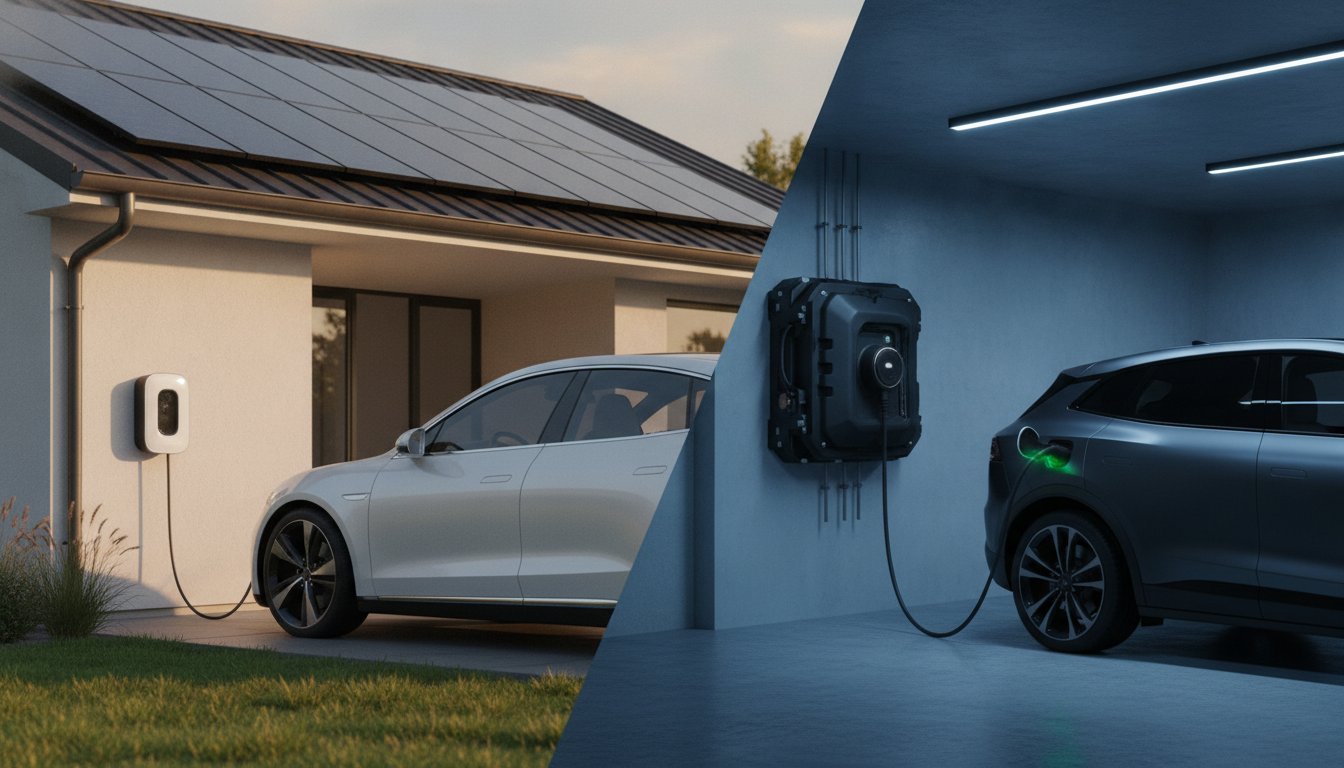
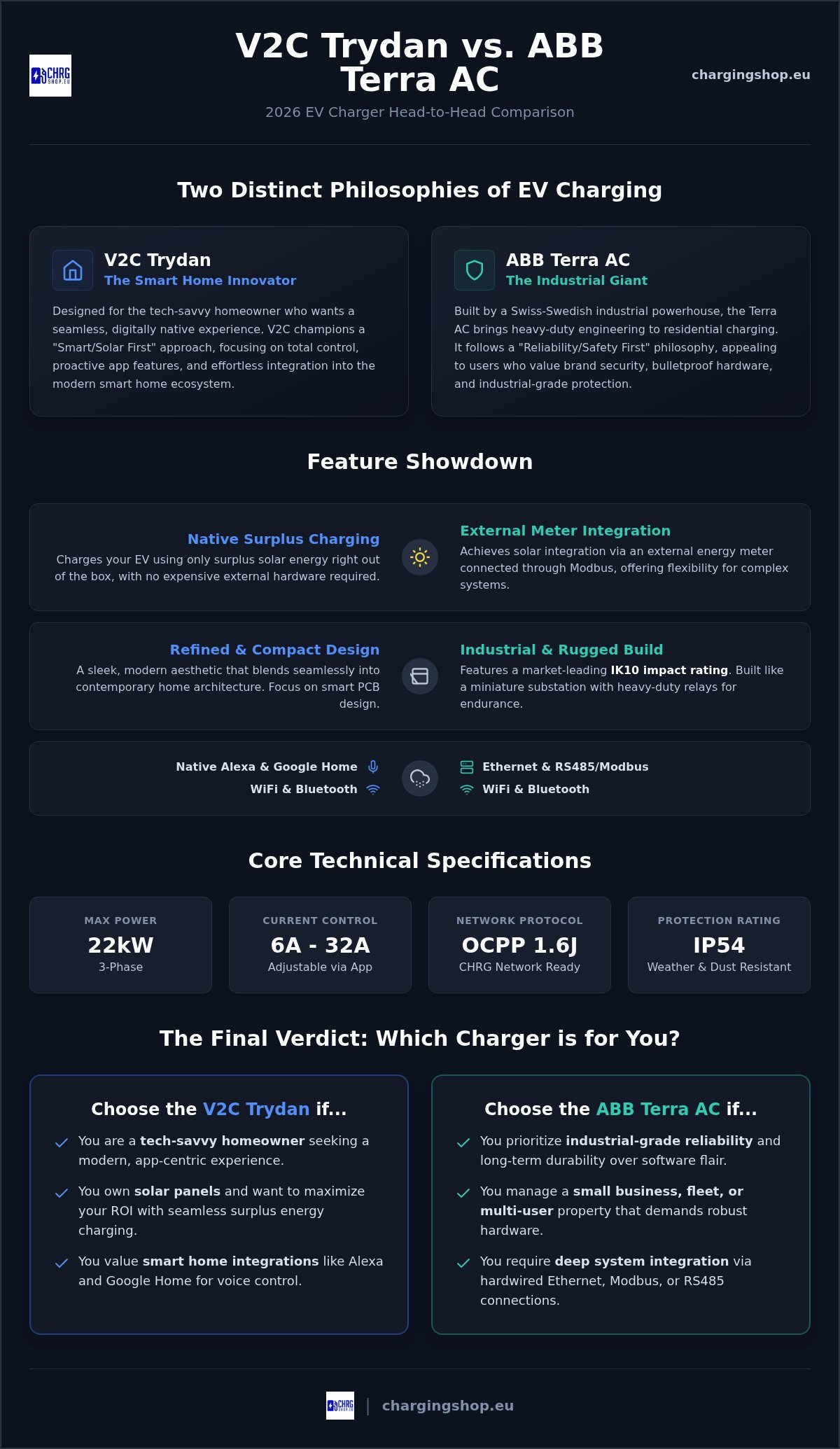
2026 is the year your driveway gets a serious electrical upgrade. If you’re comparing the V2C Trydan vs Abb terra ac charger, you’re already ahead of the curve. You want 22kW performance that doesn’t just work today but stays relevant for the next decade. These units represent two distinct philosophies in the world of electric vehicle supply equipment (EVSE). V2C is the agile Spanish innovator. They build for the modern smart home ecosystem. ABB is the Swiss-Swedish industrial giant. They bring heavy-duty engineering to residential charging. Both deliver 3-phase power, but they serve very different masters.
The core difference comes down to your priorities. V2C champions a “Smart/Solar First” approach, making it the darling of the tech-savvy crowd. ABB leans into “Reliability/Safety First,” appealing to those who want a charger with industrial pedigree. You aren’t just buying a plastic box; you’re choosing how your home interacts with the grid and your vehicle. One focuses on the digital experience, while the other prioritizes bulletproof hardware that stands the test of time.
The V2C Trydan Value Proposition
The V2C Trydan 22kW is the undisputed king of the smart home philosophy. It’s designed for the homeowner who wants total control without the headache. You get native solar integration as a core feature. This means you can charge your car using only the surplus energy from your roof without buying expensive external hardware kits. It’s a digital-native experience. The app is clean, fast, and proactive. Dynamic load balancing is a standard feature here, not a paid extra. It monitors your home’s energy consumption in real-time to prevent fuse trips while keeping your EV topped up. If you want your charger to feel like a high-tech smartphone for your car, V2C wins.
The ABB Terra AC Value Proposition
The Abb terra ac follows a professional mindset. ABB is the global leader in DC fast charging for a reason. They don’t do fluff; they do hardware that lasts. This charger is for the user who values brand security and industrial-grade protection above all else. It’s backed by over 100 years of electrical expertise. You get extensive connectivity options like OCPP 1.6J and Modbus support. This makes it the perfect candidate for the CHRG Network or complex energy management systems. It’s built to handle the elements and the rigors of daily multi-user use. While V2C focuses on the app interface, ABB focuses on the internal relays and safety protocols that keep your infrastructure secure. It’s the “set it and forget it” choice for long-term peace of mind.
Technical Specs Comparison: 22kW Performance and Hardware
Raw power defines this matchup. When comparing the V2C Trydan vs Abb terra ac charger, both units hit the 22kW 3-phase benchmark. This is the gold standard for residential and light commercial charging in 2026. ABB builds their unit like a miniature substation. It features heavy-duty industrial relays designed for thousands of cycles. V2C takes a different path. Their smart PCB design integrates complex logic directly into the board. This reduces the footprint while maximizing processing speed for smart features.
Design matters on your wall. The ABB Terra AC is a sturdy, utilitarian block built for endurance. V2C Trydan offers a more refined, compact aesthetic that blends into modern architecture. Both units adhere to strict safety protocols, aligning with the rigorous National Electric Vehicle Infrastructure Standards for hardware reliability. Connectivity is where the paths diverge. You get WiFi and Bluetooth on both, but ABB adds a dedicated Ethernet port and RS485 for hardwired stability in challenging environments.
Power Delivery and Amperage Flexibility
Precision control is vital for grid health. Both chargers allow you to adjust current from 6A to 32A instantly via their respective apps. They handle the switch between single-phase and three-phase charging with ease. You might wonder why 22kW hardware is essential for an 11kW car. It’s about thermal management and future-proofing. Running a 22kW charger at half capacity generates less heat and ensures you won’t need a hardware swap when you upgrade your EV. Check out our V2C Trydan 22kW stock to see these specs in action.
Connectivity and Smart Home Protocols
V2C Trydan is a digital native. It features native Alexa and Google Home integration right out of the box. You can start a charge with a voice command while finishing breakfast. ABB plays a more professional game. Their secret weapon is the Modbus-RTU port. This allows solar hobbyists and fleet managers to write custom scripts for deep system integration. Bluetooth reliability is a standout for both, though the V2C app feels more like a consumer product. The ABB TerraConfig experience is more technical, reflecting its industrial roots. Both ensure you stay connected, but V2C focuses on the user while ABB focuses on the system.
The Solar Battle: V2C Trydan’s Edge vs. ABB’s Modbus Flexibility
Solar charging isn’t just a luxury in 2026; it’s the primary driver of your charging ROI. When you compare the V2C Trydan vs Abb terra ac charger, the way each unit handles surplus energy will dictate your total installation experience. V2C has built its entire reputation on native solar intelligence. ABB approaches solar through the lens of industrial automation. Both can keep your car running on sunshine, but the technical path they take is radically different. Efficiency is the deciding factor here. V2C’s integrated logic reacts almost instantly to cloud cover or a sudden spike in household demand. ABB’s response time depends heavily on the speed of your external meter and Modbus configuration.
The financial impact is immediate. V2C includes the necessary sensors to monitor your solar production right in the box. This eliminates the need for expensive third-party energy meters. ABB requires an external meter or a dedicated Modbus controller to “see” your solar output. While this adds hardware cost, it provides a level of data granularity that professional energy managers crave. If you want a setup that works five minutes after the electrician leaves, V2C is the frontrunner. If you’re building a complex, multi-device energy ecosystem, ABB’s flexibility is hard to beat.
V2C Trydan: The Plug-and-Play Solar Solution
Simplicity is the ultimate sophistication. The V2C Trydan 22kW communicates directly with major inverter brands like Huawei, Solax, and Fronius. It uses an exclusive solar clamp system that clamps onto your mains. No extra meters. No complex wiring. You can set the charger to “exclusive” mode, ensuring your EV only sips energy when your panels are overproducing. This protects your home battery and maximizes your self-consumption. For a deep dive into the technical setup, read our V2C Trydan 22kW Guide to see how this hardware integrates with your specific inverter.
ABB Terra AC: The Professional Solar Route
ABB plays the long game with professional-grade connectivity. It utilizes a dedicated RS485 port for external energy management systems. This makes the Abb terra ac the preferred choice for larger solar-to-fleet deployments. You can daisy-chain multiple units to a single controller. The trade-off is setup complexity. You’ll need a tech-savvy installer to configure the Modbus registers correctly. However, once it’s live, you have industrial-scale control over every watt. It’s a robust solution for users who prioritize system-wide reliability over out-of-the-box simplicity. If you’re managing more than one vehicle or a small business fleet, this is your hardware.
Build Quality, Safety, and Long-Term Durability
Durability isn’t just about surviving a rainstorm. When evaluating the V2C Trydan vs Abb terra ac charger, you’re looking at two different levels of physical protection. Both units carry an IP54 rating. This ensures they’re sealed against dust and splashing water from any direction. However, the impact resistance tells a different story. ABB boasts an IK10 rating. This is the highest level of protection against external mechanical impacts. V2C focuses on a residential profile, prioritizing sleekness over the “tank-like” build of its competitor.
Safety protocols are a top priority for both brands in 2026. Each charger includes integrated 6mA DC leakage protection as standard. This saves you money on expensive Type B RCDs during the setup phase. They also feature robust surge protection to shield your EV’s battery from grid instability. These units are built for extremes. Whether you’re dealing with a Nordic winter or a Mediterranean summer, the internal thermal management keeps the 22kW delivery stable without derating prematurely. Reliability is baked into the hardware, not just the software.
Industrial Heritage vs. Modern Design
ABB brings over a century of electrical engineering to your driveway. Their hardware feels like it belongs in a high-stakes factory environment. It’s rugged, utilitarian, and undergoes rigorous vibration and climate testing. Electricians often prefer the ABB layout because it offers more internal wiring space. This makes the physical connection process faster and cleaner. V2C takes a different approach, leaning into Red Dot design influences. The Trydan is a statement piece. It’s compact, aesthetically refined, and won’t ruin your home’s curb appeal. You’re choosing between industrial brawn and modern elegance.
Management and Fleet Software
Managing multiple users is effortless on both platforms. RFID card readers come standard, allowing you to restrict access or track individual usage. This is essential for shared driveways or small business parking. For those who need professional-grade oversight, both chargers integrate seamlessly with CHRG Network Access. This allows for detailed billing, remote monitoring, and firmware updates across multiple stations. Thanks to full OCPP 1.6J compliance, these chargers are ready for the future of public and private charging networks. If you’re ready to secure your infrastructure, check out our Abb terra ac stock for immediate global shipping.
The Final Verdict: Which Charger Should You Buy in 2026?
The battle between the V2C Trydan vs Abb terra ac charger isn’t about finding a universal winner. It’s about matching the hardware to your driveway’s specific needs. Both units deliver 22kW of 3-phase power with precision. However, they serve two very different masters. One is a digital-first innovator designed to squeeze every cent of value from your solar panels. The other is a rugged industrial veteran built to provide decades of uninterrupted service. Your decision should rest on your primary goal: technical integration or bulletproof reliability.
Installation is another factor to weigh. Most electricians have encountered ABB hardware in industrial settings. This familiarity often leads to a faster, more confident setup. V2C is an agile challenger. While its internal layout is smart, it may require an installer who appreciates modern, app-centric configurations. Both chargers excel in safety and connectivity, but their “personalities” differ. V2C feels like a high-end smartphone for your car. ABB feels like a piece of essential utility infrastructure. Choose the tool that fits your lifestyle.
Choose V2C Trydan 22kW If…
You have a solar PV system or plan to install one soon. The native surplus charging logic is the best in the business for maximizing your ROI. You want a charger that looks like a modern tech product and integrates with Alexa or Google Home. If you value a responsive mobile app and want to avoid buying extra external energy meters, this is your unit. Explore our 22kW Home Wallbox Guide to see how the Trydan stacks up against other residential leaders.
Choose ABB Terra AC 22kW If…
You prioritize industrial-grade safety and a brand reputation that spans over a century. This is the correct choice for semi-public environments, multi-user residential blocks, or small business fleets. You need a “set it and forget it” solution that handles heavy daily use without flinching. The IK10 impact rating and professional-grade relays offer peace of mind that consumer-grade units can’t match. Read our ABB Terra AC Professional Guide for a deeper look at fleet management and billing options.
Final recommendation: Choose V2C for savings and smart home synergy. Choose ABB for durability and professional security. If you are still weighing your options, request our Personalised Charging Offer to get an expert recommendation tailored to your home’s electrical capacity and your vehicle’s specific needs.
Secure Your 22kW Infrastructure Today
Choosing between the V2C Trydan vs Abb terra ac charger determines how you’ll interact with your home’s energy ecosystem for the next decade. If you’re a tech-focused homeowner with solar panels, the V2C Trydan 22kW offers the most intuitive path to surplus charging. For those who demand industrial-grade durability and a century of engineering pedigree, the Abb terra ac remains the undisputed heavy hitter. Both hardware options are future-proofed with full OCPP 1.6J support and integrate perfectly with the CHRG Network for seamless management.
Don’t let technical jargon delay your transition to faster charging. We offer global distribution on all premium wallboxes and provide expert guidance to ensure your hardware matches your vehicle’s capacity. Take advantage of our technical expertise to find the right fit for your specific driveway or business setup. Browse the V2C Trydan and ABB Terra AC at Charging Shop to secure your Personalised Charging Offer today. Your smarter, faster charging experience is just one click away.
Frequently Asked Questions
Is the V2C Trydan app better than the ABB TerraConfig app?
The V2C Trydan app is generally considered more user friendly for residential owners because of its intuitive interface and seamless smart home integration. It focuses on the daily user experience. In contrast, the ABB TerraConfig app is a professional tool designed for technical setup and firmware management. While the ABB app offers deep industrial control, most home users find the V2C digital experience faster and more accessible for routine charging tasks.
Can I use the ABB Terra AC with my solar panels?
You can definitely integrate the Abb terra ac with solar panels, but it requires external hardware. Unlike the V2C Trydan which has native solar logic, the ABB unit needs an external energy meter or a Modbus-RTU controller to communicate with your inverter. This professional setup is highly reliable for larger systems. It allows for precise energy management, though it does add a layer of complexity to the initial hardware installation process.
Which charger has better impact resistance for outdoor installation?
The ABB Terra AC is the clear winner for physical durability with its IK10 impact rating. This is the highest standard for protecting internal components from mechanical force. While the V2C Trydan is robust enough for standard residential use, it doesn’t match the industrial tank-like build of the ABB unit. If your charger is located in a high traffic area, the ABB’s superior casing provides better long term security for your investment.
Do both chargers support OCPP for billing and remote management?
Yes, both the V2C Trydan and the ABB Terra AC fully support the OCPP 1.6J protocol. This is essential for anyone looking to connect their hardware to management platforms like the CHRG Network. This compatibility allows you to monitor usage, manage multiple users via RFID cards, and even set up billing structures. It ensures your 22kW wallbox remains a flexible part of the broader charging infrastructure as your needs grow.
Is a 22kW charger worth it if my car only supports 11kW?
Investing in a 22kW charger is a smart move even if your current car is capped at 11kW. It provides essential future-proofing for your next vehicle purchase. Additionally, running a higher capacity unit at lower speeds reduces thermal stress on the internal components. This often leads to better long term reliability. When comparing the V2C Trydan vs Abb terra ac charger, both 22kW models offer this overhead to keep your driveway ready for the future.
Does the V2C Trydan require an extra energy meter for load balancing?
The V2C Trydan doesn’t require a separate, expensive energy meter for dynamic load balancing because it includes specialized clamps in the box. These sensors monitor your home’s total power consumption in real time. The charger automatically adjusts its output to prevent your main fuse from tripping. This integrated approach simplifies the setup and reduces the total cost of ownership compared to units that mandate external third party meters for the same functionality.
Which charger is easier for a certified electrician to install?
Most certified electricians find the ABB Terra AC easier to install because of its generous internal wiring space and industrial design. The layout is familiar to professionals who work with high voltage equipment. While the V2C Trydan is straightforward for tech-savvy installers, the physical room inside the ABB casing often speeds up the manual connection process. Deciding between the V2C Trydan vs Abb terra ac charger often depends on your electrician’s familiarity with industrial hardware.
Can I manage both V2C and ABB chargers on the CHRG Network?
You can manage both V2C and ABB hardware through CHRG Network Access without any compatibility issues. Since both brands utilize the open OCPP standard, they integrate seamlessly into a single management dashboard. This is perfect for users who have a V2C Trydan at home and an Abb terra ac at their business. You get a unified view of energy consumption, user permissions, and remote diagnostics across your entire charging footprint.
