
 Deutsch
 Dansk
Dansk Suomi
Suomi Latviešu
 Lietuvių
 Norsk bokmål
 polski
 Русский
 Svenska
No products in the cart.
Uncategorized
EV Charging Load Balancing Explained: How It Works and When You Need It
06
Oct
Oct
What if your site could charge multiple EVs without letting chargers exceed the power available? If you’re looking for ev charging load balancing explained, the key idea is coordination: charging power is shared or adjusted to stay within a site’s electrical capacity. That matters when building demand changes or several vehicles plug in at once.
It’s reasonable to worry that adding chargers could exceed existing electrical capacity. Load balancing helps manage that risk, but the term can describe two different setups: sharing power among chargers, or coordinating charger demand with the building’s overall electrical load. They don’t work in exactly the same way.
This guide breaks down static and dynamic load management in practical terms, explains when each approach may help, and shows what information to gather before choosing charging hardware. You’ll also learn why metering, communication between equipment, and compatibility matter. Start with your site’s available capacity and charging needs, then match the hardware to the setup instead of assuming every charger can balance loads on its own.
Key Takeaways
- Use ev charging load balancing explained as a starting point for separating site-wide capacity control from power sharing among chargers.
- Map your electrical supply, existing loads, charging needs, and planned charger count before selecting equipment.
- Compare preset power limits with systems that adjust output as demand changes to find the approach that fits your site.
- Check what measurement hardware and communication method the setup requires, then verify charger compatibility in current manufacturer documentation.
- Use the checklist in this guide to narrow down capacity-aware hardware options for a single charger or a multi-charger site.
EV Charging Load Balancing Explained: The Site-Capacity Problem It Solves
Adding an EV charger doesn’t increase your home or workplace’s electrical capacity. It adds another demand to the supply already serving lights, heating, appliances, equipment, and other loads. EV charging load balancing coordinates charger demand with the electrical capacity available at a site. It helps keep charging within a configured limit as demand changes.
The goal is to manage available power, not create more of it. Load balancing can help make better use of existing capacity, but it doesn’t guarantee a particular charging speed. Actual power also depends on the charger’s settings and capability, the vehicle’s charging limits, and the site supply.
What does EV charging load balancing mean?
Think of your site’s electrical supply as a shared budget. A home or workplace uses some of that budget throughout the day, leaving a changing amount available for EV charging. Load balancing tracks or limits charging demand so it fits within that available headroom.
The phrase can describe two related but different controls. Site-level management limits an EV charger according to the building’s overall electrical use. Charger-to-charger management shares a set amount of power among multiple connected chargers. Load management offers a broader explanation of adjusting demand to help match available supply.
Why can several electrical loads compete for power?
Picture a workplace where EVs start charging while heating, kitchen equipment, computers, and machinery are already drawing electricity. The building’s demand isn’t fixed: equipment switches on and off, and vehicles arrive or finish charging at different times. If charging is set without accounting for other loads, the combined demand could exceed the limit assigned to the site or charging circuit.
That doesn’t mean every property needs load balancing or that a charger will automatically overload a building. Suitability depends on the site’s capacity, existing electrical demand, charger setup, and charging pattern. A site with ample headroom and one charger may have different needs from a workplace planning several chargers.
Keep the two control questions separate: How much power can the site safely allocate to charging? And, if several chargers are connected, how should they share that allocation? A system may address one or both. Either way, it manages demand against an existing limit. It doesn’t expand the supply, and charging output may change as available capacity changes.
How Dynamic EV Charging Load Balancing Measures and Shares Power
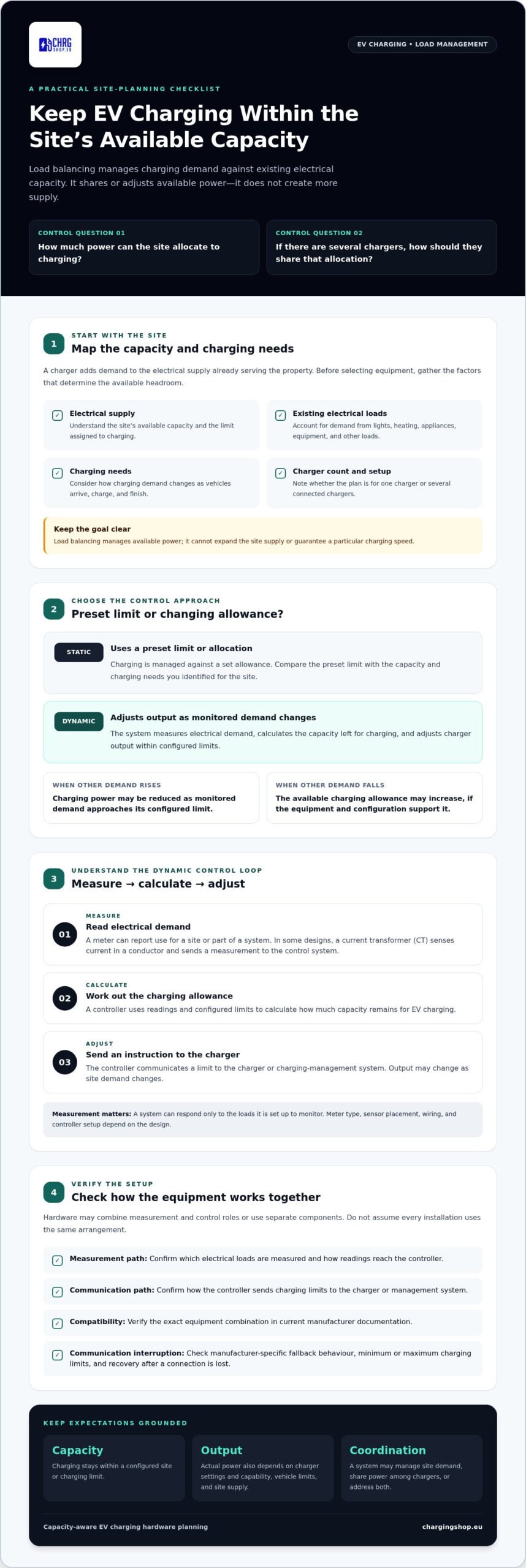
Dynamic load balancing follows a repeating control loop: measure electrical demand, calculate how much capacity remains for EV charging, then adjust charger output. This is the practical process behind ev charging load balancing explained. Instead of relying only on a fixed charging allowance, the system can respond as the site’s other electrical loads change.
For example, if a building’s equipment draws more power while a vehicle is charging, the system may reduce the power available to the charger. If that demand later falls, charging power may rise again, provided the equipment and configuration support it. The charger works within a defined capacity limit; it doesn’t create extra supply or promise a constant charging rate.
What do meters, sensors, and controllers do?
A meter can report electrical use for a site or part of its system. In some designs, a current transformer (CT) senses current in a conductor and sends a measurement to the control system. The measurement points matter: a system can only respond to the loads it is set up to monitor.
A controller uses those readings and configured limits to calculate the charging allowance, then communicates an instruction to the charger or charging-management system. The hardware may combine these roles or use separate components. Meter type, sensor placement, wiring, and controller setup depend on the system design, so don’t assume every installation uses the same arrangement.
How does the charger respond to changing demand?
Imagine a workplace where an EV is charging while other building equipment switches on. If monitored demand approaches its configured limit, the controller can signal a lower charging output. When other demand drops, the available allowance may increase, allowing charging to ramp up where the system supports that response.
That’s an adjustment, not a fixed speed promise. The vehicle and charger still have their own limits, and system behaviour depends on hardware, configuration, and communication between components. A single charger may respond to the building’s total demand. A multi-charger setup may also need to coordinate how charging power is shared among connected units.
Before choosing equipment, review how measurements reach the controller, how the controller sends limits to the charger, and what happens if communication is interrupted. Fallback behaviour, minimum or maximum charging limits, and recovery after a connection is lost are manufacturer-specific details. Verify them in current documentation for the exact equipment combination. Explore EV charging hardware as one part of planning a capacity-aware setup.
Static vs Dynamic Load Balancing: Which Charging Setup Fits?
Static and dynamic load balancing both help keep charging within a defined capacity, but manage power differently. Static management uses a preset limit or allocation. Dynamic management adjusts charging based on measurements of changing demand. Which fits depends on your site’s electrical capacity, how predictable its other loads are, and whether chargers need to share power.
| Approach | Control method | Response to changing demand | Typical fit |
|---|---|---|---|
| Static | Applies a preset power limit or allocation, depending on the system. | The limit generally stays in place rather than tracking live site demand. | Predictable use or a deliberately capped charging rate. |
| Dynamic | Uses measurements and compatible controls to adjust charging output. | Can respond to changing demand when supported by the equipment and configuration. | Variable building loads or multiple chargers sharing available capacity. |
Neither approach is automatically better. A fixed allocation may suit a simple, stable setup. Measurement-led control may make more of the available capacity when demand shifts, but it relies on compatible hardware and correct configuration. This is a key distinction in ev charging load balancing explained: the right option depends on how your site uses power, not just how many chargers you plan to add.
When can a fixed charging limit be enough?
A preset limit can suit a site with predictable electrical demand, or one where charging is intentionally capped to a chosen level. It’s straightforward: the charger or system follows an allocation rather than continually adjusting in response to building use. The trade-off is reduced flexibility. If other loads change, the fixed allowance may not reflect how much capacity is actually free. A preset limit doesn’t replace assessing the site’s electrical supply and existing loads.
When is dynamic balancing worth considering?
Consider dynamic control if other loads vary throughout the day or several chargers need to share a site’s available capacity. Homes, workplaces, and shared parking can all have these conditions, though none automatically requires dynamic balancing. By adjusting charging power to measured demand, a compatible system may use available capacity more flexibly. That can help avoid leaving headroom unused, but it doesn’t guarantee lower bills or a particular charging speed.
Before choosing, compare the actual setup: what demand is measured, which charger limits can be controlled, and how many chargers are coordinated. A static limit may be sufficient when demand is stable and the allocation meets charging needs. Dynamic management is worth evaluating when demand changes or charging loads must adapt. Keep the site’s capacity and equipment compatibility at the centre of the decision.
How to Assess Load Balancing for One Charger or a Multi-Charger Site
Start with the site, not the charger’s headline power. A single charger may need to limit its demand according to the building’s total use. At a multi-charger site, the setup may also need to distribute a shared charging allowance among several units. These are related tasks, but one doesn’t automatically provide the other. Use this checklist to clarify what your setup needs before comparing hardware.
- Identify the electrical supply. Gather available supply details and any known limits from the site’s electrical documentation.
- List existing loads. Note major equipment and when it typically operates, including loads that may run at the same time as EV charging.
- Define charging needs. Record the number of vehicles, likely simultaneous charging, how long vehicles are parked, and when they need to be ready.
- Map the planned charger count. Decide whether you need one charger or several now, and whether the site may expand later.
- Include energy systems. Note whether solar, battery storage, or an energy-management system forms part of the site.
There’s no universal capacity threshold that determines whether balancing is needed. Available capacity and charging requirements depend on the individual site. Electrical design and installation should be handled by qualified electrical professionals, using the site’s supply details and intended charging setup.
What changes between a home, workplace, and shared site?
Use the same checklist, then focus on how each location uses its chargers. At home, consider household demand and typical overnight charging patterns. A workplace should account for how many vehicles may charge together and how arrival, departure, and operating schedules affect demand. In shared parking, add access rules and decisions about allocating charging power, plus any plans to expand the number of chargers.
These details help distinguish a building-level limit from charger-to-charger sharing. For example, one charger can be managed against a home’s overall demand. A shared parking area with multiple chargers may need site-level control and coordination between chargers, depending on the design. Don’t assume a single feature covers both.
Use your findings to compare the charger’s supported control method, the measurement or management equipment required, and compatibility with the rest of the system. Check model-specific load-management details in current manufacturer documentation rather than inferring functionality from a product’s power rating. For a capacity-aware hardware setup, explore EV charging hardware suited to residential and commercial needs.
Choose Load-Balancing-Ready EV Charging Hardware with Confidence
A charger’s power rating tells you about its charging capability, not whether it can balance loads with your building or other chargers. Treat ev charging load balancing explained as a system question: the charger, measurement equipment, controller, and any management software must work together for the intended setup. Before choosing hardware, run through these checks:
- Capacity needs: Identify the site’s available electrical capacity, existing demand, and expected charging use.
- Control method: Decide whether you need a preset charging limit, site-level adjustment based on building demand, power sharing among chargers, or a combination.
- Measurement hardware: Establish what meter or sensor the system requires, what it measures, and how it connects to the control equipment.
- Charger compatibility: Check that the exact charger model supports the required control method and works with the intended measurement and management equipment.
Which compatibility details matter before choosing a charger?
Check the manufacturer documentation for the exact model and configuration. Look for support for the load-management method you need, requirements for external meters or sensors, supported integrations, and communication connections between components. These details determine whether the charger can receive and act on control instructions in your setup.
Don’t infer load-balancing capability from a charger’s power rating or general smart features. Two chargers with similar headline specifications may differ in how they support external measurement, site-level control, or coordination with other units. Match the documented functions to your site plan, and have electrical design and installation handled by qualified professionals.
How can Charging Shop support your hardware search?
Charging Shop offers residential and commercial EV charging hardware, including the V2C Trydan 22kW, V2C DENKA 20kW DC Wallbox, Alfen Single Pro Line 22kW, and Abb terra ac, along with CHRG Network access for charging-station management. Compare the requirements for your site with current manufacturer documentation for each model, and assess network access separately from the charger’s load-management functions. A charging network can support station management, but don’t assume it replaces compatible measurement or control equipment.
With your capacity needs, control method, measurement requirements, and compatibility details in hand, you’re better equipped to narrow your options. Explore EV charging hardware for a capacity-aware setup.
Plan Your Charging Setup Around Real Site Capacity
Load balancing helps coordinate EV charging with the electrical capacity available, whether the priority is setting a limit for one charger or sharing power across several. Static management applies a preset allocation; dynamic management can adjust charging based on measured demand when the system supports it. Neither creates extra capacity or guarantees a particular charging speed.
Before choosing hardware, map your site’s supply, existing electrical loads, charging schedule, and planned charger count. Then check the measurement equipment, control method, communications, and compatibility required by the exact charger model. Use current manufacturer documentation, and have electrical design and installation handled by qualified professionals.
Now you know what ev charging load balancing explained means in practice, you can compare hardware against your site’s needs with confidence. Charging Shop offers curated EV charging hardware for residential and commercial requirements, personalised charging offers, and CHRG Network access for charging-station management. Explore EV charging hardware and take the next step toward a setup that fits your capacity and charging goals.
Frequently Asked Questions
What is EV charging load balancing?
EV charging load balancing coordinates charger demand with the electrical capacity available at a site. A compatible setup may adjust charging power as other electrical loads change. It can manage one charger against the building’s total demand, or share an available charging allowance among several chargers. The exact operation depends on the hardware and configuration. Load balancing manages existing capacity; it doesn’t create more supply or promise a particular charging speed.
How does dynamic load balancing work with an EV charger?
Dynamic load balancing uses measurements of site demand to calculate how much capacity is available for charging, then adjusts charger output when supported. A meter or sensor may measure electrical use, while a controller processes the readings and communicates charging limits to compatible equipment. Check the manufacturer’s documentation for the exact measurement hardware, wiring, and communication method. Also verify what the system does if communication is interrupted, since fallback behaviour varies by implementation.
Do I need load balancing for a single home EV charger?
It depends on your home’s electrical supply, other loads, and charging requirements. A single charger may benefit from dynamic control if household demand changes and the system supports it, but not every home needs this feature. Consider when larger electrical loads operate and when your vehicle is usually parked. Base the decision on an assessment of the electrical setup and charger compatibility, rather than assuming that one charger never needs balancing.
What is the difference between static and dynamic EV load balancing?
Static management generally applies a preset charging limit or allocation. Dynamic management can adjust charging power in response to measured demand, when the equipment and configuration support that function. A fixed limit may suit predictable demand or a deliberately capped charging rate. Dynamic control can adapt more readily when loads vary. Neither approach is always best: system terminology and operation can differ, so compare your site needs with current documentation for the exact charger and controls.
Can load balancing let multiple EVs charge at the same time?
Yes, some compatible systems can coordinate power among multiple chargers, subject to the site’s available capacity and system configuration. The chargers may share or adjust their power allocation, so each vehicle won’t necessarily charge at its maximum rate throughout the session. Multi-charger power sharing is distinct from controlling charging against a building’s total demand. A site may need one function or both, depending on its electrical design and charging needs.
Does EV charging load balancing reduce electricity costs?
Not automatically. Load balancing primarily manages how charging uses available electrical capacity; it doesn’t change your electricity tariff or guarantee savings. Your costs depend on factors such as your tariff, charging schedule, site demand, and the features of the charging system. Capacity management is also different from time-of-use scheduling. Smart charging that shifts sessions to lower-cost periods may affect when electricity is used, but that depends on the tariff and system setup.
Will load balancing eliminate the need to upgrade my electrical supply?
Not necessarily. Load balancing may help manage charging within the capacity already available, but it can’t increase the site’s electrical supply. Whether an upgrade is needed depends on the supply, existing loads, charging requirements, and the design requirements that apply to your installation. There’s no universal answer based on charger count alone. Have a qualified electrical professional assess the specific site and planned charging setup before deciding whether existing capacity is sufficient.
