
 Deutsch
 Dansk
Dansk Suomi
Suomi Latviešu
 Lietuvių
 Norsk bokmål
 polski
 Русский
 Svenska
No products in the cart.
Uncategorized
EV Charging Station for Fleet Vehicles: A 2026 Buying Guide

07
Oct
Oct
What if adding more chargers is the wrong way to keep your fleet moving? The right ev charging station for fleet vehicles depends on when each vehicle is parked, how quickly it needs to recharge, and how much power your site can deliver. Get that balance wrong, and you could pay for capacity you don’t need or leave vehicles short of charge.
It’s understandable to want a clear charger count and power target before making a purchase. But those decisions should start with your fleet’s actual schedules and dwell times, not a one-size-fits-all rule. A practical plan can help you protect vehicle availability, manage site capacity, and leave room to grow without blindly oversizing the setup.
This 2026 buying guide explains how to match charging speed and charger type to daily operations, assess power demand, and plan for expansion. You’ll also see how to evaluate hardware such as the V2C DENKA 20kW DC Wallbox, Alfen Single Pro Line 22kW, and ABB Terra AC, and where charging network access fits into fleet management. Use the steps to translate your fleet’s requirements into a setup that works for your operation.
Key Takeaways
- Start with the vehicles that need charging during the same operating window to build a realistic fleet charging plan.
- Size your ev charging station for fleet vehicles around available charging time, site power, and each vehicle’s charging capability.
- Compare AC and DC charging against vehicle turnaround needs, parking time, and the power available at your site.
- Use parking patterns, cable reach, and vehicle movement to guide charger placement and a phased deployment.
- Assess charging hardware and network access separately, then align both with your fleet’s needs and growth plans.
EV Charging Station for Fleet Vehicles: Start With How Your Fleet Operates
Fleet schedules aren’t interchangeable. Routes, daily mileage, return times, and parked hours vary by vehicle and operation, so choosing an ev charging station for fleet vehicles starts with a schedule, not a charger count. First, group vehicles by when they need energy. A depot fleet that returns together at night has different charging needs from service vehicles that cycle through a workplace during the day.
Record when vehicles arrive, how long they stay, and when they must leave again. These details show whether charging can happen overnight, during a shift, or in a short gap between jobs. For a quick reference on charging formats and concepts, see this overview of EV charging station types and technology.
Map vehicle schedules before comparing chargers
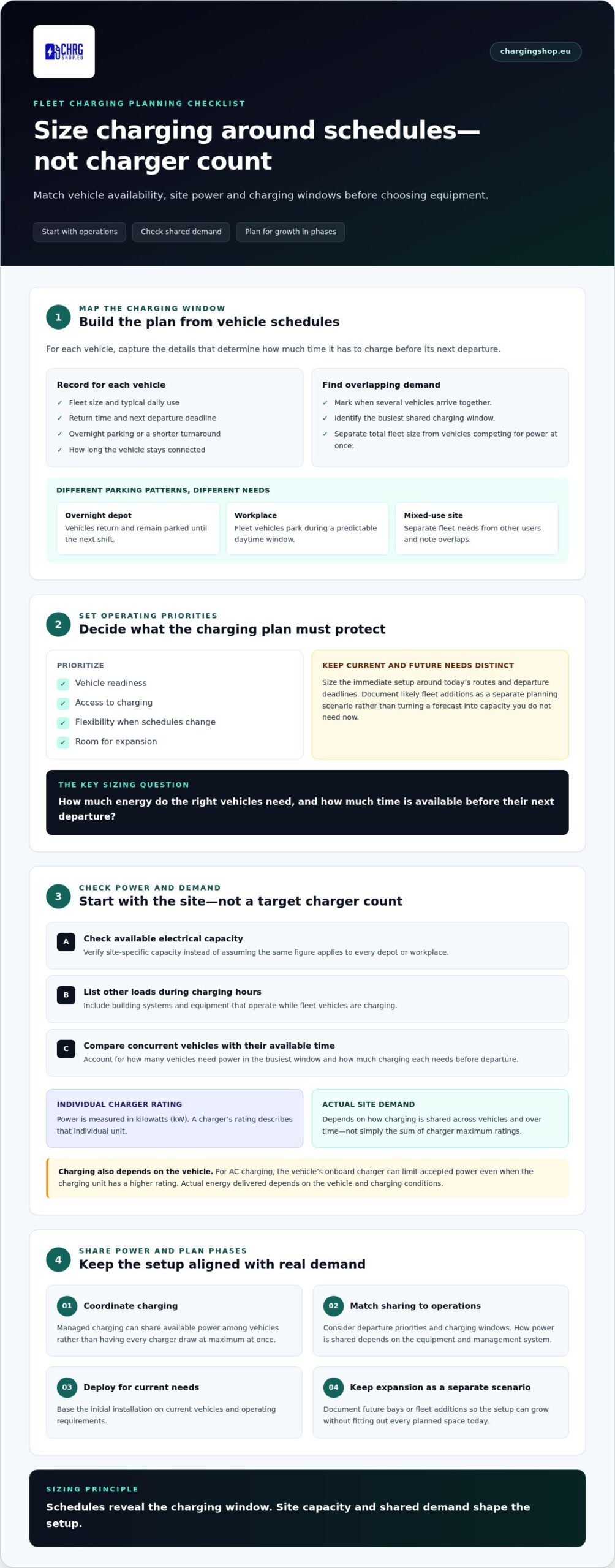
Build a simple worksheet for each vehicle. Record the fleet size, typical daily use, return time, next departure deadline, and whether the vehicle parks overnight or needs a shorter turnaround. Then mark the periods when several vehicles arrive at once. That peak window matters: vehicles may be parked for hours overall, but only part of that time may be available before the next departure.
- Overnight depot: Focus on vehicles that return and remain parked until the next shift.
- Workplace: Note fleet vehicles that are parked during a predictable daytime window.
- Mixed-use site: Separate fleet vehicles from other users and identify when their charging needs overlap.
This snapshot distinguishes total fleet size from the number of vehicles competing for charging at the same time. It also highlights a tight shared charging window, even when the site is open for many hours.
Set fleet availability and growth priorities
Decide what your charging plan must protect first. Rank vehicle readiness, access to charging, flexibility when schedules change, and room for expansion. Keep future fleet growth separate from current demand: document likely additions as a planning scenario, but size the immediate setup around today’s routes and departure deadlines. This makes expansion intentional instead of turning a forecast into unnecessary capacity now.
Fleet charging demand is the energy vehicles need, delivered to the right vehicles within the time available before their next departure.
Use this definition to compare operating patterns before assessing equipment. A vehicle parked overnight may have more charging time than one returning briefly between routes. The suitable setup depends on that window, the site’s available power, and your operation’s priorities. Start with the schedule, then use those requirements to guide charger and capacity decisions.
How to Size Fleet Charging: Power, Capacity, and Load Management
Charger ratings are only one part of the sizing decision. Power, measured in kilowatts (kW), is the rate at which a charger can deliver electricity. The time a vehicle is connected affects how much energy it can receive, but the actual amount also depends on the vehicle and charging conditions. For AC charging, the vehicle’s onboard charger can limit the power it accepts, even when the charging unit has a higher rating. The EPA’s guide to Understanding EV charging levels explains how charging levels differ.
For an ev charging station for fleet vehicles, don’t add up every charger’s maximum rating and assume that total will be your site’s constant demand. Instead, consider how many vehicles need power at once and how much charging each needs before departure. A fleet with staggered arrivals can share available capacity differently from one where vehicles return during the same short window.
Assess available power and simultaneous demand
Start with the site, not a target charger count. Gather information about available electrical capacity and note existing major loads, such as building systems or equipment operating during fleet charging hours. List how many vehicles are likely to charge concurrently in the busiest window, then compare that demand with the charging time each vehicle has. Treat site-specific electrical figures as details to verify; don’t assume the same capacity applies to every depot or workplace.
This sequence helps identify the real constraint. It could be the site’s available power, overlapping building demand, a narrow charging window, or a combination. Record your assumptions so the plan can be updated when schedules and fleet requirements change.
Use load management and expansion planning
Managed charging can coordinate how available power is shared among vehicles, instead of having every charger draw at its maximum at once. The way power is shared depends on the equipment and management system selected. When evaluating an approach, consider departure priorities and charging windows, and separate general load-management needs from specific network features.
Charger nameplate power describes an individual unit’s rating; actual site demand depends on how charging is shared across vehicles and time.
Plan in phases. Size the initial deployment around current vehicles and operating needs, and document future bays or fleet additions as a separate scenario. This gives you a path to expand without automatically fitting out every planned space today. A personalised charging offer can help frame equipment choices around your project requirements.
AC or DC Fleet Charging Station: Match Hardware to Turnaround Time
Choose AC or DC by looking at how long each vehicle can remain plugged in, how often it must return to service, and what power the site can support. Neither option is automatically best for every fleet. An ev charging station for fleet vehicles should match real turnaround requirements, not just a technology label.
| Planning factor | AC charging | DC charging |
|---|---|---|
| Charging window | Assess for longer parking periods, such as overnight or through a work shift. | Assess when vehicles have shorter windows between duties. |
| Vehicle turnover | May suit vehicles that remain parked for extended periods. | May suit higher-turnover schedules where faster replenishment is operationally important. |
| Site power | Check available capacity, charger rating, and the vehicle’s onboard AC charging limit. | Assess site capacity and the vehicle’s DC charging capability against the required turnaround. |
| Use case | Depot or workplace parking with predictable dwell time. | Operations with tight charging windows or frequent vehicle returns. |
When AC fleet charging may fit
AC is worth assessing when vehicles are parked for extended periods between duties. The longer charging window may make it practical to recharge without prioritizing rapid turnaround, subject to vehicle capability and site limits. Commercial examples include the Alfen Single Pro Line 22kW and ABB Terra AC. Compare their current specifications with vehicle requirements and the planned electrical setup before drawing conclusions about charging performance.
When DC fleet charging may fit
Consider DC when the operating schedule leaves little time between trips or shifts and getting a vehicle ready sooner matters. The V2C DENKA 20kW DC Wallbox is one option to assess against those duty cycles. Its suitability depends on the fleet’s vehicles, charging needs, and site capacity; the charger’s rating alone doesn’t determine the result. For a broader look at higher-power DC equipment, see the existing guide to 40kW DC wallboxes.
Some fleets may benefit from assessing both AC and DC for different vehicle groups or operating windows. Start with the tightest turnaround in the schedule, then consider whether other vehicles can charge during longer parking periods. This connects hardware choices to actual use rather than forcing every vehicle into the same charging pattern.
Plan Fleet Charging Deployment Around Site Layout and Daily Operations
A suitable charger can still create operational friction if it’s placed in the wrong spot. Map charging positions against parking patterns, vehicle access routes, and the order vehicles enter and leave the site. Check cable reach for each intended bay, and plan how cables will be handled so they don’t obstruct walkways or vehicle movement.
Coordinate charger locations with fleet movement
Mark dispatch peaks and shift changes on your site plan. If several vehicles arrive or depart together, charging points across a busy traffic route may create queues or block access. Note site conditions that could affect placement, including exposure to weather, restricted access, and areas where vehicles need to turn, load, or unload. Make the layout work for daily operations, not just the parking diagram.
- Map: bays, charger positions, routes in and out, and the cable reach needed at each parking space.
- Check: where vehicles may queue or cross paths during dispatch and shift changes.
- Record: environmental and access constraints that could shape equipment placement.
Keep equipment selection separate from site preparation. Choose chargers to reflect fleet needs and the intended layout, then account separately for the work needed to prepare the site.
Prepare an expansion-ready charging plan
Phase the rollout around current vehicles, schedules, and charging needs. Document the initial charging positions and equipment, then outline realistic later additions as a separate stage. Record the assumptions behind each phase, including expected fleet growth, site capacity, parking arrangements, and operating schedules. Revisit those assumptions as the fleet or site changes, rather than treating a future forecast as an immediate requirement.
Before settling on a configuration, use this checklist:
- Which vehicles need charging at each location, and when are they parked?
- Where are the bays, access routes, and practical charger positions?
- Can cables reach the vehicles without interfering with traffic or pedestrian paths?
- When do dispatch peaks or shift changes create congestion risks?
- What site constraints and capacity assumptions need to be accounted for?
- Which additions belong in the first phase, and which are future scenarios?
This planning record gives your ev charging station for fleet vehicles decision a clear operational basis. For a broader equipment overview, refer to the professional EV hardware guide as you compare options. Explore a personalised charging offer to connect equipment choices with your fleet’s requirements.
Choose Fleet Charging Hardware and Management That Fit Your Operation
Turn your fleet schedule, site capacity, charging windows, and layout into a short list of buying requirements. Then account for realistic growth: choose around current operations while keeping future needs visible. This gives you a practical basis for comparing an ev charging station for fleet vehicles without treating every charger or management option as essential.
Compare fleet hardware against your requirements
Assess hardware by charging type and how it could fit your duty cycle, not by name alone. The V2C DENKA 20kW DC Wallbox is a DC option to evaluate when the schedule calls for DC charging. The Alfen Single Pro Line 22kW and ABB Terra AC are AC examples to consider for your fleet’s charging needs. A product’s stated power or charging type doesn’t establish how it will perform with a particular vehicle or site, so compare current specifications and vehicle requirements before settling on a configuration.
For a closer look at the Alfen Single Pro Line 22kW, use a focused product review alongside your schedule and site assessment. Keep the comparison grounded in requirements: available parking time, vehicle charging capability, simultaneous demand, and practical charger placement. This helps narrow your options without assuming a single model suits every vehicle group.
Decide whether network access belongs in the plan
Charging hardware and network access address related but distinct needs. The charger is the physical equipment that supplies power to a vehicle. Network access is a separate purchasing decision connected to managing charging infrastructure. Consider the management needs of your operation and assess CHRG Network access separately from the hardware choice. A dedicated CHRG Network access guide can provide a deeper overview of that part of the decision.
Before you finalize your shortlist, check that it reflects five essentials:
- Schedules: which vehicles need charging, and when.
- Capacity: what the site can support during busy charging periods.
- Charging type: whether AC, DC, or a mix fits vehicle needs and turnaround times.
- Layout: whether parking positions and vehicle movement work with the planned equipment.
- Growth: which future additions are realistic and when they may be needed.
Ready to align hardware options with your fleet and site requirements? Request a personalised charging offer to support your project-specific purchasing decision.
Build a Fleet Charging Plan Ready to Grow
The right ev charging station for fleet vehicles starts with your operating reality: when vehicles return, how long they’re parked, and when they need to leave again. Match AC or DC hardware to those charging windows, then compare simultaneous demand with site capacity. A practical layout and phased growth plan can help serve today’s fleet without designing blindly for future demand.
Commercial options such as the V2C DENKA 20kW DC Wallbox and Alfen Single Pro Line 22kW can be assessed against your vehicle schedules and site requirements. Treat network access as a separate decision from the physical charger. CHRG Network access supports charging infrastructure management, while your hardware choice should reflect your fleet’s charging needs.
Ready to turn your requirements into a focused equipment plan? Request a personalised fleet charging offer based on your fleet and site. Take the next step with a plan built around how your operation works.
Frequently Asked Questions
How many EV charging stations does a fleet need?
There’s no universal charger-to-vehicle ratio; the right number depends on fleet size, daily energy needs, charging windows, and how many vehicles need power at once. For an ev charging station for fleet vehicles, map each vehicle’s return and departure times before choosing a quantity. Also distinguish installed chargers from vehicles served through managed scheduling: several vehicles may use the setup across different time windows, depending on site capacity and charging requirements.
Are AC or DC charging stations better for fleet vehicles?
Neither AC nor DC is best for every fleet. AC may suit vehicles parked for longer periods, while DC is worth assessing when turnaround windows are short. Compare both against vehicle charging capability, available site power, and operating patterns. A charger’s maximum rating alone won’t show how well it fits your operation. Start with actual schedules and departure deadlines, then evaluate equipment that can meet those needs within the site’s constraints.
Can multiple fleet vehicles charge at the same time?
Yes, multiple vehicles can charge concurrently if the site and charging setup can support their combined demand. Available electrical capacity, charger ratings, and any load management all affect how power is shared. A connected vehicle doesn’t necessarily receive its charger’s full rated power at every moment. Estimate how many vehicles will charge during the busiest period, then assess the capacity available to serve them without assuming all vehicles charge at full power.
How do I know if my site has enough power for fleet charging?
Compare the site’s available electrical capacity with existing building loads and the charging demand expected during busy periods. Include the number of vehicles likely to charge together and the hours available before departure. Assess site-specific electrical figures rather than relying on a standard panel size or supply assumption. If capacity is constrained, load management and phased planning are options to evaluate, but practical limits depend on the site.
What should I look for in a fleet EV charging station?
Match charger type and power to vehicle capability, parking time, site capacity, and fleet schedules. Then consider charger placement, vehicle movement, future growth, and whether your operation needs charging management. Document daily routes, return times, departure deadlines, and peak charging periods before comparing models. Treat headline specifications as a starting point, not a complete recommendation. Check model details against current manufacturer information and assess them against your vehicles and site.
Can a fleet charging system expand as the fleet grows?
Yes, expansion can be part of the plan, but future additions depend on site capacity, electrical layout, operating needs, and how the fleet changes. Separate the initial deployment from later vehicle or charger additions. Record assumptions about growth, schedules, and available power, then review them as demand evolves. Reserved space or planning for future infrastructure may be worth considering, but expansion can require additional site work and shouldn’t be treated as automatic.
Does a fleet need charging management software?
Not every fleet needs the same management tools. Consider whether you need to coordinate charging access, monitor use, or organize a growing setup, based on your fleet size, users, reporting expectations, and operating model. Keep network access separate from the hardware decision: chargers provide the physical charging equipment, while network access relates to management. CHRG Network access is available as a separate part of the solution; assess its role against your requirements.
