
 Deutsch
 Dansk
Dansk Suomi
Suomi Latviešu
 Lietuvių
 Norsk bokmål
 polski
 Русский
 Svenska
No products in the cart.
Uncategorized
EV Charger Payment Security: The 2026 Guide to Protecting Your Charging Revenue
03
Sep
Sep
Your EV charging station is a digital vault, but without the right hardware, the door is wide open to hackers. In 2026, ev charger payment security isn’t just a simple software patch; it’s a hardware-first strategy that involves encrypted modules and certified metering. You’ve worked hard to build your charging site. You shouldn’t have to worry about “skimming” devices or data theft draining your revenue while you sleep. It’s time to take control of your infrastructure.
We know the anxiety that comes with confusing MID meter regulations and the threat of network downtime. You want a site that generates consistent profit without constant security headaches. This guide will help you master the technical standards and hardware requirements needed to secure every transaction. You’ll learn exactly which brands, like Alfen, V2C, and ABB, offer the best protection for your investment. We’ll break down PCI DSS v4.0.1 compliance, ISO 15118 “Plug & Charge” standards, and how the CHRG Network secures your remote billing. Let’s build a secure, revenue-generating charging site together.
Key Takeaways
- Identify the 2026 threat landscape and why robust ev charger payment security is the foundation of a profitable, reliable charging business.
- Master the technical pillars of PCI DSS v4.0.1 compliance and MID metering to eliminate billing disputes and ensure legal transparency.
- Compare top-tier hardware from Alfen, V2C, and ABB to find the built-in security modules and anti-tamper features your site needs.
- Implement a proactive two-step audit to detect physical “skimmers” and verify the certification status of your entire commercial infrastructure.
- Leverage the CHRG Network for encrypted, cloud-based station management that protects your transaction data and revenue around the clock.
Why EV Charger Payment Security is the Foundation of Your 2026 Business
Your charging station is no longer just a plug; it’s a financial terminal. In 2026, ev charger payment security represents the end-to-end protection of transaction data and funds. It starts at the physical tap and ends when the money hits your account. Hackers now view EV stations as high-value entry points for financial theft. Maintaining robust cyber-physical system security is the only way to shield your revenue from these evolving threats.
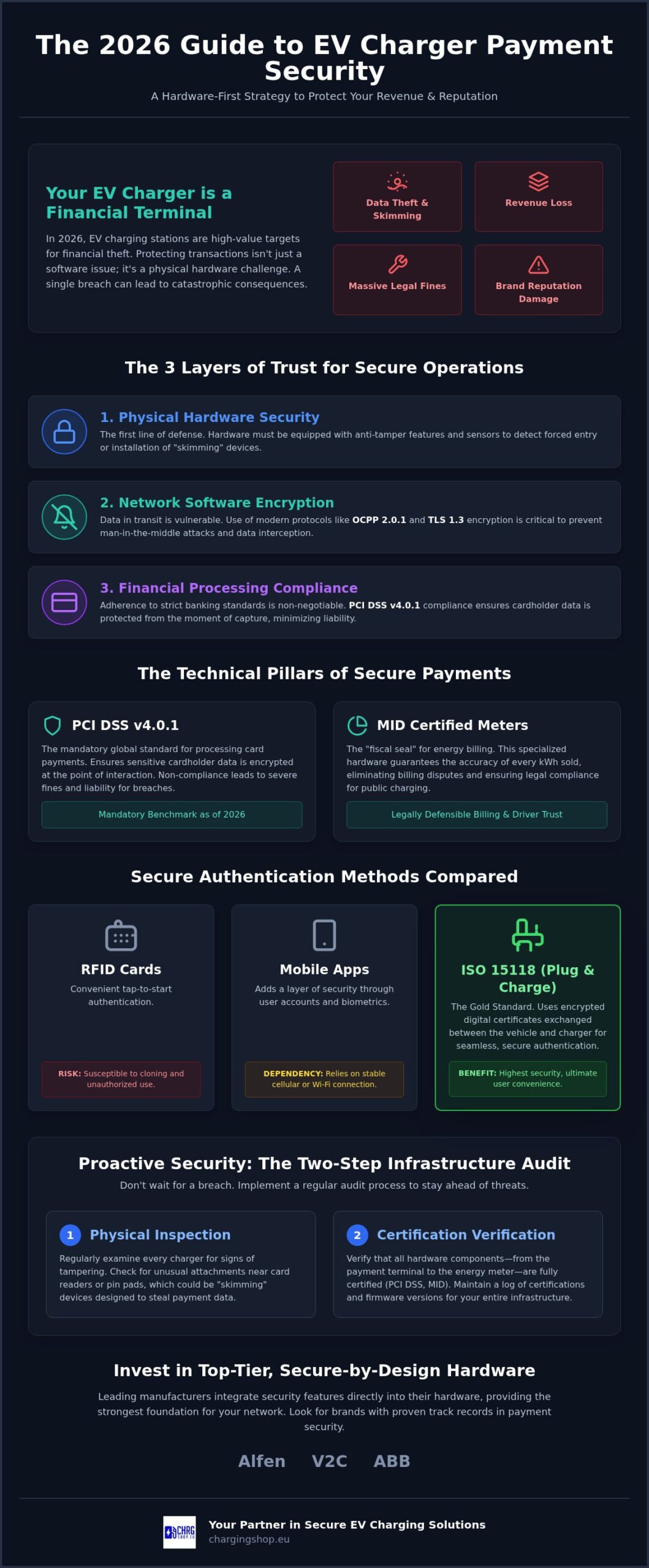
Secure operations rely on three distinct trust layers. Physical hardware must resist tampering and include sensors to detect forced entry. Network software must utilize encrypted protocols, such as OCPP 2.0.1, to prevent data interception. Finally, financial processing must adhere to strict banking standards to protect cardholder data. If any layer fails, your entire business is at risk. A breach isn’t just a technical glitch. It’s a cocktail of massive legal fines, immediate revenue loss, and scorched brand reputation.
The Shift from Free to Paid Charging
Paid charging is the new standard for site hosts looking to generate real ROI. This transition transforms you from a service provider into a high-volume merchant. Security is now a non-negotiable requirement for survival. Public trust is what scales your network. If drivers suspect “skimming” at your chargers, they’ll flock to competitors. Using secure hardware like the V2C Trydan ensures that every transaction is locked down. Secure payments aren’t just about safety; they’re about building a reliable, profitable brand that customers trust.
2026 Regulatory Landscape for EVSE
Regulations have caught up with the technology. The EU’s Alternative Fuels Infrastructure Regulation (AFIR) now mandates absolute payment transparency. By 2026, new public chargers must support direct card payments without forced subscriptions. This shift requires hardware that integrates secure digital payment terminals. Compliance isn’t just about avoiding penalties. It’s your primary shield against liability. Staying ahead of these global standards ensures your infrastructure remains viable and protected against future legal shifts. Robust ev charger payment security is your ticket to long-term market access.
The Technical Pillars of Secure EV Payments: From PCI to MID Meters
Securing your revenue requires more than a strong password. You need banking-grade standards integrated at the hardware level. PCI DSS v4.0.1 is now the mandatory benchmark for any station processing card payments as of 2026. This standard ensures that sensitive cardholder data is encrypted the moment it’s captured. If your hardware lacks these certifications, you’re not just risking a hack; you’re inviting massive merchant fines and liability. Don’t settle for “secure-ish” when your bank account is on the line.
Data doesn’t just sit on the charger. It travels. Modern ev charger payment security relies on the latest communication protocols to shield this journey. Use OCPP 2.0.1 to manage your station. It offers superior certificate management and security logging compared to older versions. Combine this with TLS 1.3 encryption to lock down the data tunnel between your hardware and the cloud. This prevents man-in-the-middle attacks where hackers intercept transaction details in real-time. Maintaining high-level cybersecurity for EV charging infrastructure is the only way to protect the grid and your bottom line.
MID Meters: The Unsung Hero of Payment Integrity
Commercial billing demands precision. A Measuring Instruments Directive (MID) certified meter is a specialized component that guarantees the accuracy of every kilowatt-hour delivered. Standard internal meters often drift, leading to revenue leakage or customer disputes over overcharging. If you’re selling electricity to the public, you can’t afford these errors. MID certification is a legal requirement for selling electricity by the kWh in most regions. It provides the “fiscal seal” needed for transparent, legally defensible billing that builds long-term driver trust.
Secure Authentication: RFID vs. App vs. Plug & Charge
How a driver starts a session determines the security of the entire transaction. Traditional RFID cards are convenient but susceptible to cloning. Mobile apps add a layer of security through biometrics, but they rely on stable cellular connections. The gold standard for 2026 is ISO 15118, commonly known as Plug & Charge. This standard uses encrypted digital certificates stored in the vehicle to automate authentication and billing. For fleet managers, dual-factor authentication is now the baseline for preventing unauthorized energy theft. You can find premium, secure hardware that supports these advanced protocols right now. V2C has even pushed the envelope with their SmartLock feature, allowing proximity-based locking via smartphone to ensure your charger only works for authorized users.
Comparing Payment Security in Premium Hardware: Alfen, V2C, and ABB
Hardware choice is your first line of defense. While software can be patched, physical security modules provide the permanent protection your revenue needs. Don’t assume every OCPP-compliant station is equal. True ev charger payment security requires dedicated hardware chips that handle encryption and tamper detection at the source. Choosing premium brands ensures you aren’t just buying a plug; you’re investing in a fortified financial terminal.
For high-speed commercial needs, the V2C DENKA DC wallbox sets the pace. It combines rapid charging with high-performance DC security protocols. V2C hardware excels in smart integration, using encrypted cloud communication to keep your data safe from the charger to the management dashboard. Their SmartLock feature even allows for proximity-based locking via smartphone, ensuring your charger only activates for authorized users. This level of control is essential for preventing energy theft in semi-public locations.
Alfen Single Pro Line: The Professional Standard
The Alfen Single Pro Line 22kW is built for serious business. It features industrial-grade security modules and internal MID-certified meters for bulletproof billing. Alfen’s Active Load Balancing does more than just manage power; it acts as a security layer that prevents grid-level tampering. By monitoring power draws in real-time, it can detect and block malicious attempts to crash your site’s electrical infrastructure. This robustness makes Alfen the preferred choice for European apartment complexes and high-traffic corporate offices where reliability is mandatory.
ABB Terra AC: Industrial Strength Security
If you want a global pedigree, the ABB Terra AC 22kW charger is the answer. ABB subjects their hardware to rigorous third-party safety testing that goes far beyond basic requirements. Every firmware update is digitally signed and encrypted. This prevents unauthorized overrides and ensures that only official, secure code ever runs on your station. ABB’s massive global infrastructure means security patches are delivered instantly. With over 95% of service cases diagnosed remotely, ABB ensures your station stays secure and operational without the need for constant on-site interventions. Secure your site with hardware that’s tested for the most demanding environments on earth.
How to Audit and Secure Your Commercial Charging Infrastructure
Stop reacting to security threats and start preventing them. A secure site isn’t a one-time setup; it’s a constant process of verification. If you’re managing multiple stations, you need a methodical approach to ev charger payment security. Don’t wait for a customer to report a stolen credit card or for a regulator to flag your billing. Take charge of your infrastructure today with a five-step security audit.
- Step 1: Conduct a physical audit. Inspect every charger for tampering. Look for overlays or “skimmer” attachments on card readers. Check for unauthorized wires or suspicious hardware additions.
- Step 2: Verify MID certification. Ensure every unit used for public billing has a visible MID seal. If the meter isn’t certified, your billing isn’t legally defensible.
- Step 3: Implement a secure management layer. Use the CHRG Network to centralize your operations. This provides a secure, encrypted tunnel for all transaction data.
- Step 4: Schedule regular firmware audits. Security patches are useless if they aren’t installed. Set a monthly schedule to verify that every unit is running the latest manufacturer software.
- Step 5: Review user access logs. Look for anomalies. Repeated failed RFID attempts or unusual app-based activity can signal a brute-force attack in progress.
Remote Management and Software Security
Cloud-based management is your best defense against data theft. A robust Central Management System (CSMS) like the CHRG Network is significantly safer than local-only management. It allows for instant, remote security patches and real-time monitoring. End-to-end encryption is the backbone of this system. It protects the data from the moment a driver taps their card until the funds reach your bank. This setup simplifies secure billing for multi-unit properties and ensures your ev charger payment security remains uncompromised across your entire network.
Physical Security Hardening
Hardware security starts on the outside. Use tamper-evident seals on all charger casings to reveal if a unit has been opened without authorization. Adequate lighting and high-definition CCTV coverage are simple but effective deterrents against physical tampering. At the hardware level, look for units that feature “Secure Boot” technology. This ensures that only authorized, digitally signed firmware can run on the device. It prevents hackers from injecting malicious code directly into the charger’s processor. Don’t leave your site vulnerable to physical intrusion. Secure your infrastructure today with hardware designed for the toughest commercial environments.
Future-Proof Your Network with Secure Hardware from Charging Shop
Hardware choice is your primary line of defense in the fight against financial fraud. You can’t patch a physical vulnerability with a software update once a skimmer is attached. High-level ev charger payment security begins at the moment of purchase. Charging Shop serves as your expert filter; we only curate OCPP-compliant brands like Alfen and ABB that meet the most stringent 2026 standards. Don’t risk your reputation on unverified hardware. Invest in quality now to avoid the crushing costs of future retrofits or legal liability.
Every charging site faces a different threat profile. A remote highway fast-charger needs more physical hardening than a monitored corporate garage. Our Personalised Charging Offer helps you navigate these specific hardware choices. We analyze your site needs to find the ideal balance of advanced security and operational cost. This proactive approach ensures you’re never overpaying for features you don’t need or leaving your revenue exposed. We simplify the complex world of EVSE hardware so you can focus on scaling your business.
Expert Support for Secure Deployments
Global regulations are shifting fast. We help you select hardware with the right security modules for your specific region, ensuring compliance with AFIR or local smart charge point rules. For residential users who refuse to compromise, our 22kW home wallbox provides commercial-grade encryption for high-end residential security. Protect your home and vehicle with the same rigor used in public infrastructure. Our team understands the technical nuances of PCI DSS 4.0 and ISO 15118. Browse our secure range today to find the perfect fit for your project.
Master Your Revenue with CHRG Network
Secure hardware needs a secure brain. Integrating premium units like the V2C DENKA or Alfen Single Pro Line with the CHRG Network creates a closed-loop, automated billing system. This cloud-based management layer handles the encrypted handshake between the driver and the bank, keeping your transaction data invisible to hackers. It simplifies complex revenue management across multi-unit properties while ensuring 100% billing accuracy. Charging Shop is the ultimate facilitator for your high-performance charging business. We provide the technology; you capture the growth. Shop Secure EV Chargers Now and future-proof your investment.
Lock Down Your Charging Revenue Today
Building a profitable charging network in 2026 requires more than just high-speed plugs. It demands a hardware-first strategy that prioritizes ev charger payment security at every trust layer. You’ve learned that MID-certified meters are mandatory for legal billing and that industrial-grade modules from Alfen or ABB provide the physical protection software alone cannot offer. Don’t wait for a data breach or a regulatory fine to audit your infrastructure. Proactive security is the only way to ensure long-term ROI and driver trust.
We provide the tools you need to stay ahead of hackers and stay compliant with banking standards. Our curated range features OCPP 2.0.1 compliant hardware and MID-certified meters designed for transparent, legally defensible billing. Pair your stations with exclusive access to the CHRG Network for encrypted, cloud-based management that keeps your revenue flowing safely. You’ve done the research; now take the final step toward a fortified charging site. It’s time to build a business that is as secure as it is successful.
Secure Your Revenue with Premium EV Hardware at Charging Shop
Frequently Asked Questions
Is it safe to use a credit card at a public EV charging station?
Yes, provided the station uses PCI DSS v4.0.1 compliant hardware. Modern chargers encrypt data at the point of interaction to prevent theft. Look for stations with integrated payment terminals rather than third-party stickers. High-quality hardware like the Abb terra ac ensures your transaction data stays protected. Always check for physical tampering before tapping your card to ensure the highest level of ev charger payment security.
What is an MID meter and why is it required for secure billing?
An MID meter is a Measuring Instruments Directive certified device that guarantees billing accuracy. It’s a legal requirement in most regions for anyone selling electricity by the kilowatt-hour. Without it, you risk revenue leakage and legal disputes from overcharged customers. Hardware like the Alfen Single Pro Line 22kW includes these meters internally. They provide the fiscal seal needed for transparent, professional billing that drivers can trust.
Can someone steal electricity from my home EV charger?
Unauthorized use is a risk if your charger lacks authentication features. You can prevent energy theft by using hardware with smart locking capabilities. The V2C Trydan 22kW features a SmartLock function that requires proximity or app-based approval to start a session. This ensures only your vehicles can draw power. Setting up scheduled charging windows or using RFID cards adds another layer of defense against opportunistic neighbors or passersby.
How does OCPP protocol improve my charger’s payment security?
OCPP 2.0.1 provides a secure communication bridge between your station and the management cloud. It includes advanced certificate management and security logging to detect unauthorized access attempts in real-time. This protocol ensures that every command sent to your station is digitally signed and encrypted. By using an OCPP-compliant network like the CHRG Network, you protect your revenue from man-in-the-middle attacks that target transaction data during transit.
What is the most secure way to authenticate a charging session?
ISO 15118, also known as Plug & Charge, is the most secure authentication method available in 2026. It uses encrypted digital certificates stored within the vehicle to automate the billing process. This eliminates the need for physical cards or apps that hackers can clone or intercept. For commercial sites, pairing this with a secure management layer ensures that every session is verified and billed without manual intervention or security gaps.
Do I need special insurance for my commercial charging station’s payment system?
Yes, most commercial operators should carry cyber liability insurance to cover potential data breaches. While hardware like the V2C DENKA 20kW DC Wallbox offers robust internal protection, insurance provides a safety net for financial losses or legal fees. Check your policy to ensure it covers both physical tampering and digital theft. Maintaining PCI compliance and regular audits often helps lower premiums by proving you take ev charger payment security seriously.
How often should I update the firmware on my EV charger for security?
You should check for and install firmware updates at least once a month. Manufacturers release these patches to fix newly discovered vulnerabilities and improve system stability. Automating this process through a cloud-based CSMS ensures your stations are never running outdated, vulnerable code. Regular updates are critical for maintaining the integrity of your payment processing and preventing hackers from exploiting known bugs in older software versions.
What should I do if I suspect my charging station has been tampered with?
Immediately disable the station remotely through your management dashboard to prevent further transactions. Conduct a thorough physical inspection for skimmers, unauthorized wires, or broken seals. Report the incident to your local authorities and your payment processor if you find evidence of a breach. You should also notify your customers if their data may have been compromised. Contact a professional to verify the unit’s safety before bringing it back online.
