
 Deutsch
 Dansk
Dansk Suomi
Suomi Latviešu
 Lietuvių
 Norsk bokmål
 polski
 Русский
 Svenska
No products in the cart.
Uncategorized
22kW EV Charger Guide 2026: Fast-Track Your Home and Business Charging
04
Sep
Sep
Why settle for 7kW when your business demands triple the speed to stay competitive in 2026? You know that slow charging is a bottleneck for your daily operations. The confusion around 3-phase power requirements and hardware compatibility is real; it’s stopping you from scaling your infrastructure. It’s frustrating to watch vehicles sit idle when they should be on the move. A high-performance 22kW EV charger is the solution you need to keep your fleet moving.
This guide cuts through the technical noise to help you master the charging landscape. We promise to help you slash wait times and select future-proof hardware that eliminates compatibility fears. You’ll gain the authority to make a decisive purchase that powers your growth without the guesswork. Stop waiting and start charging with confidence. Efficiency is just one hardware choice away.
We’ll break down the essential 3-phase electrical requirements and compare high-performance units like the V2C Trydan and Alfen Single Pro Line. We also preview how the CHRG Network transforms your hardware into a managed, revenue-generating asset. Get ready to fast-track your charging strategy now. Let’s get your infrastructure up to speed.
Key Takeaways
- Understand why a 22kW EV charger is the definitive upgrade for slashing charging times and maximizing vehicle rotation in 2026.
- Master the technical blueprint for 3-phase power and 32 Amp requirements to ensure your site is ready for high-speed AC hardware.
- Compare industry leaders like the V2C Trydan for smart home integration and the Alfen Single Pro Line for professional durability.
- Learn how to monetize your charging assets and manage multiple stations effectively through the CHRG Network integration.
- Discover the path to a seamless setup with personalized charging offers and reliable global shipping for complex infrastructure projects.
Why Upgrade to a 22kW EV Charger in 2026?
Time is your most valuable asset. In 2026, the 22kW EV charger represents the absolute peak of AC charging performance. It serves as the vital bridge between slow overnight domestic charging and expensive DC rapid stations. As the global EV charging infrastructure continues to evolve, businesses and high-mileage drivers are shifting toward these high-output units to eliminate operational downtime. If your site and vehicle support it, 22kW isn’t just a luxury; it’s a requirement for modern efficiency.
The Speed Advantage: 22kW vs. The Competition
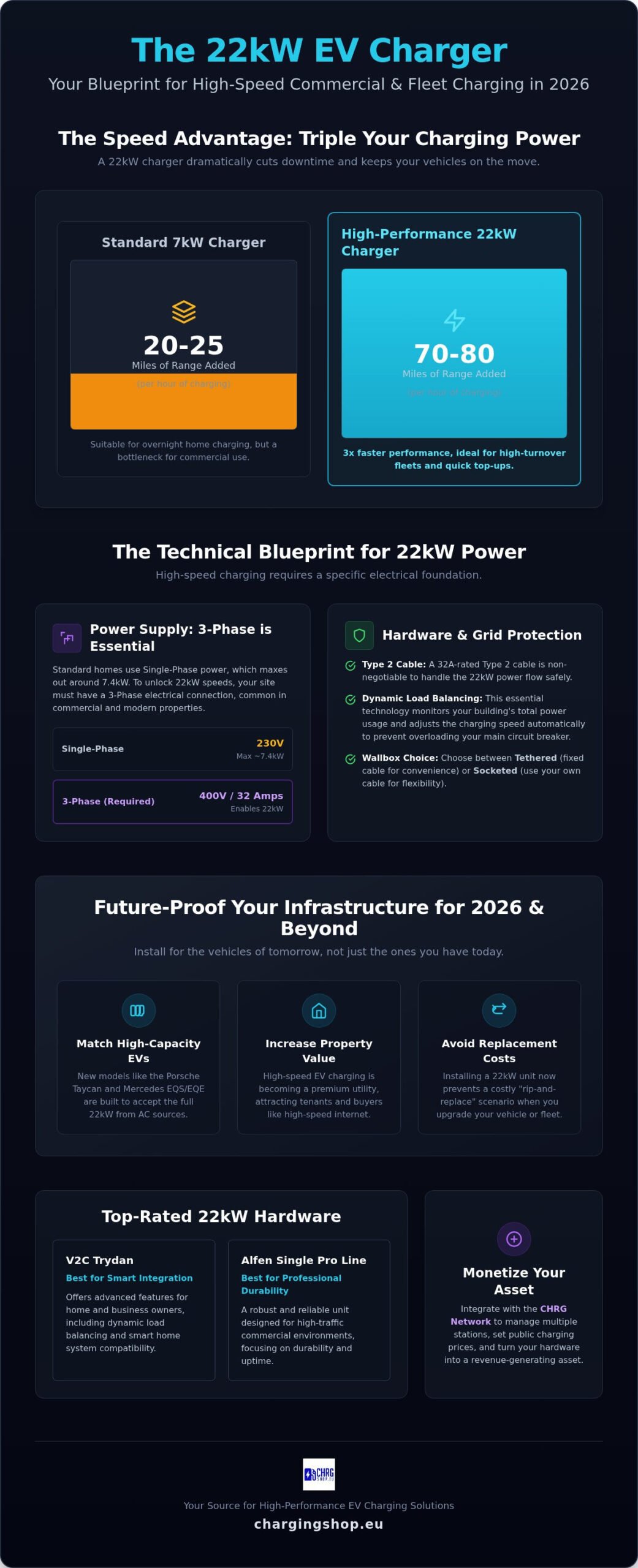
The math is simple and the results are dramatic. A standard 7kW home unit adds roughly 20 to 25 miles of range for every hour it’s plugged in. A 22kW EV charger triples that performance, delivering 70 to 80 miles of range in the same sixty minutes. This massive jump in speed is essential for high-turnover commercial fleets that can’t afford to let vehicles sit idle for eight hours. For long-distance commuters, a quick top-up during a lunch break provides enough range for the entire return journey. It effectively kills range anxiety by making charging sessions short and impactful.
Future-Proofing Your Infrastructure for 2026 and Beyond
Don’t buy for the car you have today; buy for the car you’ll own tomorrow. While many older EVs were capped at 7kW or 11kW, the 2026 market is seeing a major shift. Luxury models and high-performance SUVs like the Porsche Taycan, Mercedes EQS, and Mercedes EQE are designed to pull the full 22kW from AC sources. Even if your current vehicle is limited to 11kW, installing a 22kW wallbox now prevents a costly rip-and-replace scenario when you upgrade your fleet or personal car next year.
Property value is another significant factor. Homebuyers and commercial tenants now view high-speed charging as a premium utility, similar to high-speed fiber internet. A 22kW installation signals that your property is ready for the next generation of high-capacity onboard chargers. It’s a proactive investment that secures your logistical reliability. You’re not just installing a charger; you’re building a high-performance asset that scales with the industry.
The Technical Blueprint: 3-Phase Power and 32 Amp Requirements
Installing a 22kW EV charger isn’t as simple as swapping a plug. High-speed AC charging demands a specific electrical foundation that standard residential lines usually lack. To reach these speeds, your property must have a 3-phase electrical connection. While most homes run on single-phase power, commercial sites and modern high-end builds utilize three active wires to handle the increased load. You’re moving from a 230V system to a more robust 400V setup to accommodate the higher energy flow.
Understanding 3-Phase vs. Single-Phase Charging
Think of electricity like water pipes. A single-phase line is a single pipe that maxes out at roughly 7.4kW. Trying to push 22kW through it would cause overheating and system failure. 3-phase charging is the simultaneous use of three alternating currents to deliver high power. This configuration allows the charger to deliver 32 Amps across three separate phases. It’s significantly more efficient and manages heat better than single-phase systems because the load is distributed. If you’re unsure about your current supply, it’s best to browse our 22kW hardware and consult a technician about a 3-phase upgrade.
Cables and Connectors: Ensuring Full 22kW Compatibility
Your hardware is only as good as the cable connecting it to the car. For a 22kW EV charger, a 32A-rated Type 2 cable is non-negotiable. While Type 1 connectors exist, they’re predominantly single-phase and won’t support 22kW speeds. You also need to choose between tethered and socketed wallboxes. Tethered units offer convenience with a fixed cable, but socketed units provide flexibility if you need to switch between different cable lengths. Safety is paramount here. High-amperage continuous loads generate heat, so every component must meet strict federal EV charging standards for insulation and conductivity.
Grid protection is the final piece of the puzzle. Using dynamic load balancing is essential for home and business owners alike. This technology monitors your building’s total energy consumption in real-time. If you turn on heavy machinery or industrial HVAC systems, the charger automatically throttles its output to prevent tripping the main breaker. It ensures your 22kW setup remains a high-performance asset without compromising your site’s electrical integrity.
Top-Rated 22kW Wallboxes: V2C, Alfen, and ABB Compared
Choosing the right 22kW EV charger is about matching hardware capabilities to your specific environment. In 2026, the market has split into specialized segments. Homeowners prioritize smart integration and solar optimization, while businesses focus on durability and billing accuracy. We’ve selected three industry leaders that define these categories. Whether you need a sleek unit for your garage or a rugged station for a commercial fleet, these wallboxes deliver the performance your 3-phase setup deserves.
The V2C Trydan 22kW leads the pack for residential users. For professional environments, the Alfen Single Pro Line 22kW offers unmatched reliability. If global certifications and industrial safety are your main concerns, the ABB Terra AC 22kW charger provides a rock-solid solution. All three support OCPP (Open Charge Point Protocol), allowing you to switch software providers without replacing your hardware.
V2C Trydan 22kW: The Smart Choice for Solar Integration
V2C has perfected the intersection of renewable energy and EV charging. The Trydan unit is the smart choice for anyone with a photovoltaic system. It features best-in-class solar surplus charging, allowing you to power your vehicle using only the energy your panels produce. You don’t need to be a technical expert to manage it. The V2C Cloud app provides an intuitive interface for remote scheduling and real-time monitoring. Its built-in dynamic power management ensures your home grid stays protected even during peak 22kW output. It’s efficient, connected, and designed for the modern eco-conscious home.
Alfen and ABB: Professional Hardware for High-Traffic Areas
Business owners require hardware that can handle constant rotation. The Alfen Single Pro Line is widely considered the gold standard for commercial billing. It features a full-color display for user instructions and supports advanced RFID authorization to prevent unauthorized use. Its internal components are built for longevity, making it ideal for workplaces and retail parks where chargers operate for several hours every day.
The ABB Terra AC series focuses on industrial-grade safety and global compatibility. It includes integrated surge protection and high-end safety sensors to protect both the building and the vehicle. When it comes to durability, both Alfen and ABB units carry IP54 and IK10 ratings. This means they’re protected against dust, water splashes, and high-energy mechanical impacts. They’re built to survive harsh outdoor environments and heavy-handed daily use. Choose Alfen for sophisticated user management or ABB for a simplified, ultra-reliable industrial build.
Maximizing ROI: Commercial Charging and CHRG Network Integration
A 22kW EV charger is a high-performance asset, but its true value is unlocked through intelligent management. In 2026, businesses can no longer afford to offer electricity without oversight. Smart software transforms your hardware into a sophisticated profit center. By utilizing OCPP (Open Charge Point Protocol), your chargers connect to centralized management systems that handle everything from user authentication to automated billing. This connectivity is the foundation for a professional charging operation that scales with your business needs.
Turning Your Charger into a Revenue Stream
Stop leaving money on the table. With CHRG Network access for EV stations, you can monetize every kilowatt delivered. The system manages the entire transaction flow, allowing drivers to pay via app or RFID while the revenue is deposited directly to your account. You decide the rates. You can offer free charging for staff, mid-tier pricing for regular clients, and premium public rates for transient visitors. The software generates comprehensive usage reports, which are essential for reclaiming VAT and meeting corporate sustainability targets. It’s a hands-off approach to infrastructure management that ensures your 22kW EV charger pays for itself.
Managing Multiple Units with Load Balancing
Expansion doesn’t have to be complicated. When you install multiple units in a single parking lot, you must manage the total electrical draw. Modern 22kW hardware uses Master/Slave configurations to distribute power dynamically. This prevents your site from exceeding its maximum capacity, even when every port is in use. Real-time monitoring is a critical component of this setup. It provides instant alerts if a unit goes offline, allowing for remote restarts and minimizing downtime. For commercial fleets, this level of control ensures that every vehicle is topped up and ready for the next shift without delay. High-speed charging is only as good as the software that keeps it running.
Don’t let your hardware sit idle. You should browse our commercial management tools to maximize your infrastructure’s potential. Take the guesswork out of billing and start seeing a real return on your investment today.
Securing Your 22kW Setup: Personalized Offers and Global Shipping
Securing a 22kW EV charger is the final move in future-proofing your infrastructure for the 2026 market. You’ve analyzed the technical specs and calculated the ROI. Now, you need to execute. Charging Shop simplifies this transition by acting as your high-performance intermediary. We focus on premium hardware and software, ensuring you receive authorized equipment from world-class brands without the friction of a generalist retailer. We don’t sell vehicles or provide on-site installation; we provide the professional tools you need to succeed.
Personalized Solutions for Complex Projects
Standard checkout processes don’t always meet the needs of large-scale deployments. If you’re managing a multi-unit residential development or a corporate fleet, a generic solution isn’t enough. We provide a Personalised Charging Offer to address these unique requirements. Our team helps you select the right OCPP platform and hardware configuration to match your site’s electrical capacity. We strip away the fluff, providing a direct path to a managed infrastructure that meets your specific logistical goals. You can request a bespoke quote to get started on your complex project today.
Fast Global Delivery and Technical Support
Efficiency extends to how quickly your hardware arrives. We leverage an optimized global distribution network to deliver premium units like the Alfen Single Pro Line and V2C Trydan with minimal delay. Our commitment is to hardware-only expertise. This means we focus entirely on sourcing, shipping, and supporting the technical aspects of your equipment. While we don’t offer installation services, we ensure your chosen electrician has the most reliable, certified hardware ready for the job. Our technical support team is available to guide you through the selection process, ensuring compatibility across your entire fleet.
Before you finalize your order, use this essential 2026 checklist:
- Hardware Selection: Confirm your choice of V2C, Alfen, or ABB based on your specific environment.
- Network Access: Secure CHRG Network access for EV stations for automated billing.
- Electrical Audit: Verify your 3-phase supply and 32 Amp capacity with a qualified professional.
- Professional Installation: Source a certified local electrician to handle the physical setup and DNO notification.
Your journey to high-speed charging starts here. Explore our full catalog and secure your 2026 charging speed. Don’t let slow hardware hold your business back. Take control of your infrastructure now.
Power Up Your Infrastructure for 2026
The 2026 market moves fast; your infrastructure must move faster. Upgrading to a 22kW EV charger isn’t just about adding speed. It’s about building a reliable, high-capacity foundation that handles the next generation of electric vehicles without hesitation. You now have the technical blueprint for 3-phase power and the hardware insights to choose between industry leaders like V2C, Alfen, and ABB.
Don’t let technical hurdles or slow charging speeds stall your operations. Whether you’re optimizing a residential solar setup or managing a high-traffic commercial fleet, the right hardware makes the difference. As an official distributor of V2C and Alfen, we provide the technical expertise and global shipping you need to deploy with confidence. Combined with integrated CHRG Network management, your hardware becomes a smart, revenue-generating asset from day one.
Ready to eliminate the bottleneck? Shop the best 22kW EV chargers for 2026 at Charging Shop and take advantage of our specialized technical support. Your high-speed future is ready for activation. Let’s get you powered up.
Frequently Asked Questions
Can I use a 22kW charger if my car only supports 11kW?
Yes. Your vehicle’s onboard charger acts as a gatekeeper. If your car is limited to 11kW, it will only draw that amount from the unit. There is no risk of damage because the charger and car negotiate the power flow. Installing a 22kW EV charger now ensures your infrastructure is ready for future vehicles with higher AC intake capacities and faster charging technology.
How much does it cost to upgrade my home to a 3-phase supply for 22kW?
Upgrading to a 3-phase supply is a significant project. In the UK, you can expect costs between £3,000 and £15,000 depending on the distance to the nearest substation and necessary groundwork. You must apply through your local Distribution Network Operator (DNO) for a survey and quote. This investment is required to support the 32 Amps per phase that a high-speed 22kW unit demands.
Is a 22kW EV charger better than a 7kW charger for home use?
A 22kW unit is objectively faster, adding roughly 70 to 80 miles of range per hour compared to 25 miles on a 7kW unit. The “better” choice depends on your home’s power supply. Since 97% of UK homes lack 3-phase power, 7kW remains the standard. However, if you have the power capacity, the 22kW EV charger is the definitive choice for a rapid turnaround.
What is the difference between a 22kW AC charger and a DC fast charger?
AC chargers like the Alfen Single Pro Line send power to the car’s onboard converter. DC chargers, such as the V2C DENKA 20kW DC Wallbox, convert power externally and feed it directly to the battery. This bypasses the car’s internal limitations. While 22kW is the high-performance ceiling for AC, DC charging provides a more direct and often faster energy transfer for diverse vehicle fleets.
Do I need a special cable for a 22kW EV charging station?
You absolutely need a 3-phase, 32A-rated Type 2 cable to reach full speed. Standard 7kW cables are single-phase and won’t carry the necessary current across three lines. If you use an under-rated cable, your charging speed will be capped, and you risk overheating the components. Always verify that your cable is rated for 22kW to ensure safety and performance during every charging session.
Are all 22kW chargers compatible with the CHRG Network?
Compatibility depends on the Open Charge Point Protocol (OCPP). Most premium hardware we sell, including ABB and Alfen units, is OCPP-compliant and integrates perfectly with CHRG Network Access. This software allows you to monetize your station and manage user permissions. Before buying, confirm your wallbox supports OCPP 1.6J or higher to ensure seamless connectivity with our management platform and automated billing tools.
Can I install a 22kW charger myself?
No. You must hire a qualified, certified electrician for the installation. Working with 400V 3-phase power is dangerous and requires specialized knowledge of load balancing and safety regulations. You also need to notify your local network operator about the new load. Charging Shop provides the premium hardware, but we don’t offer installation services. Always prioritize safety by using a professional installer for your high-power setup.
What are the benefits of an OCPP compliant 22kW wallbox?
OCPP compliance gives you the freedom to choose your management software. It allows your 22kW wallbox to talk to platforms like the CHRG Network for automated billing and remote monitoring. Without it, you’re often stuck with the manufacturer’s basic app. It also supports smart grid features and dynamic load balancing, making it a critical requirement for any commercial or multi-user charging project in 2026.
