
 Deutsch
 Dansk
Dansk Suomi
Suomi Latviešu
 Lietuvių
 Norsk bokmål
 polski
 Русский
 Svenska
No products in the cart.
Uncategorized
How to Manage Multiple EV Chargers: A Practical Guide
16
Oct
Oct
What if adding another EV charger creates more scheduling friction than charging capacity? The challenge isn’t just installing more units. It’s knowing how to manage multiple ev chargers so vehicles can charge without overloading available power or leaving users unsure whose turn is next. If you’re weighing simultaneous charging, access rules, or fair energy tracking, those concerns are practical, not premature.
A reliable setup brings power, access, and oversight together. This guide will help you choose an approach for a household, workplace, or shared property, then plan charger access and power allocation around real demand. You’ll also learn which hardware and software considerations matter before expanding, from available electrical capacity to monitoring energy use. With a clear operating plan, multiple chargers can serve more vehicles without turning daily charging into guesswork.
Key Takeaways
- Map your chargers, available electrical capacity, vehicles, users, and typical charging windows before choosing a management setup.
- Learn how to manage multiple ev chargers by comparing fixed power allocation, scheduled charging, and dynamic load management.
- Compare shared chargers, separate units, managed chargers, and multi-port equipment to find an approach that fits your site’s access and coordination needs.
- Set clear charging rules, then test and adjust them as usage patterns change.
- Explore how charging hardware and CHRG Network access can support your management plans as your site grows.
Why managing multiple EV chargers takes more than adding another unit
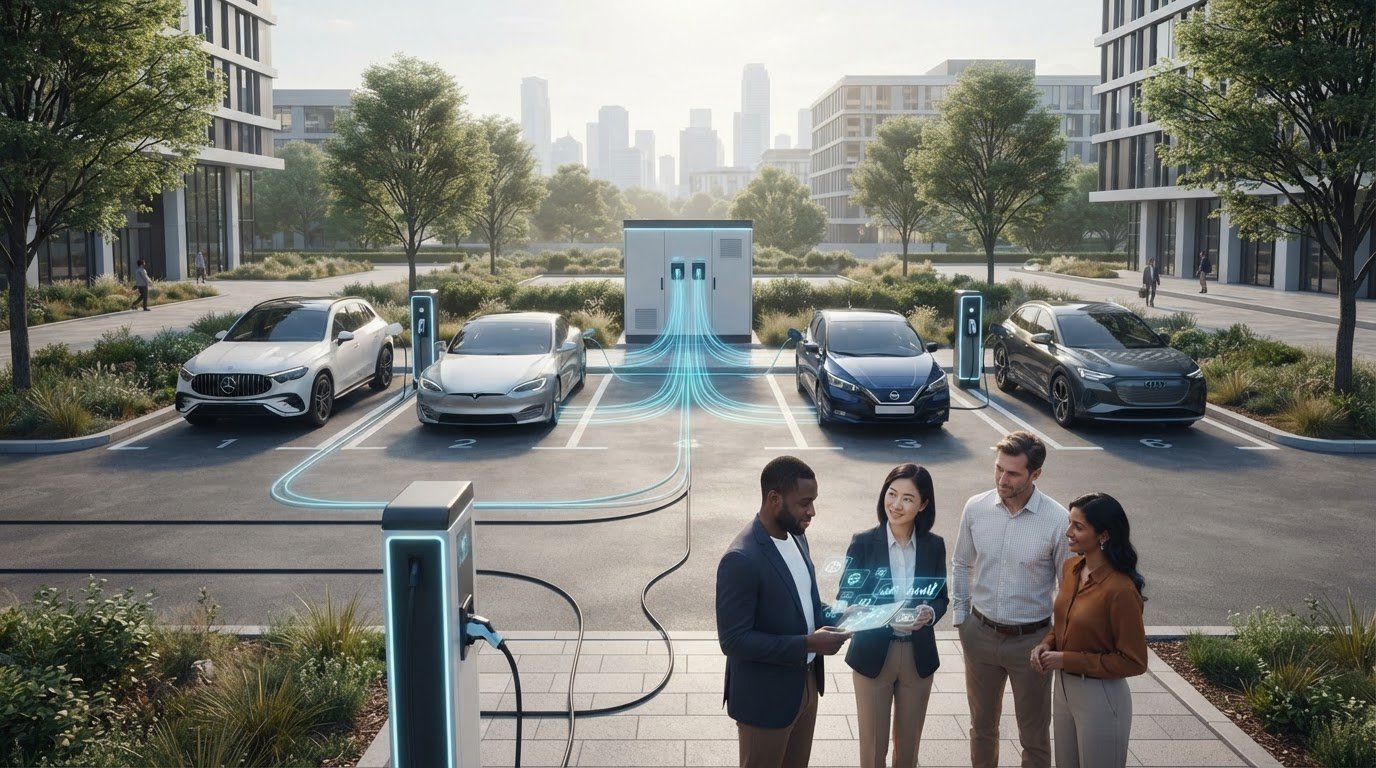
A second charger adds convenience, but it also adds another demand on the site’s electrical supply. Each unit may operate independently, yet both draw power from shared infrastructure. If several vehicles plug in at the same time, their combined demand may exceed the capacity available for charging. The challenge in how to manage multiple ev chargers is coordinating more than hardware: power, access, charging priorities, and usage information all need a plan.
An EV charging station is part of a wider setup, not just a connector on a wall. Decisions about who charges, when they charge, and how energy use is recorded shape whether a multi-charger arrangement works smoothly day to day.
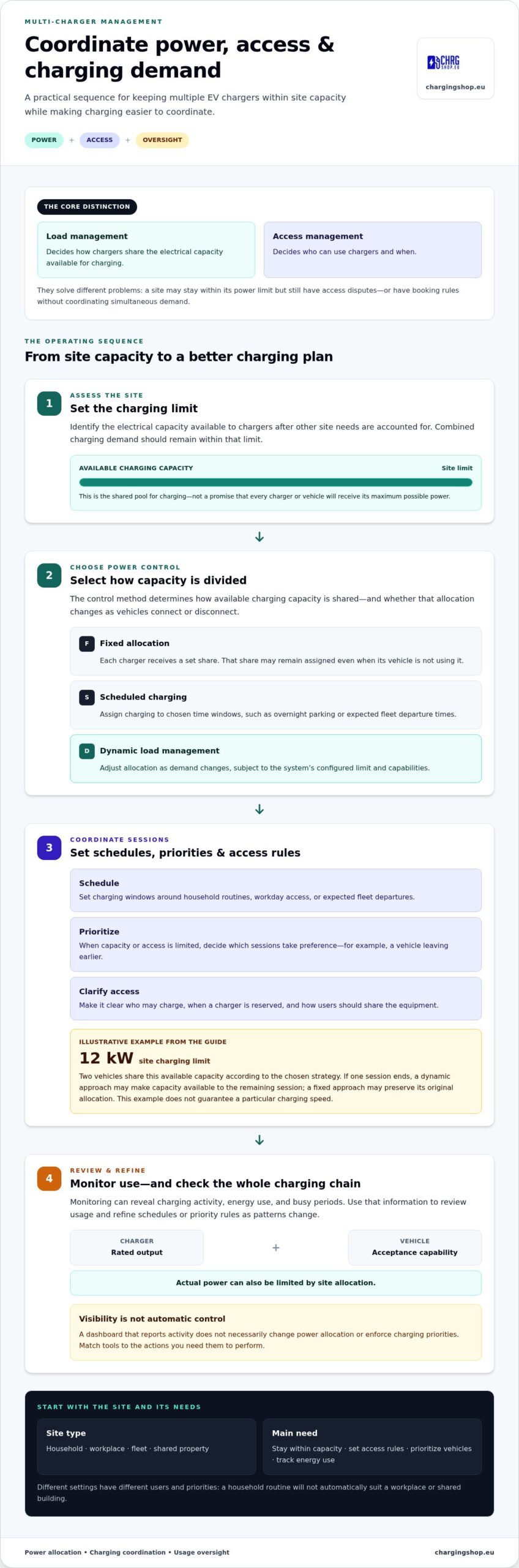
Load management decides how chargers share available electrical capacity; access management decides who can use them and when. They solve different problems. A site can stay within its power limit but still have disputes over access, or offer clear booking rules while failing to coordinate simultaneous demand.
What problems appear when several EV chargers run together?
Power allocation: If several vehicles start charging together, their sessions compete for the site’s available capacity. A power strategy helps coordinate that demand, rather than treating each charger as if it were the only one operating. Without one, charging may not align with the site’s electrical limits or users’ needs.
Access and accountability: Unclear rules can leave drivers unsure where to plug in or whether a charger is reserved. That can create queues and uneven opportunities, especially when some vehicles need a charge sooner than others. Billing and reporting are separate issues: even when power is allocated appropriately, a site may still need reliable records of energy use by vehicle, user, or department. Keep these questions distinct: who gets to charge, how available power is shared, and how consumption is recorded.
Which sites need coordinated charger management?
At home, multiple vehicles may have different routines. One driver might leave early and need a dependable overnight charge, while another uses their EV less often. A household may be able to share charging access, but it still benefits from agreeing on priorities and checking whether charging times overlap.
Workplaces need to balance employee access with predictable charging opportunities during the workday. Fleet operators may prioritize vehicles by departure time or operational role. In shared properties, residents may need clear rules for access and a fair way to understand or allocate electricity use. These settings have different users and priorities, so a household routine won’t automatically suit a workplace or shared building.
Start with your site type: Is this a household, workplace, fleet, or shared property? Then name the main need, such as staying within capacity, setting access rules, prioritizing vehicles, or tracking energy use. That answer gives you a practical starting point for selecting a management approach.
How multiple EV chargers share power and coordinate charging
Start with the site’s charging limit: the amount of electrical capacity available to the chargers after other site needs are accounted for. A coordinated setup keeps combined charging demand within that limit. The control method determines how that capacity is divided, and whether the division changes as vehicles connect and disconnect.
How does load management distribute available power?
With fixed allocation, each charger receives a set share of the available charging capacity. It’s straightforward, but a charger may hold its share even when its vehicle isn’t using it. Scheduled charging assigns charging to chosen time windows. Dynamic load management adjusts allocation as demand changes, subject to the system’s configured limit and capabilities.
For a simple hypothetical example, imagine two vehicles sharing a site limit of 12 kW for charging. If both are charging, the available power can be divided between them according to the chosen strategy. If one session ends or a vehicle disconnects, a dynamic approach may make capacity available to the remaining session, while a fixed approach may preserve its original allocation. The example illustrates allocation only, not a guaranteed charging speed.
The power each vehicle actually accepts can also affect what it receives. A charger’s rated output is one factor; a vehicle’s onboard charging capability is another. A lower vehicle acceptance rate, or a site-level allocation below the charger’s rating, can mean the vehicle takes less than the maximum the charger could provide. Assess the whole chain, not the charger label alone.
What do scheduling, prioritization, and monitoring each control?
Scheduling sets charging windows around routines, such as overnight parking at home or expected fleet departure times. Prioritization sets the rules for which sessions receive preference when capacity or access is limited. You might prioritize a vehicle leaving earlier, for example, rather than giving every session equal treatment.
Monitoring shows information about charging activity and energy use. It can help you spot busy periods, review usage, and refine schedules or priority rules. But data visibility isn’t the same as automatic control: a dashboard that reports activity doesn’t necessarily change power allocation or enforce charging priorities. Match the management tools to the actions you need them to perform.
To dig deeper into network-based station management, explore the CHRG Network management guide. If you’re considering equipment alongside network access, Charging Shop’s EV charging hardware options can help you compare available charger models as part of your planning.
Compare four ways to manage multiple EV chargers
The right setup depends on site capacity, vehicle schedules, and how much control you need over access and usage. One shared charger may suit drivers with different routines. Separate chargers provide more direct access, while management tools or multi-port equipment can help coordinate charging when sessions overlap. These approaches can also work together: management software and charging hardware solve related, but different, problems.
| Approach | Convenience | Power coordination | Access control | Best suited to |
|---|---|---|---|---|
| Shared charger | Drivers take turns using one unit | One active charging point at a time | Usually handled through agreed rules or a schedule | Sites where vehicle charging needs rarely overlap |
| Separate chargers | Vehicles have their own charging points | Needs a plan if sessions can run simultaneously | Can be assigned by vehicle or user, depending on the setup | Sites that value direct access for different vehicles |
| Managed chargers | Charging can be coordinated through management tools | May support coordinated allocation, depending on system capabilities | Management features and rules depend on the platform | Workplaces, fleets, and shared sites needing oversight |
| Multi-port equipment | Multiple vehicles connect at one piece of equipment | Depends on the equipment’s design and available site capacity | Depends on how access is organized | Sites considering a centralized charging arrangement |
When is sharing one charger enough?
Alternating sessions can work when vehicles are parked at different times or one vehicle can charge after the other. It keeps the arrangement simple, but convenience depends on driver routines. If both vehicles need energy before the same departure time, users may need to shuffle cars or agree whose turn comes first. A shared charger isn’t automatically enough for every household or workplace.
When should a site consider managed or multi-port charging?
Overlapping charging needs make coordinated power allocation more relevant, particularly if several vehicles need access during a limited window. Management software focuses on rules, oversight, or coordinating charging, depending on its capabilities. Multi-port equipment concerns the physical charging arrangement. One doesn’t automatically replace the other: a site may consider both, while accounting for its electrical capacity and the way its chargers and management system work together.
Compare the required functions, not just the number of charging points. For a hardware example, the Alfen Single Pro Line 22kW review offers a closer look at one charger model, not a universal solution. For another equipment overview, see the ABB Terra AC professional guide. As you decide how to manage multiple EV chargers, match hardware and management choices to your actual schedules, site limits, access rules, and monitoring needs.
Set up a practical system for managing multiple EV chargers
A reliable setup starts with a clear picture of the site and the people who use it. Before choosing settings, record where chargers are located, what capacity is available for charging, which vehicles need access, and when they’re usually parked. This gives you a practical foundation for how to manage multiple ev chargers without relying on assumptions about demand.
What should you map before configuring multiple chargers?
Build a simple site record first. Include the electrical limits identified for the charging setup, charger count and locations, vehicles and users, and typical charging windows or dwell times. Note who can charge, how access is assigned, and what happens if someone needs an exception. Set an initial priority order around real operational needs, such as departure times, rather than treating every session as identical.
- Assess the site. Document the available electrical capacity for charging and the current charger layout. Electrical design and installation decisions belong with qualified professionals, not DIY trial and error.
- Map demand. List the vehicles, users, usual arrival and departure times, and expected charging windows. Flag periods when several vehicles may need to charge at once.
- Set operating rules. Decide how access works, how charging is prioritized, and how users request exceptions. Keep the process easy to understand and apply consistently.
- Configure and test. Put the chosen charging and access rules into practice, then test typical use as well as peak-demand situations. Check that the arrangement reflects the site’s capacity and user routines.
- Review and adjust. Monitor charging activity and access issues. Update rules when vehicle use, occupancy, schedules, or charger numbers change.
How should you test and improve the management rules?
Test more than a quiet day. Consider a normal period, several vehicles arriving together, a vehicle staying longer than expected, and a user needing an exception. Confirm that people understand the access rules and that the chosen controls behave as intended. Then review charging sessions and recurring conflicts at planned intervals. Monitoring helps reveal patterns; use those observations to adjust schedules and priorities rather than assuming the original plan will always fit.
For a single-home charger context, the V2C Trydan 22kW home charging guide provides a relevant hardware reference. If you’re evaluating equipment and station management together, explore EV charging hardware and CHRG Network access as part of your planning.
Choose a scalable EV charger management approach with Charging Shop
A scalable setup connects the right charging hardware with a power strategy and an operating model that can keep pace with changing demand. Before selecting equipment or network access, define what the site needs to do now and what may change as vehicles, users, or chargers are added. That gives you a clear basis for deciding how to manage multiple ev chargers, without assuming one model or management approach fits every site.
What should you evaluate in hardware and management access?
Start with the actual site requirements. Consider the available electrical capacity, vehicle charging needs, expected schedules, number of users, and the level of oversight required. Then assess each part of the setup against those needs:
- Charger fit: Match the charger type and specifications to the site and vehicles. Don’t assume every model has identical capabilities or suits the same operating environment.
- Power strategy: Decide how the site will keep charging demand within its available capacity, especially when several vehicles may charge at once.
- Access and monitoring: Define who needs to charge, how access will be organized, and what usage information the site needs to review.
- Network requirements: Compare the management access needed with the number of chargers and users you plan to support. Treat interoperability and protocol requirements as project-specific criteria, and assess them against the actual hardware and management setup.
Charging Shop offers EV charging hardware across different environments, alongside access to the CHRG Network for charging-station management. A Personalised Charging Offer is another option for aligning a charging plan with your requirements. Charging Shop does not provide on-site installation, so installation isn’t included in the hardware or network access.
For a closer look at network-based station management, explore CHRG Network access for EV stations. Use it alongside the available hardware range to assess the combination that fits your site, rather than treating a charger or network choice as a complete plan by itself.
How can you plan for future charger growth?
Think beyond the current vehicle count. A household may add another EV; a workplace may add users; a shared property may see more residents requesting charging. Estimate how those changes could affect schedules, access rules, and demand before settling on an operating model. You don’t need to predict every detail, but you do need a plan that can be reviewed and updated.
Keep rules clear and repeatable. Document how access is assigned, how charging priorities work, and how usage is monitored. Revisit that process when vehicle numbers, occupancy, or charger count changes. Consistent records make it easier to spot when the setup no longer matches real use.
Ready to compare options for your site? Explore Charging Shop’s charging solutions, including EV charging hardware and CHRG Network access, as you plan your next step.
Make your next charging decision with confidence
Your next step is to turn your site’s charging needs into a clear equipment and management plan. Think beyond the immediate number of vehicles. Choose an approach that can adapt as users, schedules, and charging demand change, and make compatibility and day-to-day oversight part of the decision. That’s the practical foundation for how to manage multiple ev chargers as your setup grows.
Charging Shop brings together curated AC and DC charging hardware, including V2C, Alfen, and ABB models, with CHRG Network access and personalised charging offers. Explore these options with your site requirements in mind, then build a setup that fits the way people charge today and can support your plans for tomorrow.
Explore EV charging hardware and CHRG Network access, and take the next step toward a more organized charging setup. With a clear plan in place, you can grow your charging capacity with confidence.
Frequently Asked Questions
Can multiple EV chargers share one electrical supply?
Yes, multiple chargers can share one electrical supply if the site’s electrical design and control strategy support their combined demand. The practical limit depends on capacity available after other building loads, as well as charger settings and vehicle demand. For example, a site could set a limit for EV charging instead of making the full electrical supply available to the chargers. Have a qualified electrical professional assess the supply and design.
Is load management the same as load balancing for EV chargers?
Not always. The terms are sometimes used interchangeably, but “load management” can describe the broader process of controlling charging demand, while “load balancing” often refers to distributing available power across chargers. If you’re comparing systems for how to manage multiple ev chargers, focus on what the system actually does: whether it sets a site limit, changes charger allocations, or simply reports activity. The function matters more than the label.
How many EV chargers can run at the same time?
There isn’t one fixed number for every site. The answer depends on available electrical capacity, the power each charger draws, vehicles’ charging needs, and whether a system controls the combined demand. A site may have several chargers installed but restrict how much power they use simultaneously. Treat the electrical assessment and the configured charging limit as the basis for the operating plan, not the number of sockets alone.
Do multiple EV chargers need to be the same brand?
No, chargers don’t automatically need to share a brand. However, a mixed-brand setup makes compatibility a key planning point. Consider the connectors and charging standards used by the vehicles, then assess whether the chargers can work with the intended management platform and any required communication protocols. Don’t assume that two units can coordinate simply because they’re connected to the same supply. Confirm interoperability for the specific combination being planned.
Can one EV charger be shared by several drivers?
Yes. A shared charger can serve multiple drivers if the site has a workable way to manage turns and access. For instance, a small workplace might assign charging windows around employees’ shifts, while a household could agree which vehicle needs the charger first on busy mornings. Make the rules visible, include a process for schedule changes, and avoid relying on informal assumptions that leave users unsure when the charger is free.
What information should I track when managing several EV chargers?
Record the charger identifier, charging session start and end times, energy delivered, and the user or vehicle associated with each session. For shared sites, also note reservations or access issues so you can compare actual use with the intended schedule. Keep records consistent across chargers. This makes it easier to spot patterns, resolve allocation questions, and assess whether charging rules still match how people use the site.
Does Charging Shop install multiple EV chargers?
No. Charging Shop sells EV charging hardware and offers CHRG Network access for station management, but it doesn’t provide on-site installation. Installation planning and electrical work should be handled separately by a qualified professional. Charging Shop’s hardware range includes AC and DC options, and its personalised charging offers can help align product choices with a project’s requirements. Consider the site’s electrical design and management needs as part of your overall plan.
