
 Deutsch
 Dansk
 Suomi
 Latviešu
 Lietuvių
 Norsk bokmål
 polski
 Русский
 Svenska

No products in the cart.
Uncategorized
Load Balancing Multiple EV Chargers and How Power Is Shared

21
Oct
Oct
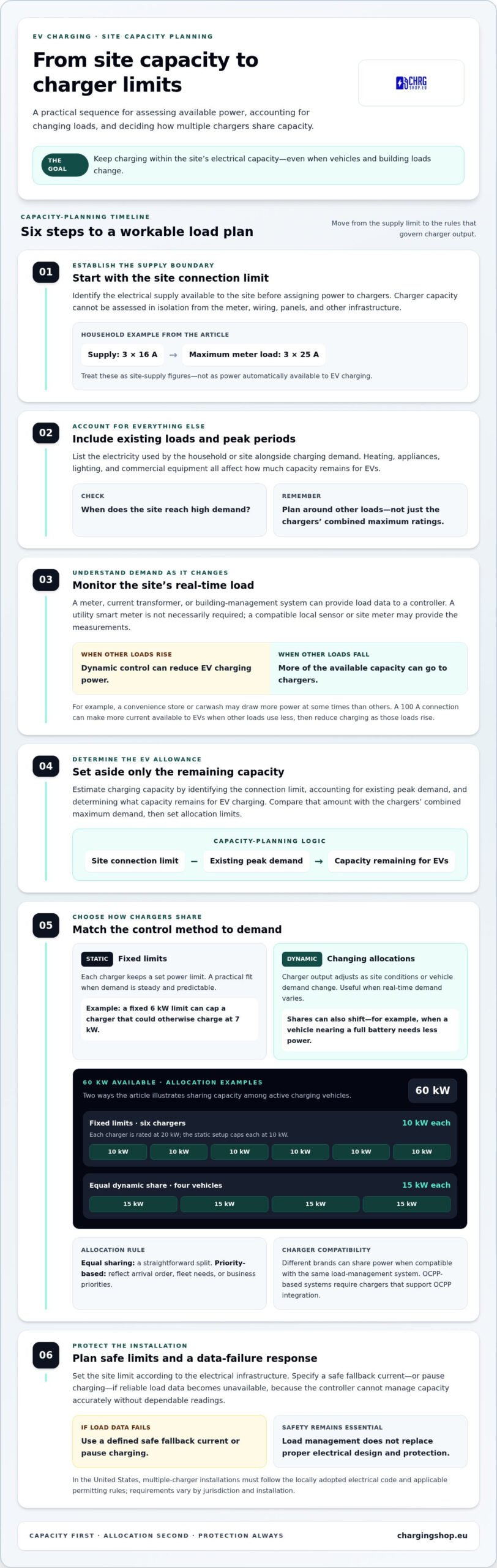
More chargers don’t have to mean a bigger power connection. Load balancing for multiple EV chargers shares available site capacity among active vehicles, either through fixed limits or changing allocations. With 60 kW available, a static setup could cap six 20 kW chargers at 10 kW each. A dynamic setup could divide 60 kW among four vehicles, giving each 15 kW.
When planning several chargers, you may wonder whether they will compete for power or overload the site. The answer depends on available capacity, other electricity use, and how the system allocates power as demand changes.
Learn how equal and priority-based sharing work, when dynamic control helps a power-limited site, and what it cannot replace. We’ll explain how site loads affect charger output and why the right approach depends on whether demand is steady or fluctuates. You’ll have a clearer way to assess capacity before adding chargers.
Key Takeaways
- Match fixed power limits to predictable charging demand; use dynamic adjustments when site loads or vehicle use change.
- Assess household and site electricity use, peak-demand periods, and utility capacity before setting charger limits.
- Choose equal sharing for a straightforward split or priority rules to reflect arrival order, fleet needs, or business priorities.
- Load management can help fit fast chargers within constrained capacity, but it doesn’t replace proper electrical design and protection.
- Plan how the system measures power, responds if load data fails, and accommodates future charging growth.
How Does Load Balancing Work for EV Chargers and When Do You Need It?
Load balancing distributes available electrical power among chargers while keeping demand within the site’s capacity. With 60 kW available, six 20 kW chargers could receive fixed 10 kW limits, or a dynamic system could adjust allocations as demand changes.
For multiple chargers, load balancing is the control system that shares site capacity among connected vehicles. It can apply fixed limits or adjust charger output as electricity use and charging demand change.
Static and Dynamic Balancing
Static balancing gives each charger a set power limit, while real-time dynamic balancing changes allocations as site conditions shift. That difference matters when vehicles connect at different times or other equipment draws electricity. For example, a fixed 6 kW limit can cap a charger that could otherwise charge at 7 kW. Static settings suit steady, predictable demand; dynamic control responds to changing demand.
Adjusting Power to Available Capacity
Dynamic load balancing measures available electrical capacity and adjusts charger output to stay within a defined site limit. A 100 A connection can make more current available to EVs when other loads use less power, then reduce charging as those loads rise. This can help operators use spare capacity without exceeding the connection limit.
Dynamic EV charger load balancing measures site demand and updates power allocations as that demand changes. For example, when a convenience store or carwash uses more electricity, the system can reduce EV charging. When those loads drop, chargers can use more of the available capacity.
Equipment and installation costs depend on the sensing equipment, controller, charger compatibility, and electrical work required. The site’s existing power setup and number of chargers also affect the project, so there is no single cost for every installation.
Sharing Power Among EVs
Dynamic balancing divides the capacity reserved for EV charging among vehicles that are actively charging. If four vehicles share 60 kW, each can receive 15 kW under an equal allocation. The system can also adjust shares: a vehicle nearing a full battery may need less power, allowing more to go to a vehicle with a lower charge level.
Chargers from different brands can share power if they are compatible with the same load-management system. If the system uses OCPP, the chargers must support OCPP integration, which enables communication between charging stations and a management platform.
At a power-limited site, dynamic control is most useful when overall demand changes, such as when vehicles charge alongside other building loads. Static limits may be more practical when usage is consistent and operators do not need real-time adjustments.
What is electric vehicle charging management?
EV charging management coordinates charger demand with the electricity available across a home or commercial site. It combines capacity planning, monitoring, and power limits to prevent overloading and manage changing energy use.
Household and Site Electrical Capacity
Household and site capacity is the electrical supply available to chargers after accounting for existing building demand. It matters because several chargers can draw power alongside heating, appliances, lighting, or commercial equipment.
Start with the connection limit, then account for other loads during periods of high demand. In one household example, a meter supplies 3 x 16 amps, with a maximum meter load of 3 x 25 amps. The difference helps illustrate why charger capacity cannot be assessed in isolation. Wiring, panels, and other infrastructure also shape how much power the site can safely use.
Static load balancing applies fixed charger limits, while a dynamic system can respond as household or building loads change. In either case, planned charging demand must stay within the site’s electrical capacity.
Monitoring Site Capacity and Demand
Monitoring measures electricity use at a suitable point and provides load-management data to a controller, which uses it to manage charger output. Measurements may come from a meter, current transformer, or building-management system.
Real-time readings show how much capacity is available and how much the site is already using. For example, when a building load rises, a dynamic controller can reduce the power allocated to EV charging; when that load falls, more capacity may become available to chargers. This is useful at sites where demand changes during the day. A utility smart meter is not necessarily required: a compatible local sensor or site meter can provide the measurements.
Overload Protection and Safety Rules
Overload protection keeps charging demand within a defined electrical connection or circuit limit. In the United States, multiple-charger installations must follow the electrical code adopted locally and applicable permitting rules. Requirements vary by jurisdiction and installation.
Set the site limit according to the electrical infrastructure, not just the chargers’ combined maximum ratings. A load-management design should also specify a safe fallback current or pause charging if reliable load data becomes unavailable. Without dependable readings, the controller cannot manage capacity accurately. Proper electrical design and protection remain necessary even when charging power is actively managed.
Capacity Calculations and Management Hardware
To estimate charging capacity, identify the site connection limit, account for existing peak demand, and determine the remaining capacity for EV charging. Then compare that amount with the chargers’ combined maximum demand and set allocation limits. For a household with a 3 x 16 amps supply, include other major loads rather than treating the full supply as charger capacity.
Load management can use a meter or current transformer to measure electricity, together with a controller that adjusts charger power. A building-management system may also provide site-load data. Match the equipment to the measurement point and control method, and define what happens if readings fail.
A Personalised Charging Offer can help align charger choices with a site’s capacity and charging needs.
Equal and priority-based power allocation
Once the site sets aside capacity for charging, its management system determines how connected EV charging stations share that power. Equal allocation gives each active vehicle the same share; priority rules direct power according to operational needs.
Equal Power Allocation
Equal allocation divides available charging capacity evenly among active chargers. It gives each EV a predictable share, making a workplace or shared parking area easier to manage.
For example, a commercial site can split power equally when drivers have similar parking times and no vehicle needs special treatment. If a charger disconnects, the management system can recalculate shares among the remaining active sessions. Equal allocation is easy to explain, but may not suit a fleet with urgent departures or vehicles connected for very different periods.
Priority-Based Charging
Priority-based charging assigns power according to rules such as arrival order, fleet requirements, or driver and business priorities. It is useful when a site needs to serve some vehicles before others rather than treat every charging session equally.
A first-in, first-charged policy can place four EV charging stations in an arrival queue. The first connected vehicle gets priority, while later arrivals wait or receive less power, depending on the system settings. A fleet operator might instead prioritize vehicles scheduled to leave first. Clear rules help drivers understand how power is allocated and give operators a consistent way to manage competing requests.
Real-Time and Granular Allocation
Real-time allocation updates charger power as demand changes, while granular control adjusts it in defined increments. Monitoring can improve allocation accuracy, which matters when several charging sessions share limited power.
For example, a system that allocates power in 25 kW increments could assign 75 kW when an EV requests 70 kW. That leaves 5 kW unused, illustrating how the control step affects the final allocation. Finer increments can track requests more closely; larger increments may leave more capacity unused or give a vehicle more than it requested.
Choose allocation rules to match the site’s operating pattern. A commercial location may value a clear queue, while a fleet depot may prioritize departure times. The management system should apply those rules consistently as vehicles connect, disconnect, or change their charging demand.
Installing fast chargers at sites with constrained power
Load balancing can let a site use fast chargers even when its electrical supply cannot support every charger at maximum output simultaneously. How many can share a circuit or service depends on available capacity, charger ratings, and allocation settings.
Sharing Power Across Active Chargers
Load balancing shares the capacity reserved for charging among active chargers, allowing more units to operate within a constrained site limit. This matters because the chargers’ combined maximum rating may exceed the power the site can supply at once.
For example, four 150 kW DC fast chargers have a combined maximum draw of 600 kW. A site with 400 kW available can support those four chargers through load balancing, with power distributed among vehicles as demand changes. The chargers can’t all deliver their maximum output simultaneously under that site limit. Instead, the controller manages their combined draw against available charging capacity.
Peak shaving and load balancing serve different purposes. Peak shaving limits the site’s grid demand; load balancing distributes charging power among active chargers. A site can use both, but power allocation still needs to reflect charger ratings and available capacity.
State-of-Charge-Based Power Adjustment
State-of-charge-based adjustment uses vehicle battery information to change the power each active charger receives. This matters because vehicles at different battery levels may have different charging needs during the same session.
For example, a dynamic system may reduce the allocation to a vehicle nearing a full battery and send more power to one with a lower charge level. It can also consider expected remaining charging time and overall energy use when adjusting charger output. Vehicles don’t charge at the same rate throughout the range from 0% to 100%, so an allocation that changes with demand can use capacity more effectively than an unchanged split.
Circuit Capacity and Installation Setup
There is no universal charger count for one circuit or service. The practical limit depends on available electrical capacity and each charger’s power rating. Load balancing can manage shared demand, but it does not replace electrical design or protection.
To configure a site, first establish total capacity and the power available for EV charging. Next, align allocation limits with charger ratings and expected peak demand. Then define how the system divides power among active chargers, including how it responds when a vehicle’s charging needs change.
Consider a system that allocates power in 25 kW increments. If an EV requests 70 kW, it may assign 75 kW, leaving 5 kW unused. That example shows why allocation increments matter: a system’s settings affect how closely it can match available capacity to vehicle requests. Plan the charging infrastructure around those control limits, site demand, and future expansion needs.
Load balancing across multiple chargers
A load-balancing system coordinates charging stations so they can operate simultaneously without exceeding the capacity reserved for EV charging. For load balancing multiple EV chargers, it tracks demand, allocates power, and updates charger limits as vehicles connect or disconnect.
Can multiple chargers balance loads across phases or buildings? Yes, if the system measures and controls capacity across those phases or buildings. Each electrical service still needs its own limits, because a shared controller cannot make separate supplies interchangeable.
At a commercial hub, the controller can use site-load data to calculate how much power is available for charging. It then distributes that capacity among active vehicles according to configured rules. Equal allocation gives active sessions an even share; priority settings can instead favor fleet needs or arrival order.
Reliable measurements are central to this process. A meter, current transformer, or building-management system can provide load data, while OCPP can carry information between compatible charging stations and a management platform. The platform can update charging profiles as sessions begin or end. Local control can also protect the site without relying on a distant cloud connection.
Power sharing can respond to more than the number of connected vehicles. A system may use battery state of charge, expected remaining charging time, and overall energy consumption to adjust allocations. For example, when one vehicle is nearly charged, its allocation may fall, freeing capacity for a vehicle with a lower charge level.
Plan for data interruptions as well as normal operation. A load-balancing design should specify a safe fallback current or pause charging if reliable load data becomes unavailable. This gives operators a defined response instead of leaving chargers to rely on stale measurements.
Capacity planning also shapes future expansion. Set the site limit, account for other building loads, and consider how additional charging stations will fit into the control strategy. A well-designed approach to load balancing multiple EV chargers can also coordinate charging with intermittent solar or wind generation, helping make use of renewable energy as it becomes available.
For a site-specific view of charger choices and charging needs, explore a Personalised Charging Offer.
Charging Shop: V2C Trydan 22kW
Charging Shop helps you compare EV charging hardware when site capacity, charger type, and expected use shape the decision. The V2C Trydan 22kW, V2C DENKA 20kW DC Wallbox, and Alfen Single Pro Line 22kW offer options for different charging requirements.
Start with the power your site can make available, then consider how many vehicles may charge simultaneously and whether you need AC or DC charging. A charger’s rated output alone does not determine how much power each vehicle receives in a shared setup. Site capacity and load-management design matter too.
If you’re weighing hardware for a power-limited site, a Personalised Charging Offer can help you focus on the charging setup that fits your needs. Visit Charging Shop to explore your options.
Plan Your Next Charging Step
A load-balancing plan for multiple EV chargers should suit how your site operates today and how you expect it to grow. Before choosing hardware, bring together your charging goals, available capacity, vehicle schedules, and priorities. This gives you a clearer basis for comparing options and planning a setup around real demand, rather than focusing on charger ratings alone.
Think ahead, too. New vehicles, longer operating hours, or changing building loads can alter how a charging system needs to distribute power. A flexible plan helps you account for those needs early and make informed decisions about your charging infrastructure.
Charging Shop can help you explore hardware options and a charging approach suited to your requirements. Share your plans, from the type of site to how vehicles will use the chargers, and take the next step with a clearer direction.
Contact Charging Shop to discuss your charging needs and move your project forward with confidence.
Frequently Asked Questions
How Does OCPP Enable Smart Load Balancing and Remote Control?
OCPP lets EV charging stations exchange information with a back-end management platform. The platform can send updated charging profiles as sessions start, stop, or change, supporting coordinated control across connected chargers. For example, an operator can use a central system to adjust charging rules across a site. OCPP carries those commands and data, but does not measure building electricity use by itself; sensors or site meters provide that information.
How does an EV charger know the available load?
A charger or load controller receives readings from a meter, current transformer, or building-management system. The measurement point matters: a sensor on the incoming supply can reflect both building use and EV demand, while a charger-only reading cannot show every other site load. The controller uses those readings and the configured site limit to determine charging headroom. A utility smart meter is not essential if a suitable local sensor provides the data needed.
What happens if communication fails?
If communication with a distant cloud platform fails, a local controller can still protect the site if it continues receiving reliable local load measurements. This separates site protection from remote access. If the controller loses the measurements it needs, the system should follow its predefined fallback, such as applying a safe current limit or pausing charging. Choose the fallback during system design, rather than improvising after a fault.
What are the benefits and drawbacks of dynamic versus static load balancing?
Dynamic balancing adapts to changing site demand, making it useful where building loads or vehicle arrivals vary. It requires reliable measurements and compatible control equipment. Static balancing uses preset limits, so its behavior is straightforward and suits predictable schedules. The tradeoff is less flexibility: a fixed allocation can leave capacity unused when some chargers are inactive. Compare operating patterns, measurement needs, and the consequences of fixed limits before choosing.
What happens if EV charger load balancing fails or loses communication?
The response depends on which connection fails. If the cloud link drops but local measurements and control remain available, local management can continue applying site limits. If load data becomes unreliable, a properly designed system follows its specified safe fallback current or pauses charging. Losing remote access is not the same as losing the sensor data needed to manage power. Define the response to both conditions in advance.
