
 Deutsch
 Dansk
 Suomi
 Latviešu
 Lietuvių
 Norsk bokmål
 polski
 Русский
 Svenska

No products in the cart.
Uncategorized
V2C Trydan 22kW Socket: Best Solar & DLM Charger
10
Nov
Nov
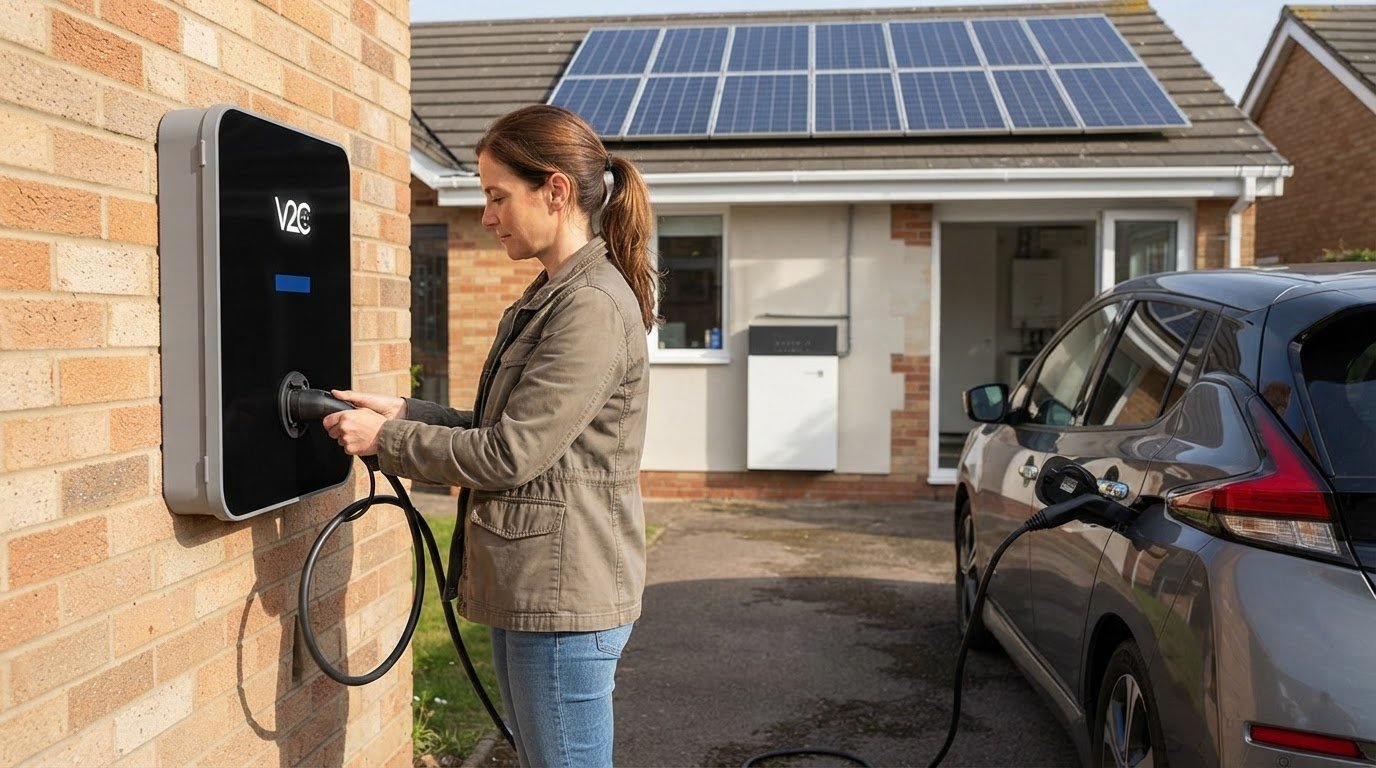
A 22 kW socket charger can offer fast home charging, but your vehicle and electrical supply determine the power you can actually use. The V2C Trydan 22 kW socket version stands out for drivers seeking a charger with dynamic load management (DLM) and solar balancing: it can adjust charging to household demand and use surplus solar power.
Choosing a charger involves more than its maximum output. You also want to manage charging times, avoid pushing household demand too high, and make better use of the solar energy your home generates. The right setup brings those needs together, while matching the charger to your vehicle and electrical system.
Learn how the Trydan handles load balancing, scheduled charging and solar surplus, and what affects the results. This guide explains the practical features to weigh when choosing a 22 kW socket charger, so you can decide whether its charging controls fit your home.
Key Takeaways
- See how dynamic load balancing adjusts charging to household demand and helps manage the power shared by home appliances and your EV.
- Learn how charging schedules and selectable energy modes can help align charging with lower-cost periods.
- Find out what the solar setup needs to direct surplus generation to your vehicle, and how battery storage affects the arrangement.
- Explore whether the V2C Trydan 22kW socket charger suits your setup, or whether another charging option better matches your requirements.
Dynamic load balancing
Dynamic load management adjusts electric vehicle charging as household energy use changes. The V2C Trydan uses live consumption information to help manage available power.
Overload Prevention
Household appliances and an electric vehicle can draw power at the same time. Dynamic load balancing responds to total energy consumption, reducing charging power when other demands rise. That helps avoid overloading the home’s electrical supply without requiring you to stop charging manually.
Look at how the system measures consumption and communicates with the charger. A compatible meter provides the data Trydan needs to adjust charging. For wireless dynamic power control, the WiFi meter and charger must connect to the same WiFi signal. A stable shared connection lets the charger respond to changing household demand.
The key decision is whether the measurement method fits your home’s electrical and solar setup. Household consumption changes as appliances switch on and off, so real-time adjustment can be more useful than relying on a fixed charging level. Dynamic control manages the charging load; it does not increase the power available from your electrical supply.
Trydan Power Control Methods
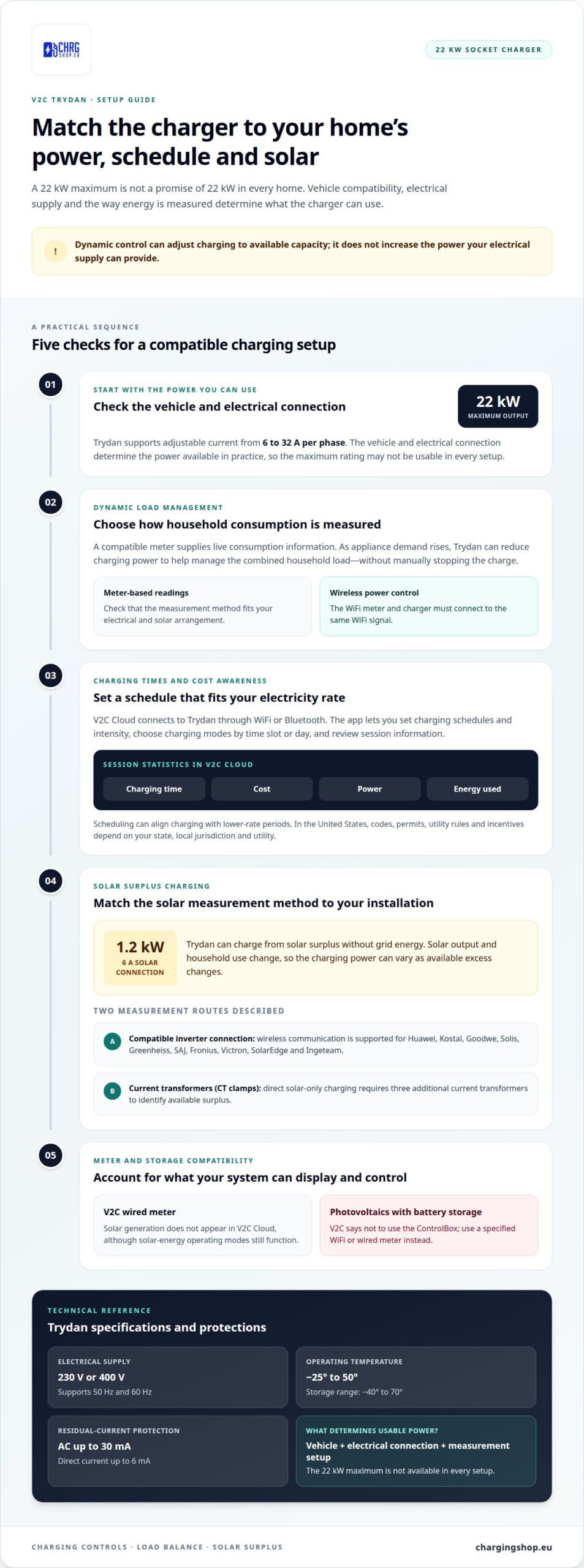
Trydan supports adjustable current from 6 to 32 A per phase. The charger can therefore vary its output in response to available capacity, rather than always drawing at its maximum. Its maximum output is 22 kW, but the electrical connection determines the power available in practice.
For dynamic control, Trydan can use meter-based readings. The wireless method requires the charger and WiFi meter to share the same network. The measurement setup is what allows the charger to account for household demand as it changes.
When comparing a 22 kW charger, focus on more than its headline rating. Check that the vehicle, electrical connection and measurement method work together. A compatible setup lets dynamic control adjust charging to the power available, helping balance convenient EV charging with other household loads.
Charging schedules and electricity-cost management
V2C Trydan connects to the V2C Cloud app through WiFi or Bluetooth. Use it to set charging schedules, choose charging intensity, and review energy use and session costs.
In the United States, electrical codes, permits, utility rules, and incentives depend on your state, local jurisdiction, and utility. Those local requirements determine what applies to a 22 kW charger installation, so establish them for your address before planning the work.
To manage electricity costs, schedule charging for periods when your electricity rate is lower. Trydan supports scheduled charging, letting you align a session with your tariff rather than charging immediately after plugging in. You can also view statistics in V2C Cloud, including charging time, cost, power, and energy consumption. Use that information to assess whether your current schedule matches your rate plan.
Trydan can charge using grid electricity, excess solar power, or a combination of both. Its charging modes can be selected by time slot or day, allowing you to coordinate charging with your schedule. Set your preferred mode and charging window in the app, then use session statistics to see how those settings fit your routine.
Electrical specifications matter alongside scheduling. Trydan is specified for 230 V or 400 V and supports 50 Hz and 60 Hz. Its operating temperature range is -25° to 50°, with a storage range of -40° to 70°. The supply, vehicle, and installation determine what charging power is usable; the 22 kW maximum isn’t available in every setup.
Built-in electrical protections include residual-current protection for alternating current up to 30 mA and direct current up to 6 mA. These protections are part of the charger’s electrical safety design, while a qualified installation must account for the site’s electrical system. For help matching charging controls to your requirements, explore a personalised charging offer.
Solar surplus charging
Solar surplus charging directs excess solar power into your electric vehicle instead of drawing that energy from the grid. The V2C Trydan can charge using solar surplus without grid energy, with solar connections supported from 1.2 kW (6A). If you’re weighing the V2C Trydan 22 kW socket version as the best charger for DLM and solar balancing, focus on how your solar system measures available excess.
The connection method depends on your inverter and metering setup. Trydan can connect wirelessly with compatible inverter brands, including Huawei, Kostal, Goodwe, Solis, Greenheiss, SAJ, Fronius, Victron, SolarEdge and Ingeteam. Check that the inverter or meter arrangement provides the energy information needed for solar charging. Wireless communication is one way the charger can receive readings and manage charging as generation changes.
Current transformers, or CT clamps, provide another way to measure energy flows. Direct solar-only charging requires three additional current transformers. These help the charger identify available surplus and direct it toward the vehicle. Choose the measurement approach to suit the inverter and electrical arrangement, rather than assuming every solar installation uses the same connection.
Meter type also affects what appears in V2C Cloud. V2C wired meters don’t display solar generation there, although solar-energy operating modes still function. In photovoltaic installations with storage batteries, V2C says not to use the ControlBox; use a specified WiFi or wired meter instead. That distinction matters when planning solar charging alongside home storage.
Solar output changes with generation and household energy use, so charging power can vary as surplus shifts. Trydan’s solar modes direct available excess toward the vehicle. For drivers comparing whether the V2C Trydan 22 kW socket version is the best charger with DLM and solar balancing for their needs, consider inverter compatibility, meter choice, and battery storage together. The OCPP 1.6 JSON protocol supports management-platform integration, but doesn’t replace solar metering or inverter communication.
Can the V2C Trydan automatically balance solar charging with household loads and battery storage?
Yes, Trydan can adjust vehicle charging using measured household consumption and available solar surplus. That lets it respond as home demand changes, directing available excess toward the electric vehicle rather than drawing from the grid. The key is the measurement connection: the charger needs compatible energy data to manage its charging power. Its 22 kW maximum is a charger rating, not a guarantee that solar generation or a home battery can supply that power.
Battery storage changes the metering setup. V2C advises against using the ControlBox in photovoltaic installations with storage batteries. Instead, use a specified WiFi or wired meter. This matters because the charger needs information about energy flows to balance vehicle charging against household use. The choice of meter must fit the solar and storage arrangement, not just the charger.
Keep the roles clear. Trydan manages the EV charging load; its solar and meter functions do not make it a home-battery management system. Meter readings help the charger respond to household consumption and solar surplus, while the battery system manages its stored energy. Don’t assume that selecting solar charging also controls battery charging or discharging.
For a practical setup, align three elements: the solar inverter or meter, the battery installation, and the charger’s communication method. WiFi metering depends on a compatible connection, while a wired meter uses a physical connection to provide readings. These choices affect how Trydan receives energy information and adjusts vehicle charging. Solar-only charging also depends on sufficient surplus, with the stated connection threshold beginning at 1.2 kW (6A).
A suitable meter setup can help a charger respond to household loads and make use of available solar surplus. For a configuration matched to your charger and storage arrangement, request a personalised charging offer.
Charging Shop: V2C Trydan 22kW
Charging Shop offers the V2C Trydan 22kW for drivers looking to combine home charging with dynamic load management and solar balancing. Its adjustable charging controls make it a relevant option when household demand and solar generation both shape your charging plan.
Choose the Trydan when its charging features match your setup. If your requirements differ, Charging Shop also offers the V2C DENKA 20kW DC Wallbox and Alfen Single Pro Line 22kW. A Personalised Charging Offer can help you identify an option suited to your charging requirements.
Consider your vehicle’s charging capability, electrical supply, solar equipment and preferred charging routine together. These factors determine which charger fits your home and how you can use its features. Contact Charging Shop to discuss your charging requirements and available options.
Make your charging setup work for you
The right charger fits how you use your home, not just the headline rating. Consider when your vehicle is parked, how you want to use excess solar power, and whether your electrical setup supports the charging power you need. These priorities turn a feature list into a practical decision.
If you’re considering the V2C Trydan 22 kW socket version as the best charger for DLM and solar balancing, focus on how its controls fit your day-to-day charging habits. A setup that makes sense for your routine is easier to use consistently, whether your priority is managing household demand or making use of solar surplus.
Take the next step with a clear view of your vehicle, home electrical supply, and charging goals. Discuss your charger requirements with Charging Shop and move toward a setup that suits the way you drive and charge.
Frequently Asked Questions
Buyers Guide: How to Choose the Best EV Charger?
Start with your vehicle’s charging capability, your home’s electrical supply, and how long the vehicle usually stays parked. For overnight home use, convenience may matter more than maximum output; a socket requires carrying a compatible cable, while an integrated cable is ready to connect. For workplace or public charging, consider whether users need authentication or station management. Match the charger to the setting and your daily routine.
How Much Does Installation Cost?
Installation cost depends on the existing electrical supply, cable route, and any changes needed to support the charger. A straightforward connection and a project requiring longer cable runs or electrical upgrades involve different work, so there is no single reliable figure for every home. Budget for installation separately from the charging equipment: Charging Shop sells chargers but does not provide on-site installation.
What Certifications and Safety Standards Matter?
Check that the charger’s documentation identifies the safety protections and standards applicable to your location and installation. For the V2C Trydan, listed protections include over-current, over-voltage, earth-fault, integrated lightning protection, DC ground fault, and leakage current protection. These are protection features, not a substitute for checking the product’s certification documents or requirements for the installation site. Avoid assuming a charger carries a certification that its documentation doesn’t name.
What are the V2C Trydan 22 kW socket-version specifications and supported connector types?
The V2C Trydan is rated for 22 kW three-phase output and 32 A maximum current. Its rated supply voltage is 230 V AC single-phase or 400 V AC three-phase. The product listing specifies a 5 m Type 2 cable, so Type 2 is the supported vehicle connector. Actual charging power depends on the vehicle and electrical supply, even when the charger’s maximum rating is higher.
Does the V2C Trydan support dynamic load management (DLM), and which meters or energy monitors are compatible?
Yes. Dynamic Load Management identifies total energy consumption in real time and adjusts charging to avoid overloading. Listed compatible monitoring options include Shelly and Wibeee meters. For wireless dynamic control, the charger and WiFi meter must share the same WiFi signal, so network connection is part of the setup.
How does V2C Trydan solar surplus charging and solar balancing work?
Trydan can direct excess solar generation to vehicle charging, reducing the amount of grid electricity used for that charging. Its listed compatible inverter brands include GoodWe, Fronius, Huawei, Ingeteam, Kostal, SolarEdge, SolaX, and Victron; Shelly and Wibeee are also listed for monitoring. For a photovoltaic installation with battery storage, use a specified WiFi or wired meter rather than the ControlBox. The meter provides readings that help balance charging with household use and solar generation.
