
 Deutsch
 Dansk
 Suomi
 Latviešu
 Lietuvių
 Norsk bokmål
 polski
 Русский
 Svenska

No products in the cart.
Uncategorized
ISO 15118 Explained: 2027 EU EV Charging Changes
27
Nov
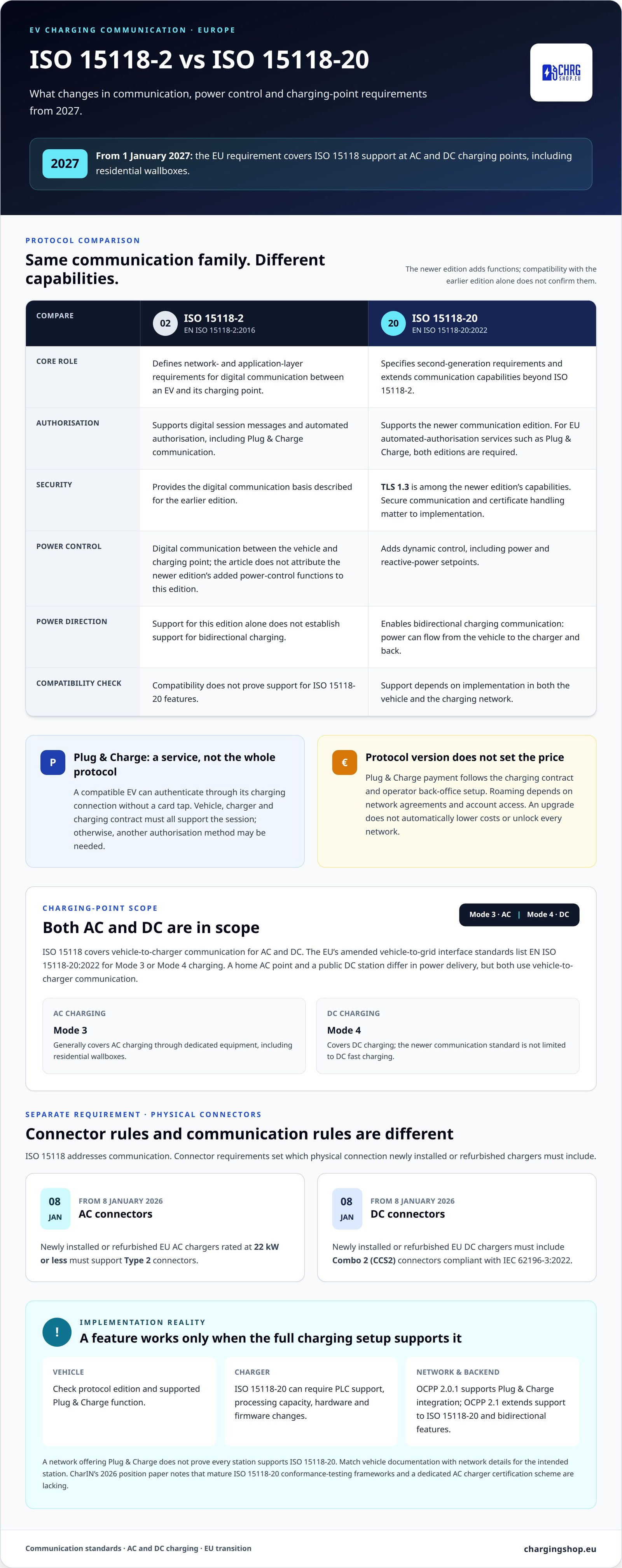
The 2027 shift is about charger communication, not just connectors. From 1 January 2027, the EU requirement covers ISO 15118 support at AC and DC charging points, including residential wallboxes. ISO 15118-2 and ISO 15118-20 bring different communication capabilities, with the newer standard supporting features such as bidirectional charging.
It’s easy to assume a new standard means every charger will behave differently overnight. The practical impact depends on the charger, the vehicle and which ISO 15118 functions each supports. This guide explains what ISO 15118-20 and ISO 15118-2 change for EV charging in Europe from 2027, and what the timeline means for new and existing equipment.
Get a clear view of Plug & Charge, AC and DC charging, TLS 1.3 and vehicle-to-grid power flows. You’ll also see how the transition rules apply, why ISO 15118-2 still matters, and what to consider when choosing charging hardware for a home or business. No protocol deep dive required to understand the essentials.
Key Takeaways
- See how ISO 15118-2 supports digital communication and Plug & Charge, and why it remains relevant alongside the newer standard.
- Understand what TLS 1.3, dynamic power control and bidirectional charging add with ISO 15118-20.
- Learn how the EU’s 2027 requirements apply across AC and DC charging points, including residential wallboxes.
- Follow the transition timeline and find out how renovation affects existing Mode 3 charge points.
ISO 15118-2 digital communication and Plug & Charge
EN ISO 15118-2:2016 defines network and application-layer requirements for digital communication between an EV and its charging point. That exchange supports automated authorisation and carries session messages, unlike IEC 61851’s simpler electrical signal.
Plug & Charge capabilities
Plug & Charge lets a compatible EV authenticate through its charging connection, without a card tap. Under EU requirements for automated authorisation, charging points must meet both EN ISO 15118-2:2016 and EN ISO 15118-20:2022. Vehicle-to-charger communication can handle authorisation before energy flows. ISO 15118-2 defines the network and application layers carrying this exchange. The EV, charger and charging contract must all support the session. Otherwise, another authorisation method may be needed.
Payments, roaming, and charging costs
ISO 15118-20 changes communication options, not the electricity tariff itself. Plug & Charge payment follows the charging contract and operator back-office setup. Roaming depends on network agreements and account access, not protocol version alone. An upgrade therefore doesn’t automatically reduce costs or unlock every network. Use the session receipt and contract terms to understand billed charging costs. Operators must connect vehicle authorisation with payment systems before drivers can pay automatically.
Vehicle and network support
ISO 15118-20 support depends on implementation in both the vehicle and charging network. ISO 15118-2 support alone doesn’t establish support for the newer edition. A network offering Plug & Charge doesn’t prove every station supports ISO 15118-20. No single EU-wide model list follows from the standard itself. Match the vehicle’s protocol documentation with network details before relying on a feature. For example, check the supported edition, Plug & Charge function and connector for the intended station.
Wallbox describes ISO 15118 as a protocol, not just Plug & Charge. In the European Union, charging points that support automated authorisation services such as plug-and-charge must meet both EN ISO 15118-2:2016 and EN ISO 15118-20:2022 requirements. This frames Plug & Charge as one service within a broader communication protocol, rather than as another name for the whole protocol. For automated authorisation, the stated EU requirements cover both editions together, not one as a substitute for the other.
ISO 15118-20 TLS 1.3, dynamic control and bidirectional charging
ISO 15118-20:2022 adds capabilities beyond ISO 15118-2:2016. The differences affect power control, hardware readiness and communication security.
Dynamic and bidirectional power transfer
Bidirectional charging lets power flow from the vehicle to the charger and back. ISO 15118-20 enables this communication, including power and reactive-power setpoints. The 2022 edition doesn’t include the grid code itself. Dynamic control can help coordinate energy transfer, while dynamic on-road power transfer concerns vehicles receiving power as they travel. CLC/TS 50717 is an example standard for dynamic on-road transfer. These are distinct use cases.
Operator upgrade requirements
Moving to ISO 15118-20 can require charger hardware, firmware and backend changes. Charging equipment needs Power Line Communication support and processing capacity for cryptographic workloads and TLS 1.3. Some existing AC platforms may need hardware changes, not just a firmware update. On the backend, OCPP 2.0.1 supports Plug & Charge integration, while OCPP 2.1 extends support to ISO 15118-20 and bidirectional features.
Interoperability and certification risks
Interoperability risk arises when a vehicle, charger and backend implement different capabilities or versions. Cybersecurity depends on secure communication and certificate handling. One implementation uses TLS 1.3, mutual TLS through OCPP SecurityProfile 3, and unique certificates for each charging station. According to CharIN’s 2026 position paper, mature ISO 15118-20 conformance testing frameworks and a dedicated AC charger certification scheme are lacking. That can complicate consistent testing across equipment.
Protocol differences
ISO 15118-2:2016 specifies network and application-layer requirements; EN ISO 15118-20:2022 specifies the second-generation requirements. The newer edition adds TLS 1.3, dynamic control and bidirectional charging communication. In practice, this means ISO 15118-20 support cannot be assumed from ISO 15118-2 compatibility alone. Operators assessing hardware needs can use a Personalised Charging Offer to align equipment choices with their charging environment.
AC and DC charging protocol scope
ISO 15118 covers communication for both AC and DC charging. From 1 January 2027, the EU requirement applies to ISO 15118 support at charging points, including residential wallboxes. The question of what ISO 15118-20 and ISO 15118-2 change for EV charging in Europe from 2027 comes down partly to this broad scope. A home AC point and a public DC station both use vehicle-to-charger communication, though their power delivery differs.
Charging modes help distinguish the connection types. Mode 3 generally covers AC charging through dedicated equipment, while Mode 4 covers DC charging. According to EUR-Lex, the EU’s amended vehicle-to-grid interface standards list EN ISO 15118-20:2022 for Mode 3 or Mode 4 charging. This places the newer communication standard across both modes, rather than limiting its relevance to DC fast charging.
Connector rules set a separate timeline. From 8 January 2026, newly installed or refurbished EU AC chargers rated at 22 kW or less must support Type 2 connectors. Newly installed or refurbished EU DC chargers must include Combo 2, or CCS2, connectors compliant with IEC 62196-3:2022. These requirements concern physical connections; ISO 15118 addresses communication between the vehicle and charger. Understanding what ISO 15118-20 and ISO 15118-2 change for EV charging in Europe from 2027 therefore means separating connector compatibility from protocol support.
Will an EV using ISO 15118-2 still charge at a station supporting ISO 15118-20? It can if the vehicle and station share a compatible charging mode and communication option. A newer protocol label alone doesn’t establish compatibility for every pairing. Connector fit and the functions implemented at both ends also shape the session. That distinction helps explain why broad protocol scope doesn’t guarantee every feature works across all vehicles and stations.
ISO 15118-2 transition timeline
Two EU milestones shape the transition. From 8 January 2026, newly installed or renovated publicly accessible AC charge points must support EN ISO 15118-2. This is the earlier requirement, focused on public AC charging. Understanding what ISO 15118-20 and ISO 15118-2 change for EV charging in Europe from 2027 starts with separating this milestone from the wider transition. Connector rules are separate: they cover the physical plug, not vehicle communication.
From 1 January 2027, EN ISO 15118-20 applies more broadly in the EU, including new private Mode 3 and Mode 4 points. This extends the scope beyond publicly accessible charging. Existing Mode 3 charge points are exempt from the ISO 15118-20 requirement until renovation. Whether equipment is new, private, public or renovated affects which milestone applies. An existing point doesn’t automatically follow the same timeline as a replacement.
AFIR (EU) 2023/1804 and Delegated Regulation (EU) 2025/656 cover EU public charge-point requirements, including vehicle communication. EN ISO standards set technical communication requirements. The European Commission published Delegated Regulation (EU) 2025/656 on June 18, 2025, updating technical requirements under AFIR. Together, these instruments explain what changes for EV charging in Europe from 2027 under ISO 15118-20 and ISO 15118-2, while distinguishing infrastructure rules from technical standards.
CharIN proposed postponing mandatory software implementation until January 2028. That was a proposal, not the EU milestone described above. Planning also involves commissioning: a charger produced today may take six to eight months to install and commission. Account for that lead time alongside the applicable date and renovation plans. For help aligning equipment choices with your charging requirements, request a Personalised Charging Offer.
Charging Shop
Charging Shop helps you turn the ISO 15118 transition into a practical hardware decision. Start with your charging environment, whether it’s home, workplace or another setting, then match the equipment to your AC or DC requirements. A Personalised Charging Offer can help you compare suitable options without treating every charger as interchangeable.
The available range includes the V2C Trydan 22kW, V2C DENKA 20kW DC Wallbox and Alfen Single Pro Line 22kW. Use the standards and timeline discussed above to guide your requirements, then consider which charging setup fits your use case. Product choice alone doesn’t establish support for a particular ISO 15118 edition, so focus on the specifications relevant to your planned installation.
For help with your charging requirements, contact Charging Shop.
Plan Your Next Charging Decision
Make protocol capability part of your next charging decision, alongside where the equipment will operate and how drivers will use it. Thinking through ISO 15118-20 and ISO 15118-2, and what changes for EV charging in Europe from 2027, can help you frame the right questions before choosing hardware. Focus on the charging environment, the functions that matter to you, and how the vehicle and charger need to work together. That turns a standards update into a practical project brief, not a last-minute specification scramble.
For a home, workplace or commercial setup, match the equipment to your actual charging needs rather than buying around a single feature. Charging Shop can help you consider suitable options through a Personalised Charging Offer. Contact Charging Shop to discuss your needs and take the next step with a clearer plan. Your charging setup can move forward with confidence.
Frequently Asked Questions
What does ISO 15118-20 add for bidirectional charging, Plug & Charge, and wireless charging?
ISO 15118-20 supports communication for bidirectional power flows and automated Plug & Charge authorisation. It doesn’t define the physical wireless charging system. For static wireless charging, the relevant standards include EN 61980-1, EN 61980-2 and EN 61980-3. In practice, wireless power transfer and vehicle communication are related parts of a charging setup, but they’re covered by different standards.
Is ISO 15118-20 mandatory for EV chargers or vehicles in Europe from 2027?
The EU requirement applies to charging points, not directly to vehicles. From 1 January 2027, the broader requirement includes new private Mode 3 and Mode 4 points. Existing Mode 3 charge points are exempt until renovation. A vehicle isn’t required by this charging-point rule to support ISO 15118-20, but its supported communication features affect which functions it can use at a compatible charger.
What is the European Commission AFIR timeline for ISO 15118 compliance at public charging stations?
For newly installed or renovated publicly accessible AC charge points, the earlier milestone is 8 January 2026, when EN ISO 15118-2 support is required. From 1 January 2027, the wider EU requirement covers ISO 15118 support at charging points, including new private Mode 3 and Mode 4 points. Treat these as separate milestones: the first concerns public AC points, while the later scope is broader.
