
 Deutsch
 Dansk
 Suomi
 Latviešu
 Lietuvių
 Norsk bokmål
 polski
 Русский
 Svenska

No products in the cart.
Uncategorized
How to Use Cable Retraction for Safer Commercial EV Depots
26
Nov
The reel matters less than whether it suits the charger cable and depot layout. For a commercial EV charger with cable retraction, match the reel to the AC or DC cable assembly, then plan for safe reach, smooth handling and a clear return path.
AC and DC charging setups may use different cable assemblies, so don’t choose a reel by appearance alone. Select a system suited to the cable and able to reach each parking position without pulling at a sharp angle.
This guide explains how AC and DC charging reels differ, how to position a retractor, and how to guide and protect cables during use. These steps help reduce loose-cable hazards, avoid unnecessary strain and keep a depot charging area organized.
Key Takeaways
- Choose an AC or DC reel to suit the charging cable and the way vehicles use each bay.
- Keep cables clear of traffic and ground hazards to help reduce wear and trip risks.
- Guide cables smoothly during use and retraction to limit strain on the cable and fittings.
- Position the retractor for practical reach across parking spaces without forcing the cable into an angle.
Cable protection from vehicle damage and weather
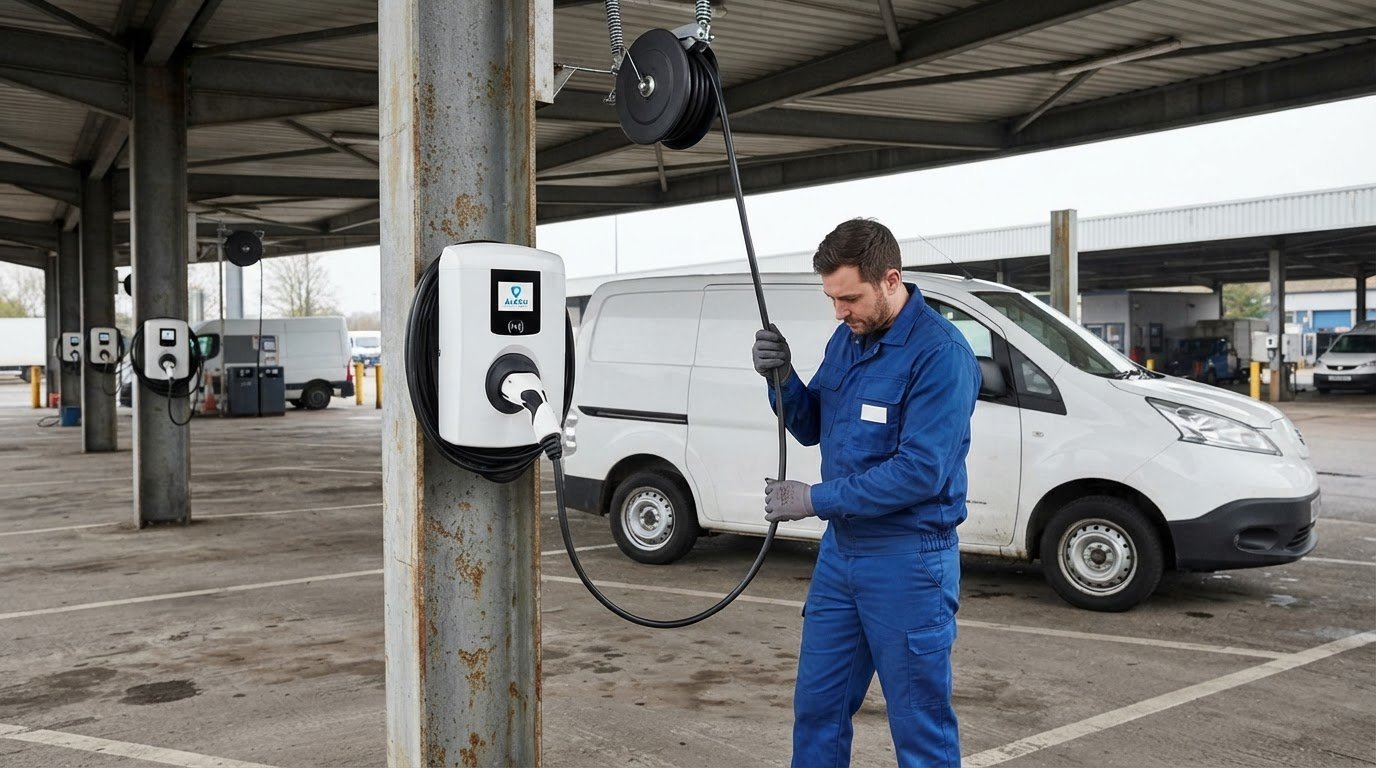
- Keep the cable suspended between charging sessions. A wall- or ceiling-mounted retractor lifts the lead away from vehicle paths, reducing the chance that a tyre will cross the insulation or connector. It also limits contact with moisture, mud, ice and debris on the depot floor.
- Route the cable clear of wheels and turning space. Set its resting point so a parked vehicle cannot trap the lead under a tyre. For example, if a van reverses into a bay, the cable should retract toward the wall or ceiling, not trail behind the rear wheels. Clear routing reduces crushing and abrasion.
- Use the retractor to reduce repeated bending. Pulling a cable across the ground can drag it over rough surfaces and sharp edges. Repeated bends can contribute to internal wire breakage, while friction wears the outer covering. A guided return helps prevent repeated dragging and tight bends.
- Keep the cable unbunched while charging. Don’t leave excess length coiled or piled beside the vehicle. A bunched cable can trap heat and increase wear on internal wiring. Extend only enough cable to reach the charge port, keeping the rest clear of wheels, doorways and standing water.
- Retract the cable after each session and inspect its route. Check that the lead returns fully to its home position instead of hanging low or resting on the ground. Look for cuts in the outer jacket, crushed sections, exposed wiring or debris around the connector. A retractor helps limit exposure, but it does not make a damaged cable safe or weatherproof.
Suspending and retracting the lead helps prevent vehicle runovers from damaging insulation or internal wiring. It also limits exposure to foot traffic, moisture and debris, while reducing bend-related wire breakage and external wear.
Depot safety and trip-hazard reduction
Plan each charging bay around vehicle movement and pedestrian access. Applicable accessibility and electrical-code requirements depend on the depot’s jurisdiction and site layout.
Reduce Tripping Hazards
Map the route from each charger to its vehicle before setting cable positions. Keep leads out of pedestrian aisles, doorways and marked walking routes. For example, a cable crossing the route between a staff entrance and parked vans creates a trip hazard, even if charging is brief.
Position the retractor so the cable reaches the charge port without crossing a busy walkway. At bays beside shared access lanes, direct the cable toward the vehicle, not across the lane. Keep connectors away from places where pedestrians step or carts turn.
During depot operations, observe how drivers approach and leave each bay. A cable that clears a parked vehicle may still obstruct a reversing route when vehicles change direction. Adjust its resting position to keep it clear of pedestrian crossings and vehicle movement areas.
Review Safety and Accessibility Requirements
Review the electrical and accessibility requirements that apply to the depot’s location and installation. Check local rules for charger placement, cable routing, accessible routes and electrical equipment. Don’t assume one layout meets requirements across jurisdictions or facilities.
Keep designated accessible paths clear during charging, not just while cables are stored. Consider the full route around a charger, including the space needed to approach it and reach a vehicle’s charge port. A cable should not force people into a vehicle lane or make them detour around equipment.
Include the retractor, cable travel, charger and parking position in the site layout review. Check that extending the lead won’t block an exit, cross an access route or interfere with nearby electrical equipment. Document the intended cable path so the commercial charging area can be assessed against local requirements.
Review the layout if a bay changes use or traffic patterns shift. A new parking orientation can put a previously clear cable route across an accessible path. Keep the route and retractor position aligned with how the depot operates.
Guiding cables during extension and retraction
Support durability with smooth cable handling, routine visual checks and a clear understanding of warranty terms for the cable and retractor. Coverage varies by product, so check what applies to wear, mechanical failure and accidental damage.
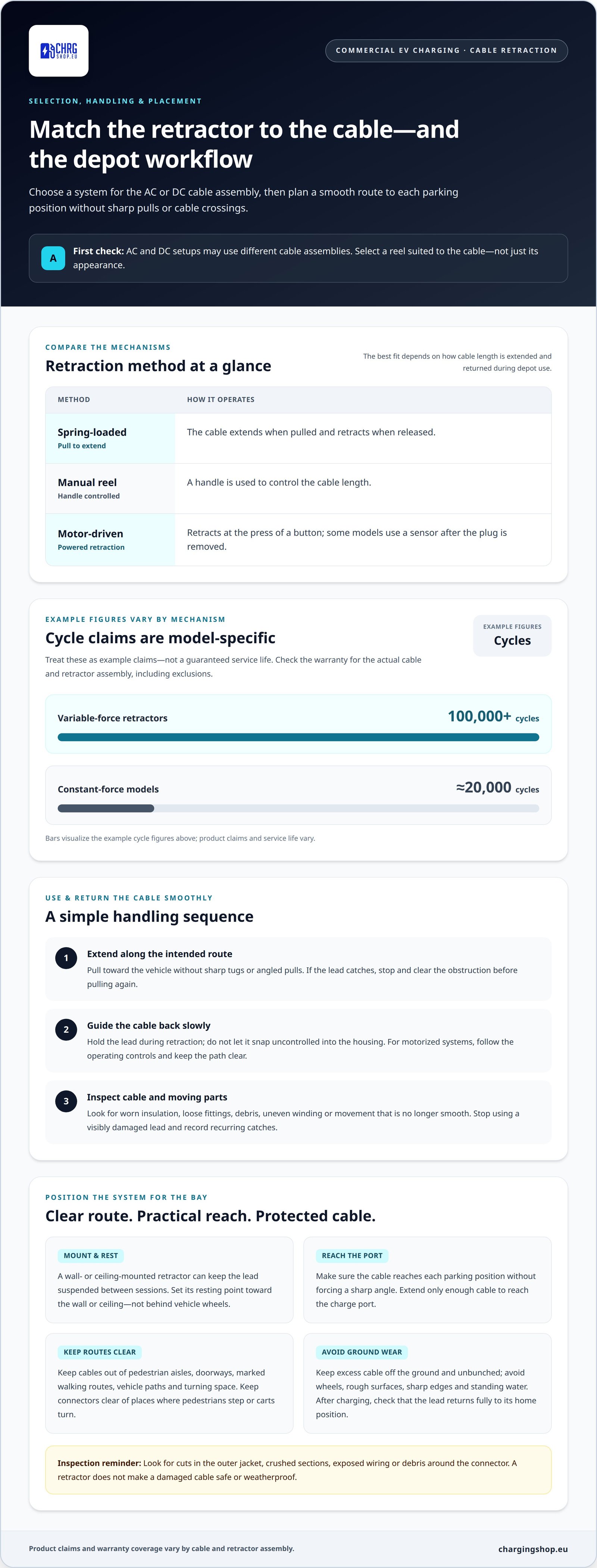
- Pull the cable along its intended path. Extend it toward the vehicle without sharp tugs or angled pulls. A straight approach reduces stress on the cable, connector and fittings. If the lead catches on an obstruction, stop and clear the route before pulling again.
- Choose a retraction method that suits the depot workflow. Spring-loaded systems extend when pulled and retract when released. Manual reel systems use a handle to control cable length. Motor-driven systems retract at the press of a button, while some models use a sensor after the plug is removed.
- Guide the cable back slowly. Hold the lead as it retracts; don’t let it snap uncontrolled into its housing. For a motorised unit, follow the operating controls and keep the cable path clear. This helps prevent impacts to the connector and strain where the cable enters the retractor.
- Inspect the moving parts and cable. Look for worn insulation, loose fittings, debris or a cable that no longer moves smoothly. Keep the retractor’s path clear, and stop using any visibly damaged lead. Record recurring catches or uneven winding so maintenance can address the cause.
- Compare endurance claims carefully. Example figures vary by mechanism: variable-force retractors may list 100,000+ cycles, while constant-force models may list approximately 20,000 cycles. Treat these as model-specific comparisons, not a guaranteed service life. Match warranty coverage to the actual cable and retractor assembly, including stated exclusions.
Selecting and positioning a commercial cable retractor
In the U.S., incentive eligibility depends on the program and project criteria; cable retraction alone does not establish eligibility. Installation costs and electrical requirements depend on the charger, site layout, available electrical capacity and cable route.
- Match the retractor to charger type and cable reach. Confirm that the system suits the charger’s Level 1 or Level 2 type. Measure the path from the retractor to each vehicle’s charge port. A cable that reaches one parking position may not serve another without strain, so plan around every bay the charger must cover.
- Choose manual or automatic operation for depot use. Spring-loaded manual retractors may suit stations with low to medium use. Manual reels let users control how much cable they extend. Automatic retractors suit high-traffic stations where quick turnover matters, but generally cost more to install and maintain than manual types.
- Decide between a reel and a basic spring-loaded cable. Reels and retractors are generally preferred over basic spring-loaded retractable cables in high-traffic commercial areas. They can reduce torsional stress and long-term cord wear. Match the mechanism to usage patterns, cable movement and available space around the charger.
- Set the mounting point to suit parking geometry. Wall or ceiling mounting can work, depending on the facility layout. Position the unit so the lead reaches each intended parking spot without a sharp angle or excessive tension. For example, a ceiling-mounted system may suit bays where a wall-mounted unit would leave the cable short of the charge port.
- Include electrical capacity and site work in planning. The charger’s power needs, existing electrical capacity, mounting surface, and cable route all affect project requirements and installation costs. Assess those factors together before settling the retractor position. A personalised charging offer can help align charger selection with the depot’s charging needs.
Costs vary with the charger, site layout, electrical capacity and cable route. Automatic retractors generally cost more to install and maintain than manual models. Electrical requirements depend on the charger’s power needs and the site’s available capacity.
Charging Shop
Charging Shop helps you connect depot requirements with suitable EV charging hardware and a tailored charging offer. Once you’ve mapped parking positions, cable reach, and charging needs, use those details to narrow your charger choice. The V2C Trydan 22kW, V2C DENKA 20kW DC Wallbox, and Alfen Single Pro Line 22kW are among the available options for different charging environments.
A Personalised Charging Offer can help bring your project requirements together as you decide which charging hardware suits your depot. Consider charger type, power needs and bay layout alongside the cable-retraction plan, so your equipment choices reflect how vehicles use the space.
Contact Charging Shop to discuss your depot requirements and request a Personalised Charging Offer.
Make Cable Management Part of Depot Planning
Treat cable routing as an operating decision, not an accessory to add after placing the charger. Changes to vehicle sizes, parking patterns or pedestrian routes can affect how each bay works. Include them in future layout reviews to keep the setup practical for your team.
A commercial EV charger with cable retraction should suit the charging equipment, parking geometry and daily workflow. Bring these requirements together in a project brief before selecting equipment. This gives your decision a clear starting point and keeps cable management grounded in the depot’s needs.
Charging Shop offers EV charging hardware and personalised charging offers to help you plan that next step. Contact Charging Shop about cable retractors and move your depot project forward with confidence.
Frequently Asked Questions
What is the difference between the AC Charging Reels and DC Charging Reels?
The reel must suit the charger’s cable assembly and the route from the charger to the vehicle. AC and DC describe charging methods, so don’t assume their reels or cables are interchangeable. In a depot with both charger types, match each reel to its charger’s cable and connector, then check reach and routing for the assigned bays.
How do retractable cable EV chargers work, and what retraction designs are available?
Retractable systems store or support cable so users can extend it for charging and return it afterward. Spring-loaded spools rewind released cable; manual reels use a handle for controlled winding. Motor-driven models retract at the press of a button, and some use plug-removal sensors. External suspension systems use a separate wire or pulley. For a shared fleet bay, choose controls drivers can use consistently.
What are the charging power levels and connector types for commercial EV chargers with cable retraction?
Choose power and connector compatibility according to the charger, vehicle, and cable assembly. Charging Shop’s listed options include the V2C Trydan 22kW and Alfen Single Pro Line 22kW, plus the V2C DENKA 20kW DC Wallbox. Its wallbox range uses Type 2 connectors. Match the retractor to the specific cable, and remember that the vehicle’s specifications affect the power it can accept.
What are the installation costs and electrical requirements for commercial retractable-cable EV chargers?
Costs depend on the charger, site layout, available electrical capacity and cable route. Electrical requirements depend on the charger’s power needs and the site’s capacity. Automatic retractors generally cost more to install and maintain than manual models.
