
 Deutsch
 Dansk
Dansk Suomi
Suomi Latviešu
 Lietuvių
 Norsk bokmål
 polski
 Русский
 Svenska
No products in the cart.
Uncategorized
Apartment Complex EV Charging Solutions: The 2026 Management Guide
25
Sep
Sep
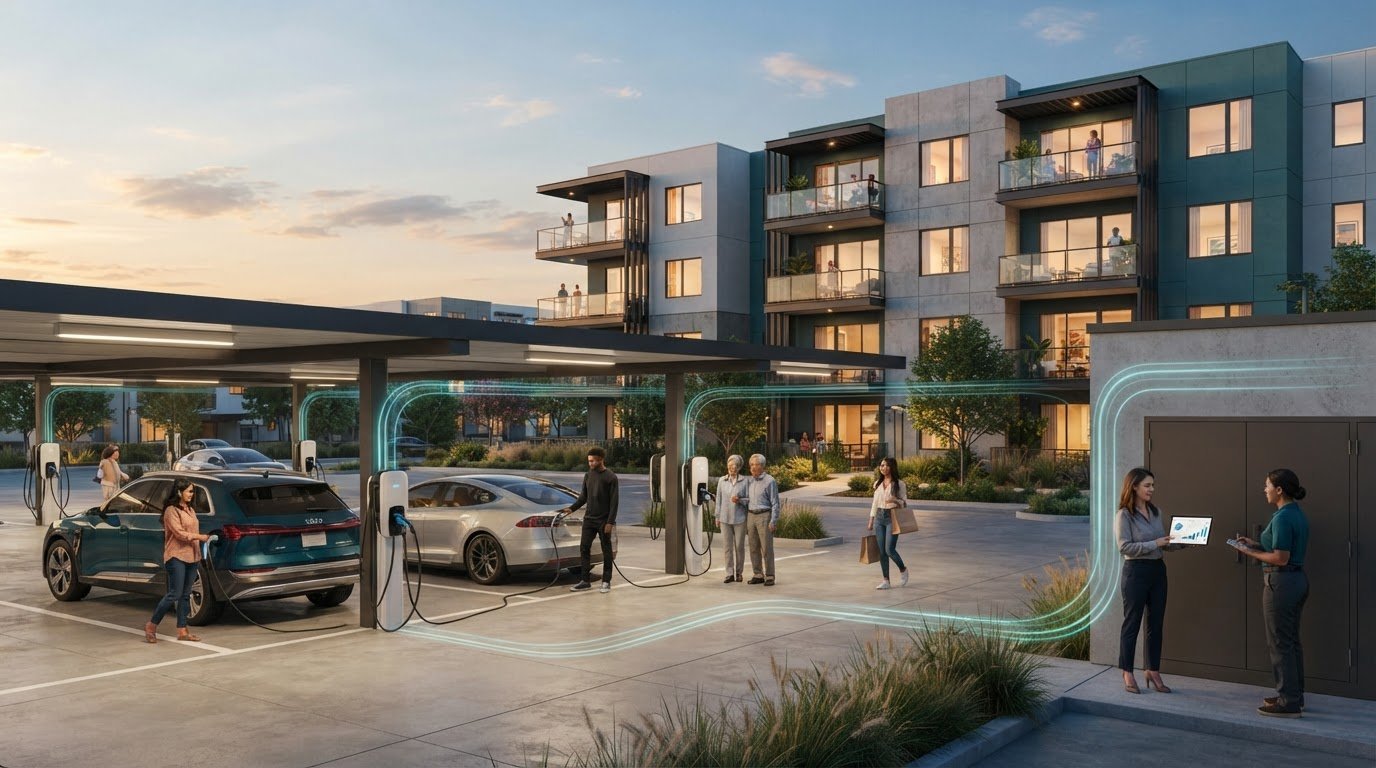
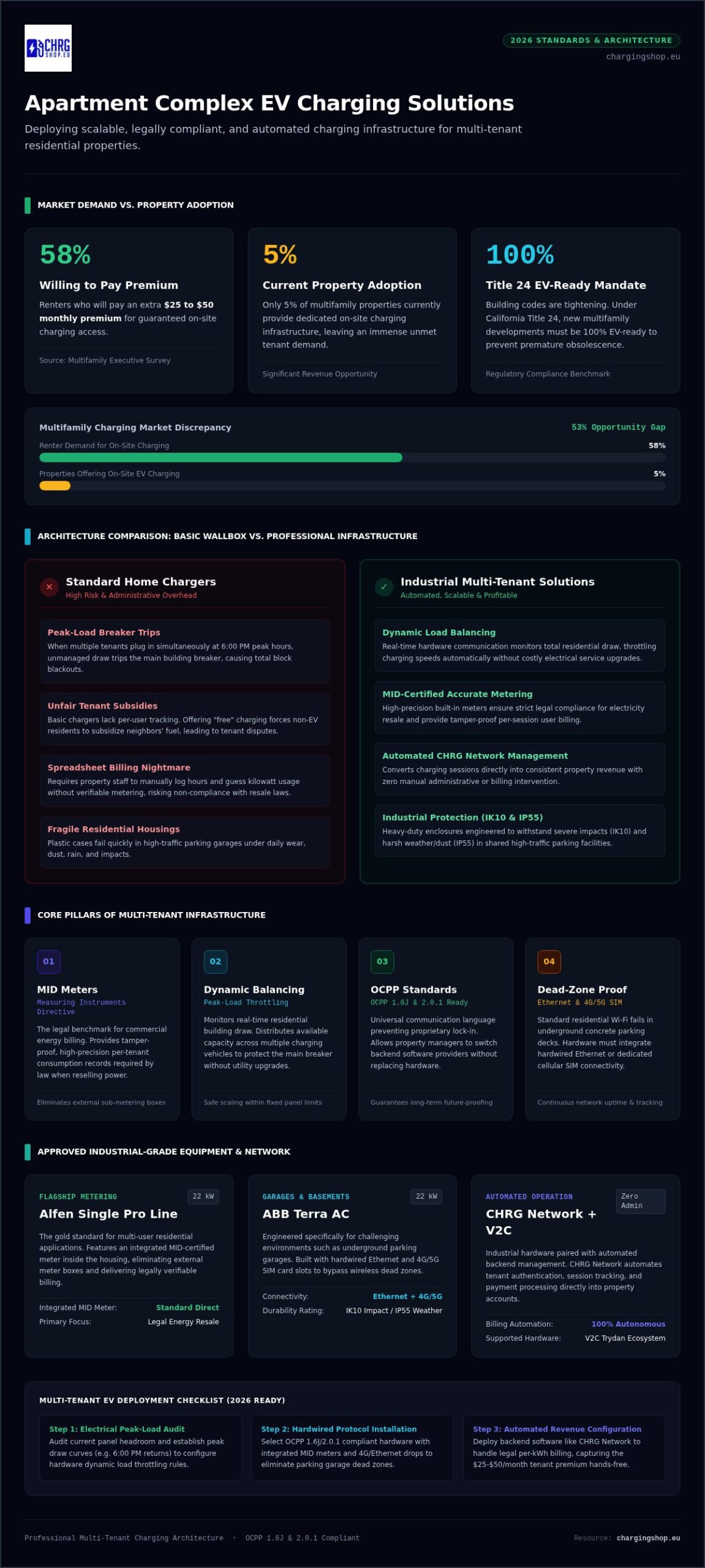
A 2026 Multifamily Executive survey reveals that 58% of renters will pay a $25 to $50 monthly premium for on-site charging access. Despite this massive demand, only 5% of multifamily properties currently offer it. You’re looking at a significant revenue opportunity, but the technical logistics of apartment complex ev charging solutions often feel like a massive headache. You don’t want to spend hours on manual billing or risk overloading an older building’s electrical capacity.
It’s a common struggle to manage unfair cost distribution and high infrastructure costs. We’ve written this guide to clear the path. You’ll learn how to deploy scalable, profitable charging using industrial-grade hardware like the Alfen Single Pro Line and ABB Terra AC. We’ll explain how the CHRG Network automates your billing and how smart load management prevents grid stress. This is your roadmap to professional, OCPP-compliant infrastructure that meets the latest 2026 standards without the fluff. Stop worrying about electrical limits and start building a future-proof amenity that pays for itself.
Key Takeaways
- Distinguish between standard home chargers and professional hardware to avoid infrastructure failure and limited user tracking in shared spaces.
- Leverage MID-certified meters to ensure your billing practices remain legally compliant with 2026 energy regulations and fair for all tenants.
- Scale your apartment complex ev charging solutions efficiently by using dynamic load balancing to distribute power across multiple units without costly grid upgrades.
- Transition to automated network management to convert charging sessions into consistent revenue with zero manual administrative intervention.
- Select industrial-grade hardware like the V2C Trydan or Alfen Single Pro Line to build a robust, future-proof charging ecosystem for your property.
The Multi-Tenant Challenge: Why Standard Chargers Fail
Don’t make the mistake of treating a residential block like a single-family driveway. Apartment managers often think any wallbox will suffice, but standard home chargers aren’t built for the rigors of multi-tenant environments. You’re dealing with shared electrical panels, dozens of different users, and strict laws regarding electricity resale. If you install a basic unit instead of professional apartment complex ev charging solutions, you’re inviting grid blackouts and a management nightmare of manual spreadsheets. By 2026, building codes are tightening significantly. In California, Title 24 now requires new multifamily buildings to be 100% EV-ready. Deploying non-networked hardware today is a waste of capital. Modern electric vehicle charging infrastructure demands smart, networked communication to function safely and profitably.
Power Constraints in Residential Blocks
Most existing residential blocks have a fixed ceiling for electrical capacity. You must understand your building’s total peak load before adding new equipment. A standard Level 2 charger draws a lot of current. Imagine five tenants coming home at 6:00 PM and plugging in simultaneously. Without a system to throttle that draw, you’ll trip the main breaker and leave the entire building in the dark. It’s a massive safety risk. Professional apartment complex ev charging solutions solve this through hardware-level communication. These systems monitor the building’s draw in real-time and adjust charging speeds automatically. It keeps the lights on while ensuring every car gets the power it needs.
The Billing and Transparency Gap
Transparency is the only way to avoid tenant infighting. If you offer “free” charging, your non-EV tenants are effectively subsidizing the fuel for those who drive electric. That won’t last. Simple plug-and-play chargers lack the sophisticated tracking required for fair cost distribution. In many regions, reselling electricity requires MID-certified meters for legal billing. Hardware like the Alfen Single Pro Line 22kW includes these high-precision meters by default. Without them, you’re guessing at usage, which leads to disputes and potential legal trouble. Don’t settle for “close enough” when it comes to resident money. Choose hardware that provides verifiable, per-user data every single time.
Essential Hardware for Apartment Complexes
Selecting the right hardware is the difference between a high-yield asset and a constant maintenance liability. You need equipment that withstands high-traffic use and communicates flawlessly with your management network. According to a property manager’s guide, charging infrastructure is now a top-tier amenity that drives property value and tenant retention. Don’t get stuck with proprietary systems. Demand OCPP 1.6J or 2.0.1 compliance. This universal language ensures you can switch software providers without replacing your chargers. It’s the only way to future-proof your apartment complex ev charging solutions.
High-traffic environments also demand industrial-grade durability. You aren’t just buying a charger; you’re buying a piece of utility infrastructure that must survive rain, dust, and daily wear. Look for IK10 impact ratings and IP55 weather protection. Cheap plastic housings won’t survive five years in a busy parking garage. Investing in robust hardware now prevents expensive replacement costs later. You want hardware that feels solid and performs consistently under pressure.
MID Meters: The Gold Standard for Billing
The Measuring Instruments Directive (MID) is the legal benchmark for energy billing. If you plan to charge tenants for the electricity they consume, you need a meter that meets these high-precision standards. It’s not just a recommendation; in many jurisdictions, it’s a legal requirement for reselling power. The Alfen Single Pro Line 22kW is built specifically for this purpose. It integrates the MID meter directly into the housing. This eliminates the need for external enclosures and cuts down on installation complexity. You get accurate, tamper-proof data for every tenant session, making administrative overhead almost non-existent.
Professional Connectivity and Access Control
Underground garages are notorious for dead zones. Don’t rely solely on Wi-Fi for your apartment complex ev charging solutions. Choose hardware with hardwired Ethernet or 4G/5G SIM slots to ensure the system stays online. The ABB Terra AC 22kW chargers offer these robust connectivity options, which are vital for remote management. Security is just as vital. Use RFID card access to ensure only authorized tenants can start a session. It prevents neighbors from stealing power and keeps your usage data clean.
Space management is your final hardware hurdle. Dual-socket units allow two cars to charge from a single pedestal, saving on ground works and cabling. However, single-socket units like the V2C Trydan offer more flexibility for assigned parking spots. Assess your layout before you buy. If you’re ready to upgrade your property, check out our personalized charging offer for a tailored hardware breakdown.
Software & Billing: Automating Your Charging Network
Hardware is just the muscle; software is the brain. Without a robust management platform, your apartment complex ev charging solutions are just expensive wall decorations. You need a system that handles the heavy lifting of user authentication, load management, and financial transactions. Automated billing is the key to turning a service into a revenue stream. It converts every charging session into precise revenue without you ever touching a spreadsheet. Remote monitoring allows you to spot a hardware fault and reboot a unit before a tenant even realizes there’s a problem. This level of efficiency is what separates professional property management from amateur setups.
Tariff customization is another massive advantage for property owners. You don’t want to charge your long-term residents the same rate as a delivery driver or a weekend visitor. Professional software lets you set tiered pricing. You can offer discounted rates for residents while maximizing profit from guest parking. It’s about flexibility and control. You decide the margin, and the software handles the collection.
CHRG Network: The Manager’s Control Center
Managing multiple stations across a sprawling property shouldn’t be a full-time job. CHRG Network access provides real-time visibility into every charging point you own. You can see who is charging, how much energy they’re pulling, and the health of your hardware from a single dashboard. This platform handles complex billing cycles effortlessly. Whether you bill monthly or per session, the money moves from the tenant’s wallet to your account automatically. It also generates detailed monthly reports. Use these for HOA audits, tax compliance, or to prove the ROI of your infrastructure investment to stakeholders.
OCPP: Future-Proofing Your Investment
Never buy a ‘closed’ charging system. If a manufacturer locks you into their proprietary software, you’re at their mercy for fee hikes and slow updates. Demand Open Charge Point Protocol (OCPP) compatibility. This industry standard allows you to switch software providers without ripping out your physical hardware. It gives you the freedom to choose the best network for your needs. Standardizing your fleet with OCPP-compliant brands like Alfen or ABB ensures your apartment complex ev charging solutions remain flexible as technology evolves. It simplifies your operations and protects your capital investment for the long haul.
Scalability and Load Balancing in Multi-User Environments
Scaling your infrastructure shouldn’t require digging up the entire parking lot every time a new tenant buys a Tesla. Most residential buildings have a hard limit on available power. If you try to run thirty chargers at full tilt, you’ll blow the main transformer. This is where professional apartment complex ev charging solutions prove their worth. By using smart power distribution, you can support a large fleet of vehicles on a relatively small electrical footprint. It’s about working smarter with the juice you already have, ensuring your building remains functional while every car gets a reliable charge.
Dynamic Load Management (DLM) Explained
Dynamic Load Management is the secret to high-density charging. It acts as a digital traffic controller for your building’s electricity. The system monitors the total consumption of the residential block in real-time. When the elevators are running and the lights are on, the chargers throttle down. As the building’s demand drops at night, the chargers ramp up. This software-driven distribution prevents the need for massive, six-figure grid upgrades. You just need hardware with built-in support for external power meters to feed the data back to the stations. It’s a proactive way to avoid the “make-ready” infrastructure hurdles that stall many projects.
The ‘Master-Slave’ Hierarchy
In a Master-Slave setup, one primary unit acts as the brains for a group of secondary chargers. This reduces installation complexity because you only need one main communication point for the whole cluster. For smaller complexes or boutique buildings, even a 22kW wallbox for home can be adapted into a multi-unit cluster if it supports daisy-chain connectivity. You can scale from two points to fifty by simply adding ‘slaves’ to the existing chain. It keeps your cabling neat and your controller costs low. It’s a plug-and-play approach to growth that doesn’t require a total system overhaul every year.
Smart systems also allow for prioritized charging. You can ensure that emergency vehicles or tenants with early morning shifts get full power first, while others charge more slowly overnight. Looking toward 2030, EV adoption will only accelerate. Design your infrastructure now by installing oversized conduit and sufficient panel space. Utility “make-ready” programs often fund the electrical upgrades needed for these setups, so check your local incentives. It’s much cheaper to pull extra wire today than to renovate again in three years. Ready to map out your building’s capacity? Get a personalized charging offer for your project today.
Ready to Deploy? Get Your Professional Charging Solution
Deploying apartment complex ev charging solutions doesn’t have to be a multi-year struggle. You’ve seen the technical requirements and the legal hurdles. Now it’s time to execute. Start by securing a Personalized Charging Offer that maps out the exact hardware and software mix your specific building requires. By selecting industry-standard hardware from Alfen, ABB, or V2C, you ensure long-term reliability and high uptime. Once the hardware is in place, activate your CHRG Network subscription to take full control of your revenue and user access. You aren’t just installing chargers; you’re future-proofing your asset and driving immediate property value. Act now to capture the growing market of EV-driving renters before your competitors do.
Efficiency is your greatest asset during deployment. You need a partner that understands the logistical friction of multi-tenant projects. Focus on hardware that arrives pre-configured for your network to minimize onsite troubleshooting. A proactive approach today prevents the “dumb” infrastructure mistakes that lead to expensive retrofits in two years. If your overall facility upgrade also involves modernizing parking access or automated entry points, specialized providers like Kaputechnika Bolt supply dedicated gate automation and garage solutions to keep vehicle entry seamless. Every day you wait is a day of lost charging revenue and missed tenant leads. Get your infrastructure online and start seeing the ROI immediately.
Choosing Your Hardware Mix
Not every parking spot needs the same equipment. For smaller residential blocks or projects where smart home integration is a priority, the V2C Trydan 22kW is an excellent choice. It’s compact, intelligent, and easy for tenants to manage via a personal app. If you manage a premium development, consider mixing standard AC units for overnight residents with high-speed DC chargers, like the V2C DENKA, for visitor parking. This variety caters to different needs and maximizes your turnover rate. For large-scale developments, order your hardware in bulk to ensure consistency across the entire site. Having a unified fleet simplifies maintenance and spare parts management for your technical team.
Next Steps for Property Managers
Your path to a successful rollout is straightforward and methodical. First, request a site-specific hardware recommendation to avoid buying gear that doesn’t fit your building’s load profile. Next, set up your management dashboard on the CHRG Network. This allows you to define your pricing structures, set resident tariffs, and authorize RFID cards before the first car even plugs in. Finally, ensure your electrical contractor has the technical data sheets for your chosen units to ensure a smooth commissioning process. Clear communication now prevents installation errors later. Get your Personalized Charging Offer here to start the process with professional support. Secure your infrastructure, satisfy your tenants, and start generating revenue today.
Future-Proof Your Property Today
The shift toward electric mobility is a current reality for property managers. You now understand that successful apartment complex ev charging solutions depend on three critical pillars: professional OCPP-compliant hardware, MID-certified metering for legal resale, and automated billing via the CHRG Network. These tools eliminate the administrative burden of manual tracking while preventing costly grid overloads. You’ve discovered how to scale your infrastructure without massive upgrades by using dynamic load balancing. It’s time to turn that knowledge into a high-yield asset.
Don’t let your building fall behind as 2026 building standards take effect. Take the final step to secure your building’s future, increase your property value, and satisfy the growing demand from EV-driving residents. We’re here to simplify the technical hardware choices and ensure your investment pays off from day one. The technology is ready, the market is waiting, and your property is the perfect candidate for a professional upgrade. Start building a smarter, more profitable parking environment right now.
Get a Personalized Charging Offer for Your Apartment Complex
Frequently Asked Questions
Can I bill tenants individually for the electricity they use?
Yes, you can automate this using a networked management platform. By using CHRG Network access, you track every kilowatt-hour consumed by specific residents. The software assigns costs based on unique RFID cards or app logins. This removes the administrative burden from property managers. It ensures that only those who use the chargers pay for the energy, keeping communal costs fair for non-EV owners.
What is an MID-certified meter and why do I need one for an apartment?
An MID-certified meter is a high-precision device that meets the Measuring Instruments Directive standards for energy accuracy. You need one because it’s the legal requirement for reselling electricity to tenants in many jurisdictions. Hardware like the Alfen Single Pro Line 22kW includes these built-in. Without a certified meter, you cannot legally charge residents for their specific usage. It protects you from legal disputes and ensures billing transparency across the property.
How many EV chargers can my building’s electrical grid handle?
The number of chargers depends on your building’s total peak load and the use of load management software. Standard grids might only support a few cars charging at once. However, by deploying apartment complex ev charging solutions with Dynamic Load Balancing, you can often triple the number of stations. The system throttles charging speeds when building demand is high. This prevents the main breaker from tripping while maximizing the available electrical capacity.
Do I need to install a new internet connection for the charging stations?
You don’t necessarily need a dedicated line, but you must ensure reliable connectivity. Most professional hardware, like the Abb terra ac, supports Ethernet, Wi-Fi, or 4G/5G SIM cards. Underground garages often have dead zones where standard Wi-Fi fails. In these cases, hardwired Ethernet or cellular connectivity is essential for the CHRG Network to function. Consistent internet access allows for remote monitoring and real-time billing updates without physical intervention.
Is it better to have a single-socket or dual-socket charger in a shared garage?
It depends on your parking layout and electrical distribution strategy. Dual-socket units are excellent for shared bays because they allow two vehicles to charge from one pedestal. This saves on cabling and ground works during the deployment phase. Single-socket units like the V2C Trydan are often better for assigned parking spots where a tenant has a dedicated charger. Both options support multi-user environments when paired with a management network.
How does the CHRG Network help with station management?
The CHRG Network acts as a centralized brain for your entire infrastructure. It handles user authentication, automated billing, and firmware updates remotely. You can view real-time status reports and energy consumption data from a single dashboard. This visibility is vital for apartment complex ev charging solutions where multiple users share hardware. It simplifies the management of complex billing cycles and provides the data needed for tax compliance or HOA audits.
What happens if a non-resident tries to use the apartment’s EV charger?
Professional hardware remains locked until a user authenticates with an authorized RFID card or mobile app. If a non-resident plugs in, the charger won’t deliver power. You can also configure the CHRG Network to allow public access at a higher tariff if you choose. This turns your private stations into a public revenue stream during the day. Access control ensures that your residents always have priority while preventing unauthorized energy theft.
Can I set different electricity prices for daytime and nighttime charging?
Yes, professional management software allows for flexible tariff scheduling. You can set lower rates during off-peak hours to encourage tenants to charge when building demand is low. This helps balance the electrical load and can reduce overall costs if your utility offers time-of-use pricing. You have full control over the margins and can adjust these rates instantly through your network dashboard. It’s a powerful tool for optimizing your infrastructure’s profitability.
