
 Deutsch
 Dansk
Dansk Suomi
Suomi Latviešu
 Lietuvių
 Norsk bokmål
 polski
 Русский
 Svenska
No products in the cart.
Uncategorized
Best EV Charger for Daily Commute: Choose the Right Home Setup
28
Sep
Sep
The highest-powered charger isn’t automatically the best EV charger for daily commute needs. What matters is replacing the energy you use each day within the time your car is parked at home. If charger ratings, vehicle limits, and home electrical capacity feel like too many variables, start with your routine.
There’s little value in paying for charging power your car can’t accept or your home setup can’t support. Estimate your daily energy use from your commute distance and vehicle efficiency, then compare it with your usual parking time. The right setup is practical, dependable, and suited to your driving habits.
This guide explains how to estimate daily charging needs, compare charger output with your vehicle’s charging limit and home electrical supply, and check the details before buying. You’ll also learn how to assess overnight charging without overcomplicating the decision. By the end, you can choose a home setup that replenishes the energy you use for commuting, not one chosen for a headline number you may never need.
Key Takeaways
- Estimate the energy your commute uses between charging sessions instead of sizing a charger around your EV’s full battery capacity.
- Check your vehicle’s onboard AC charging limit and your home’s electrical supply before comparing charger power.
- Find the best ev charger for daily commute by weighing your charging hours, daily driving needs, and setup limits, not just the highest power rating.
- Compare a standard outlet, an AC wallbox, and public charging to see which balance of convenience and charging speed suits your routine.
- Use vehicle and charger documentation to confirm connectors and specifications. Compare options such as V2C Trydan 22kW, Alfen Single Pro Line 22kW, and ABB Terra AC.
Best EV Charger for Daily Commute: Start With the Energy You Use
You want to leave for work with enough charge for the day, without turning a simple routine into a technical project. Start with the energy your driving uses between charging sessions, then compare that amount with the time your EV is parked at home. Your daily need is not the vehicle’s full battery capacity. It’s the energy required to replace what you typically use.
Estimate how much energy your commute uses
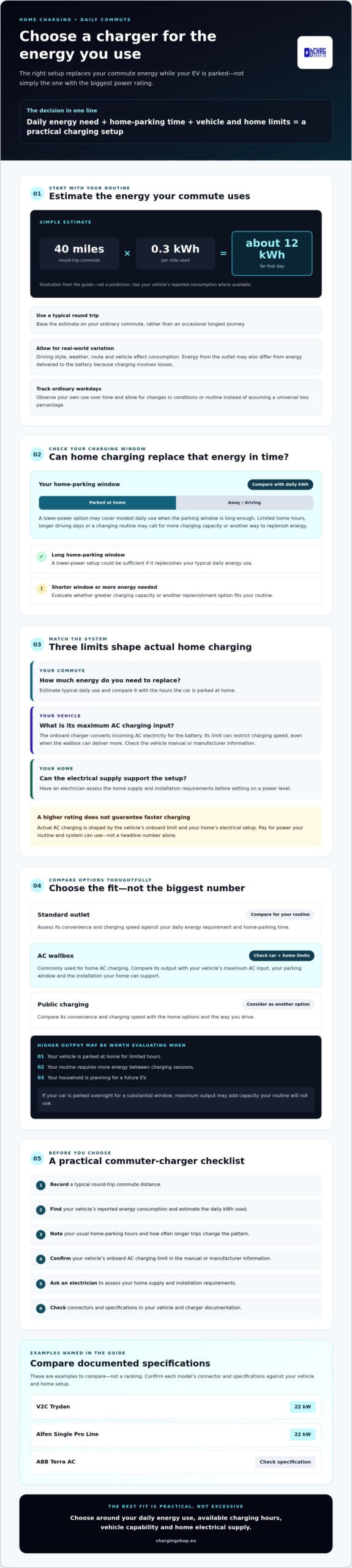
Use your typical round-trip commute, not the longest journey you make occasionally. Multiply the distance by your vehicle’s energy consumption. For example, a 40-mile round trip in an EV that uses 0.3 kilowatt-hours per mile comes to about 12 kWh for that day. This is an illustration, not a prediction. Use your vehicle’s reported consumption where available.
Consumption varies with driving style, weather, route, and vehicle. Energy drawn from the outlet may also differ from energy delivered to the battery because charging involves losses. Rather than relying on a universal loss percentage, track your use over ordinary workdays and allow for variation when conditions or your routine change.
Turn daily energy use into an overnight charging window
Next, compare the energy you need with the hours your vehicle is usually parked at home. A lower-power option may cover a modest daily commute when the parking window is long enough. If you arrive home late, leave early, or drive farther on some days, you may need more charging capacity or another way to replenish energy.
Daily energy need matters more than headline power because the right charger is the one that replaces your routine’s energy while your car is parked. Your home charger, vehicle, and electrical supply all affect charging. This electric vehicle charging station overview explains the broader charging context, including AC and DC charging.
Use this quick check before comparing hardware:
- Record a typical round-trip distance.
- Find your vehicle’s reported energy consumption and calculate the approximate daily kWh used.
- Note your usual home-parking hours and how often longer trips change the pattern.
This gives you a practical baseline for identifying the best ev charger for daily commute needs. It keeps the decision focused on overnight replenishment rather than buying power your day-to-day driving may not require.
Match EV Charger Power to Your Car and Home Supply
A home charger’s advertised output is only one part of the equation. Your vehicle must be able to accept that power through its onboard AC charger, and your home’s electrical supply and installation design must support the setup. The best ev charger for daily commute needs fits all three: your driving, your car, and your home.
What limits your actual home charging speed?
AC charging is commonly used with home wallboxes. The vehicle’s onboard charger converts incoming AC electricity into a form the battery can store. Its maximum AC input can limit charging speed, even if the wallbox is rated to deliver more. Check your vehicle manual or manufacturer information for that limit. Have an electrician assess your home supply and installation requirements before settling on a power level.
The U.S. Environmental Protection Agency also explains how driving habits and household electrical capacity inform the decision to choose the right power level. Use that guidance alongside your vehicle documentation and an assessment of your home setup.
| AC output | Practical fit | Checks and likely use case |
|---|---|---|
| Lower | Can suit a longer home-parking window and a more modest daily energy requirement. | Confirm it can replenish your typical use overnight. Consider it if your vehicle and home supply support the setup. |
| Higher | May suit shorter parking windows, greater daily energy use, or plans to accommodate a future vehicle. | Check the car’s maximum AC input and have an electrician assess the home supply and installation design. A higher rating alone doesn’t mean every EV will charge faster. |
When does a higher-output wallbox make sense?
Higher output is worth evaluating when your vehicle is parked at home for limited hours or your routine requires more energy between sessions. It may also suit a household planning for a future EV. Before choosing, confirm that vehicle’s AC capability and your electrical setup. If your car is parked overnight for a substantial window, maximum output may add capacity your routine won’t use. For a focused power discussion, see this 22kW home wallbox guide.
Compare charger ratings only after checking vehicle and home limits. Charging Shop’s home EV charger options include hardware you can evaluate against those requirements. Arrange installation separately, and verify product specifications and regional electrical requirements before buying.
Compare Home EV Charger Options Without Overbuying
A standard outlet, a dedicated AC wallbox, and public charging can all fit into a commuter’s routine. The right choice depends on how much energy you need, where the vehicle is parked, and what its charging system and your home supply can support. Compare the whole setup, not just the charger’s headline rating.
| Option | Daily routine | Parking access | Vehicle limit | Home supply |
|---|---|---|---|---|
| Standard outlet | May suit a modest daily need if the available charging window is long enough. | Best considered when the car is regularly parked near an appropriate outlet. | Actual charging is affected by the vehicle’s accepted AC input and the charging equipment used. | Confirm outlet suitability and equipment requirements with qualified local advice. |
| Dedicated AC wallbox | Can provide a dedicated home-charging setup. Choose output to match your use. | Useful when you have a regular home parking place and want to charge there. | A wallbox cannot make a vehicle accept more AC power than its onboard system allows. | Have an electrician assess the supply and installation design. |
| Public charging | Can supplement home charging or suit drivers without dependable home parking. | Depends on access to a suitable public charger during your routine. | Charging speed depends on the vehicle and charger type. | Doesn’t use your home supply, but relies on public charging access. |
Is a standard outlet enough for a daily commute?
It might be. Compare the energy you use on a typical day with the time available to charge at home, then check outlet and charging equipment requirements for your location and vehicle. If you have little time to recharge or want a more consistent home setup, a dedicated wallbox may be a better fit. Don’t assume an outlet is suitable without qualified local advice. The U.S. Department of Energy’s guide to installing charging equipment offers additional home-charging considerations.
Which wallbox criteria matter most to commuters?
Start with verified charger output, vehicle compatibility, connector, and local electrical requirements. Check current product documentation before relying on features such as scheduling, monitoring, or network access. Charging Shop offers options including V2C Trydan 22kW, Alfen Single Pro Line 22kW, and ABB Terra AC. Confirm each model’s specifications before comparing them. For a product-specific evaluation, read the V2C Trydan 22kW buying guide.
The best ev charger for daily commute use is the one that meets your routine without exceeding your vehicle’s or home’s limits. Browse EV charging hardware as you compare options, and arrange installation separately.
Use This Checklist to Choose a Daily-Commuter EV Charger
Work through the decision in order. This prevents you from comparing products before you know what your commute needs or what your setup can support. Gather the details below, then use them to narrow your shortlist.
What to check before choosing a model
- Record your driving pattern. Note your typical round-trip commute, how many hours the vehicle is parked at home, and any regular days with substantially more driving. Use ordinary weeks as your baseline, not an occasional long trip.
- Check your vehicle’s limits. Consult the owner’s manual or manufacturer information for maximum AC charging capability and accepted connector type. Confirm connector compatibility in both the vehicle and charger documentation.
- Assess your home supply. Ask a qualified local professional to assess the electrical supply and installation requirements. Available capacity and installation design can affect which charger output is practical.
- Compare verified product details. Check the charger’s output, connector, and other relevant specifications against your vehicle, home assessment, and regional requirements. Consider features such as scheduling or monitoring only when current product information confirms them.
Before ordering, confirm who is responsible for installation and which local requirements apply. Charging Shop sells EV charging hardware but does not provide on-site installation. Arrange the electrical assessment and installation separately with a qualified local professional.
How to avoid paying for unused charging capacity
Compare the charger’s usable output with your vehicle’s charging limit and the hours it’s usually parked at home. If that combination can replenish the energy you use in your normal routine, a higher rating may not provide a practical daily benefit. Consider a future vehicle or changed commute as a separate scenario, then check whether your home supply could support that choice before paying for extra capacity.
The best fit depends on your daily routine and the limits of your vehicle and home electrical system. Keep your notes beside the product specifications as you compare. Charging Shop’s confirmed options include V2C Trydan 22kW, Alfen Single Pro Line 22kW, and ABB Terra AC. Check current specifications and regional suitability instead of assuming a model fits based on its name or rating.
Ready to compare hardware against your checklist? Explore EV charger options and verify the details that matter for your setup.
Choose a Commuter-Ready Charger From Charging Shop
Bring your commute data, vehicle limits, available home-charging hours, and electrical assessment together before choosing. Match the energy you use each day with the time you have to recharge, then confirm the charger and home supply can support the setup. The best ev charger for daily commute use isn’t automatically the model with the highest rating. It’s the option that fits your routine and verified system requirements.
What information to have ready for a personalized charging offer
Prepare a brief, accurate snapshot of your needs before asking about a Personalised Charging Offer. You don’t need to guess at technical details. Share what you know and note anything that still needs professional assessment.
- Your vehicle’s make and model, plus the connector and charging capability listed in its documentation.
- Your typical round-trip commute distance and usual home-parking duration.
- Known details about your home electrical supply, if available. Don’t estimate capacity based on appearance or assumption.
- Your intended charging location and any preferred functions, such as scheduling or monitoring. Verify these against current product information.
This information helps focus a product comparison on your actual use rather than a general-purpose recommendation.
Compare confirmed products and take the next step
Charging Shop’s confirmed hardware options include the V2C Trydan 22kW, Alfen Single Pro Line 22kW, and ABB Terra AC. Treat these as products to evaluate, not as a universal ranking. Before selecting any model, verify its current output, connector, compatibility, and relevant functions in the product documentation. Confirm regional requirements and compare the details with your vehicle information and home electrical assessment.
For product-specific information, read the Alfen Single Pro Line 22kW review. Then explore Charging Shop’s EV charging options and ask about a Personalised Charging Offer if you need help narrowing the hardware choices. Charging Shop sells charging hardware and does not provide on-site installation, so arrange assessment and installation separately with a qualified local professional.
Set Up Charging That Fits Your Commute
The best ev charger for daily commute use is matched to the energy you drive through, your vehicle’s charging capability, your home’s electrical supply, and the time your car is parked. Check those limits before comparing charger ratings. A higher number isn’t automatically a better fit.
Charging Shop offers hardware options including V2C Trydan 22kW, Alfen Single Pro Line 22kW, and ABB Terra AC. Confirm each model’s current specifications, connector, and suitability for your vehicle and home before choosing. You can also ask about a Personalised Charging Offer or explore CHRG Network Access if network access is relevant to your needs. Arrange installation separately.
Ready to compare options against your routine? Explore EV chargers and request a personalized charging offer. With your commute details and vehicle information in hand, you can make a practical choice and build a simpler charging routine with confidence.
Frequently Asked Questions
How do I calculate the charging power I need for my daily commute?
Multiply your typical round-trip distance by your vehicle’s energy consumption to estimate the energy used per commute. For example, 40 miles multiplied by 0.3 kWh per mile equals 12 kWh. To estimate the average power needed during home charging, divide that energy by the hours available to charge. Treat this as a starting point: driving conditions and charging losses affect the energy drawn. This helps identify the best ev charger for daily commute needs.
Is a standard outlet enough to charge an EV for a daily commute?
It can be enough if the energy your commute uses can be replenished while your vehicle is parked, and the outlet and charging equipment are suitable for your location and vehicle. Check your vehicle’s documentation and get qualified local advice before relying on a standard outlet. If your parking window is short or your daily energy need is higher, compare a dedicated AC wallbox or public charging as alternatives.
Can a 22kW EV charger charge every electric car at 22kW?
No. A 22kW rating doesn’t mean every EV can accept power at that rate. For home AC charging, the vehicle’s onboard charger limits how much AC power it can use. The home electrical supply and installation design can also constrain available power. Check the vehicle manual or manufacturer information for its maximum AC input, then confirm the charger and electrical setup are suitable.
How long should I charge my EV overnight for a daily commute?
There’s no single overnight charging duration that suits every EV and commute. Estimate the energy used on a typical day, then compare it with your available parking hours and the charging power your vehicle and home setup can support. The vehicle’s displayed charge level or charging information can help you monitor progress. Allow for changes in driving conditions and energy use, and follow the vehicle and charger instructions.
What happens if my home electrical supply cannot support the charger I want?
If your home supply can’t support your preferred charger setup, ask a qualified local electrician to assess the electrical capacity and installation requirements before you buy. The assessment can help clarify which options are appropriate for your home, including whether a different charger output should be considered. Don’t guess at capacity or assume a particular change is suitable. Regional electrical requirements also matter, so confirm them before choosing equipment.
Which EV charger features are useful for a daily commuter?
Start with the essentials: suitable output, a connector compatible with your vehicle, and compliance with local electrical requirements. Scheduling may help align charging with your routine or electricity plan, while monitoring can make charging activity easier to track. Features vary by model, so check current product documentation rather than assuming they’re included. Choose functions you’ll actually use instead of focusing on a long feature list.
Can Charging Shop install an EV charger at my home?
No. Charging Shop sells EV charging hardware and offers Personalised Charging Offers and CHRG Network Access, but it does not provide on-site installation. Arrange any electrical assessment and installation separately with a qualified local professional. Before ordering, check the charger’s connector and specifications against your vehicle, and confirm the home supply and regional requirements. This helps you select suitable hardware while keeping installation arrangements clear.
