
 Deutsch
 Dansk
Dansk Suomi
Suomi Latviešu
 Lietuvių
 Norsk bokmål
 polski
 Русский
 Svenska
No products in the cart.
Uncategorized
Cloud Managed EV Chargers: The Ultimate 2026 Management Software Guide
10
Aug
Aug
Is your EV charging hardware actually making you money, or is it just a glorified power outlet? In 2026, the difference between a cost center and a revenue engine is your ev charging station management software. With the global market projected to reach over $36 billion by 2035, the stakes for your infrastructure have never been higher. You need a digital brain that automates the heavy lifting so you can focus on scaling your network.
We know the operational headaches. Manual billing is a logistical nightmare, and “charger squatters” block your most profitable ports for hours. It’s natural to worry about local grid capacity as more high-powered vehicles plug in simultaneously. This guide promises to solve those pains. You’ll learn how to automate revenue collection, gain total visibility into station health, and use smart energy management to cut operational costs immediately.
We’ll explore the critical 2026 updates, including OCPP 2.1 integration and mandatory AFIR compliance for ISO 15118. From the CHRG Network’s advanced features to optimizing hardware like the V2C Trydan or Alfen Pro Line, this is your roadmap to a professional, future-proof charging operation. Let’s get your chargers working at peak efficiency and maximum ROI.
Key Takeaways
- Understand why hardware alone isn’t enough and how a cloud-based “brain” manages complex tasks like load balancing and user access.
- Identify the five mission-critical features that eliminate manual billing headaches and protect your local grid from expensive power surges.
- Discover why choosing ev charging station management software with OCPP compliance is the only way to avoid vendor lock-in and future-proof your site.
- Learn specific monetization strategies to transform your chargers into a passive revenue stream for hotels, retail, or commercial parking lots.
- See how to build a seamless tech stack by pairing high-performance hardware like the V2C Trydan with the exclusive CHRG Network.
What is EV Charging Station Management Software?
Stop thinking about chargers as standalone boxes. They’re nodes in a digital network. ev charging station management software is the cloud-based platform that turns these nodes into a controllable, profitable system. It connects your hardware to a central dashboard via the internet, giving you total command over your infrastructure from any device. Without this software, you’re just providing a plug; with it, you’re running a business.
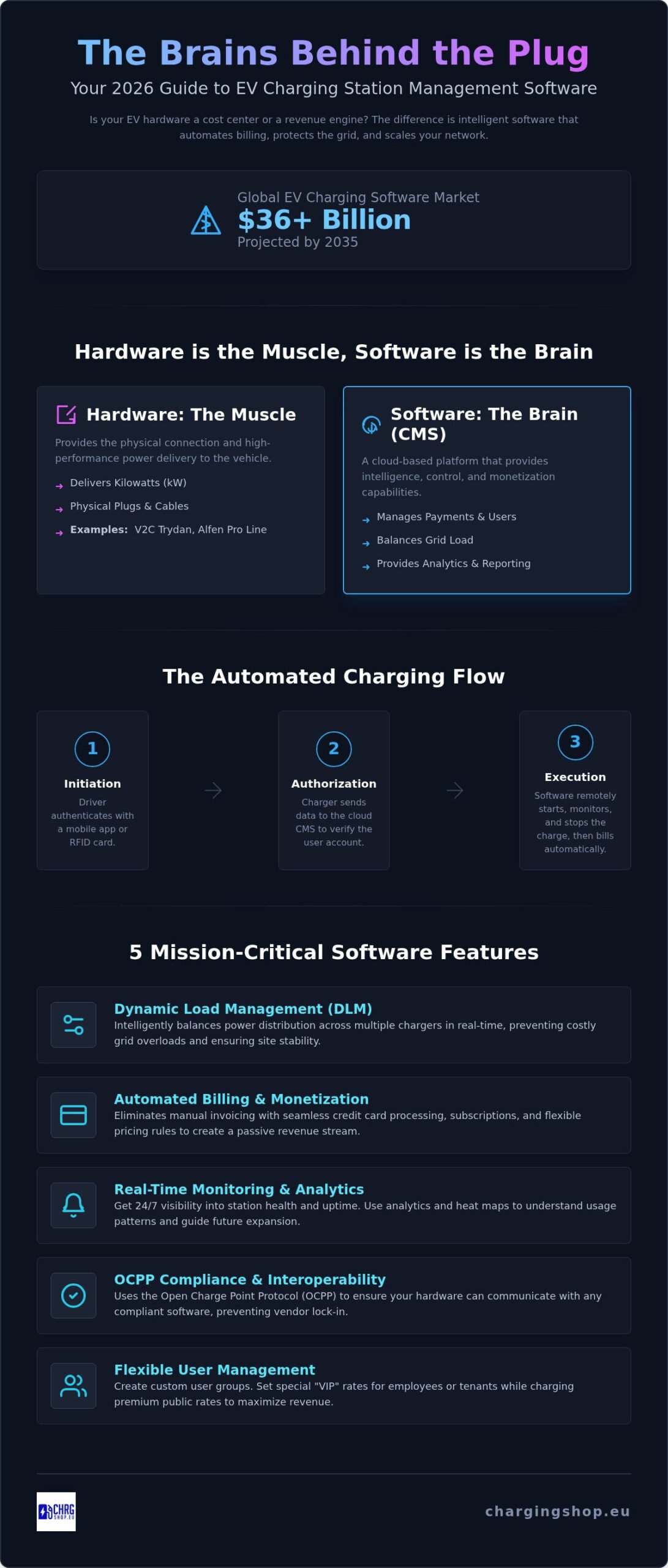
Hardware provides the muscle, but software provides the intelligence. A premium unit like the Alfen Single Pro Line 22kW or the V2C Trydan 22kW is built for high-performance power delivery, yet it needs a “brain” to handle complex logic. Hardware alone cannot process a credit card payment, verify a user’s subscription, or balance the load across fifty vehicles to prevent a grid blowout. This critical communication relies on the Open Charge Point Protocol (OCPP), the industry standard that allows different hardware brands to speak to a central management system seamlessly.
To visualize how this works, follow the data flow in three simple steps:
- Initiation: The driver plugs in and authenticates their session via a mobile app or RFID card.
- Authorization: The charger sends a data packet to the cloud CMS to verify the user’s account and payment method.
- Execution: The software sends a “start” command, monitors energy flow in real-time, and closes the session once the battery is full, automatically processing the transaction.
By 2026, local-only management has become a relic of the past. For commercial sites and multi-unit residential buildings, it’s completely obsolete. You cannot manage a modern fleet or a retail parking lot with a simple Bluetooth connection. You need the visibility and control that only a cloud-managed tech stack provides.
The Role of the Central Management System (CMS)
Real-time monitoring is the heartbeat of your operation. A CMS tracks station health and uptime 24/7. If a charger goes offline, you’ll know before the first customer complains. It manages user access through RFID cards or apps, ensuring only authorized drivers draw power. It also collects the granular data needed for sustainability reporting and claiming government tax credits, turning your charging logs into actionable business intelligence.
Why Cloud-Managed is the Standard in 2026
5 Mission-Critical Features of Modern EV Software
Selecting the right ev charging station management software is the most important decision you’ll make for your infrastructure. In 2026, a basic connection isn’t enough. Your platform must act as a financial controller, an energy manager, and a technical support team all at once. Implementing automated maintenance and management systems ensures your stations stay online and profitable without constant manual intervention. Here are the five features that define a high-performance network.
- Dynamic Load Management (DLM): Balances power in real-time to prevent grid overloads.
- Automated Billing: Handles everything from credit card processing to monthly invoices.
- OCPP Interoperability: Uses open standards like OCPP 2.1 to prevent vendor lock-in.
- Real-Time Analytics: Provides heat maps of usage to guide your next expansion.
- User Management: Allows you to set “VIP” rates for employees while charging a premium for the public.
If you want to maximize your ROI, you need hardware that supports these features out of the box. You can browse our OCPP-compliant chargers to find the perfect match for your management platform.
Dynamic Load Balancing and Grid Protection
Grid protection is your insurance policy against massive utility fines. Modern software throttles power delivery based on real-time building demand. If your facility’s HVAC system kicks into high gear, the software instantly dials back the chargers to stay within your power budget. This allows you to install more chargers without paying for expensive infrastructure upgrades. Many 2026 systems now integrate directly with on-site solar and battery storage, prioritizing “green” charging when renewable production is at its peak.
Automated Billing and Revenue Generation
Stop wasting hours on spreadsheets. Automated billing turns your charging stations into a hands-off revenue stream. You can set flexible pricing models based on your business needs: charge per kWh, per hour, or set flat session fees to discourage “charger squatters.” Once the session ends, the software processes the payment and manages the automated payouts directly to your bank account. Automated billing reduces administrative overhead by 90% while ensuring you never miss a cent of revenue. This level of efficiency is non-negotiable for commercial operators managing multiple sites in a competitive market. For a deeper look at how to structure your tariffs and maximize returns, the CHRG Network EV station management guide for 2026 covers every billing model and revenue strategy in detail.
Interoperability: Why OCPP Compliance is Non-Negotiable
Don’t get trapped in a proprietary ecosystem. Interoperability is the backbone of a professional EV network. The Open Charge Point Protocol (OCPP) is the universal language that allows your hardware to talk to your ev charging station management software. Without it, you’re locked into one vendor’s ecosystem forever. If their software fails or their prices spike, your expensive hardware becomes a brick. Compliance ensures you have the freedom to switch platforms whenever you want.
Hardware synergy is where the real value lies. Premium units like the Alfen Single Pro Line 22kW thrive on these open standards. They are built for flexibility and high-performance communication. By choosing hardware with verified OCPP support, you ensure your investment is future-proof. Before you buy your next wallbox, verify the technical specs for “OCPP 1.6J” or the newer “OCPP 2.0.1” certification. If it’s not listed, you’re buying a closed system that will limit your growth.
The Benefits of an Open Ecosystem
An open network lets you mix and match the best hardware for each specific location. You can run an OCPP Compliant Charging Station alongside different models like the Abb terra ac or V2C Trydan. All these devices report to the same central dashboard. This diversity allows for faster innovation because software developers can push updates and new features independently of the hardware manufacturer’s internal schedule. You get the latest tech without waiting for a hardware refresh.
Remote Management and Troubleshooting
Remote troubleshooting is your biggest cost-saver. You can reset chargers from your smartphone the moment a driver reports an error. You’ll diagnose 80% of technical issues remotely, which means you avoid the high cost of sending a technician to the site. This level of control is essential for maintaining high uptime and keeping your customers happy. For a full breakdown of how to implement this, check out our Remote EV Charger Management: The 2026 Setup & Strategy Guide. Professional ev charging station management software makes these remote fixes a standard part of your daily operations.
Monetization: Turning Your Chargers into a Revenue Stream
Turn your parking lot into a profit center. Your ev charging station management software isn’t just a control panel; it’s a high-performance point-of-sale system. Hotels, retail centers, and parking operators use cloud management to generate consistent passive income. By 2026, the global EV fleet has expanded to the point where drivers actively prioritize businesses with reliable, visible charging. Your infrastructure can meet that demand while quickly recouping your initial investment.
Set the right price to stay competitive. You must balance your local electricity costs with healthy profit margins. Use your CMS to implement time-of-use tariffs. This strategy encourages charging during off-peak hours when power is cheaper, while maximizing revenue during busy periods. High utilization is the primary driver of a fast ROI. The software handles the complex math, so you don’t have to.
Don’t wait for customers to find you by accident. Use your software to broadcast your location to global maps like Google Maps and PlugShare. Drivers see your real-time availability and current pricing before they even arrive. This visibility drives foot traffic to your site. You can also reward regulars with loyalty programs. Offer discounted rates to your best customers or hotel guests to build long-term value and brand loyalty.
Pricing Strategies for Different Industries
Tailor your approach to your specific audience. In workplaces, you can offer free charging for employees as a benefit but charge visitors a standard market rate. Retail environments thrive on speed; use high-speed DC charging with premium session fees for customers who need a quick top-up while they shop. For apartments, focus on cost recovery. Use software models that split utility bills accurately between tenants based on their exact usage data, ensuring fairness and transparency.
The Importance of MID Meters for Billing
Transparency is a legal requirement. If you sell electricity by the kWh, you must use certified metering. Modern ev charging station management software integrates with MID meters to provide legal transparency and precise data for every session. MID-certified hardware is the only legal way to bill for kWh in the EU. This ensures your transactions are audit-proof and compliant with strict regional regulations. Without this certification, you risk heavy fines and legal challenges.
Start generating revenue today. Get CHRG Network access to unlock full monetization and billing features for your charging stations.
Scaling with the CHRG Network and Charging Shop
Execution is everything. You’ve learned about load balancing, monetization, and the necessity of open standards. Now, you need a partner to pull it all together. Charging Shop isn’t just a hardware retailer. We provide the complete tech stack. By pairing high-performance hardware with the CHRG Network, you get a “plug-and-play” solution that eliminates technical friction. This is the most efficient way to deploy ev charging station management software across a single site or a global portfolio.
The journey from unboxing to your first revenue-generating session is shorter than you think. When you unbox a premium unit like the V2C Trydan 22kW, the hardware is already built for cloud connectivity. Once installed, you simply connect it to the CHRG Network dashboard. Within minutes, you’re setting pricing rules, monitoring live energy flow, and welcoming your first drivers. We simplify the complex world of EV infrastructure so you can focus on your core business.
Future-proofing is built into our DNA. As 2026 regulations like the EU’s AFIR mandates evolve, our software updates automatically to keep you compliant. You don’t need to be a tech expert to stay ahead of the curve. Whether you’re managing a hotel parking lot or a massive commercial fleet, we provide a tailored hardware and software package designed for your specific site requirements. For a comprehensive walkthrough of the platform’s capabilities, the CHRG Network access for EV stations 2026 management guide details every feature you need to turn your hardware into a fully managed, revenue-generating asset.
Why the CHRG Network is the Choice for Pros
Facility managers don’t have time for complicated code. The CHRG Network features a user-friendly interface designed for clarity and speed. It offers seamless integration with the world’s leading brands, including Alfen, V2C, and ABB. You get total visibility of your network’s health in one place. Our team provides proactive support, offering expert guidance to ensure your chosen hardware perfectly matches your operational goals. We bridge the gap between technical hardware specs and real-world business utility.
Next Steps: From Planning to Power-On
Moving from a plan to a functional charging hub requires a methodical approach. Follow these steps to ensure a smooth rollout:
- Site Audit: Evaluate your current electrical capacity and determine how many ports your users actually need.
- Select Hardware: Choose OCPP-compliant units from the Charging Shop catalog to ensure long-term flexibility.
- Activate Software: Start your CHRG Network subscription to unlock automated billing and remote management tools.
- Go Live: Launch your stations and monitor performance through your real-time dashboard.
Ready to build your network? Get a Personalized Charging Offer Today and let our experts design the perfect ev charging station management software and hardware bundle for your business.
Take Command of Your Charging Network
Your hardware is only as capable as the system behind it. By now, you know that ev charging station management software is the essential tool for turning a simple plug into a professional revenue engine. You’ve seen how OCPP compliance protects your investment and how automated billing removes the administrative burden. 2026 is the year to stop managing your chargers manually and start scaling with a cloud-first strategy.
Browse OCPP-Compliant Hardware and Join the CHRG Network today. We’re ready to help you build a smarter, more profitable charging future.
Frequently Asked Questions
Do I really need software for a single home charger?
You don’t always need professional software for a single home charger, but it’s highly recommended for smart energy management. Most owners use basic apps for simple scheduling. However, if you want to track exact electricity costs or integrate with solar panels, cloud-based tools are essential. High-performance units like the V2C Trydan 22kW offer these features to help you charge during the cheapest utility windows automatically.
Can I use one management software for different brands of chargers?
Yes, you can manage multiple brands on a single platform if your hardware is OCPP compliant. This is the primary benefit of using ev charging station management software like the CHRG Network. It allows you to mix premium hardware from Alfen, V2C, and ABB on one dashboard. You’ll see real-time health and usage data for your entire network without switching between different proprietary manufacturer apps.
How much does EV charging station management software cost?
Software costs typically depend on your specific feature requirements and the total number of charging ports you manage. Most providers use a subscription model based on monthly or annual fees per port. Some platforms also take a small percentage of processed transaction revenue. While we don’t list specific pricing here, choosing a scalable platform ensures you only pay for the capacity you actually use as your network grows.
Is my data secure when using cloud-managed EV chargers?
Data security is a top priority for professional cloud-managed systems. Top-tier platforms use encrypted communication protocols to protect user payment details and station telemetry data. This ensures that your financial transactions and driver information remain private. Using ev charging station management software with robust security standards is the best way to safeguard your infrastructure against unauthorized access or any potential data breaches in a digital-first environment.
What happens if the internet goes out at my charging station?
Most modern chargers continue to function in a basic offline mode if the internet connection drops. They often store authorization data locally so existing RFID cards still work for your regular users. Once the connection is restored, the charger syncs all session data and billing information back to the cloud. This prevents drivers from being stranded while ensuring you don’t lose any revenue data during temporary network outages.
Can the software help me qualify for government grants or tax credits?
Yes, management software is often a mandatory requirement for qualifying for government incentives. Many regions require detailed usage reports and carbon savings data to verify grant eligibility. The software automatically generates these reports for you. It tracks every kWh delivered, providing the verifiable audit trail needed to prove your station meets the technical and operational standards for various local or national tax credits.
How do I set up automated billing for my tenants or employees?
Setting up automated billing is straightforward within your CMS dashboard. You simply assign drivers to specific user groups, such as “Tenants” or “Staff,” through the management interface. You can then set unique pricing rules for each group. The software tracks individual usage and automatically generates invoices or processes credit card payments. This eliminates the need for manual spreadsheets and ensures everyone pays their fair share of electricity costs.
Does cloud software support V2G (Vehicle-to-Grid) technology in 2026?
Yes, the latest software versions now support V2G capabilities. As of 2026, the industry has transitioned toward OCPP 2.1, which includes native support for bidirectional energy flow. This allows you to use EV batteries as a temporary power source for your building or the grid. While you still need V2G-compatible hardware, the software provides the critical logic required to manage these complex energy exchanges with maximum efficiency.
