
 Deutsch
 Dansk
 Suomi
 Latviešu
 Lietuvių
 Norsk bokmål
 polski
 Русский
 Svenska

No products in the cart.
Uncategorized
Fast EV charger for home use: compare Level 2 options
19
Nov
Nov
A smart charger isn’t automatically a faster charger. For a fast EV charger for home use, Level 2 is the key category: it uses 240-volt AC and can add roughly 12 to 60 miles of range per hour. Amperage, your vehicle’s charging limit, and the electrical setup all shape the actual charging speed.
It’s easy to focus on app controls and scheduling, but they don’t replace the basics: matching charger output to your vehicle and home electrical supply. A straightforward charger may be enough for reliable home charging, while smart features can help you manage charging times and settings.
Compare Level 2 options by amperage, estimated range added per hour, circuit requirements, and smart functions. You’ll see how charger output affects charging speed, what can limit that speed, and which features are worth prioritising for your routine.
Key Takeaways
- Distinguish home Level 2 charging from DC fast charging to set realistic expectations for each option.
- Understand how outdoor placement and exposure to the elements affect charger setup choices.
- Use an amperage comparison to narrow your options while accounting for your vehicle’s charging limit.
- Decide whether smart controls fit your routine and when a personalised charging offer may help.
Level 2 home charging
Level 2 is the faster home option for most EV drivers. It uses 240-volt AC power and generally delivers 6 to 19 kW, compared with roughly 1 kW from a 120-volt Level 1 supply. A 110-volt wall outlet is slower than a dedicated 240-volt charger, so Level 2 can better suit daily driving that requires a fuller battery overnight.
Amperage shapes output, but your vehicle and electrical panel set the practical ceiling. A 240-volt circuit at 32 amps delivers 7.7 kW; a 48-amp charger on a 240-volt line produces 11.5 kW. At that output, a 75 kWh battery could take about 6.5 hours to charge fully. Home and public Level 2 stations in North America range from 16 to 80 amps, but a higher-rated unit won’t make a vehicle accept more power than it supports.
| Charging option | Power and supply | Typical use |
|---|---|---|
| Level 1 | 120-volt AC, roughly 1 kW | Portable charging from a household outlet |
| Level 2 | 240-volt AC, generally 6 to 19 kW | Home charging with a dedicated circuit |
| DC fast charging | 50 to 400-plus kW | High-power charging away from home |
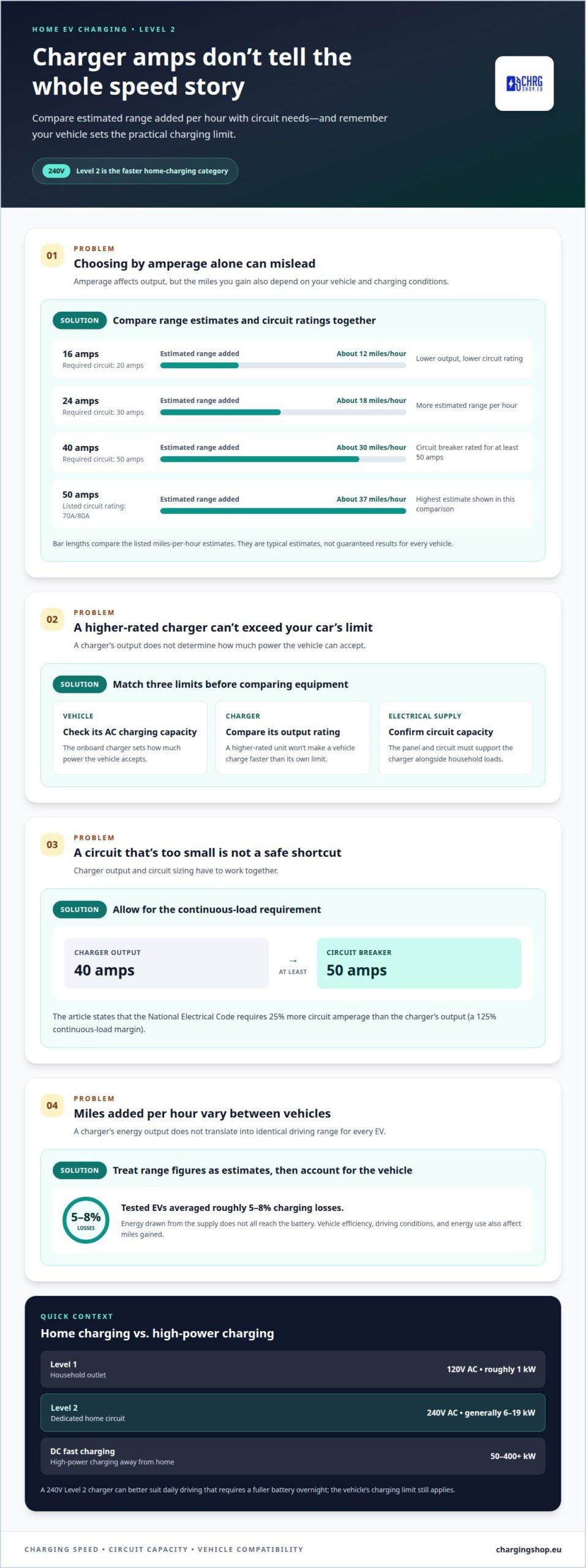
Portable Level 1 and Level 2 chargers can suit different locations, provided the supply and connector match. An adapter can address a connector difference, but it can’t raise the vehicle’s charging limit. For a 40-amp charger, the circuit requires a breaker rated for at least 50 amps. The National Electrical Code requires 25% more circuit amperage than the charger’s output.
Vehicles that support 48A or higher home charging depend on each model’s onboard AC charging limit; the charger alone can’t establish compatibility. Check the vehicle’s stated AC charging capacity against the charger output and circuit.
A fast EV charger for home use doesn’t inherently damage a battery; the vehicle manages the charging it accepts. Correct circuit sizing matters for fire safety: the federal EV charging tax credit is set to expire on June 30, 2026, according to the Internal Revenue Service.
What is a Home EV Charger?
A home EV charger supplies electricity to your vehicle through either a dedicated hardwired connection or a suitable outlet. In the US, the National Electrical Code requires a 125% continuous-load margin; permit requirements are handled locally.
Outdoor Installation and Weather Protection
An outdoor charger faces moisture and precipitation, so its connection method matters. A hardwired unit avoids relying on an exposed plug and receptacle; a plug-in charger instead connects through an outdoor outlet, such as a NEMA 14-50. Choose a location that lets the cable reach the vehicle without obstructing access. The practical difference is exposure: an outdoor plug connection needs suitable weather protection around the receptacle.
Electrical Capacity and Installation Costs
Electrical capacity determines whether the panel can support a charger at its intended amperage alongside household loads. If capacity is limited, the installation may require changes to the electrical service; the panel, circuit route, and charger location all influence the work involved. Those same factors shape installation costs, so a nearby panel with available capacity differs from a setup requiring longer wiring or capacity changes. A tailored charging setup can help align equipment choices with your requirements.
Hardwired Installation
Hardwiring connects a charger directly to a dedicated circuit, without a plug-in outlet. It suits a fixed charging location and is often preferred outdoors, where it avoids using a receptacle. A plug-in charger connects to a compatible outlet and can be unplugged. Either option depends on the circuit’s capacity and the charger’s amperage. Choose an installation method that fits the location, electrical supply and cable reach.
Charger amperage and EV range added per hour
Amperage and voltage determine a charger’s output, but your vehicle’s charging capacity sets the limit on what it can accept. Compare estimated miles added per hour, not amperage alone.
Amperage and Voltage
Voltage describes the electrical supply, while amperage measures current flowing through the connector. At the same voltage, higher amperage generally means more charging power. A 240-volt Level 2 charger therefore delivers a different output from a lower-current unit using the same supply.
Estimated range added per hour helps translate that output into driving value. A 16-amp charger is listed at about 12 miles per hour, while a 24-amp charger adds about 18 miles. The required circuit ratings are 20 amps and 30 amps, respectively. These pairings help compare charging speed with the electrical capacity needed.
For a higher output, a 40-amp charger is listed with a 50-amp required circuit or breaker rating and about 30 miles added hourly. A 50-amp charger is listed with a 70A/80A required rating and about 37 miles per hour. Those estimates describe typical range added, not a guaranteed result for every vehicle.
Power and Charging Output
Power combines voltage and amperage, while your vehicle’s onboard charger and battery capacity determine how much power it can accept. A higher-output charger won’t make a vehicle charge faster than its own limit. Compare the charger’s rating with your vehicle’s AC charging capability before choosing.
Range estimates also vary with vehicle efficiency and charging losses. Tested EVs averaged roughly 5 to 8 percent losses, so energy drawn from the supply doesn’t all reach the battery. Driving conditions and the vehicle’s energy use affect miles gained from the same charging session.
For convenient overnight charging, estimate how much energy your regular driving requires, then compare that need with the charger’s output and your circuit rating. Match the connector to your vehicle, and treat miles-per-hour figures as estimates. This keeps your choice grounded in your vehicle’s capabilities, home electrical supply and daily charging needs.
Charger prices and promotional discounts
Compare the complete home-charging setup, not just the charger. The equipment, outlet type, circuit work and installation requirements all affect the total. A setup using a suitable existing outlet involves different work from one that needs electrical circuit changes. Compare included features and warranty terms as well as the purchase price.
A 3-year warranty is described as a must-have for a home EV charger. Read the coverage terms: the warranty period alone doesn’t explain what components or issues it covers. Smart features, such as mobile app controls, can also shape value if you’ll use them to manage charging. A basic unit may be a better fit if app-based scheduling adds little to your routine.
For plug-in models, compare the charger with the outlet and its rating. A 14-50 outlet is recommended for continuous 40-amp EV charging; a compatible 50-amp plug does not replace the need for an appropriately rated circuit. Hardwired and plug-in setups can involve different installation work, so compare the complete configuration rather than treating the charger as the only cost.
The federal EV charging tax credit described by the Internal Revenue Service covers 30 percent of total costs, up to $1,000. It was set to expire on June 30, 2026. State and utility rebates are separate programs, with eligibility and terms depending on location and program rules. A public charging promotion is also different from a home-charger rebate, so don’t count a public-network discount as a reduction in home equipment costs.
For a home-flex setup, weigh the charger’s features against your garage, outlet, and charging routine. A promotion matters only if the equipment fits your vehicle and electrical setup. Explore a personalised charging offer to compare a setup with your requirements.
Charging Shop
Charging Shop helps you move from comparing charger ratings to choosing equipment that fits your vehicle and home-charging needs. Its range includes the V2C Trydan 22kW, V2C DENKA 20kW DC Wallbox, and Alfen Single Pro Line 22kW. Match a charger’s specifications to your vehicle’s AC charging limit and your home’s electrical setup before deciding; a higher rating alone doesn’t guarantee faster charging.
If you’re comparing charger types or need a solution tailored to your requirements, Charging Shop’s Personalised Charging Offer is a practical next step. Share the home-charging setup you’re considering to help guide your choice. Contact Charging Shop to discuss your needs.
Make Your Home Charging Plan Work for You
Turn your charging needs into a practical setup by considering where your vehicle parks, how often it needs charging and whether app controls would genuinely help your routine. These priorities can guide a more useful choice than selecting the highest-rated unit by default. A fast EV charger for home use should suit your vehicle and daily habits, not just look powerful on a specification sheet.
Keep the decision focused: match the charger to your vehicle’s capabilities, consider your home’s electrical setup and choose features you’ll use. If you’re still weighing options, Charging Shop’s Personalised Charging Offer can help match your requirements with a suitable charging solution.
Contact Charging Shop to discuss your home-charging needs and take the next step with confidence.
Frequently Asked Questions
What are the different types of EV chargers?
EV charging is commonly grouped into Level 1, Level 2, and DC fast charging. Level 1 uses a household outlet and suits drivers with modest daily mileage or long parking periods. Level 2 is a common home upgrade. DC fast charging is typically used at public stations, where higher power supports quicker stops. Your vehicle’s connector and charging capability determine which options it can use.
How much will a home EV charger cost?
The total depends on the charger, its features and the electrical work your home needs. A plug-in unit using a suitable existing outlet may involve different work from a hardwired charger or a setup requiring circuit changes. Plan for the charger and installation separately. Compare warranty coverage and included equipment too, since the purchase price alone doesn’t describe the complete setup.
Will a home EV charger help me save money?
Home charging may help you make better use of your electricity plan if it costs less than your usual public charging option. Any potential benefit depends on local electricity rates, public charging prices and when you charge. Scheduling charging during lower-rate periods may help if your utility offers time-based rates. Compare your actual bills and charging habits rather than assuming savings are automatic.
What is the fastest Level 2 EV charger?
The fastest Level 2 options are high-amperage chargers, but their usable output depends on the electrical supply and vehicle. North American Level 2 stations range from 16 to 80 amps, while Level 2 output generally falls between 6 and 19 kW. A unit at the top of its range won’t deliver that speed to every vehicle or home circuit.
What is the fastest Level 2 EV charger for home use?
For home use, the fastest suitable Level 2 charger is the one whose output matches both your vehicle’s onboard AC charging limit and your home circuit. An 80-amp station sits at the top of the listed North American amperage range, but the vehicle may accept less power. Choose based on the complete setup, not the charger’s headline rating alone.
How many miles of range per hour do 40A, 48A, and 80A home EV chargers add?
Estimated figures are about 30 miles per hour for a 40-amp charger and 36 miles per hour for a 48-amp charger. An 80-amp charger’s range gain depends on the vehicle’s charging limit, supply, and efficiency, so amperage alone doesn’t determine miles added. Treat estimates as planning guides; vehicle efficiency and charging losses affect the result.
