
 Deutsch
 Dansk
 Suomi
 Latviešu
 Lietuvių
 Norsk bokmål
 polski
 Русский
 Svenska

No products in the cart.
Uncategorized
High Capacity EV Charger Charging Power and Times Explained
21
Nov
Nov
A higher-power charger doesn’t always mean a faster charge. A high capacity EV charger can deliver up to 19.2 kW on Level 2 in the United States, while DC fast charging typically delivers 50-350 kW, but your vehicle’s charging limits and battery level also shape the time. And yes, charging usually slows as the battery nears full.
If you’re estimating a charge, the battery size and the power it can accept matter as much as the charger’s rating. This guide explains how Level 2 and DC fast charging affect charging times, why advertised power isn’t always the power your EV receives, and what changes as the battery fills. You’ll get a clearer picture of what to expect, whether you’re planning routine home charging or a faster stop on the road.
Key Takeaways
- Compare the charger’s rated output with your EV’s charging capacity to understand the power it can actually use.
- Estimate charging time from the energy your battery needs, not the charger’s headline rating alone.
- Choose between Level 2 and DC fast charging based on where you charge and how quickly you need to continue your trip.
- Plan fast-charging stops around the useful charging window rather than assuming maximum power continues to a full battery.
Level 2 charging voltage, power, and charging times
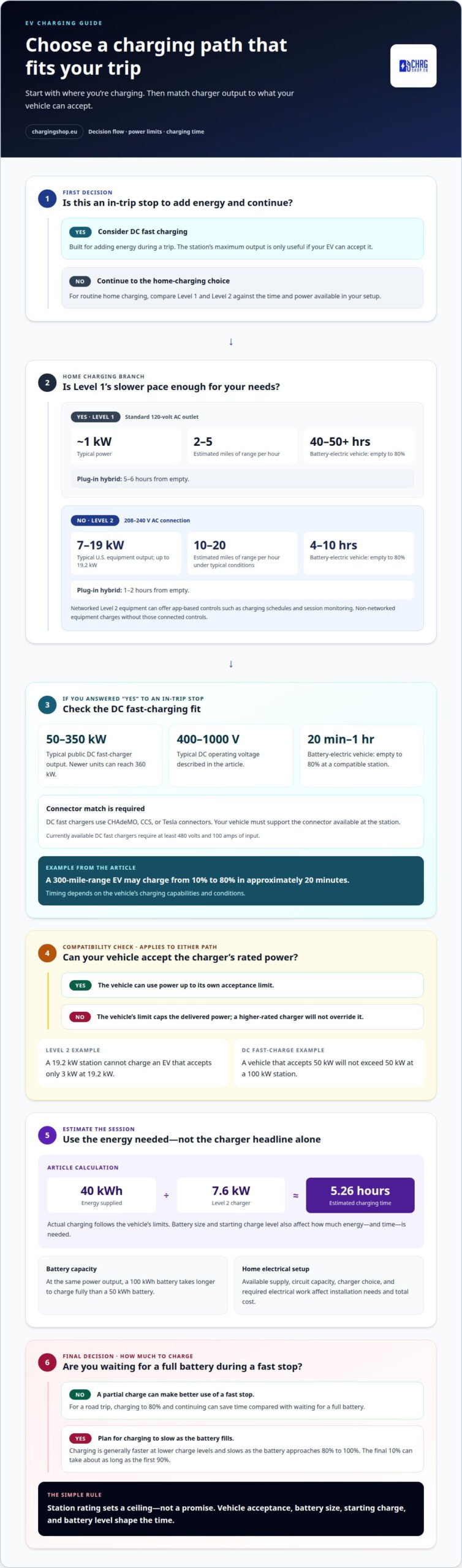
For home use in the United States, the fastest option covered here is a Level 2 charger, which can deliver up to 19.2 kW on a 208/240-volt AC connection. The actual charging speed depends on the home’s electrical supply and the vehicle’s acceptance rate.
There’s no single universal kW threshold for “high capacity.” In the United States, Level 2 equipment typically delivers 7-19 kW, with output reaching 19.2 kW. A high-capacity EV charger is therefore best understood relative to the Level 2 range and what your vehicle can use.
Level 1 charging uses a standard 120-volt AC outlet and typically delivers about 1 kW. It’s the slower option: a battery-electric vehicle can take 40-50+ hours to charge from empty to 80%, while a plug-in hybrid can take 5-6 hours from empty. Level 1 typically adds an estimated 2-5 miles of range per hour.
Level 2 uses 208-240 V AC and can provide an estimated 10-20 miles of range per hour under typical conditions. The vehicle and charger work together to set the delivered power, so a higher-rated unit won’t exceed the car’s charging capacity. Level 2 equipment can charge a battery-electric vehicle from empty to 80% in 4-10 hours, or a plug-in hybrid from empty in 1-2 hours.
Networked and non-networked Level 2 chargers differ in their connected features. Networked equipment can offer app-based controls such as charging schedules and session monitoring. Non-networked equipment focuses on charging without those connected controls. Either way, AC power from the charger is converted for battery storage by the vehicle.
When choosing a high-capacity EV charger, compare its output with your home’s electrical supply and your vehicle’s acceptance rate. The right match is the one that can deliver useful power in your setup, not simply the one with the highest rating.
Direct current fast charging power and charging times
DC fast charging supplies direct current to the battery, bypassing the vehicle’s onboard AC charger. Public equipment typically delivers 50-350 kW and operates at 400-1000 V DC. Newer units can reach 360 kW, but the station’s maximum power output is only one part of the charging equation. The EV must also be able to accept that power.
That makes DC fast charging useful when drivers need to add energy during a trip, rather than leave the vehicle charging for hours. A compatible station can charge a battery-electric vehicle from empty to 80% in 20 minutes to 1 hour. A 300-mile-range EV may charge from 10% to 80% in approximately 20 minutes, depending on its charging capabilities and conditions.
Connector type matters, too. DC fast chargers use CHAdeMO, CCS, or Tesla connectors, and the vehicle must support the connector available at the station. Input requirements are substantial: currently available DC fast chargers require at least 480 volts and 100 amps of input. Station power, vehicle compatibility, and the battery’s ability to accept energy together determine the charging session’s pace.
Charging does not stay at its peak rate throughout a session. A battery typically accepts power faster at a lower state of charge, then the vehicle reduces the rate as the battery fills. This tapering protects battery operation, so the final part of a charge may take longer than the charger’s headline rating suggests. For many trips, planning for a partial charge can make better use of a fast stop.
Choosing a DC unit means matching its output and connector to the vehicle’s capabilities and charging needs. A Personalised Charging Offer can help align those requirements with a suitable charging solution.
How Long Does it Take to Charge an Electric Vehicle (EV)?
Charging time depends on the energy the battery needs, the station’s output, and the vehicle’s acceptance rate. For example, supplying 40 kWh through a 7.6 kW Level 2 charger is estimated to take 5.26 hours. Actual charging follows the vehicle’s limits, not just the number printed on the charger.
High-capacity Level 2 chargers deliver AC power, while DC fast charging sends direct current to the battery. A 19.2 kW station cannot charge an EV that accepts only 3 kW at 19.2 kW. Likewise, a vehicle that accepts 50 kW won’t exceed 50 kW at a 100 kW DC fast charging station.
A vehicle’s AC charging rate depends on its onboard charging system, while its DC charging rate depends on its ability to accept power. The supported rate varies by model, so there is no single maximum that applies to every EV. Check your vehicle’s charging specifications to see how much power it can accept from compatible stations.
Battery size also changes the time required. At the same power output, a 100 kWh battery takes longer to charge fully than a 50 kWh battery. The starting charge level matters too, because it determines how much energy the battery needs. A larger battery may accept high power, yet still require more total charging time.
For a home charger, the total cost, including installation, depends on the equipment and the electrical work required at your property. There is no single price for every setup. Your home’s supply, circuit capacity, and charger choice all affect the installation requirements and overall cost.
Use these factors to assess compatibility before focusing on headline power: connector match, AC or DC charging support, vehicle acceptance rate, and battery capacity. If you regularly use public charging stations, compare the vehicle’s DC limit with station output. For home charging, match the Level 2 unit to the vehicle’s AC limit and available electrical supply.
Charging speed as the battery approaches full
An EV’s charging curve changes with its state of charge. The battery generally accepts power more readily at lower charge levels, then charging slows as it approaches 80% to 100%. Charging is often fastest at lower-to-middle battery levels, while DC fast-charging efficiency varies with the vehicle and charging conditions. That’s why a station’s maximum output doesn’t describe the speed of an entire session.
For a road trip, charging to 80% and continuing can save time compared with waiting for a full battery. The final 10% can take about as long as the first 90%, because the vehicle reduces power as the battery fills. A charging curve shows this change over a session: power rises or holds, then tapers as state of charge increases. Battery capacity also matters. At the same charging power, a 100 kWh battery takes longer to fill than a 50 kWh battery.
Temperature affects charging speed, too. The optimal battery temperature range for charging is 20-30°C. Thermal management helps keep the battery within a suitable operating range, while the charger and vehicle coordinate power delivery. Cold or hot conditions can affect the rate the battery can accept, so peak output may not last throughout a session. Workplace charging can follow a different pattern from a highway stop: a longer parking period may make slower charging practical.
Utility rebates and federal or state incentives vary by location and program. Eligibility and covered costs depend on each incentive’s terms, so include one in your charger budget only after reviewing those terms.
Build a charging plan around the battery’s useful charging window, your parking time, and the vehicle’s charging curve. For a tailored equipment match, request a Personalised Charging Offer.
Charging Shop
Charging Shop helps you connect vehicle compatibility and charging needs with suitable EV charging hardware. Its selection includes the V2C Trydan 22kW, V2C DENKA 20kW DC Wallbox, and Alfen Single Pro Line 22kW, with options across different charging requirements.
Not sure which power level suits your vehicle, battery, and charging routine? Charging Shop’s Personalised Charging Offer helps you consider these factors together, including whether AC or DC charging better suits your needs. It is useful when comparing charger output with your EV’s acceptance limit, rather than choosing by maximum power alone.
Contact Charging Shop to discuss a charging solution that fits your requirements.
Make your next charging choice count
Choose a charging setup for how you expect to use your vehicle, not just the fastest number on a product label. Consider where the vehicle will usually be parked, how long it stays there, and whether your charging needs may change. These priorities can help you select an option that fits your routine.
A high-capacity EV charger makes sense when its capabilities match both your vehicle and its intended location. Consider compatibility and everyday convenience alongside power. A well-matched setup makes charging easier to plan, whether you prioritize regular home charging or flexibility across a broader routine.
Ready to choose a charging solution? Contact Charging Shop to discuss the right direction for your needs. Take the next step with a clear view of how you charge, and choose with confidence.
Frequently Asked Questions
How fast is DC fast charging?
DC fast charging can add about 180-240 miles of range per hour, although the vehicle’s capabilities shape the rate it receives. That estimate helps compare a brief stop with a longer charging session, but it isn’t a promise of constant speed. Battery level and the vehicle’s acceptance limit affect the rate during a stop, so use the range figure as a planning guide.
What Are the Installation Considerations for High-Amp Chargers?
Installation planning starts with the home’s electrical supply, available panel capacity, and the charger’s current rating. A high-amp home charger typically needs a 240-volt supply and a dedicated circuit. The cable route and existing electrical loads also matter because they shape the work required. These factors determine whether the charger can deliver its rated output in that home.
What is the power output of a Level 2 charger?
A US Level 2 charger can deliver up to 19.2 kW, while typical equipment spans 7-19 kW. The actual power reaching your vehicle is limited by the lower of the station’s output and the EV’s AC acceptance rate. For example, a car with a lower onboard charging limit won’t use the charger’s full rating, even with a compatible connection.
What electrical panel and service capacity are needed for a high-capacity EV charger?
Your panel and service must support the charger’s voltage and current while accounting for other electrical loads. Level 2 home charging uses 240 volts, and high-amp equipment typically needs a dedicated circuit. The required capacity depends on charger settings, existing panel load, and the vehicle’s needs. An electrical load assessment identifies whether available service can accommodate the intended charging output.
What permits and electrical code requirements apply to installing a high-capacity EV charger in the US?
US permit and code requirements depend on the local jurisdiction and installation site, so there is no universal checklist for every project. For underground garages, installation must account for fire-service regulations, ventilation, emergency shut-off devices, and steel conduit for power and network cables. These site-specific conditions can affect equipment layout and approvals, so include them in project planning.
How much faster is a 48-amp or 80-amp charger than a standard Level 2 charger?
Neither a 48-amp nor an 80-amp charger guarantees a fixed speed increase over a standard Level 2 unit. More current can raise potential AC output, but the vehicle’s onboard charger and electrical supply set the usable limit. If the EV accepts less power than the station can provide, choosing a higher-amp unit won’t shorten its charging time.
