
 Deutsch
 Dansk
 Suomi
 Latviešu
 Lietuvių
 Norsk bokmål
 polski
 Русский
 Svenska

No products in the cart.
Uncategorized
Future proof EV charger costs and installation choices
20
Nov
Nov
The charger is only one part of the installation cost. A future-proof EV charger setup depends on whether your electrical panel can support the load, how much wiring the route requires, and what you want the system to do later. There is no reliable total that fits every home: panel capacity, circuit design, cable routing, and backup compatibility all affect the project.
It makes sense to look beyond the unit price. A setup that suits your current car but leaves no practical way to add another EV, smart load management, or vehicle-to-home backup could limit your options later. Plan the capacity and wiring around your home’s electrical service and the charging features you expect to use.
Learn how panel capacity affects charging, when plug-in or hardwired wiring makes sense, and whether a subpanel or spare conduit could help. You’ll also see what conventional chargers cannot do for home backup and how to choose a setup with room to adapt.
Key Takeaways
- Assess your home’s electrical service and planned charging needs before choosing charger power; spare breaker spaces alone don’t prove there’s enough capacity.
- Compare plug-in and hardwired setups based on the circuit design, charger requirements, and wiring route.
- Plan for home backup separately: vehicle-to-home power needs a compatible EV and capable bidirectional charging equipment.
- Build flexibility into future charging plans by considering additional vehicles, evolving connector options, and energy-management features.
Electrical panel capacity and load management
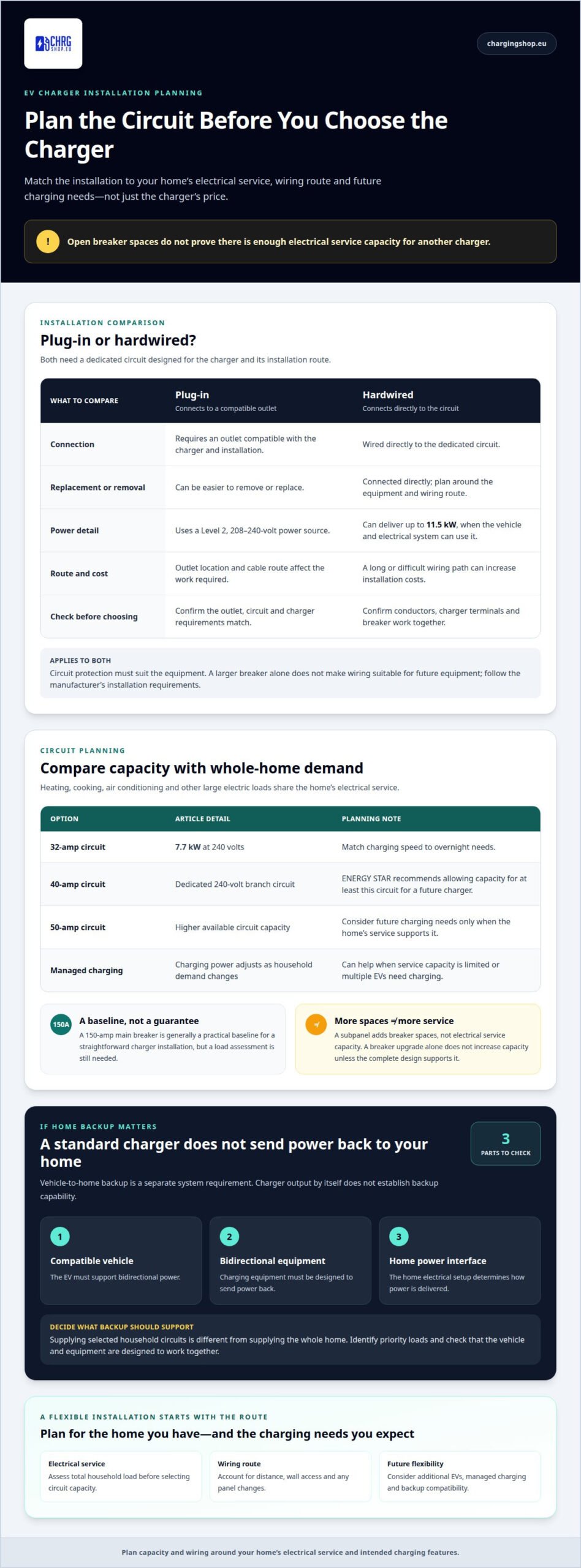
A high-power electric vehicle charger needs a dedicated circuit matched to the charger, conductors, and electrical service. For a typical Level 2 setup, plan around 240-volt AC power; a 32-amp circuit delivers 7.7 kilowatts. A 40- or 50-amp circuit can support faster home charging, but the home’s total load determines whether installation is suitable.
Start with the main breaker rating and the home’s existing electrical demand. A 150-amp main breaker is generally a practical baseline for a straightforward charger installation, but it doesn’t replace a load assessment. Heating, cooking, air conditioning, and other large electric loads all draw from the same service. Two open breaker positions don’t prove the service can support another charger.
A subpanel creates more breaker spaces, not more electrical service capacity. If the panel is tight, load management can help by automatically adjusting charging power as household demand changes. For two EVs, coordinated charging or alternating sessions may meet driving needs without two full-power circuits. ENERGY STAR recommends allowing capacity for at least a 40-amp, 240-volt dedicated branch circuit for a future charger.
| Option | Circuit capacity | Planning consideration |
|---|---|---|
| 32-amp circuit | 7.7 kilowatts at 240 volts | Match charging speed to overnight needs. |
| 40-amp circuit | 240-volt dedicated branch circuit | ENERGY STAR recommends planning for this capacity. |
| 50-amp circuit | Higher available circuit capacity | Allow for future charging needs when service supports it. |
| Managed charging | Power adjusts to household load | Consider for multiple EVs or limited service capacity. |
Choose the circuit only after comparing charger demand with the whole-home load and main service. A breaker upgrade alone will not increase capacity unless the complete electrical design supports it.
Also account for timing: according to the Internal Revenue Service, the federal EV charging tax credit is set to expire on June 30, 2026.
Plug-in versus hardwired installation
A Level 2 charger uses a 208-240-volt power source and a dedicated circuit. A plug-in unit connects to a compatible outlet, so it can be easier to remove or replace. A hardwired charger connects directly to the circuit and can deliver up to 11.5 kW. The right choice depends on the charger’s requirements, the home’s wiring route, and whether an outlet suits the installation location.
Both options need circuit protection designed for the equipment. The conductors, charger terminal ratings, and breaker must work together; fitting a larger breaker alone does not make the circuit suitable for future equipment. Follow the manufacturer’s installation requirements and account for the driveway distance, wall access, and any panel changes when planning the route. A long or difficult wiring path can increase installation costs.
The final amount depends on the electrical work and cable route, not just whether the charger plugs in. Ask the builder to install a dedicated 240-volt garage or carport outlet during construction if a charger is planned later.
Federal, state, and utility incentives depend on current program terms and location. According to the Internal Revenue Service, the federal EV charging tax credit was set to expire on June 30, 2026. State or utility support may have separate eligibility requirements, so don’t assume incentives apply automatically.
Warranty length and coverage vary by manufacturer. Review the written terms, look for a recognized safety certification, and match the charger’s weather rating to its indoor or outdoor location. After installation, keep the circuit details, equipment instructions, inspection records, and warranty documents together. This makes future servicing or equipment replacement easier to plan.
Vehicle-to-home backup power compatibility
A standard smart EV charger moves electricity into a vehicle; it doesn’t, by itself, send battery power back into a home. Vehicle-to-home backup requires a compatible vehicle and equipment designed for bidirectional charging. Treat the car, charging equipment, and home power interface as one system. A charger’s power output alone doesn’t establish backup capability.
Start by deciding what you want backup power to support. Powering selected household circuits during an outage is different from supplying the whole home. The vehicle battery, bidirectional equipment, and home electrical setup all affect how power can be delivered. Check that the vehicle and equipment are designed to work together, then identify the loads that matter most.
Solar adds another layer. Panels can charge the vehicle when generation is available, while battery storage can hold energy for later. System settings determine how available power is divided among household use, storage, and vehicle charging. Compare your usual driving schedule and overnight charging needs with solar production: daytime charging may suit a parked vehicle, while stored energy can shift charging beyond peak generation.
Sharing power between two Wall Connectors requires equipment that supports coordinated charging. With compatible load management, the system can allocate available power across vehicles instead of treating each charger as an independent full-load demand. Set priorities around departure times and battery needs. For example, a vehicle leaving early might take priority over one parked overnight.
Compare charger prices alongside useful power output and supported functions. Higher output can shorten charging time when the vehicle and electrical system can use it, but it does not automatically provide backup capability. A lower-output option may better suit overnight driving needs. For a solar-and-storage plan, consider household demand, solar availability, and vehicle use together before selecting equipment. Keep the backup goal, charging schedule, and power-sharing settings aligned as one practical system.
Why EV charging infrastructure needs future-proofing
A garage charger can stay in service for years, while vehicles and energy needs change. Connector standards can change over time, so compatibility matters when replacing a vehicle. Connector compatibility matters when replacing a vehicle, so consider how a future-proof EV charger setup can adapt without rebuilding the entire electrical route.
Plan the infrastructure, not just the charging unit. ENERGY STAR states that pre-wiring a new home during construction can save a homeowner hundreds of dollars later. Spare conduit is especially useful if a future cable route would run beneath pavement or behind finished walls. Conduit sizing depends on the project, so there is no universal diameter for every garage.
Plan for more than one vehicle and one charging schedule. Smart-grid and load-responsive charging can adjust charging to available power, while coordinated charging can help serve multiple EVs. If you may add solar or storage, map how those systems could connect with charging. Bidirectional charging and vehicle-to-grid systems also require compatible vehicles and capable equipment.
Electrical codes, safety standards, and industry regulations continue to evolve. A future upgrade may affect the electrical panel, wiring route, or equipment choices, so keep installation records and plan access for later work. At commercial sites, adding connected chargers increases exposure to grid disturbances and cumulative surge risks. Consistent surge protection and monitoring can support system stability and help identify stress early.
Smart charging features worth planning for include load-responsive controls and coordinated charging; these help manage demand as vehicles or household needs change. Software should support the functions needed to integrate the charger with the planned energy system. Choose based on your garage layout, likely vehicle changes, and whether solar, storage, or backup power matters. Explore adaptable EV charging options as you shape that plan.
Charging Shop
Charging Shop helps you match EV charging hardware to your electrical capacity, charging plans, and future requirements. Turn to its Personalised Charging Offer when you’re weighing charger options against panel capacity, wiring choices, multiple vehicles, or a possible energy-system upgrade. The range includes the V2C Trydan 22kW, V2C DENKA 20kW DC Wallbox, and Alfen Single Pro Line 22kW. Compare options by the role each could play in your setup, rather than choosing by output alone. Your circuit, vehicle compatibility, and intended charging schedule all matter. For a clearer next step, contact Charging Shop to discuss your charging requirements and equipment options.
Turn your charging plan into a confident next step
Your charging setup should suit how you expect to use your home, not just the vehicle in the driveway today. Before choosing equipment, list your priorities: daily driving, future vehicles, energy management, or backup power. Rank them to make trade-offs clearer and keep the decision focused on what will provide value for you.
A future-proof EV charger is a practical match for your needs and the system around it. You do not need to add every possible feature at once. Choose a clear direction, then make sure your equipment fits that plan. Charging Shop offers EV charging options for different requirements, alongside a Personalised Charging Offer.
Ready to move from research to a tailored equipment choice? Contact Charging Shop for advice and take the next step toward charging that fits your plans.
Frequently Asked Questions
How much does it cost to install a home EV charger?
Your total depends on the wiring route, panel work, and how close the charger location is to the electrical panel. For example, a long route through finished walls may require more work than an accessible garage installation. Budget for the hardware and installation separately, and consider consulting qualified trade specialists such as Synergy Trades Group to evaluate your home’s setup and perform necessary upgrades.
Should I install a larger breaker now for a future charger?
No. A larger breaker is suitable only when the complete electrical design supports it, including the installed charger, conductors, and equipment terminal ratings. Increasing breaker size alone can leave the wiring mismatched to its protection. If you are preparing for a future charger, planning the circuit route or adding conduit during other work can preserve options without fitting an oversized breaker.
Do two future EVs require two full-power circuits?
Not necessarily. Two vehicles can share available charging capacity through equipment with coordinated load management, or charge in alternating sessions. The practical choice depends on each vehicle’s daily use and when it needs to be ready. For example, a household with different departure times may schedule charging in sequence rather than demand full power for both cars at once.
Can charging equipment be mounted outside?
Yes, if the specific charger is designed and rated for its outdoor location. Check the product’s stated mounting and weather-protection details against the conditions where it will sit. For example, V2C Trydan 22 kW Solar – Display, 3 Phase, Type 2 cable, Black is listed for indoor and outdoor mounting with IP54 protection. Underground garages have separate requirements, including ventilation and steel conduit.
Which plug type should I choose for my charging equipment?
Choose a connector that fits your vehicle’s inlet and your expected vehicle changes. In the United States, adapters for switching between J1772 and NACS connectors are widely available, which can help bridge different vehicle connections. Before selecting a charger, consider whether you prefer an integrated cable or a socket-based unit. Cable-type stations offer added convenience because the cable is ready to use.
What features make an EV charger future-proof?
A future-proof EV charger should suit your electrical capacity and allow practical load management as your household needs change. Consider coordinated charging for multiple vehicles, connectivity that supports your intended energy system, and a cable or connector strategy suited to your vehicle plans. If backup power matters, remember that charging equipment alone is not enough: vehicle-to-home use requires a compatible vehicle and bidirectional equipment.
