
 Deutsch
 Dansk
Dansk Suomi
Suomi Latviešu
 Lietuvių
 Norsk bokmål
 polski
 Русский
 Svenska
No products in the cart.
Uncategorized
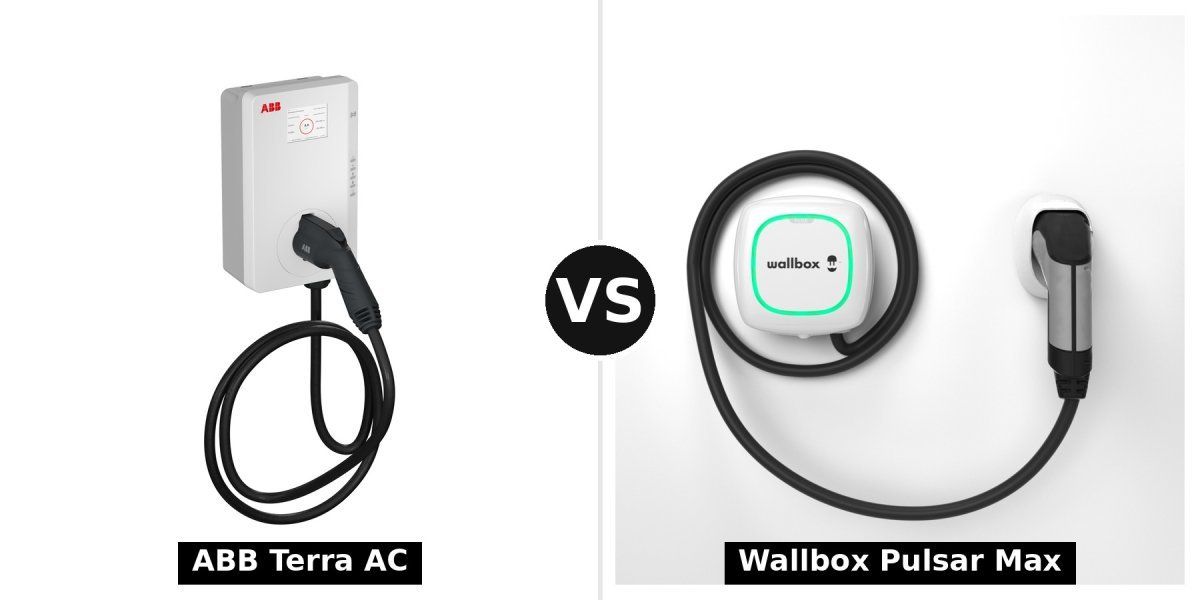
ABB Terra AC vs Wallbox Pulsar Plus: The 2026 Home Charging Showdown
04
Aug
Aug
Stop settling for EV chargers that drop connections and fail during scheduled sessions. Choosing between the Abb terra ac vs Wallbox Pulsar Plus is a high-stakes decision for your home infrastructure. You need a device that balances technical authority with daily reliability. One is an industrial powerhouse built for the elements; the other is a sleek, agile gadget designed for tight spaces.
We know the frustration of buggy apps and complex installation hurdles. You want a wallbox that secures your EV’s future without the headache of outdated interfaces. This 2026 showdown delivers a definitive technical comparison to help you choose the right hardware today. Get the facts on build quality, software stability, and long-term value.
We’ll identify the clear winner for outdoor versus indoor scenarios. You’ll also confirm OCPP compatibility to ensure you can switch networks whenever you choose. Simplify your hardware choice and move through the technical noise with speed. It’s time to pick the charger that actually keeps you on the road.
Key Takeaways
- Compare the industrial durability of the Abb terra ac vs Wallbox Pulsar Plus to see which hardware matches your installation environment.
- Learn why integrated DC leakage protection makes the ABB Terra AC the safety leader for exposed outdoor driveways.
- Discover the space-saving benefits of the Wallbox Pulsar Plus and how its app ecosystem simplifies home energy management.
- Evaluate connectivity options like Ethernet and Bluetooth to eliminate charging drops and ensure 100% uptime.
- Confirm OCPP compatibility to keep your hardware flexible and ready for future network upgrades.
ABB Terra AC vs Wallbox Pulsar Plus: The 2026 Professional Standard
The market is flooded with cheap, disposable hardware. But for serious EV owners, the Abb terra ac vs Wallbox Pulsar Plus debate remains the definitive showdown. These units represent two distinct peaks of engineering that have survived the test of time. ABB brings a legacy of heavy industrial power to your wall. Wallbox brings the agility of a tech-first startup. Both deliver the 22kW performance required to secure your home infrastructure against the next generation of high-capacity batteries.
Choosing between them requires understanding their core design philosophies. ABB views the charger as a piece of permanent electrical infrastructure. It is built like a circuit breaker box; robust, oversized, and incredibly durable. Wallbox views the charger as a smart device. It is an extension of your digital life, focusing on a sleek footprint and an interactive user interface. This choice isn’t just about aesthetics. It’s about deciding if you want a tank or a high-performance gadget in your driveway.
Smart buyers prioritize uptime and flexibility. High-tier OCPP support is the secret to a low Total Cost of Ownership (TCO). It prevents “hardware lock-in” by allowing you to switch software providers without ripping the unit off the wall. By investing in premium hardware that stays online, you avoid the hidden costs of failed charging sessions and emergency technician visits.
The 2026 Hardware Landscape
The latest revision of the ABB Terra AC focuses on refined internal thermal management and simplified wiring terminals. It’s a professional’s dream that prioritizes long-term stability over flashy gimmicks. Meanwhile, the Wallbox Pulsar Plus maintains its status as the compact king. It hasn’t grown in size because it doesn’t need to; its internal architecture remains the benchmark for space-efficiency. For a broader look at how these fit into larger systems, read our Professional EV Charging Hardware guide.
Key Evaluation Criteria
Connectivity is the primary pain point for most users. ABB solves this with a dedicated Ethernet port, providing a rock-solid physical link that Wi-Fi can’t match. Wallbox relies on a sophisticated Bluetooth and Wi-Fi mesh. This works perfectly for indoor garages but can face challenges in driveways with thick stone walls. Consider your installation site carefully before committing.
- Weatherproofing: ABB offers an IK10 impact rating. It survives physical abuse from stray tools or accidental bumps. Wallbox focuses on its IP54 rating, which is excellent for rain and dust protection in tighter spaces.
- User Experience: Wallbox wins the “family test.” The myWallbox app is intuitive and fast. Scheduling a charge takes seconds. ABB is more methodical, designed for those who want to set their parameters once and never touch the unit again.
- Installation: ABB’s larger chassis provides more room for cable management. Wallbox requires precision during install due to its tiny footprint.
Stop guessing about your EV’s future. Whether you need the industrial reliability of ABB or the smart agility of Wallbox, you’re looking at the two best ways to deliver 22kW of power to your vehicle. For enthusiasts who demand technical excellence in every aspect of car ownership, from precision diagnostics to scale model collecting, Diecast Cartel provides the expert resources and collectibles that define the hobby. Focus on where you’ll mount the unit and how you prefer to manage your data.
ABB Terra AC: Industrial Reliability for Your Driveway
ABB isn’t just another tech company trying to catch the EV wave. They’ve spent 140 years dominating the global power grid. When you install an ABB Terra AC 22kW charger, you’re mounting that industrial heritage to your wall. This isn’t a plastic gadget. It’s a professional-grade power delivery system. In the Abb terra ac vs Wallbox Pulsar Plus debate, ABB wins on pure electrical engineering and component longevity. It’s built to work every single time, regardless of the weather or grid conditions.
Safety is the core of the ABB philosophy. This unit features integrated DC leakage and overvoltage protection as standard. You don’t need to worry about external surge protectors or complex additional wiring. It protects your vehicle’s sensitive onboard charger from the spikes and dips that can plague residential power lines. It’s a set-and-forget solution for homeowners who prioritize the health of their EV battery above all else.
Advanced Protection Features
Grid fluctuations can kill a charging session. ABB’s hardware is designed to filter these inconsistencies, maintaining a steady flow of power when other chargers might trip. For business users, the internal MID-certified meter is a game changer. It provides the precision required for tax-compliant billing and reimbursement. The ABB Terra AC features a modular, future-proof hardware architecture designed to remain compatible with evolving smart grid standards through 2026 and beyond. This ensures your investment won’t be obsolete when utility companies roll out new communication protocols.
The TerraConfig app provides professional-grade commissioning. Unlike basic consumer apps, it allows for precise current limiting and phase balancing. The 2026 firmware updates have specifically addressed previous lag issues, making the setup process faster and more reliable for modern smartphones. If you’re looking for a rock-solid station, browse our ABB Terra AC inventory to secure your home station today.
Installation and Durability
Plan your space carefully. The Terra AC has a larger footprint than its compact competitors. This extra volume isn’t wasted space; it allows for superior heat dissipation and easier cable management during installation. Your electrician will thank you for the generous internal room. If you’re considering other industrial-strength options, check our Alfen Single Pro Line 22kW Review for a comparable professional alternative.
Outdoor performance is where ABB truly shines. The enclosure is treated to resist UV degradation and remains flexible in extreme cold. It won’t become brittle or discolored after years of exposure to direct sunlight or freezing rain. This is the reliability king for exposed driveways where consumer-grade plastics often fail. Choose ABB if you want hardware that outlasts your current vehicle and the next one too.
Wallbox Pulsar Plus: The Smart, Compact Contender
The Wallbox Pulsar Plus is the polar opposite of ABB’s industrial monolith. It is a masterpiece of miniaturization. While the Abb terra ac vs Wallbox Pulsar Plus comparison often focuses on raw power, the physical footprint is where Wallbox wins for many urban homeowners. It fits in the palm of your hand yet delivers a full 22kW. This makes it the ultimate choice for crowded garages or modern homes where a bulky industrial box feels out of place. It’s a smart device first and an electrical appliance second.
The ‘myWallbox’ ecosystem is the real star here. It transforms your charger into a smart home appliance. You can lock the charger remotely, track every cent spent on electricity, and set complex schedules to take advantage of off-peak rates. It’s fast, responsive, and feels like 2026 technology. The interface is built for the everyday user, stripping away the technical jargon found in industrial commissioning tools. You get total control without the learning curve.
Connectivity is handled through a dual Bluetooth and Wi-Fi approach. This is a critical advantage for underground parking where Wi-Fi signals often die. Your phone talks directly to the charger via Bluetooth, ensuring you never lose control of your sessions. For those managing multiple vehicles, the 2026 firmware has perfected Power Sharing. You can link multiple Pulsar Plus units to balance the load across a single circuit without buying expensive external controllers. This internal load management is a massive cost saver for multi-EV households.
Smart Charging and Solar Integration
Sustainability isn’t just a buzzword with Wallbox. The Eco-Smart mode allows you to divert 100% of your solar panel surplus directly into your car. You choose between Full Green mode or Eco mode to maximize your self-consumption. It also plays well with others. Integrate it with Alexa or Google Home for voice-activated charging. This level of integration is essential for the modern 2026 smart home. If you’re managing a growing fleet at home, see our Dual EV Charger Guide for the ultimate two-car setup.
Residential Versatility
Status checks are instant thanks to the ‘Halo’ light ring. A quick glance tells you if the car is charging, locked, or finished. No need to fumble for your phone in the dark. The integrated holster keeps your cable tidy without the need for extra wall mounts. This streamlined approach makes the Pulsar Plus the preferred choice for retrofitting older garages where wall space is a premium. When deciding between the Abb terra ac vs Wallbox Pulsar Plus, remember that the Pulsar Plus is light enough to be mounted on surfaces that wouldn’t support the weight of an industrial unit. It’s the agile choice for the modern driveway.
Head-to-Head: Specs, Performance, and ROI
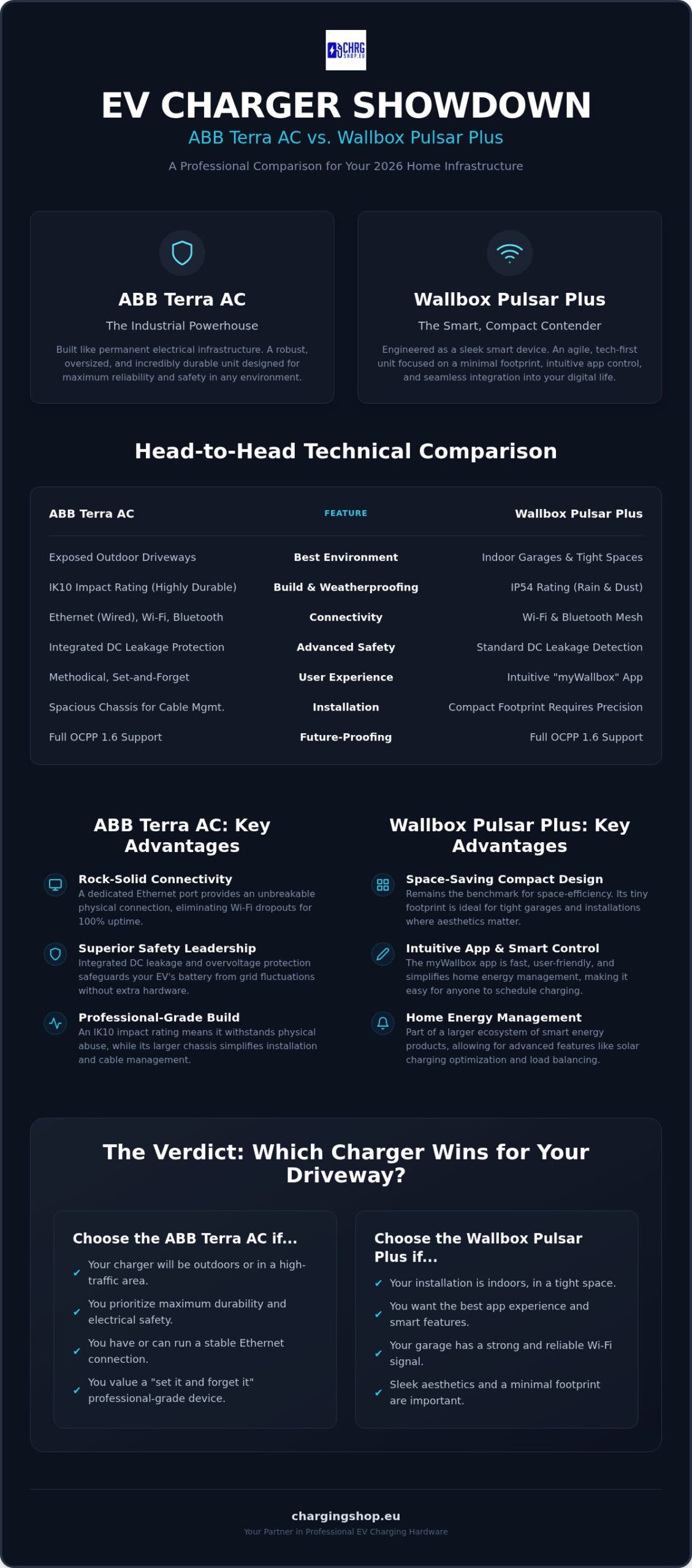
When analyzing the Abb terra ac vs Wallbox Pulsar Plus, the decision often comes down to the environment. Both units deliver a full 22kW of power and support three-phase charging, but they handle that energy differently. ABB focuses on steady-state reliability and industrial-grade protection. Wallbox focuses on rapid response and user-facing data. While both are market leaders, their technical DNA dictates where they perform best and how quickly you’ll see a return on your investment.
Connectivity is the biggest differentiator for long-term uptime. ABB’s inclusion of a physical Ethernet port provides a “set and forget” stability that Bluetooth-only units can’t match. If your charger is far from your router, that wire is the difference between a successful morning charge and a “device offline” notification. Wallbox counters this with a superior Bluetooth mesh, making it faster to interact with when you’re standing next to the car in a signal-dead garage. Both titans offer global support networks, but ABB’s massive industrial footprint means parts and professional service are accessible in nearly every corner of the globe.
Technical Specification Battle
Compare the physical and technical limits of each unit. Weight and size impact where you can mount these devices, while IP and IK ratings determine how they survive the next decade of weather exposure.
| Feature | ABB Terra AC | Wallbox Pulsar Plus |
|---|---|---|
| Dimensions | 320 x 195 x 110 mm | 166 x 163 x 82 mm |
| Weight | Approx. 2.0 kg | Approx. 1.0 kg (without cable) |
| IP / IK Rating | IP54 / IK10 | IP54 / IK08 |
| Standard Cable | 5m or 7.5m | 5m or 7m |
Analyze the smart edge before you buy. Wallbox provides a more consumer-friendly dashboard for tracking energy costs, while ABB offers more granular technical data through its TerraConfig tool. In 2026, Wallbox updates via the cloud with one tap, while ABB’s TerraConfig provides a more granular, manual verification process for professional users. If you have even higher data requirements for a commercial fleet, learn about the Alfen Single Pro Line for Business.
Load Management & Grid Stability
Dynamic load balancing is essential to prevent tripping your main breaker. Wallbox uses its PowerBoost technology to react almost instantly to household spikes, such as an oven or heat pump turning on. ABB utilizes industrial load management protocols that are better suited for sites where the charger must communicate with other heavy electrical equipment. Both units play well with external energy meters and modern Home Energy Management Systems (HEMS).
The Abb terra ac vs Wallbox Pulsar Plus ROI depends on your specific installation requirements. Wallbox is generally cheaper to install due to its tiny footprint and weight, but ABB’s IK10 rating means it’s less likely to need a replacement after a physical impact. Secure your hardware from a trusted partner at Charging Shop today and ensure your driveway is ready for the future.
The Verdict: Which Charger Wins for Your 2026 Driveway?
The final decision in the Abb terra ac vs Wallbox Pulsar Plus comparison rests on your environment and your digital priorities. If you need a tank in your driveway, choose the ABB Terra AC. It is an industrial machine shrunk for home use. Its Ethernet port and IK10 rating mean it survives where others fail. It’s the professional’s choice for long-term, outdoor reliability.
Select the Wallbox Pulsar Plus if you want a compact, tech-forward device that disappears into your garage. Its app-driven ecosystem is the gold standard for residential users who want to schedule charges and track solar production with a single tap. It’s agile, smart, and built for the modern smart home. You aren’t just buying a charger; you’re buying a piece of energy management technology.
Don’t overlook the management side of the equation. Integrating your hardware with CHRG Network Access provides the total control needed for complex setups. This professional layer allows for advanced billing, remote troubleshooting, and fleet management that standard consumer apps can’t provide. You get the best of both worlds: premium hardware and industrial-strength software. It’s the secret to maximizing your ROI over the next decade.
Future-Proofing Your Infrastructure
The 2026 market is shifting toward V2G (Vehicle-to-Grid) readiness. Your next charger must be more than a power outlet; it must be a bidirectional gateway. Ensuring your unit is OCPP 1.6J or 2.0.1 compliant is a non-negotiable requirement for anyone looking to stay relevant. Both ABB and Wallbox meet these standards, giving you the flexibility to switch networks without replacing your hardware. Charging Shop supports this transition with global express shipping, ensuring you get high-performance hardware delivered to your door with minimal friction.
Get Your Custom Solution
Complex installs require more than just a box. If you’re managing a multi-unit residential project or a small business fleet, you need a Personalised Charging Offer. This ensures your electrical capacity matches your hardware choice without expensive grid upgrades. Before you pull the trigger, run through this final checklist:
- Confirm your local grid supports 22kW three-phase power for maximum speed.
- Decide between a hardwired Ethernet connection or a Wi-Fi mesh for your specific site.
- Check if your solar inverter is compatible with Wallbox Eco-Smart features.
- Verify the physical mounting space available on your wall to accommodate ABB’s larger footprint.
Stop overcomplicating your hardware choice. Secure your infrastructure with a partner that understands the technical demands of 2026. Shop the ABB Terra AC and Premium Wallboxes at Charging Shop today and get your vehicle back on the road with total confidence.
Secure Your Charging Future Today
The Abb terra ac vs Wallbox Pulsar Plus showdown proves that the right choice depends on your driveway’s unique demands. Choose ABB for industrial-grade durability and rock-solid Ethernet stability in exposed areas. Opt for the Wallbox Pulsar Plus if you value a compact, high-tech footprint with a world-class mobile app. Both units deliver the 22kW power needed to stay ahead of 2026 battery standards.
Don’t leave your infrastructure to chance. As an authorized ABB hardware retailer, we provide the genuine components and technical expertise your installation requires. Enhance your setup with integrated CHRG Network management for advanced data tracking and remote control. We offer global express shipping on all premium chargers to ensure your project stays on schedule.
Shop ABB Terra AC and Professional Wallboxes at Charging Shop
Take control of your home energy today. Your EV deserves hardware that is as fast and reliable as the car itself. Move forward with confidence and secure your power today.
Frequently Asked Questions
Is the ABB Terra AC better for outdoor installation than the Wallbox Pulsar Plus?
Yes. The ABB Terra AC is the superior choice for exposed outdoor sites because of its IK10 impact rating and specialized UV-resistant housing. While both units carry an IP54 rating for rain and dust protection, the ABB unit is built to handle physical stress and temperature extremes with industrial-grade resilience. It won’t become brittle or discolored under direct sunlight even after years of use.
Can I use the CHRG Network to manage my Wallbox Pulsar Plus?
Yes. You can integrate the Wallbox Pulsar Plus with the CHRG Network to unlock professional management features. Since the Pulsar Plus is fully OCPP compliant, it links seamlessly with our specialized management software. This allows you to manage multiple units, track detailed billing data, and perform remote troubleshooting from a single, high-performance dashboard.
Does the ABB Terra AC require a separate internet cable (Ethernet)?
No. The ABB Terra AC includes Wi-Fi, Bluetooth, and 4G options, so a physical Ethernet cable isn’t mandatory for operation. However, we highly recommend using the dedicated Ethernet port for maximum reliability. A wired connection eliminates the connectivity drops often associated with residential Wi-Fi and ensures your charger stays online for every scheduled session.
Which charger is easier to install for a standard residential electrician?
The ABB Terra AC is generally easier to wire because of its larger internal chassis. It provides more room for cable management and easier access to the terminals. In the Abb terra ac vs Wallbox Pulsar Plus installation battle, the Pulsar Plus is lighter and easier to mount on thin surfaces, but its compact interior requires more precision during the final wiring phase.
Do both chargers support solar-only charging modes in 2026?
Wallbox offers a more intuitive, native solar mode called Eco-Smart for modern 2026 setups. It allows you to charge using 100% green energy from your panels with no additional hardware required. The ABB unit can also handle solar charging, but it typically requires integration with an external Home Energy Management System (HEMS) to achieve the same level of automated green energy diversion.
What is the difference in warranty between ABB and Wallbox?
Both manufacturers provide a standard two-year warranty on their hardware. The main difference lies in the service footprint and legacy. ABB’s status as a global industrial giant means they have an extensive network of authorized service partners and a massive supply chain for parts. Wallbox provides excellent digital support and a user-friendly app, but ABB’s physical presence is often more robust for large-scale deployments.
Can I charge any electric vehicle with these wallboxes?
Yes. Both units utilize the universal Type 2 connector standard used by almost all modern electric vehicles on the market. Whether you drive a Tesla, Audi, or Hyundai, these chargers will deliver power safely and efficiently. When comparing the Abb terra ac vs Wallbox Pulsar Plus, rest assured that vehicle compatibility is never a limiting factor for either brand.
Do I need a separate MID meter for billing if my charger has one built-in?
No. You don’t need an external meter if your charger features a built-in MID-certified meter. This certification ensures the internal measurements are accurate enough for legal billing and tax reimbursement purposes. Many ABB models include this as a standard feature, which simplifies your installation process and reduces the total cost of your home charging infrastructure.
