
 Deutsch
 Dansk
Dansk Suomi
Suomi Latviešu
 Lietuvių
 Norsk bokmål
 polski
 Русский
 Svenska
No products in the cart.
Uncategorized
Best EV Charger with Ethernet Connection: 2026 Buyer Guide
22
Sep
Sep
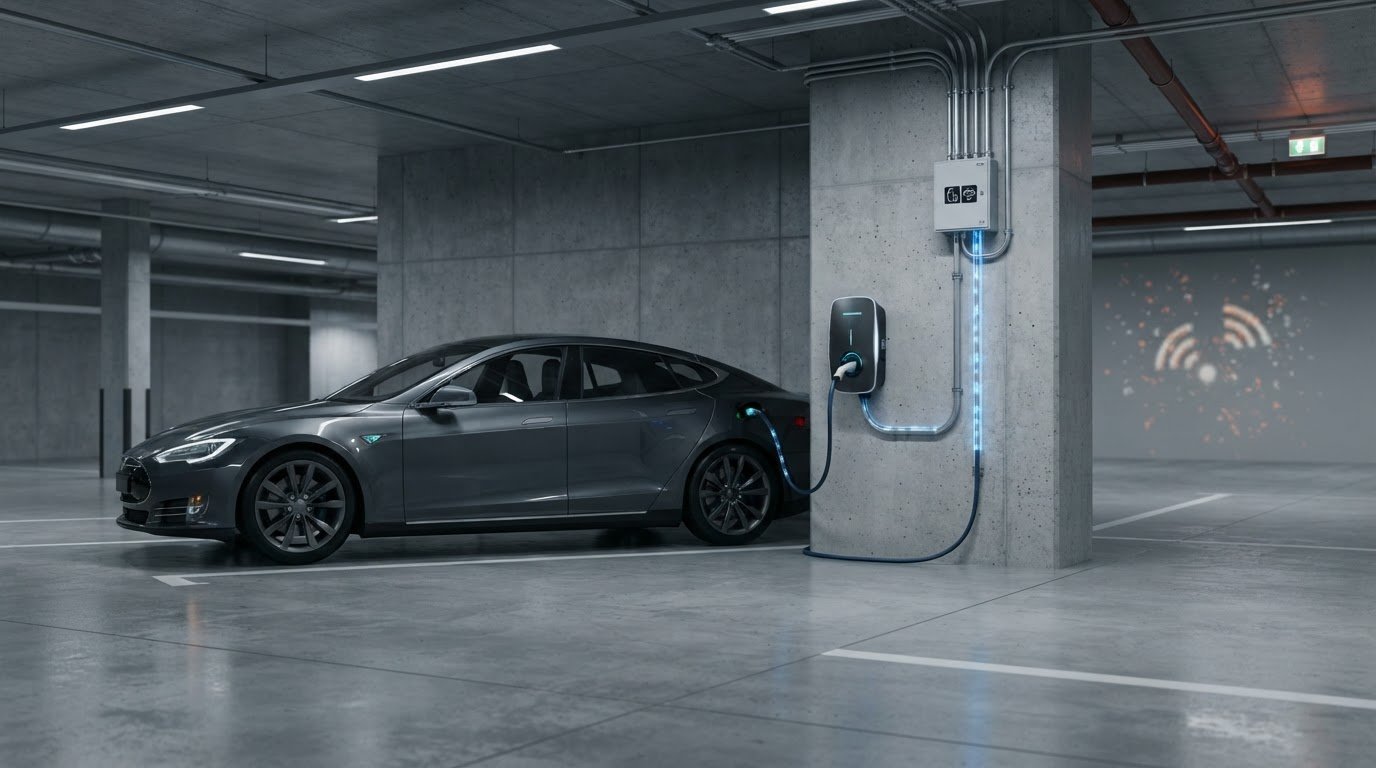
A dropped Wi-Fi signal inside a concrete garage shouldn’t dictate whether your vehicle is ready for the morning commute. In underground garages and commercial parking bays, standard 2.4 GHz wireless signals routinely drop up to 40% of their data packets. That connectivity loss silently cancels scheduled off-peak sessions, disrupts dynamic load management, and cuts off revenue tracking. Upgrading to a dedicated EV charger with ethernet connection eliminates this failure point, replacing unreliable wireless handshakes with zero-latency Cat6 stability.
You shouldn’t have to gamble on whether your wallbox stays connected when utility rates plunge or commercial billing demands run high. In this 2026 buyer guide, you’ll discover how a hardwired Ethernet EV charger eliminates dropped signals, secures billing, and powers uninterrupted smart charging. We evaluate top RJ45-equipped hardware, break down local Modbus and OCPP 2.0.1 integrations, and show you exactly how to design a high-uptime charging setup that never misses a beat.
Key Takeaways
- Learn why investing in an EV charger with ethernet connection guarantees reliable off-peak charging schedules and eliminates communication failures in concrete garages.
- Discover the critical hardware requirements for stable data transmission, including weather-sealed RJ45 glands and STP Cat6 shielding to combat electrical noise.
- Compare the best hardwired wallboxes for 2026 to choose the ideal unit for high-performance residential power or demanding commercial fleet operations.
- Master cabling best practices, such as running dedicated conduit pathways and deploying star topologies, to prevent network downtime.
- Explore how hardwired OCPP connections and CHRG Network access safeguard real-time billing accuracy and dynamic load balancing across shared charging hubs.
Why Choose an EV Charger with Ethernet Connection Over Wi-Fi?
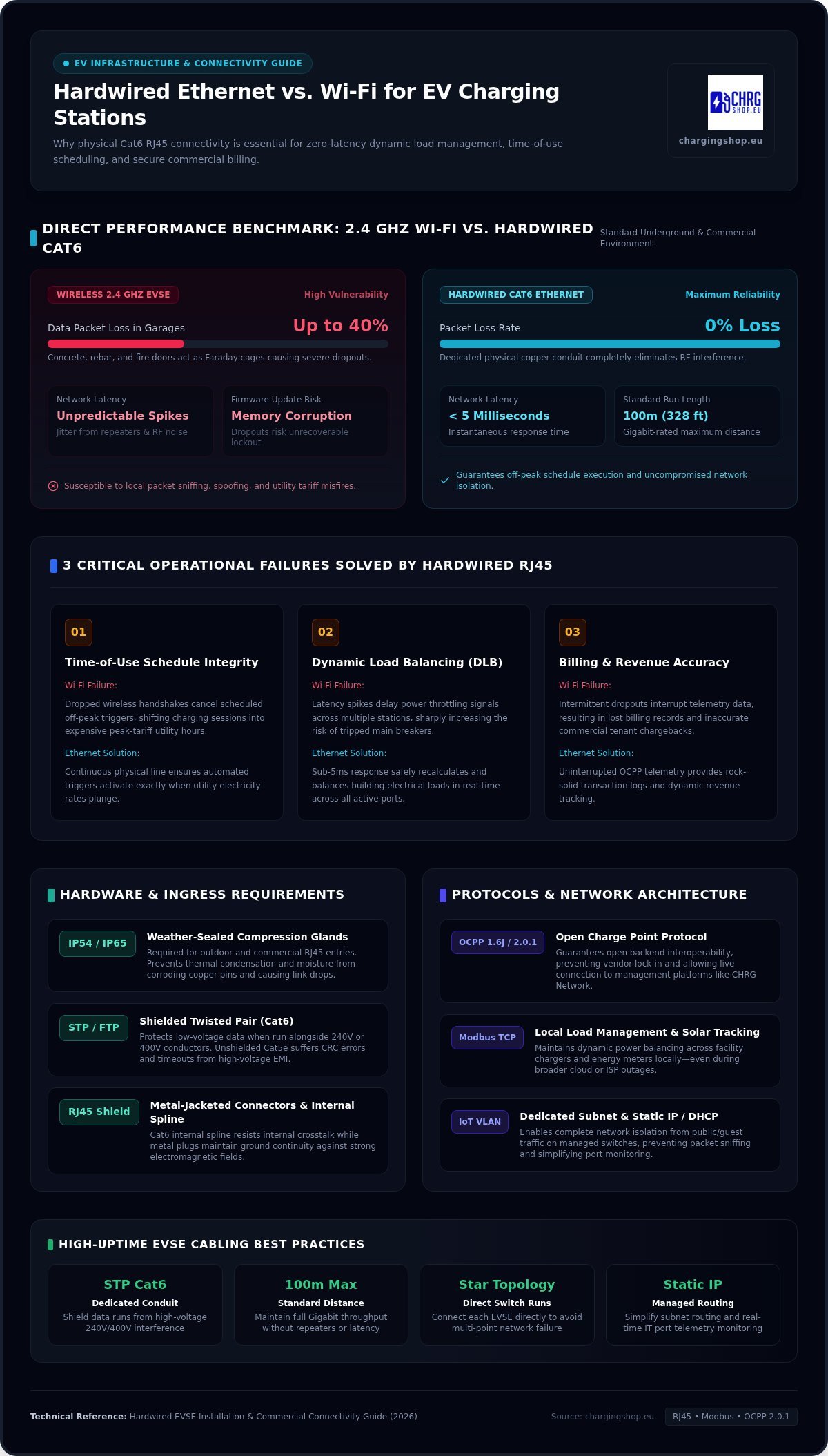
Wireless convenience often collapses when faced with real-world infrastructure. Standard 2.4 GHz Wi-Fi frequencies cannot reliably penetrate structural concrete, steel rebar, and insulated fire doors. When signal degradation causes packet drops, smart wallboxes lose contact with your home network or management cloud. Installing an EV charger with ethernet connection bypasses radio frequency interference completely, guaranteeing an uninterrupted, physical data pipeline.
Reliable connectivity isn’t just about app notifications; it dictates operational efficiency and electrical safety:
- Time-of-Use Integrity: A lost wireless handshake halts off-peak schedule triggers, pushing high-draw charging into expensive peak-tariff utility hours.
- Dynamic Load Balancing (DLB): DLB algorithms balance building loads in real time. Latency spikes over Wi-Fi can delay power throttling, increasing the risk of tripped main breakers.
- Uninterrupted Uptime: Physical Cat6 copper connections maintain latency below 5 milliseconds, avoiding the packet loss common to crowded wireless bands.
The Limitations of Wireless EVSE in Garages and Basements
Underground residential garages and commercial parking basements act as Faraday cages. While many users attempt to bridge dead zones with Wi-Fi repeaters, extenders introduce severe network jitter and dropped packets. This added latency wrecks time-sensitive communication. Even worse, wireless dropouts during over-the-air firmware upgrades can corrupt device memory, leaving expensive charging hardware in an unrecoverable lockout state.
Data Security and Local Network Stability
Hardwired RJ45 infrastructure closes critical security loopholes. Outdoor Wi-Fi stations expose your network to local packet sniffing and wireless spoofing. A physical cable run keeps your charging infrastructure segregated, making it easy to isolate hardware onto a dedicated IoT Virtual LAN (VLAN).
Direct cabling also ensures reliable telemetry for local solar tracking, dynamic energy metering, and commercial billing. Physical wiring allows continuous messaging via the Open Charge Point Protocol (OCPP) to backend management software, preventing dropped billing records. On the local level, protocols like Modbus TCP/IP continue balancing facility power loads seamlessly across connected chargers, even during broader internet and cloud server disruptions.
Key Technical Requirements for Ethernet-Enabled Charging Stations
Selecting an EV charger with ethernet connection requires looking past basic spec sheets. Hardware reliability depends entirely on the physical ingress protection of the port and the network protocols operating behind it. Commercial and outdoor residential wallboxes demand weather-sealed, compression-gland RJ45 entries rated at least IP54 or IP65. Without proper cable glands, moisture and thermal condensation will corrode exposed copper pins, triggering silent link drops and packet degradation over time.
On the networking layer, prioritize wallboxes that support static IP assignment alongside standard DHCP reservations. Assigning fixed IP addresses streamlines device management across managed switches, simplifies subnet routing, and makes port monitoring straightforward for IT administrators.
Cabling Standards: Cat5e vs. Cat6 and Cable Shielding
High-voltage AC supply cables generate strong electromagnetic fields. If you pull low-voltage data cables alongside 240V or 400V conductors, unshielded wires pick up severe electromagnetic interference (EMI). Standard Unshielded Twisted Pair (UTP) Cat5e often fails under these conditions, causing cyclic redundancy check (CRC) errors and communication timeouts.
Always deploy Shielded Twisted Pair (STP or FTP) Cat6 cabling terminated with shielded, metal-jacketed RJ45 plugs. Cat6 features tighter wire twists and internal splines that resist crosstalk, easily maintaining Gigabit speeds across runs up to the standard 100-meter (328-foot) limit. For complex conduit routing, reviewing established DOE EV charging procurement and installation guidance helps you match electrical run clearances with optimal low-voltage segregation rules.
Software Protocols: OCPP Compatibility and Local APIs
Network hardware must pair with open, future-proof software. Demand compliance with OCPP 1.6J or OCPP 2.0.1. Open protocols prevent vendor lock-in, letting you swap backend charging platforms without replacing your physical wallboxes. If you are configuring a home setup, verify that the charger provides local REST APIs or Modbus TCP/IP support. These local protocols allow instant communication with domestic solar inverters and battery storage without relying on external internet routing.
Choosing high-spec equipment from the start protects your investment against obsolescence. Explore the network-ready hardware available through technical EVSE hardware distributors to ensure your next charging station comes equipped with certified RJ45 connectivity out of the box.
Top EV Chargers with RJ45 Ethernet Ports: 2026 Buying Guide
Selecting the right hardware comes down to electrical throughput, enclosure space, and backend software compatibility. Before pulling cable, verify your vehicle’s onboard AC converter capacity. While many passenger vehicles cap AC charging at 11 kW, commercial depots and shared properties benefit immensely from 22 kW three-phase hardware to cycle vehicles through charging bays rapidly. Crucially, verify that your chosen EV charger with ethernet connection provides adequate internal clearance for RJ45 cable bend radiuses and sealed compression glands.
Alfen Single Pro Line 22kW: The Enterprise Standard
Engineered for demanding commercial environments, this station sets the benchmark for multi-user charging hubs. A native RJ45 socket links directly to local switches, running dynamic load balancing across dozens of stalls without cloud latency. It integrates a certified MID meter for legally compliant energy billing and implements encryption aligned with Joint Office EVSE cybersecurity and networking guidelines. Explore our full evaluation of the Alfen Single Pro Line 22kW to review its enterprise networking architecture.
ABB Terra AC: Industrial Grade Reliability for Commercial Sites
ABB brings grid-level engineering to workplace and fleet charging. The Terra AC features a robust casing that shields the internal RJ45 port from moisture, thermal swings, and industrial dust. Built-in Modbus TCP/IP support enables direct power monitoring, while native OCPP backhaul keeps charge points online during busy fleet turnaround windows. Read our in-depth ABB Terra AC 22kW charger guide to assess its commercial load balancing capabilities.
V2C Trydan 22kW: Intelligent Hardwired Charging for Smart Homes
For residential installations, the V2C Trydan combines wired stability with automated solar energy integration. Deploying a residential EV charger with ethernet connection guarantees that dynamic solar surplus routines never miss a beat when clouds roll in. The wallbox communicates directly with home energy meters and solar inverters over your local network, throttling charge speeds in milliseconds. Discover full home automation features in our comprehensive guide to the V2C Trydan 22kW.
Network Architecture and Hardwiring Best Practices for EVSE
A flawless physical deployment is just as critical as the charging station itself. Installing an EV charger with ethernet connection requires deliberate network planning before you pull a single foot of wire. Neglecting basic physical layer standards leads to intermittent packet loss, corrupted telemetry, and frustrating communication dropouts. Follow professional structured cabling rules and qualify every link with a network certifier before torquing down the enclosure seals.
Conduit Routing and Preventing High-Voltage Interference
High-voltage lines feeding 32A or 40A currents generate intense electromagnetic fields. Running low-voltage communication cables alongside 240V single-phase or 400V three-phase conductors in the same raceway violates standard electrical codes unless the data cable carries an industrial 600V insulation rating.
Follow these wiring rules to ensure clean, error-free data transfer:
- Use Dedicated Conduit: Pull your shielded Cat6 cable through a separate rigid PVC or metallic conduit run to isolate it from inductive noise.
- Maintain Separation: Keep data pathways separated from AC power lines. When pathways must intersect, cross them at strict 90-degree angles to minimize electromagnetic coupling.
- Secure Enclosure Seals: Pass network runs through IP68-rated compression glands at the wallbox entry point to prevent water ingress and preserve factory weather ratings.
Router and Managed Switch Configuration
Your local network setup dictates how reliably charge points communicate with the cloud. Avoid connecting smart chargers directly to unmanaged consumer routers without security rules. Instead, route wallbox connections into a managed switch and isolate the ports onto a dedicated IoT Virtual LAN (VLAN). This network segregation blocks unauthorized access to your private local network if an outdoor terminal is ever physically compromised.
Assign static IP addresses via DHCP MAC address reservations to eliminate internal IP conflicts during router reboots. Configure your firewall rules to permit outbound traffic across the secure WebSocket ports required by your OCPP cloud software. Finally, implement Quality of Service (QoS) packet prioritization on your network router to ensure that real-time load management data packets take priority over standard home or office internet traffic.
Getting your physical infrastructure right saves countless hours of troubleshooting down the road. If you are preparing a multi-point installation or commercial project, request a Personalised Charging Offer to equip your facility with certified, network-ready charging stations built for high-performance deployments.
Commercial Fleet and Property Management with the CHRG Network
Every dropped data packet in a commercial or multi-tenant setting represents lost revenue. When an operator relies on spotty wireless connections, payment gateways fail to authenticate user RFID cards or mobile apps. Charge points get flagged as offline, turning frustrated drivers away and stranding billable kilowatt-hours. Deploying an EV charger with ethernet connection provides the hardwired backbone necessary to keep billing transactions and telemetry flowing without interruption.
Open network architecture eliminates single-vendor hardware locks. Instead of getting trapped in proprietary software ecosystems, property managers can connect diverse, OCPP-compliant charge points to a single cloud dashboard. This unified approach streamlines split-tariff billing, private fleet tracking, and automated driver reimbursements across multiple sites.
Ensuring 100% Uptime for Commercial Billing and OCPP Backends
A continuous physical link ensures that charging records sync with your backend in real time. Hardwired RJ45 ports eliminate the dreaded authorization timeout, processing credit card handshakes and app check-ins instantly. For multi-family residential parking and public charging bays, direct Ethernet links guarantee that tenant usage data transfers directly to billing ledgers without dropped records or reconciliation errors.
Pairing reliable stations with open management software protects your bottom line. Check out our comprehensive guide to CHRG Network access for EV stations to see how an open CSMS centralizes multi-site monitoring, smart tariffs, and automated revenue collection on one screen.
Selecting Your Ideal Network-Ready Hardware Solution
Choosing the right hardware configuration starts with evaluating your available electrical supply. Single-phase 7.4 kW units match smaller residential panels, while 22 kW three-phase hardware maximizes turnaround speed for workplaces, depots, and multi-tenant properties. Check out our in-depth 22kW wallbox for home analysis to evaluate high-power options for private garages.
Ready to upgrade your infrastructure? Charging Shop supplies industry-leading, network-ready wallboxes engineered for heavy commercial and smart residential demands. Contact our team today to request a Personalised Charging Offer and source the exact hardware your site requires.
Upgrade to Uncompromised Charging Uptime Today
Don’t let unstable wireless signals compromise your energy savings or morning vehicle readiness. Installing an EV charger with ethernet connection guarantees rock-solid reliability, eliminating dropped off-peak schedules and protecting millisecond-sensitive dynamic load balancing. For commercial operators, physical Cat6 connections provide the baseline stability required to authenticate drivers, prevent dropped billing sessions, and secure automated revenue via OCPP backends.
Building a future-proof charging setup starts with professional-grade hardware. Charging Shop delivers a curated inventory of premier European wallboxes, including proven solutions from Alfen, ABB, and V2C. Every unit features full OCPP compatibility and integrates smoothly with the CHRG Network platform for multi-point management. Don’t leave your power delivery to chance. Explore network-ready EV chargers at Charging Shop today, request your personalized charging proposal, and take complete control of your charging infrastructure.
Frequently Asked Questions
Why is an Ethernet connection better than Wi-Fi for an EV charger?
An Ethernet connection provides direct physical signal stability that wireless frequencies cannot match. Reinforced concrete garage walls and metal barriers degrade 2.4 GHz Wi-Fi signals, causing frequent packet loss and dropped charging commands. Hardwired copper cables deliver sub-5ms latency and zero interference. This ensures automated schedules start reliably and dynamic load balancing responds instantly to protect your electrical panel.
Do all smart EV chargers include an RJ45 Ethernet port?
No, many popular residential chargers omit an RJ45 Ethernet port entirely to cut manufacturing costs. Mass-market wallboxes frequently depend only on basic 2.4 GHz Wi-Fi and Bluetooth. If you need rock-solid connectivity, you must deliberately choose an EV charger with ethernet connection built into the chassis, such as dedicated commercial stations or smart models like the V2C Trydan.
Can I run a standard Cat6 cable alongside the main EV power line?
You cannot run standard unshielded Cat6 inside the same conduit as high-voltage power conductors. Electrical safety codes prohibit mixing low-voltage data cables and 240V or 400V power lines unless the data cable carries an industrial insulation rating equal to the supply voltage. For standard installations, always route shielded STP Cat6 through its own separate conduit to prevent severe electromagnetic interference.
Does the Ethernet connection work if my home internet goes offline?
Yes, local Ethernet network communication remains fully operational even when your broader internet service drops. The wallbox still communicates over the local area network using Modbus TCP/IP or local APIs. This allows continuous dynamic load balancing between your domestic energy meter, battery storage, and the charger without internet access. However, cloud-dependent smartphone controls will pause until WAN service restores.
Which commercial EV chargers offer built-in Ethernet and OCPP support?
Proven enterprise stations like the Alfen Single Pro Line 22kW and the Abb terra ac feature native RJ45 ports and certified OCPP compliance. These commercial units connect directly to local switches for rock-solid data transfer. They integrate seamlessly with central management software like the CHRG Network, enabling automated driver billing, remote telemetry, and multi-point load balancing across shared parking bays.
Do I need a static IP address for my Ethernet-connected EV charger?
A static IP address isn’t strictly mandatory, but assigning one via DHCP reservation is an industry best practice. Binding a fixed local IP address to your charger’s MAC address prevents internal routing conflicts during router reboots. It guarantees that local energy management systems, Modbus meters, and backend OCPP servers can always reach the wallbox at an unchanging network address.
Can an Ethernet EV charger balance load with a home solar system?
Yes, hardwired wallboxes excel at dynamic solar balancing by eliminating the packet latency that causes over-generation waste. An EV charger with ethernet connection communicates instantaneously with compatible solar inverters and energy meters. The station tracks real-time PV generation changes every second, immediately adjusting charging currents so you direct 100% of excess green energy straight into your vehicle battery.
