
 Deutsch
 Dansk
Dansk Suomi
Suomi Latviešu
 Lietuvių
 Norsk bokmål
 polski
 Русский
 Svenska
No products in the cart.
Uncategorized
Cost to Operate a Level 2 Charger: 2026 Operational Guide
21
Sep
Sep
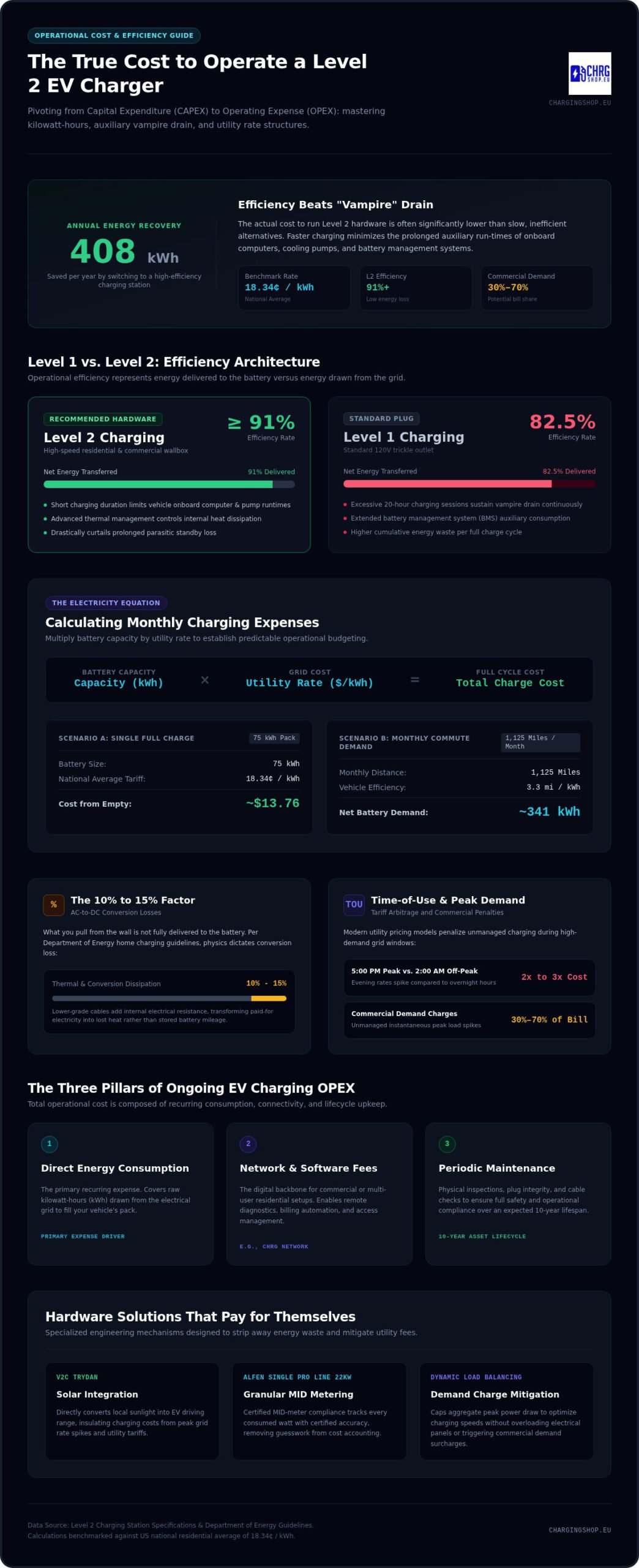
Did you know that switching to a high-efficiency station saves the average driver roughly 408 kWh per year in avoided energy loss? While many owners expect a massive spike in their utility bills, the actual cost to operate a level 2 charger is often lower than the “vampire” drain of inefficient alternatives. If you’re tired of guessing what your monthly statement will look like or feeling confused by peak versus off-peak pricing, you aren’t alone. It’s a common frustration for anyone trying to maximize their EV investment.
We’re going to master the math behind your charging habits. You’ll learn exactly how to project your monthly expenses using the current national average of 18.34 cents per kWh and see how smart hardware like the V2C Trydan or Alfen Single Pro Line slashes long-term costs. This guide breaks down predictable monthly estimates, strategies to eliminate energy waste, and hardware picks that pay for themselves. Get ready to turn your charger into a precision-managed asset that works for your budget. We’ll strip away the complexity and focus on immediate, high-performance solutions for your home or business.
Key Takeaways
- Calculate your exact monthly bill by multiplying battery capacity by your utility rate to eliminate pricing uncertainty and budget effectively.
- Reduce the long-term cost to operate a level 2 charger by selecting hardware that minimizes standby power draw and parasitic energy losses.
- Leverage solar integration with smart units like the V2C Trydan to convert sunlight into free vehicle range and insulate yourself from grid rate hikes.
- Deploy dynamic load balancing to optimize charging speeds without triggering costly utility demand charges or overloading your electrical panel.
- Automate billing and remote monitoring with the CHRG Network to turn your charging station into a managed, revenue-generating asset.
Breaking Down the Operational Costs of Level 2 Charging
Stop focusing solely on the purchase price. That’s your Capital Expenditure (CAPEX), and it’s only the entry fee. To truly master your EV budget, you must pivot to Operating Expense (OPEX). The cost to operate a level 2 charger is a recurring reality that determines your long-term ROI. Think of your charger as a high-performance energy manager rather than a simple plug. While the initial hardware cost is fixed, your monthly expenses fluctuate based on efficiency, software needs, and utility structures. Shifting your focus to cost-per-mile provides the only metric that actually matters for your bottom line.
The Three Pillars of Ongoing EV Charging Expenses
Managing your monthly spend requires a clear understanding of where the money goes. Most owners face three primary cost drivers:
- Direct Energy Consumption: This is your heaviest lift. It covers the raw kilowatt-hours (kWh) pulled from the grid to fill your battery.
- Network and Subscription Fees: Smart hardware often requires a digital backbone. Systems like the CHRG Network provide remote management and automated billing, which are essential for commercial sites or multi-user residential setups.
- Periodic Maintenance: Quality hardware is built to last, but it isn’t “set and forget.” You’ll need occasional physical inspections and cable checks to maintain safety and compliance over a 10 year lifespan.
Level 2 Efficiency: Why Higher Power Doesn’t Mean Higher Waste
It’s a common myth that higher power equals higher waste. In reality, Level 2 systems are significantly more efficient than standard Level 1 wall plugs. When you charge at higher speeds, your vehicle’s onboard computers, cooling pumps, and battery management systems run for a much shorter duration. This reduces the “vampire drain” that eats away at your efficiency during slow, 20 hour charging sessions. Most Level 2 charging station specifications show an efficiency rate of 91% or higher, whereas Level 1 often drops to 82.5% due to prolonged auxiliary power draw. Operational efficiency in Level 2 hardware is the ratio of energy delivered to the battery versus energy drawn from the grid, accounting for thermal and conversion losses. Premium wallboxes like the V2C Trydan or ABB Terra AC use advanced thermal management to keep energy loss to a minimum. You aren’t just charging faster; you’re charging smarter and wasting less electricity in the process.
The Electricity Equation: Calculating Your Monthly Charging Bill
Calculating the cost to operate a level 2 charger starts with a simple formula. Take your battery capacity in kWh and multiply it by your local utility rate. If you have a 75 kWh battery and your rate matches the national residential average of 18.34 cents per kWh, a full charge from empty costs roughly $13.76. Your driving habits dictate how often you repeat this cycle. A driver covering 1,125 miles a month at an average efficiency of 3.3 mi/kWh consumes about 341 kWh net battery demand. High-performance units like the Alfen Single Pro Line 22kW provide granular data tracking through MID-meter compliance. This ensures you see every watt consumed without the guesswork often found in cheaper, uncertified hardware.
Navigating Time-of-Use (TOU) and Peak Demand
Utility companies in 2026 use aggressive Time-of-Use (TOU) tariffs to manage grid load. The price delta between peak and off-peak charging is massive. In many regions, charging at 5 PM costs double or triple what it costs at 2 AM. Smart scheduling in your wallbox eliminates this “peak price penalty” automatically. You don’t need to manually plug in at midnight; the hardware manages the timing to hit the lowest rates. For commercial sites, dynamic load balancing is a necessity. It prevents utility demand charges, which can represent 30% to 70% of a commercial electric bill. By capping the peak draw, you keep your operational costs predictable and avoid expensive penalties.
Efficiency Losses: The 10-15% Factor
What you pull from the wall isn’t exactly what ends up in the battery. AC-to-DC conversion losses are a physical reality. Following the Department of Energy’s home charging guidelines, expect about a 10% to 15% energy loss during the charging process. Cable quality plays a significant role here. Lower-grade cables create resistance, turning your paid-for electricity into wasted heat instead of vehicle range. High-quality hardware minimizes this waste through superior internal components and thermal management. Don’t ignore the “vampire load” either. Many smart chargers consume 8 to 12 watts indefinitely while in standby mode. ENERGY STAR certified units cut this draw to between 2.0W and 4.0W, saving you money even when the car isn’t connected. If you want to see exactly how much your setup could save, check out our Personalised Charging Offer for a custom efficiency breakdown.
Maintenance and Network Fees: The Hidden Costs of Ownership
Don’t let the simplicity of a wallplug fool you. While electricity is the most visible expense, the total cost to operate a level 2 charger includes digital and physical upkeep. For residential users, these costs are minimal. For commercial operators, they are central to the ROI equation. Moving beyond the energy bill means managing software subscriptions and hardware longevity to ensure your station remains an asset rather than a liability. Remote diagnostics now allow for many issues to be resolved without a single on-site repair visit, keeping your uptime high and your overhead low.
Smart Features and Subscription Models
Software as a Service (SaaS) is the engine behind modern EV management. If you manage a multi-user site, the CHRG Network simplifies cost recovery by automating billing and user authentication. Commercial network fees typically range from $15 to $35 per port per month. These subscriptions pay for cloud connectivity, cellular data, and real-time reporting. Always prioritize OCPP compliance. This protocol is your insurance policy against vendor lock-in. It allows you to switch software providers without replacing your physical hardware. According to the U.S. Department of Energy, understanding the operational and maintenance costs of EV charging infrastructure is vital for long-term budgeting, especially as networking requirements evolve.
Hardware Longevity and Wear-and-Tear
Physical maintenance requirements differ sharply between home and public use. Residential chargers are low-touch, but commercial units face high-frequency cycling and physical stress. Cable management is the #1 maintenance item for any station. Cables dragged across asphalt or left in the rain fail prematurely. Use high-quality holsters and retractors to extend the life of your equipment. Internally, premium components make a massive difference. The Abb terra ac features industrial-grade contactors and relays designed to handle thousands of charging cycles without degradation. For commercial installations, expect to spend between $200 and $800 per port annually on preventative maintenance. A professional technician will perform the following checks:
- Terminal Torque: Ensuring electrical connections haven’t loosened due to thermal expansion.
- Ground Fault Testing: Verifying that safety shut-off mechanisms trigger correctly.
- Physical Integrity: Inspecting the housing for cracks or water ingress that could compromise the electronics.
- Firmware Updates: Deploying the latest security patches and efficiency optimizations.
Strategic Cost Reduction: Using Smart Hardware to Save
Stop treating your charger like a simple toaster. Passive charging is expensive. Active energy management is the only way to effectively lower the cost to operate a level 2 charger. Modern hardware transforms your station from a simple power outlet into a high-performance energy manager. By leveraging automation and real-time data, you can bypass peak rates and protect your electrical infrastructure simultaneously. Smart hardware doesn’t just deliver power. It dictates when and how that power is used to ensure you never pay more than necessary for a full battery.
Maximizing Solar Self-Consumption
Use your roof to fuel your commute. If you have an existing PV system, the V2C Trydan 22kW offers the most direct path to energy independence. It features specialized solar-only charging logic, such as “Zöld Mód,” which ensures your car only draws power when your solar panels produce a surplus. This prevents the common mistake of selling energy to the utility at a fraction of the cost you pay to buy it back later. The ROI of a solar-aware charger is immediate because every kilowatt-hour generated by your panels is a kilowatt-hour you don’t buy from the grid. This hardware logic prioritizes your car as a storage battery for excess solar energy, effectively turning the sun into free mileage.
Data is Money: The Power of Energy Monitoring
Accuracy drives savings. High-end wallboxes utilize MID-certified meters to provide billing-grade data for every session. This level of precision is vital for tax deductions or company car reimbursement. Real-time monitoring apps allow you to see exactly how your charging habits impact your monthly bill. You can identify energy waste and adjust your schedule with a few taps. Dynamic Load Balancing (DLM) is another critical tool. It monitors your home’s total electrical draw in real time. If you turn on the oven and the dryer, the charger automatically throttles its speed to prevent a tripped breaker or a utility demand spike. This automated protection allows you to charge safely at maximum speeds during off-peak hours without manual intervention. Integrating this data into your overall home energy management system gives you a complete picture of your household’s efficiency. Ready to take control of your energy spend? Browse our high-efficiency hardware and start saving today.
Choosing High-Efficiency Hardware for Long-Term ROI
Don’t fall into the trap of prioritizing the lowest sticker price. A cheap, “dumb” charger is often a financial liability in disguise. While the initial savings feel good, the long-term cost to operate a level 2 charger spikes when you can’t manage energy flow. High-performance hardware acts as a shield against rising utility rates and equipment failure. You aren’t just buying a plug; you’re investing in an energy management system that dictates your total cost of ownership for the next decade.
Hardware that lacks smart scheduling forces you into expensive peak-rate charging sessions. Cheap internal relays and thin cables also generate more heat, which translates directly into paid-for electricity that never reaches your battery. Beyond efficiency, consider the risk of obsolescence. Many budget units lack the memory or processing power for firmware updates, meaning they won’t support future grid-interactive features or new vehicle communication protocols. Investing in professional-grade gear ensures your station remains functional as technology evolves through 2026 and beyond.
Selecting a 22kW station is the strategic choice for future-proofing. Even if your current vehicle only accepts 7kW or 11kW, 22kW hardware provides the headroom needed for the next generation of EVs. It allows for faster turnover in commercial settings and more flexible load sharing in multi-car households. High-capacity units often feature more robust thermal management, which reduces energy loss even when charging at lower speeds. This overhead protects your investment and keeps your operational efficiency at its peak.
Our Top Picks for Operational Efficiency
We’ve curated a selection of hardware designed specifically to keep your running costs at a minimum. Each brand offers a distinct advantage depending on your environment:
- V2C Trydan: The premier choice for residential automation. Its native solar integration and “Zöld Mód” logic make it the gold standard for owners looking to eliminate grid dependency.
- Abb terra ac: Built for high-utilization environments. Its industrial-grade build quality and reliability make it the go-to for workplaces or residential complexes where downtime isn’t an option.
- Alfen Single Pro Line: The professional benchmark for data accuracy. With MID-certified metering and advanced fleet tracking, it’s the ideal tool for businesses that need to recoup energy costs with precision.
Before you buy, run through this final checklist to ensure your station is cost-optimized. Verify it has automated scheduling to hit off-peak windows. Ensure it supports dynamic load balancing to avoid utility demand charges. Confirm it is OCPP compliant so you aren’t locked into a single software provider. Finally, check for ENERGY STAR certification to minimize standby power waste. Ready to upgrade your efficiency? Browse our high-efficiency Level 2 chargers now.
Master Your Energy Future
Managing your monthly energy spend doesn’t have to be a guessing game. By combining smart hardware with strategic timing, you transform a recurring utility bill into a high-performance managed asset. You now have the blueprints to master the cost to operate a level 2 charger by leveraging data instead of luck. From V2C solar integration that harvests free fuel to the CHRG Network remote management for professional cost recovery, the tools for total control are at your fingertips.
Efficiency is the ultimate driver of your long-term ROI. Relying on ABB industrial reliability ensures your hardware stands up to high-utilization demands while minimizing parasitic energy loss. You have the math, the strategies, and the hardware picks to eliminate energy waste for good. Stop overpaying for your mileage and start charging with technical precision. It’s time to build a predictable, optimized charging budget that works for you.
Maximize your savings with our smart Level 2 chargers. Take the first step toward a more efficient, cost-effective driving experience today.
Frequently Asked Questions
Is it cheaper to charge an EV at night with a Level 2 charger?
Yes, it is usually much cheaper. Most utilities offer Time-of-Use (TOU) rates that drop significantly during off-peak hours, typically overnight. Smart chargers allow you to schedule sessions to start when rates are lowest. This automated approach ensures you never pay peak prices for your energy. It’s the most effective way to lower your monthly bill without changing your driving habits or sacrificing convenience.
Do Level 2 chargers use electricity when not in use?
Yes, smart chargers consume a small amount of “standby” power to maintain Wi-Fi or cellular connections. This is often called vampire load. ENERGY STAR certified hardware is designed to minimize this draw, keeping it between 2.0W and 4.0W. While this adds a negligible amount to your annual expenses, the smart features it enables save far more money by optimizing your charging schedule and preventing energy waste.
How much does maintenance cost for a residential wallbox?
Residential maintenance is virtually zero. Unlike commercial stations that require annual service contracts, home units like the Abb terra ac are built for long-term reliability without professional intervention. You should periodically inspect the charging cable for physical damage and ensure the holster is clear of debris. These simple checks keep your hardware safe and efficient, ensuring the cost to operate a level 2 charger remains low for years.
Can I operate a Level 2 charger without a monthly subscription?
Yes, you can. Most residential wallboxes offer full functionality, including scheduling and app control, without any recurring fees. Monthly subscriptions are typically reserved for commercial environments that need the CHRG Network for automated billing, user authentication, or fleet data tracking. If you are a homeowner charging a personal vehicle, your only recurring cost is the electricity reflected on your standard utility statement.
Does a 22kW charger cost more to operate than a 7kW charger?
Not necessarily. You pay for the energy (kWh) delivered to the battery, not the speed of delivery. A 22kW charger like the Alfen Single Pro Line can be more efficient because it completes the charge faster. This reduces the time the car’s internal battery management systems and cooling pumps need to run. Higher power doesn’t mean higher waste; it often means a more optimized and shorter charging cycle.
How much can solar integration reduce my EV operating costs?
Solar integration can potentially eliminate your grid charging costs entirely. By using hardware like the V2C Trydan, you can set the system to charge only when your solar panels produce excess energy. This “solar-only” logic ensures you use free, self-generated power instead of buying electricity from the grid. It significantly accelerates the ROI of your PV system while providing the cheapest possible fuel for your vehicle.
Are there hidden fees in EV charging management software?
Professional software fees are usually straightforward but essential for commercial sites. These fees cover cellular connectivity, cloud management, and automated reporting. If you use the CHRG Network, expect a transparent monthly fee per port. Be aware that if you monetize your station, there may be small transaction processing fees. Always choose OCPP-compliant hardware to ensure you can switch software providers if fee structures change in the future.
What happens to my operating costs if I charge multiple vehicles?
Total energy costs will rise with more mileage, but your infrastructure costs don’t have to. Using dynamic load balancing allows you to charge multiple vehicles on a single circuit without overloading your panel. This optimizes the cost to operate a level 2 charger by sharing available power efficiently. You avoid the need for expensive electrical upgrades while ensuring every vehicle is ready to drive by morning using off-peak electricity.
