
 Deutsch
 Dansk
Dansk Suomi
Suomi Latviešu
 Lietuvių
 Norsk bokmål
 polski
 Русский
 Svenska
No products in the cart.
Uncategorized
EV Charging for Retail: 2026 Commercial Buyer’s Guide
23
Sep
Sep
Adding EV charging can triple your shoppers’ dwell time and triple their in-store spending. It turns passive parking bays into active revenue engines. Yet, rolling out customer ev charging for retail often feels like an operational minefield. You are likely stuck debating AC destination hardware against high-powered DC fast chargers, fearing severe grid capacity constraints, and dreading closed proprietary networks that hold your operational data hostage.
You don’t need to overcomplicate your electrical infrastructure to capture this demand. In this 2026 commercial guide, discover how to select the right commercial EV charging hardware to boost customer dwell time, basket size, and recurring retail revenue. We walk you through matching charger speeds to real shopper visits, protecting your electrical service through intelligent dynamic load balancing, and launching an automated, monetised charging setup built on open OCPP standards.
Key Takeaways
- Match your hardware to real dwell patterns: deploy 22kW AC chargers for multi-hour shopping and high-turnover DC units for quick-stop convenience.
- Drive foot traffic, dwell time, and higher retail spend by deploying reliable customer ev charging for retail across your parking bays.
- Prevent expensive grid capacity bottlenecks by auditing site infrastructure and enforcing intelligent dynamic load balancing across all stations.
- Eliminate vendor lock-in with open OCPP compliance, giving you complete freedom to switch management platforms whenever business needs change.
- Automate recurring revenue collection and tariff controls seamlessly using back-end management tools like CHRG Network access.
Why Customer EV Charging for Retail Drives Dwell Time and Revenue
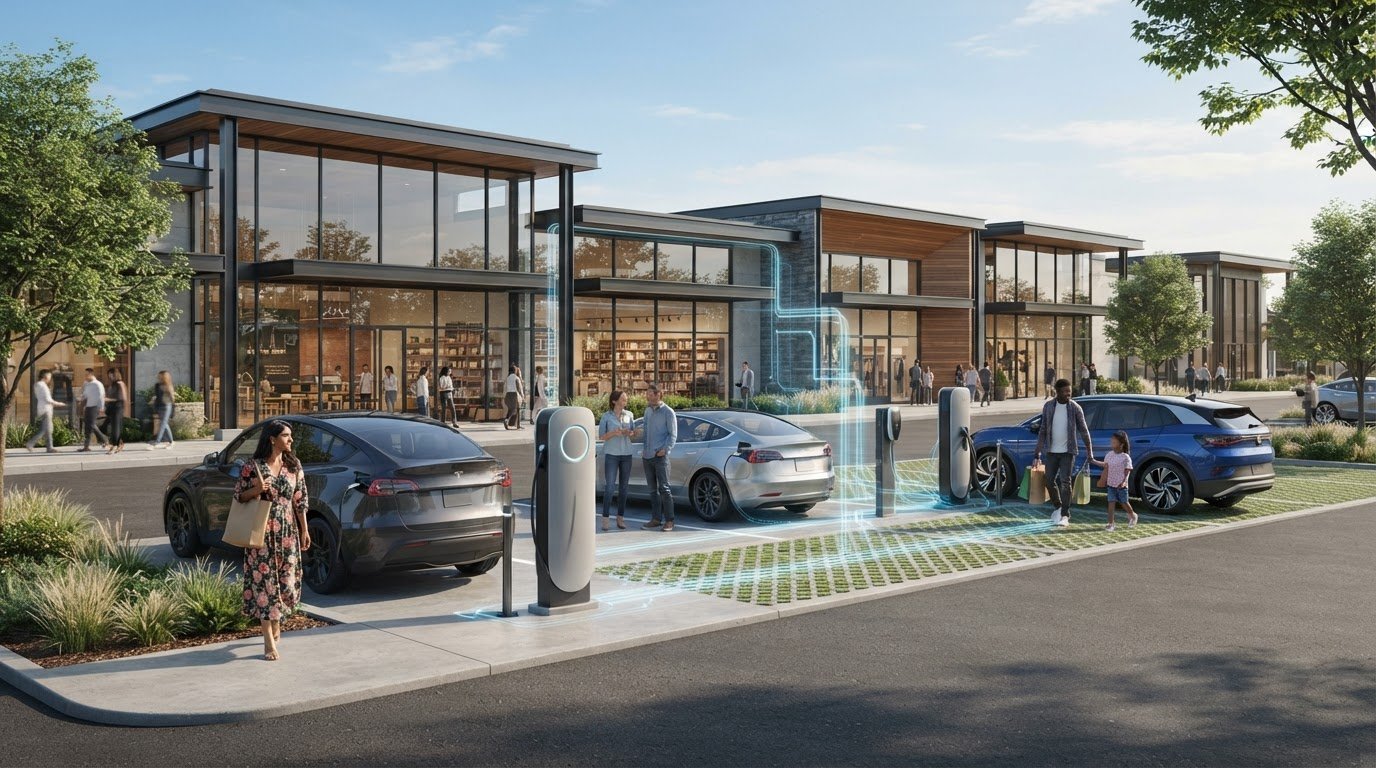
Every commercial parking bay represents unrealised commercial value. Electric vehicle owners represent an affluent, tech-focused demographic actively planning shopping trips around dependable charging access. Installing dedicated customer ev charging for retail directly taps into this behavior. It pulls qualified foot traffic away from non-equipped competitors, keeps shoppers on-site longer, and establishes a direct stream of parking tariff revenue.
Modern drivers rarely make random roadside stops. Instead, they consult digital navigation apps and mapping aggregators before leaving home. Deploying public hardware puts your retail storefront directly onto global navigation systems as an official destination. Rather than settling for a generic third-party host model that claims your margins, owning your charging assets gives you complete operational control over access tariffs, site branding, and customer retention.
The Retail Footprint Advantage: Attracting High-Spending Drivers
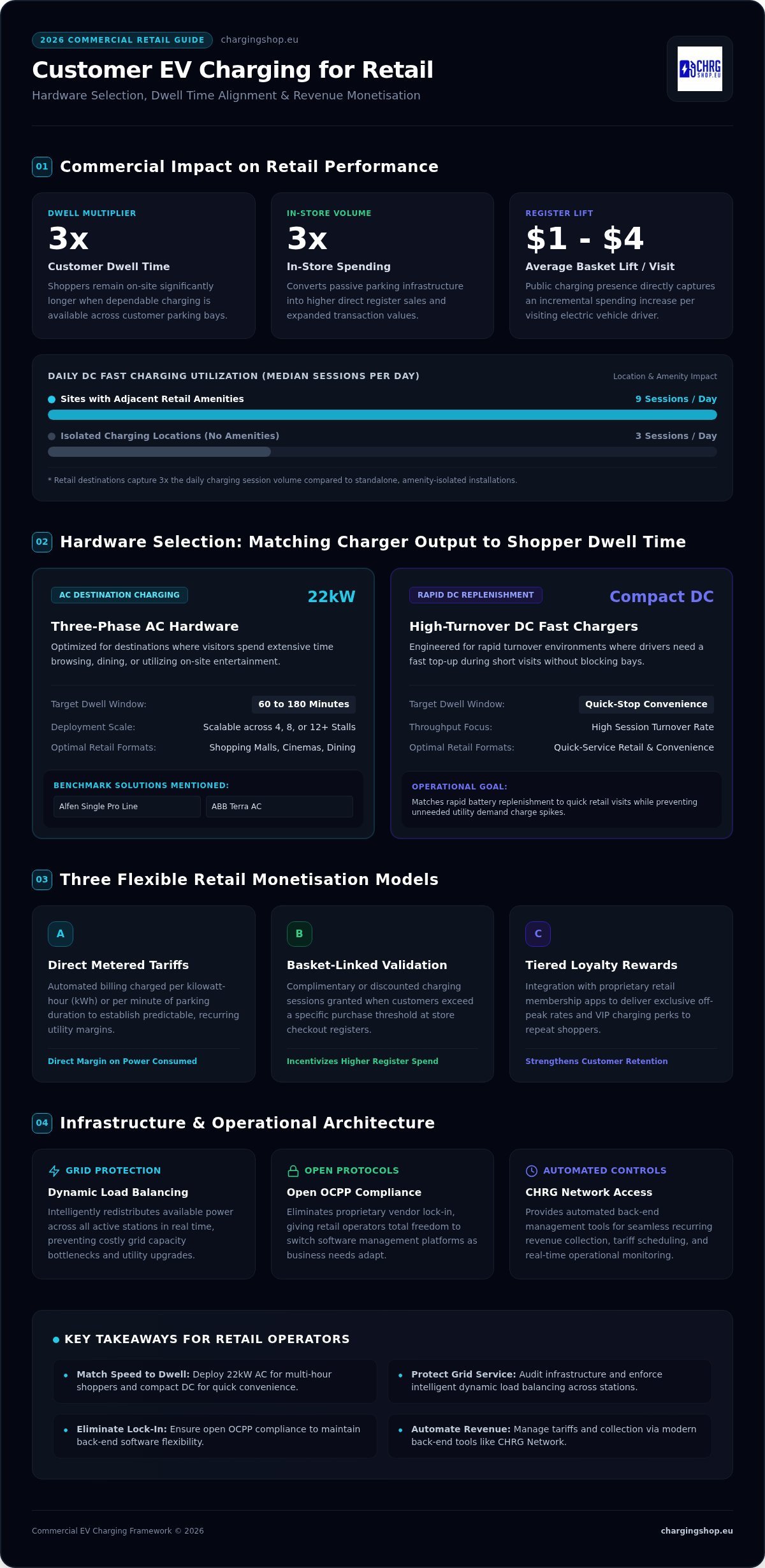
EV owners look for convenient places to top up while running routine errands. When a retail location provides dependable charging, it becomes the default choice for weekly groceries, dining, and lifestyle retail. Studies show that retail locations offering public chargers capture an average basket lift of $1 to $4 per visit. When sites feature adjacent amenities, DC fast charging stations see a median of 9 sessions per day, compared to just 3 daily sessions for isolated locations.
Integrating your site into the wider electric vehicle charging infrastructure turns everyday parking into a high-visibility marketing asset. Shoppers intentionally bypass competing retail plazas to visit stores where they can charge securely while browsing aisles.
Monetisation Models: Direct Revenue vs. Customer Loyalty Perks
Commercial hardware allows you to customise your monetization strategy to fit your exact retail model. You don’t need a single rigid pricing structure; modern platforms let you deploy multi-layered tariffs:
- Direct Metered Tariffs: Bill drivers automatically per kilowatt-hour or per minute of parking duration to generate reliable margins on consumed power.
- Basket-Linked Validation: Provide discounted or complimentary charging sessions to customers who hit a minimum spend threshold at your checkout registers.
- Tiered Loyalty Rewards: Connect charging access directly to your existing retail membership apps, offering exclusive off-peak rates to repeat shoppers.
This flexible approach ensures your equipment pays for itself through direct usage fees while simultaneously boosting in-store sales volume.
Selecting Hardware: AC Destination Chargers vs. Compact DC Fast Chargers
Hardware selection makes or breaks customer ev charging for retail. Choose chargers that are too slow, and quick-stop shoppers leave without a meaningful charge. Install massive highway-grade DC dispensers, and excessive utility demand charges will wipe out your retail margins. The secret lies in matching your charging speed to real-world customer dwell times.
According to the U.S. Department of Energy, public EV charging infrastructure works best when power output reflects how long a visitor plans to stay. Shopping centers and plazas naturally favor AC destination charging, while quick-service retail demands rapid direct-current replenishment. Matching station throughput to actual parking duration keeps utilization high and prevents parked cars from blocking bays long after reaching full capacity.
22KW AC Charging: Ideal for Long-Dwell Retail Destinations
Commercial 22kW three-phase AC chargers thrive where shoppers linger for 60 to 180 minutes. They fit shopping malls, department stores, cinemas, and full-service dining destinations. Because AC hardware is efficient to deploy across multiple parking bays, you can scale to four, eight, or twelve dedicated stalls without overloading your main distribution board.
Two benchmark AC solutions lead this commercial segment:
- Alfen Single Pro Line: Built specifically for high-frequency commercial parking. Read our detailed Alfen Single Pro Line 22kW Review 2026 to see why it serves as the gold standard for public billing precision and smart grid integration.
- ABB Terra AC: Exceptional durability with built-in protections for high-turnover customer bays. Explore the ABB Terra AC 22kW Charger guide to evaluate its retail connectivity and metering capabilities.
Compact 20kW to 40kW DC Charging: Fast Top-Ups for Short-Stay Retail
High-turnover venues like supermarkets, pharmacies, and specialty bakeries require a different approach. Shoppers rarely stay longer than 30 to 45 minutes. Level 2 AC chargers cannot transfer meaningful range in that brief window, often bottlenecked by the vehicle’s onboard converter.
Compact DC wallboxes solve this challenge by supplying direct DC power directly to the vehicle battery. A unit like the V2C DENKA 20kW DC Wallbox delivers rapid, noticeable range during a routine grocery run. Check our 40kW DC Wallbox Guide for Businesses to compare high-turnover architectures. If you want to configure the right hardware mix for your specific square footage, explore tailored commercial packages at chargingshop.eu.
Technical Checklist: Power Management, Metering, and Retail Infrastructure
Deploying customer ev charging for retail demands rigorous electrical planning before mounting a single box. Too many property managers purchase chargers without inspecting their switchboards, only to trigger costly supply upgrades. Successful retail rollouts rely on sourcing commercial-grade hardware directly, then teaming up with certified local electrical contractors who manage civil works and final grid connections.
Work through this practical technical checklist before breaking ground on your parking lot:
- Step 1: Audit Site Capacity: Commission a licensed electrician to evaluate available building load, peak demand cycles, and spare breaker positions.
- Step 2: Deploy Dynamic Load Balancing: Protect main panels from overload without paying for massive utility transformer upgrades.
- Step 3: Specify MID-Certified Meters: Ensure your hardware integrates certified internal metering to bill electricity legally.
- Step 4: Verify Durability Ratings: Demand heavy-duty enclosures rated for outdoor retail environments.
- Step 5: Establish Hardwired or Cellular Data: Equip every charge point with reliable 4G/LTE or Ethernet to keep billing transactions live.
Dynamic Load Balancing: Preventing Breaker Trips During Peak Hours
Commercial facilities experience dramatic energy spikes. When HVAC chillers, bakery ovens, and supermarket refrigeration units run simultaneously on a hot afternoon, available electrical headroom shrinks fast. Dynamic load management continuously monitors main panel consumption in real time.
The system automatically dials back charger output during building consumption peaks, then ramps output back up as store demand falls. Power is shared evenly across all plugged-in vehicles. This prevents tripped main breakers, avoids crippling utility demand surcharges, and eliminates the need for expensive infrastructure overhauls.
Certified Metering and Rugged Hardware for Commercial Public Access
Commercial monetization requires legal precision. Under European regulations, selling electricity directly to retail customers requires Measuring Instruments Directive (MID) certified sub-meters. Stations like the Alfen Single Pro Line come equipped with integrated MID-approved meters, guaranteeing verifiable kilowatt-hour billing data that protects your business during consumer pricing audits.
Retail parking bays endure constant mechanical wear. Public charging stations require IK10 impact ratings to withstand stray shopping carts or accidental vehicle bumps. They also need minimum IP54 ingress protection against driving rain and dust. Choose units featuring heavy-duty universal Type 2 sockets or robust tethered cables built for non-stop customer handling day in and day out.
Software and Payment Gateways: Managing Customer Charging with Open Protocols
Hardware delivers raw power to parking bays, but software dictates whether customer ev charging for retail runs profitably. Locking your business into closed, single-vendor networks restricts how you monetise your parking spaces and leaves you vulnerable to forced subscription increases. Commercial retailers need open software architectures that let them command their own pricing, track site telemetry, and switch network operators whenever necessary.
Driver convenience must remain front and center. Customers expect frictionless access without downloading three different apps just to buy groceries. Modern retail charging setups combine open roaming connectivity with straightforward payment options:
- Direct Contactless Payment: Enables tap-and-go access via credit card, Apple Pay, or Google Pay directly at the pedestal or wallbox.
- Universal RFID Cards: Lets retail subscription holders and fleet visitors initiate sessions instantly.
- Open Roaming Aggregation: Automatically publishes your charging points across major navigation apps and in-dash car mapping systems.
The Critical Value of Open OCPP Compliance
Open Charge Point Protocol (OCPP) is non-negotiable for retail parking. Proprietary networks bind hardware to a single back-end provider. If that vendor hikes monthly subscription costs or shuts down operations, your physical chargers become useless bricks.
OCPP guarantees seamless interoperability across proven commercial hardware manufacturers like Alfen, ABB, and V2C. By insisting on open OCPP-compliant hardware, you protect your capital investment. You retain complete ownership of your physical charging assets, maintaining the freedom to switch management software whenever your retail business demands better terms or new features.
Automated Billing and Remote Management via the CHRG Network
Managing public EV bays should never burden your front-of-house retail staff. Automated back-end software handles driver authentication, live energy tracking, and credit card processing without manual store intervention.
Set dynamic pricing tiers to match your operational strategy. Establish peak-hour rates, offer discounted rates during quiet morning foot-traffic windows, or enforce idle fees to prevent vehicle overstaying. Leverage CHRG Network Access for EV Stations to gain end-to-end station visibility, automate customer payments, and export accounting reports for simple VAT filing. Ready to deploy an independent, revenue-generating charging network across your locations? Review commercial hardware and back-end packages at chargingshop.eu.
Recommended Commercial Hardware Solutions for Retail Sites
Public retail charging demands industrial build quality. Standard residential wallboxes cannot withstand continuous public plug cycles, harsh weather exposure, or heavy everyday handling. Selecting specialized commercial hardware for customer ev charging for retail guarantees operational reliability, precise power metering, and steady daily turnover across your parking spaces.
Rather than signing long-term concession deals that surrender your parking bays to external operators, purchasing your own hardware ensures that revenue flows directly to your business. Here is how leading commercial hardware models match real-world retail applications.
Top Commercial EV Chargers for Retail Parking Lots
Three proven charging stations deliver the uptime, safety, and connectivity required for customer-facing commercial deployments:
- Alfen Single Pro Line 22kW: Purpose-built for multi-bay parking garages and shopping centers. It integrates certified MID metering, a full-color status display, and rugged composite housing designed for high-frequency destination charging.
- ABB Terra AC: Engineered with enterprise-grade electrical safety protections, space-efficient form factor, and versatile connectivity via RFID, Bluetooth, and cellular modems. It excels in shopping plazas requiring scalable, multi-socket installations.
- V2C DENKA 20kW DC Wallbox: Built specifically for high-turnover storefronts like supermarkets and quick-service retail. By supplying direct current straight to the traction battery, it delivers fast, meaningful charging top-ups in under 45 minutes.
Procurement and Deployment: Building Your Retail Charging Infrastructure
Setting up your charging footprint doesn’t have to be complicated. Retain maximum control over your site assets by following a streamlined, three-step procurement playbook:
- Buy Commercial Hardware Directly: Source enterprise-grade charging stations directly from dedicated distributors like Charging Shop to cut out inflated operator markups.
- Contract Certified Local Installers: Partner with licensed local electricians to handle site preparation, trenching, panel breakers, and grid compliance without paying bundled middleman fees.
- Activate Open Management: Connect your chargers to CHRG Network Access to set custom driver tariffs, track session telemetry, and automate your revenue collection from day one.
Every retail site carries unique power limits and parking flow dynamics. Request a Personalised Charging Offer from Charging Shop today to configure the exact hardware package, load management profile, and network setup required for your retail property.
Transform Your Parking Bays into Profitable Retail Assets
Deploying customer ev charging for retail is one of the fastest ways to increase shopper footfall, extend dwell times, and unlock reliable recurring margins. Success comes down to three operational rules: align your charging speeds directly with customer dwell patterns, protect your electrical capacity using dynamic load balancing, and insist on open OCPP compliance to keep full ownership of your physical assets.
Don’t surrender your parking revenue to restrictive operators or inflated third-party middleman contracts. As an official commercial distributor of tier-one hardware from Alfen, ABB, and V2C, Charging Shop delivers direct commercial hardware packages backed by seamless CHRG Network software access. You get complete operational freedom and transparent billing without proprietary vendor lock-in.
Ready to upgrade your commercial parking infrastructure? Request a Personalised Charging Offer for your retail location today and turn your parking spaces into high-performing commercial assets.
Frequently Asked Questions
How does offering customer EV charging benefit a retail business?
Installing customer ev charging for retail boosts in-store dwell times, lifts average shopping basket sizes, and pulls high-income drivers away from competing plazas. Instead of parking at a competitor, EV drivers choose stores where they can recharge while shopping. It also turns standard parking bays into a continuous revenue stream through metered driver tariffs while putting your retail storefront directly on global in-car navigation maps.
Should retail stores install 22kW AC chargers or DC fast chargers?
That depends on your average customer dwell time. Long-stay venues like shopping malls, movie theaters, and department stores where customers linger for one to three hours benefit most from 22kW AC units like the Alfen Single Pro Line or Abb terra ac. Quick-stop retailers like supermarkets and convenience stores see better turnaround with compact direct-current units like the V2C DENKA 20kW DC Wallbox, which delivers meaningful battery replenishment in under 45 minutes.
Can retailers charge customers for the electricity used at parking bays?
Yes, commercial retailers can easily monetize their parking bays by billing drivers per kilowatt-hour, parking minute, or flat session fee. In European markets, you must deploy hardware equipped with certified internal MID meters to ensure legal billing compliance. Connecting your stations to management software like CHRG Network Access lets you set dynamic tariffs, automate driver credit card billing, and offer free or discounted charging validation for loyal customers.
What is dynamic load management and why do retail car parks need it?
Dynamic load management is an intelligent control system that monitors your property’s real-time power draw and balances electricity across active EV chargers. When store lighting, refrigeration, and HVAC systems spike during peak business hours, the system dials back charging output automatically. This protects your main electrical panels from tripping, avoids severe utility demand penalties, and saves you from paying for costly utility grid transformer upgrades.
Why is open OCPP compliance essential for commercial EV chargers?
Open Charge Point Protocol (OCPP) prevents proprietary vendor lock-in. Closed charging networks lock you into their hardware and software bundle, leaving you helpless if they hike monthly subscription fees. Open OCPP compliance ensures your physical charging stations can communicate with any management platform. You retain total operational ownership of your hardware and can switch backend management providers whenever your business strategy or software budget requires a change.
Do retail businesses need to perform on-site electrical installation themselves?
No, retailers shouldn’t attempt self-installation or expect hardware suppliers to do electrical contracting. The best strategy is to purchase commercial-grade hardware directly from specialized distributors like Charging Shop, then contract a certified local electrical installer. Certified local electricians understand regional building codes, execute required trenching and panel connections safely, and conduct the necessary load audits to ensure compliant customer ev charging for retail installations.
How do retail customers pay for charging sessions at commercial wallboxes?
Customers can pay using several frictionless, modern payment methods without mandatory app downloads. Most commercial setups support direct contactless payment via credit card, debit card, Apple Pay, or Google Pay directly at the pedestal. Drivers can also tap universal RFID charge cards linked to roaming networks, or scan a dedicated QR code on the charger enclosure to pay instantly through a mobile browser window.
