
 Deutsch
 Dansk
Dansk Suomi
Suomi Latviešu
 Lietuvių
 Norsk bokmål
 polski
 Русский
 Svenska
No products in the cart.
Uncategorized
3 Phase vs Single Phase EV Charger: The Complete 2026 Power Guide
05
Sep
Sep
Buying the fastest charger available is often the quickest way to overspend without seeing a single second of improvement in your charging time. When comparing a 3 phase vs single phase EV charger, the right choice depends on your property’s grid and your car’s onboard limits, not just the kW rating on the box. It’s easy to feel overwhelmed by technical specs or worry about tripping your main breaker during a peak charge. You want speed. You need reliability. Most importantly, you need compatibility.
We’re here to cut through the noise. This guide simplifies the complex world of AC power so you can choose the right hardware with total confidence. You’ll learn how to match high-performance units like the V2C Trydan 22kW or the Alfen Single Pro Line to your specific vehicle and home capacity. We’ll break down real-world charging speeds, explain the shift toward 22kW standards in 2026, and show you how to future-proof your setup. Get ready to master your power requirements and secure a charging solution that actually delivers. Stop guessing and start charging with technical authority.
Key Takeaways
- Differentiate between standard 7.4kW residential power and industrial-grade 22kW delivery to match your property’s electrical capacity.
- Analyze your vehicle’s onboard charger limits to determine if a 3 phase vs single phase EV charger will actually reduce your charging time.
- Master dynamic load balancing to safely manage high-performance charging alongside other high-draw appliances like heat pumps.
- Identify professional hardware solutions like the V2C Trydan 22kW or Alfen Single Pro Line for multi-EV households and commercial fleets.
- Use the “Miles per Hour of Charge” metric to choose a setup that fits your specific daily commute and overnight charging habits.
The Phase Debate: Why Single Phase vs 3 Phase Matters in 2026
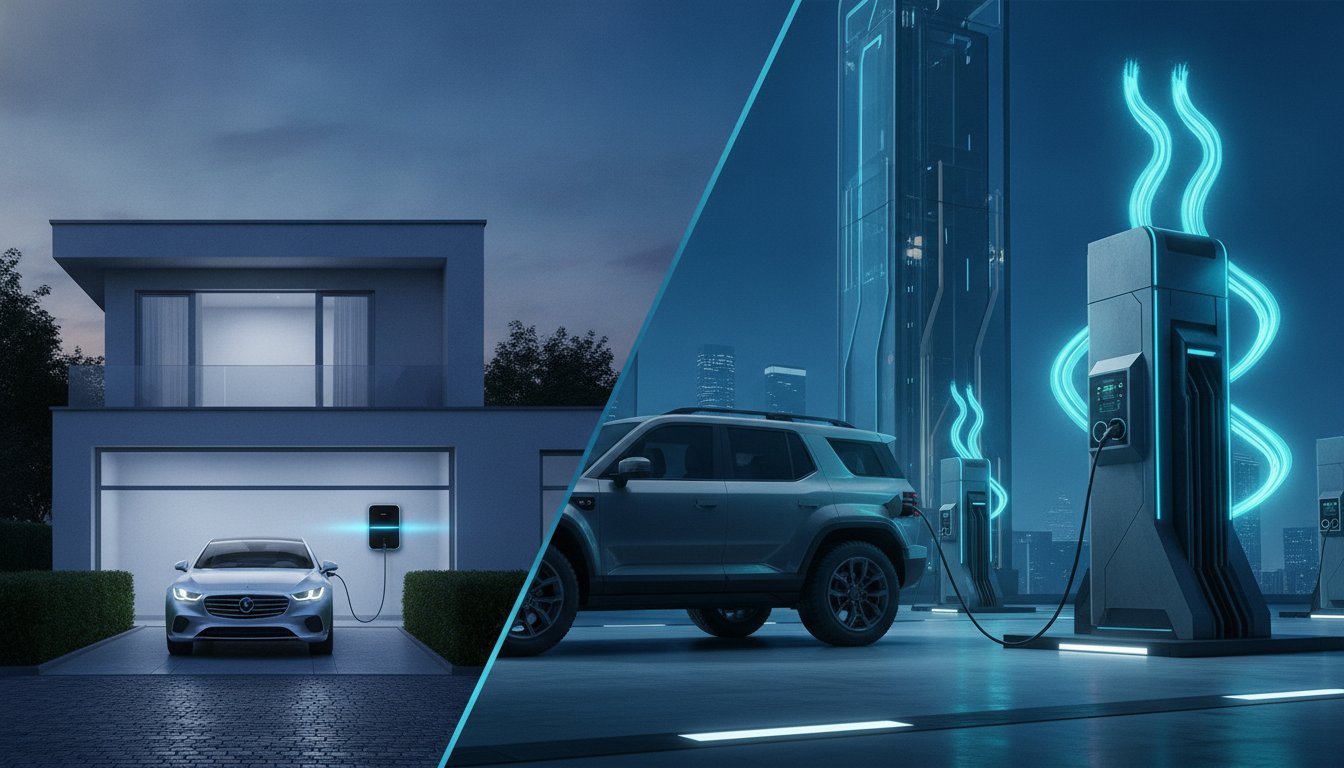
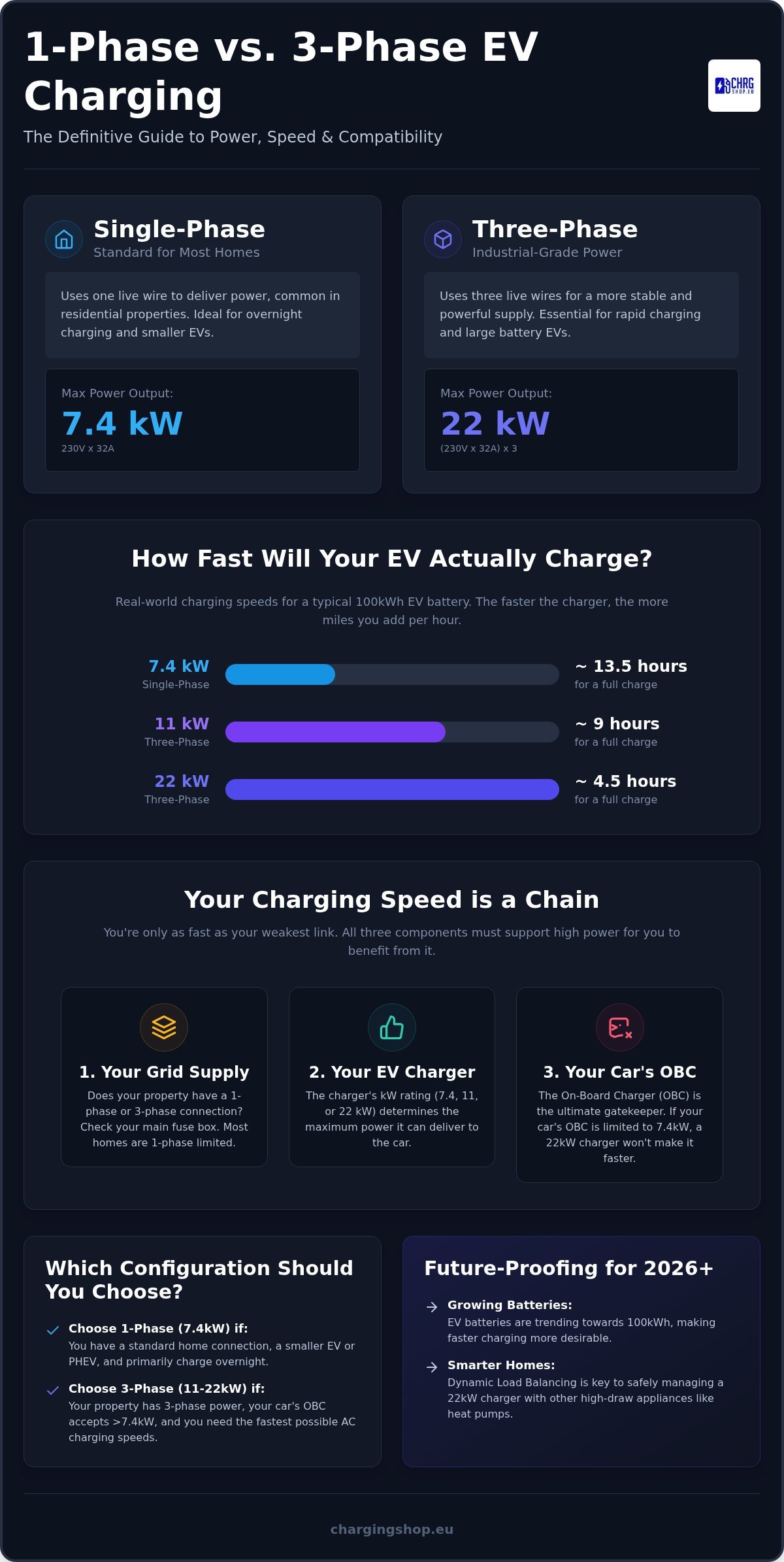
In 2026, the choice between a 3 phase vs single phase EV charger isn’t just about technical specs. It’s about your time. Single-phase power is the standard for most residential properties, delivering up to 7.4kW. It’s reliable and handles overnight charging for small to mid-sized EVs perfectly. 3-phase power is the heavy hitter. Delivering 11kW to 22kW, it’s built for speed and high-capacity batteries. This is the industrial-grade solution brought home.
You’re balancing charging velocity against infrastructure upgrades. As EV batteries grow toward 100kWh in 2026, a standard single-phase unit might leave you waiting 14 hours for a full charge. That’s unacceptable for high-mileage drivers. 3-phase setups solve this by spreading the load across three wires instead of one, allowing for a massive increase in power delivery without overheating your home’s internal wiring.
How Your Grid Connection Dictates Your Options
Look at your fuse box. A single-phase supply has one main fuse. A three-phase supply has three. Your main fuse acts as a hard ceiling for your power consumption. In most UK homes, a 60A to 100A main fuse is the norm, often capping you at single-phase speeds unless you pay for a costly grid upgrade. European properties often have 3-phase access as standard, making a 22kW Alfen Single Pro Line a seamless addition. Always check your local EV charging standards to ensure your grid can handle the load without tripping the main breaker during peak hours.
The Onboard Charger (OBC) Bottleneck
Don’t buy power you can’t use. Your car’s Onboard Charger (OBC) is the ultimate gatekeeper. If your vehicle only supports a 7.4kW intake, installing a 22kW V2C Trydan won’t make it charge faster. It’s like trying to fill a narrow bottle with a firehose. Many 2026 models, including high-end SUVs and performance sedans from brands like Tesla, Audi, and Porsche, now feature 11kW or 22kW OBCs as standard. Check your vehicle’s technical sheet before investing. A 22kW 3 phase vs single phase EV charger comparison only matters if your car can actually digest the extra current. Future-proof your setup only when the hardware matches your vehicle’s ambition.
Technical Breakdown: Amps, Volts, and Power Delivery
Power delivery is a simple calculation of voltage multiplied by current. In the 3 phase vs single phase EV charger debate, understanding these numbers prevents you from buying redundant hardware. Most residential grids operate at 230V. When you pull 32A through a single wire, you hit the 7.36kW limit. This is the ceiling for single-phase charging. It works, but it’s the electrical equivalent of pushing a high volume of water through a single narrow pipe.
Three-phase systems change the math by using three conductors. Here is how the power breaks down:
- Single Phase: 230V x 32A = 7.36kW (The standard home limit)
- 3 Phase (11kW): 230V x 16A x 3 phases = 11.04kW (Balanced and efficient)
- 3 Phase (22kW): 230V x 32A x 3 phases = 22.08kW (Maximum AC speed)
Charging with three phases is technically “cooler.” By spreading the electrical load across three wires, the system reduces resistance and heat buildup. Lower heat translates to better efficiency and less stress on your vehicle’s internal components during long sessions.
Single Phase Efficiency and Limitations
Pulling a full 32A on a single phase can create “phase unbalance” on your local grid. This heavy draw on one line while others remain idle can lead to voltage drops. You might notice lights flickering or minor performance issues with other high-draw appliances when your car is at peak intake. Single-phase charging serves as the baseline for 2026 residential use. It’s cost-effective for installation, but it lacks the sophisticated load distribution found in industrial-grade setups.
3-Phase Power: The Industrial Advantage
The real magic of 3-phase power is delivering more energy at lower amperage per wire. An 11kW charge only requires 16A per phase. This significantly reduces the thermal load on your home’s wiring compared to a 32A single-phase draw. If you’re looking at a 22kW wallbox for home, 3-phase is a mandatory requirement. However, keep the 2026 hardware gap in mind. Many modern EVs are still capped at 11kW intake. Buying a 22kW charger ensures you’re ready for future battery tech, even if your current car can’t use every amp. To find the right match for your current vehicle, explore our high-performance hardware and compare the specs directly. Choose a system that balances your current needs with the inevitable shift toward larger batteries.
Speed Comparison: How Fast Will Your EV Actually Charge?
Power ratings are just abstract numbers until you see them reflected in minutes and hours. When choosing a 3 phase vs single phase EV charger, your daily mileage and battery size are the only metrics that matter. A standard 75kWh battery, common in mid-range 2026 EVs, takes roughly 10 hours to reach a full charge on a 7.4kW single-phase unit. This is the “overnight” reality for most drivers. If you’re running a high-capacity 100kWh+ pack in a luxury SUV or commercial van, that wait time stretches toward 14 hours, which can leave you stranded if you have a busy morning.
Think in “Miles per Hour of Charge” to simplify your decision. A 7.4kW charger adds approximately 25 miles of range for every hour it’s plugged in. For an average 30-mile commute, that’s barely 75 minutes of work. However, if you’re a high-mileage driver covering 150 miles daily, you need the faster recovery times offered by 3-phase hardware. Keep in mind that external factors like ambient temperature and your current State of Charge (SoC) will impact these speeds. Batteries charge slower in freezing conditions and always “taper” their intake once they hit 80% to protect long-term cell health.
Single Phase (7.4kW) Performance
Single-phase charging is the workhorse of residential setups. It’s perfectly adequate for standard sedans and daily urban driving. You’ll get a reliable top-up while you sleep. The limitation appears when you deal with long-range 80kWh+ packs. Expect a 10 to 12-hour window for a full recovery from near-zero. It’s a “set and forget” solution that works well for 90% of current users but lacks the punch needed for rapid turnaround times.
3-Phase (11kW & 22kW) Performance
The 11kW configuration has become the modern “sweet spot” for 2026 hardware. An 11kW 3-phase connection delivers charge approximately 50% faster than a standard single-phase outlet, making it the ideal upgrade for modern households. Professional units like the Alfen Single Pro Line 22kW provide the flexibility to hit 11kW for most cars or the full 22kW for compatible high-performance models. With a 22kW setup, a full 0% to 100% cycle on a 75kWh battery can drop to just over 3 hours. This is the gold standard for multi-EV homes or business fleets that can’t afford to let vehicles sit idle for half a day. Stop waiting and start moving.
Smart Phase Management and Dynamic Load Balancing
In 2026, raw power isn’t enough. You need intelligence. Dynamic load balancing (DLB) is the critical technology that prevents your home from going dark when your EV, heat pump, and induction oven all demand power at once. When comparing a 3 phase vs single phase EV charger, the complexity of management changes significantly. A single-phase setup simply throttles the total current. A 3-phase system requires sophisticated phase rotation to ensure one wire isn’t overloaded while the others sit idle. This prevents “phase unbalance,” a common issue where one line hits its limit while the others have capacity to spare.
Smart management allows your charger to communicate with your home’s main meter in real-time. If your appliances demand more current, the charger instantly scales back. This is especially vital for solar owners. Modern 3-phase inverters produce energy across all three lines. A smart charger can redirect this surplus directly into your car’s battery. It ensures you use 100% of your generated green energy instead of exporting it. This level of control turns your EV into a strategic energy asset rather than just another appliance on the grid.
V2C Trydan: The Master of Dynamic Power
The V2C Trydan 22kW is engineered for these high-stakes scenarios. It constantly monitors your home’s total consumption through an integrated clamp or smart meter connection. If your power draw approaches the main fuse limit, the Trydan automatically adjusts its charging current in milliseconds. You don’t have to worry about grid failure or manual intervention. Use the V2C app to set priorities. You can schedule charging for low-tariff 3-phase windows, ensuring you get the fastest speeds at the lowest costs without ever risking a blackout.
Commercial Scaling with 3-Phase Networks
For businesses, the stakes are even higher. Managing a fleet requires CHRG Network access for EV stations. This platform allows you to distribute available power across dozens of 3-phase chargers simultaneously. By utilizing Open Charge Point Protocol (OCPP), you get remote phase monitoring and real-time load shedding. This prevents expensive peak-demand charges from your utility provider. If you’re ready to upgrade your infrastructure, buy professional 3-phase hardware now to secure your facility’s energy future. Efficient power management isn’t a luxury. It’s an operational necessity for the 2026 electric economy.
Final Verdict: Which Configuration Should You Buy?
Your choice between a 3 phase vs single phase EV charger boils down to a calculation of your vehicle’s intake capacity and your daily mileage. Stick with a single-phase setup if you charge a standard sedan overnight and your local grid upgrade costs are high. It’s the logical, cost-effective path for batteries under 60kWh. However, if you’re managing a multi-EV household or a 2026-spec SUV with a 100kWh+ pack, 3-phase power is a necessity. Business fleets see the most immediate ROI here. Faster turnaround times translate directly to higher vehicle uptime and reduced operational bottlenecks.
Think about future-proofing before you sign off on any installation. Even if your current car is limited to a 7.4kW intake, installing 3-phase cabling now saves you significant money later. Trenching and electrical labor are the primary costs of any setup. Doing this work twice costs thousands more than doing it right the first time. Consulting dedicated specialists like EVxpert can help you assess your switchboard capacity and get your hardware installed correctly the first time. Prepare your property for the high-capacity batteries that will be standard by the end of the decade. A 3-phase foundation ensures you’re ready for the next generation of performance EVs without another round of construction.
Best Single Phase Solutions
Standard residential driveways require plug-and-play reliability and ease of use. The ABB Terra AC 22kW charger is a strategic pick for this scenario. While it’s a high-performance 22kW unit, it can be easily down-rated to single-phase during installation. This gives you professional-grade hardware that adapts to your current grid while remaining ready for a future power upgrade. It’s durable, smart, and handles the basics with industrial precision.
Premium 3-Phase Hardware Picks
High-performance users need intelligence alongside raw power. The V2C Trydan stands out as the best all-rounder for 3-phase smart homes. Its ability to integrate with solar arrays and manage dynamic loads makes it the tech-savvy choice for 2026. For commercial-grade environments where reliability is the only metric that matters, the Alfen Single Pro Line is the benchmark. It’s built to withstand constant use and integrates seamlessly with fleet management software. Don’t settle for slow recovery times. Browse our full collection of 22kW 3-phase wallboxes and secure your high-speed charging solution today.
Secure Your High-Performance Power Strategy
Choosing between a 3 phase vs single phase EV charger is the difference between waiting half a day and being ready in three hours. You now understand that your vehicle’s onboard charger and your home’s grid capacity are the ultimate gatekeepers of speed. Don’t let outdated infrastructure throttle your 2026 driving experience. By installing 3-phase hardware today, you eliminate future bottlenecks and gain the intelligence of dynamic load balancing.
As an authorized V2C and Alfen distributor, we provide the industrial-grade tools you need to stay ahead. We offer global shipping on all AC and DC wallboxes, ensuring you get premium hardware regardless of your location. Manage your infrastructure with ease using OCPP cloud management via the CHRG Network. It’s time to stop compromising on charging velocity.
Upgrade your charging speed today; shop our premium 3-phase wallboxes and take total control of your energy future. Your next journey starts with the right power setup.
Frequently Asked Questions
Can I use a 3-phase EV charger on a single-phase home supply?
Yes, you can. Most high-end 3-phase units, such as the ABB Terra AC, allow for single-phase installation. You won’t achieve 22kW speeds; you’ll be limited to a standard 7.4kW output. This is a smart strategy for future-proofing your home. It ensures that if you ever upgrade your grid connection later, your hardware is already capable of handling the increased power delivery without a full replacement.
Is 3-phase charging better for my car’s battery health?
3-phase charging is technically superior for thermal management. By spreading the electrical load across three phases, the system operates at a lower amperage per wire compared to a high-current single-phase draw. This results in less heat buildup in your home’s wiring and the car’s internal components. While it doesn’t directly extend battery life, reducing thermal stress during long charging sessions is always a technical advantage for long-term reliability.
How much does it typically cost to upgrade from single to 3-phase?
Costs vary significantly based on your distance from the local substation and current infrastructure. In the UK, a domestic upgrade typically ranges from £3,000 to £15,000. You must contact your Distribution Network Operator (DNO) for a formal quote. We provide the high-performance hardware like the V2C Trydan, but the grid upgrade itself is a utility service. Plan for this expense early to avoid surprises during your installation phase.
Do all electric cars support 22kW 3-phase charging?
No, they don’t. Many vehicles are limited to an intake of 7.4kW or 11kW. Even if you install a high-performance 3 phase vs single phase EV charger, your car’s Onboard Charger (OBC) dictates the final speed. High-end 2026 models often feature 11kW as standard, but only a select few handle the full 22kW. Always verify your vehicle’s technical specifications before purchasing hardware to ensure you aren’t buying redundant power capacity.
What happens if I plug a single-phase car into a 3-phase charger?
Your car will charge safely but only at its maximum single-phase rate. The charger and vehicle communicate to negotiate the highest safe current available. If your car only has a single-phase OBC, it will simply ignore the extra two phases provided by the wallbox. You won’t damage the vehicle’s electrical system, but you also won’t see any of the speed benefits associated with the 3-phase infrastructure you’ve installed at your property.
Is a 3-phase charger required for solar EV charging?
It isn’t strictly required, but it’s highly recommended if you have a 3-phase solar inverter. A 3-phase charger like the V2C Trydan can capture surplus energy across all three lines simultaneously. This prevents you from exporting green energy to the grid while your car sits idle. It’s the most efficient way to maximize your self-consumption and lower your total energy costs by keeping your solar power inside your own battery.
Can I charge two cars at once on a single-phase connection?
You can, but you’ll need dynamic load balancing to prevent tripping your main fuse. Since a single-phase supply is capped at 7.4kW, two cars would share that power, charging at roughly 3.7kW each. For multi-EV households, upgrading to a 3 phase vs single phase EV charger is the better move. It allows both vehicles to charge at their maximum rates simultaneously without overwhelming your home’s electrical capacity or slowing down your morning.
Why is my 22kW charger only charging my car at 11kW?
This is almost always due to the vehicle’s Onboard Charger (OBC) limit. Most modern EVs are capped at 11kW for AC charging to balance manufacturing cost and vehicle weight. Even with a 22kW Alfen Single Pro Line, the car will only draw what its internal converter can handle. Check your car’s infotainment settings and technical manual to confirm its maximum AC intake rate. Your charger is ready for more; your car is the bottleneck.
