
 Deutsch
 Dansk
Dansk Suomi
Suomi Latviešu
 Lietuvių
 Norsk bokmål
 polski
 Русский
 Svenska
No products in the cart.
Uncategorized
UL Certified EV Charger for Home: The Ultimate 2026 Safety Checklist
14
Aug
Aug
Why Safety Certification is Non-Negotiable for Home Charging
Plugging your electric vehicle in at home is a high-stakes electrical event. You’re pulling a massive amount of power—far more than any other appliance—for hours at a time. This sustained, high-voltage process generates significant heat. Without rigorous safety standards, it’s a recipe for disaster.
This is where certification becomes your non-negotiable insurance policy. For hardware sold in Europe, the mandatory safety standard is the CE mark. It’s the legal confirmation that a product meets the EU’s stringent health, safety, and environmental protection requirements. Buying an uncertified “gray market” charger is a gamble with your car, your home, and your family’s safety.
- Heat is the Enemy: High-voltage charging generates constant heat. Certified chargers are built with materials and thermal monitoring systems designed to manage this heat safely over thousands of hours.
- Protection Against Catastrophe: Uncertified chargers often lack robust protection against thermal runaway, short circuits, and power surges, creating a severe fire risk.
- Insurance Compliance is Critical: In the event of a fire, insurance companies will investigate the cause. If the fire is traced back to uncertified, non-compliant electrical equipment, your claim could be denied, leaving you with catastrophic financial losses.
- Built to Last: Certification isn’t just about the electronics. It ensures every component, from internal relays to the charging cable itself, meets strict durability and quality standards for long-term, reliable use.
The Real Risks of Uncertified EV Chargers
The dangers of a cheap, unlisted charger go far beyond a simple malfunction. The risks are severe and immediate:
- Component Failure & Fire: Low-quality internal parts can fail under sustained load, leading to electrical arcing. This creates intense, localized heat that can easily ignite the charger’s plastic housing and spread.
- Electromagnetic Interference: Poorly shielded electronics in uncertified units can emit significant electromagnetic noise, disrupting your home’s Wi-Fi, radio, and other sensitive devices.
- Electric Shock Hazard: Inadequate grounding and the absence of required safety interlocks, like proper residual current detection, create a real risk of life-threatening electric shock when handling the plug or cable.
Insurance and Liability: Protecting Your Property
Your homeowner’s insurance policy isn’t just a document; it’s a contract based on the assumption that your property adheres to local safety regulations. Introducing a non-compliant, uncertified piece of high-voltage equipment can void that contract.
- Policy Requirements: Most European insurance policies implicitly or explicitly require that all permanently installed electrical appliances are CE-marked and installed according to local codes.
- The Aftermath of a Fire: A fire investigation will pinpoint the origin. If an uncertified EV charger is found to be the cause, your insurer has grounds to deny your claim entirely, holding you financially liable for all damages.
- Professional Refusal: Reputable electricians will refuse to install uncertified hardware. They are legally and professionally liable for the work they do. Installing a non-compliant device puts their license and business at risk—a clear signal you shouldn’t be using it.
Decoding Charger Safety Marks: From UL to CE
You may have seen “UL Certified” mentioned frequently online, especially on US-based websites. UL (Underwriters Laboratories) is the gold standard for safety in North America. However, for a charger to be legally and safely used in Europe, it must carry the CE mark.
The CE mark signifies conformity with European standards. It’s not just a sticker; it’s a declaration by the manufacturer that the product meets all relevant EU directives. For EV chargers, this primarily involves compliance with the IEC 61851 standard.
- IEC 61851: The European EVSE Standard: This is the core technical standard for Electric Vehicle Supply Equipment (EVSE) in Europe. It defines the electrical safety requirements, communication protocols between the car and the charger, and connector specifications.
- Continuous Compliance: Reputable manufacturers conduct ongoing quality control and testing to ensure every unit produced meets the standards declared by the CE mark.
- Built for European Grids: CE-marked chargers are designed and tested for the European electrical environment (e.g., 230V/400V at 50Hz), ensuring safe and stable operation.
* Third-Party vs. Self-Certification: While UL is a third-party certification (meaning an independent lab tests the product), CE is a self-declaration. However, this declaration must be backed by a comprehensive technical file containing test reports and design documents proving compliance with standards like IEC 61851.
The IEC 61851 Standard Explained
When you see the CE mark on an EV charger, it confirms adherence to critical safety functions defined by IEC 61851, including:
- Control Pilot Signal: A constant communication link between the charger and the vehicle that verifies a safe connection, determines the maximum charging current, and starts/stops the flow of power. The power will not flow until this “digital handshake” is complete.
- Residual Current Detection (RCD): This is arguably the most critical shock prevention feature. The standard requires protection against both AC and DC electrical faults. This is typically achieved with a Type B RCD or a Type A RCD combined with 6mA DC leakage detection, which shuts off power instantly if a dangerous fault is detected.
- Cable and Connector Integrity: The standard mandates specific requirements for cable durability, strain relief, and impact resistance for the Type 2 connector, the universal standard across Europe.
Thermal Management and Fire Prevention
A key part of CE compliance is proving the charger can handle heat safely. This goes beyond simple ventilation.
- Internal Temperature Monitoring: Certified chargers contain multiple sensors that constantly monitor the temperature of critical components. If temperatures exceed safe limits, the charger will automatically reduce power or shut down completely to prevent overheating.
- Flame-Retardant Materials: The charger’s housing must be made from materials with a specific flame-retardant rating (e.g., UL94-V0), ensuring that if an internal component does fail and ignite, the fire will not spread outside the enclosure.
- High-Quality Contactors: The contactor is the heavy-duty internal switch that controls the flow of power. Certified chargers use industrial-grade contactors designed to prevent “weld-shut” failures, where the switch gets stuck in the “on” position—a dangerous fault found in cheap, unlisted units.
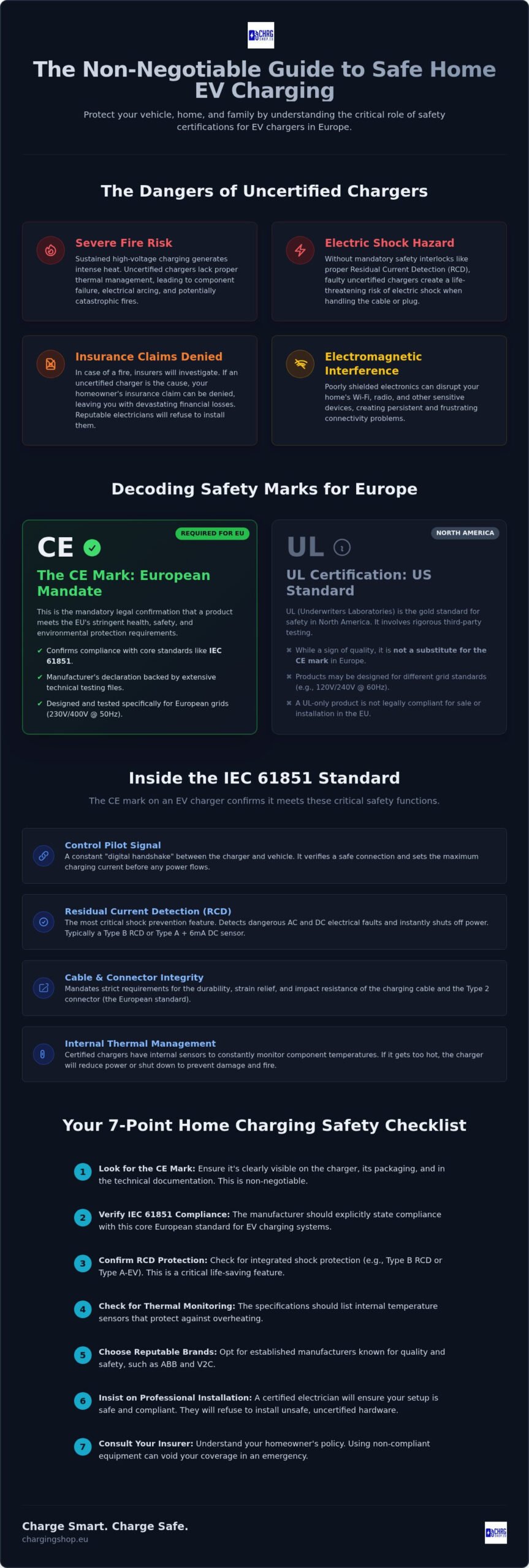
UL vs. CE: Understanding Global Safety Standards for Europe
Navigating safety standards can be confusing, especially with products sold globally. Let’s clarify the key differences and what matters for you in Europe.
The single most important rule is this: If you live in the EU or UK, your charger must have a CE mark. A UL mark from the US is not a substitute and does not provide legal compliance for a European installation.
| Standard | Region | Testing Model | What it Means for You |
|---|---|---|---|
| CE (Conformité Européenne) | European Union / EEA / UK | Manufacturer’s Self-Declaration | Mandatory for Europe. Confirms the product meets all legal EU safety, health, and environmental standards (like IEC 61851). Your absolute must-have. |
| UL (Underwriters Laboratories) | North America (primarily USA) | Third-Party Testing & Certification | The gold standard in the US. Indicates rigorous independent testing. Not a valid compliance mark for Europe. |
| ETL (Intertek) | North America (primarily USA) | Third-Party Testing & Certification | A direct competitor to UL in the US. Tests to the same standards (UL 2594). Like UL, it is not a valid compliance mark for Europe. |
Can I Use a UL-Certified Charger in Europe?
No, not unless it also carries the CE mark. The electrical grids, regulations, and even plug types are different. A charger designed only for the North American market will not be compliant with European electrical codes. Using one is unsafe, illegal for a permanent installation, and will likely void your insurance.
Navigating European Standards for Global Hardware
Top-tier global brands understand this complexity. Companies like ABB design their hardware from the ground up to meet multiple international standards. An ABB Terra AC sold in Europe is fully CE-marked and compliant with all relevant IEC standards. The same product family sold in the US will be UL-listed.
- Global Engineering, Local Compliance: Brands like ABB and V2C invest heavily in engineering their products to meet the world’s most stringent safety requirements, including IEC 61851 for Europe.
- The Power of the Technical File: While CE is a self-declaration, reputable manufacturers back it up with a massive technical file containing hundreds of pages of test data from accredited labs, proving their compliance. This is your assurance of safety.
- Multiple Certifications = Maximum Reliability: When a global brand pursues multiple certifications (like CE, UL, etc.) for different regions, it demonstrates a deep commitment to safety and quality engineering that benefits all customers.
The 7-Point Checklist for a Safe European Home EV Charging Station
Use this checklist to cut through the marketing noise and verify that your chosen charger is genuinely safe and compliant for your home in Europe.
- Verify the CE Mark. This is non-negotiable. The CE logo must be physically present on the charger’s rating plate. Go one step further: ask the seller for the product’s EU Declaration of Conformity. Any legitimate retailer, like Charging Shop, can provide this.
- Check the IP Rating for Your Location. The Ingress Protection (IP) rating tells you how well the charger is sealed against dust and water. For an indoor garage, IP44 is sufficient. For outdoor installation exposed to rain, demand IP54 or higher.
- Confirm Integrated RCD / DC Leakage Protection. To prevent electric shock, your charger must have internal safety devices to detect faults. Look for confirmation of either an integrated Type B RCD or a Type A RCD with 6mA DC leakage detection. This saves you money on installing an expensive external device.
- Demand a High-Quality Type 2 Cable and Connector. The cable is a high-wear component. Ensure it’s from a reputable manufacturer and feels robust. The connector should be ergonomic and made from durable, industrial-grade materials.
- Ensure It Has Dynamic Load Management. This is a critical software safety feature. Dynamic load management monitors your home’s total electricity usage in real-time and automatically adjusts the charging speed to prevent overloading your main breaker.
- Look for Over-the-Air (OTA) Firmware Updates. A smart charger’s safety and functionality can be improved over time. OTA updates allow the manufacturer to patch security vulnerabilities and deploy new safety features, keeping your charger secure and up-to-date.
- Insist on Professional Installation. A home EV charger is not a DIY project. It’s a permanent addition to your home’s electrical system. Hire a qualified, certified electrician to ensure it is installed safely and in compliance with all local wiring regulations.
Premium Certified Hardware: Why ABB and V2C Lead the Market
When safety is your top priority, investing in a premium, certified brand is the only logical choice. Industry leaders like ABB and V2C don’t treat safety standards as a box to be ticked; they treat them as the foundation of their engineering.
- Decades of Expertise: These brands build their reputation on industrial-grade safety and reliability, bringing that expertise to your home garage.
- Full European Compliance: V2C Trydan and ABB Terra AC are fully CE-marked and engineered specifically for European homes, ensuring seamless safety and compatibility.
- Advanced Safety Features Standard: Features like integrated DC leakage protection, dynamic load management, and robust thermal monitoring are built-in, not optional extras.
- Long-Term Value: Investing in premium hardware from an authorized retailer like Charging Shop reduces your long-term risk and provides peace of mind that your charger will perform safely for years to come.
ABB Terra AC: The Global Safety Benchmark
ABB is a world leader in electrification technology. Their Terra AC wallbox is a testament to this legacy, offering a combination of robust safety features and smart connectivity that few can match.
- Built by an Industrial Giant: With over a century of experience in electrical safety, ABB’s engineering and quality control are second to none.
- Comprehensive Protection as Standard: The Terra AC comes with fully integrated overcurrent, overvoltage, undervoltage, ground fault, and surge protection, plus integrated DC leakage supervision.
- Proven Reliability: This charger is trusted by businesses and homeowners globally for its rock-solid performance. For a detailed look, see our ABB Terra AC vs Alfen Single Pro Line comparison.
V2C Trydan: Smart Safety for Solar Homes
V2C is a Spanish innovator renowned for its market-leading smart charging technology. The V2C Trydan is engineered for maximum safety and efficiency, especially in homes with solar panels.
- Unmatched Dynamic Power Management: V2C’s load balancing is the best in the business, seamlessly integrating with your home’s grid and solar production to charge safely and cost-effectively without ever tripping your breaker.
- Premium European Engineering: The Trydan is designed and built in Europe to the highest quality standards, with full CE compliance and a focus on long-term durability.
- Smart Protection: Its advanced software not only manages power but also protects your home grid and your vehicle’s battery from electrical instability.
Frequently Asked Questions (FAQ)
- Is CE marking required by law for home EV chargers in Europe?
- Yes, absolutely. Any EV charger sold or installed in the European Union must be CE-marked. It is a legal requirement and confirms the product complies with EU safety regulations.
- Can I use a UL-certified charger from the US if it has a plug adapter?
- No. A plug adapter does not change the charger’s internal electronics, which are designed for the US grid (120/240V, 60Hz). Using it on a European grid (230V, 50Hz) is unsafe, non-compliant, and will void your insurance.
- How do I check if my EV charger is actually CE compliant?
- Look for the CE logo on the product’s data plate. For absolute certainty, ask the retailer for a copy of the EU Declaration of Conformity. A reputable seller will provide this document without hesitation.
- What happens if my home insurance finds an uncertified charger after a fire?
- Your insurance company will likely deny your claim. Home insurance policies require that all electrical installations comply with local laws and safety standards. Using non-compliant hardware can be considered negligence, making you financially responsible for all damages.
- Does a CE-marked charger charge my car faster?
- No. The CE mark is a declaration of safety and compliance, not performance. Charging speed is determined by the charger’s power output (in kW), your home’s electrical supply, and your vehicle’s maximum charging rate.
- Are all chargers sold on major marketplaces like Amazon CE-marked?
- No, and this is a major risk. Marketplaces are filled with third-party sellers offering cheap, uncertified chargers that are not legally compliant or safe for use in Europe. Always buy from a specialized, reputable retailer like Charging Shop that can verify the certification of its products.
- What is the difference between an IP44 and IP54 rating?
- The first digit relates to dust protection, and the second to water protection. IP44 is protected against solid objects over 1mm and water splashes from any direction. IP54 offers the same dust protection but is protected against water jets from any direction, making it more suitable for outdoor locations exposed to driving rain.
- Do portable EV chargers need CE certification too?
- Yes. Any electrical product sold in the EU, including portable chargers (Mode 2 chargers), must be CE-marked to be considered safe and legal for use. This safety standard is equally vital for smaller electric mobility devices; for example, VoltRides focuses on providing certified electric bikes and scooters that adhere to these strict safety expectations.
