
 Deutsch
 Dansk
Dansk Suomi
Suomi Latviešu
 Lietuvių
 Norsk bokmål
 polski
 Русский
 Svenska
No products in the cart.
Uncategorized
3-Phase EV Charging Station: How It Works and How to Choose
30
Sep
Sep
What if a higher-powered charger still charges your EV at the same speed? A 3 phase ev charging station can deliver more AC power than a single-phase setup, but only when your vehicle and electrical supply can use it. The station’s rating alone does not determine how quickly your battery fills.
If phases, amperage, and kilowatts feel like a confusing mix, focus on three limits: your vehicle’s onboard AC charger, the power available at your property, and the station’s configuration. The lowest of these sets the maximum potential charging rate. Checking all three before you compare products helps you avoid choosing a station whose headline rating your setup cannot use.
This guide explains how three-phase and single-phase AC charging differ, what affects charging speed, and how to check whether your property can support a three-phase unit. You’ll also learn what to confirm in vehicle and charger specifications, and what to ask a qualified installer to assess. With those details in hand, you can choose equipment that fits your needs without assuming an electrical upgrade is required.
Key Takeaways
- A 3 phase ev charging station uses three-phase AC supply, but that alone does not guarantee faster charging.
- Compare your vehicle’s maximum AC charging rate with the power available at your property to understand likely charging performance.
- Check your vehicle specifications, electrical supply, and station requirements before choosing equipment.
- Ask a qualified installer to assess your property and determine whether its electrical setup can support your preferred charger.
- Compare exact product configurations, then match connectivity and management features to the way you plan to use the station.
What Is a 3-Phase EV Charging Station, and What Does It Change?
A 3 phase ev charging station is AC charging equipment connected to an electrical supply with three phases. This describes how power reaches the station, not how fast every vehicle will charge. To make use of three-phase power, the vehicle’s onboard charger must support it, the property must have a suitable supply, and the station must be configured for the electrical system.
Single-phase AC charging draws power through one phase; three-phase charging uses three. Neither option is automatically right for every driver. Your vehicle’s capabilities and the supply available at your site determine whether three-phase charging offers a practical advantage.
How does three-phase power differ from single-phase power?
Think of single-phase power as one lane carrying traffic and three-phase power as three coordinated lanes. The comparison helps explain how three phases can carry more AC power when the vehicle and installation support them. Actual performance depends on voltage, current, wiring, and equipment ratings, not on the analogy. For the underlying principles, see this overview of three-phase electric power.
Charging power is measured in kilowatts (kW), while energy delivered over time is measured in kilowatt-hours (kWh). In practical terms, kW describes the rate of charging and kWh describes the amount of energy added to the battery. A higher potential power rate can add energy faster, but only if the vehicle and electrical supply can accept it.
What does a charging station actually do?
The station connects the building’s electrical supply to the vehicle and communicates with it before and during charging. It manages the power connection and provides safety functions, including controlling when power flows. For AC charging, the vehicle’s onboard charger generally converts incoming AC into DC that the battery can store. The station supplies and controls the AC connection; it does not set the vehicle’s onboard charging limit.
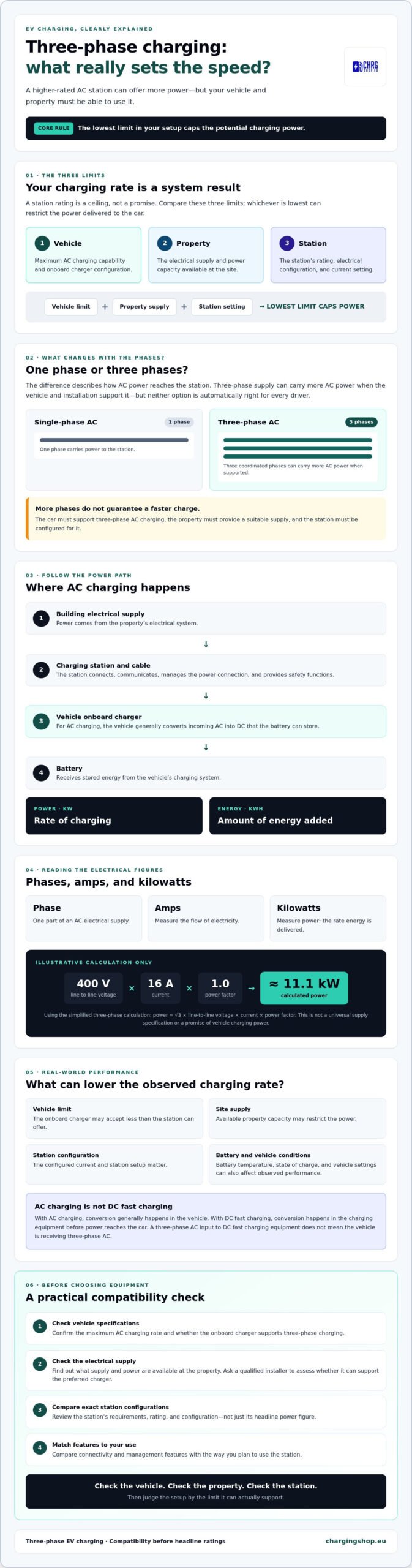
Actual charging power is capped by the lowest limit among the vehicle, site supply, and station configuration. A station’s rated output is therefore a ceiling, not a promise of the power your EV will receive. Check all three limits before estimating what a three-phase setup can deliver.
How a 3-Phase EV Charging Station Delivers AC Power
Charging follows a clear path: electricity leaves the building supply, passes through the station and charging cable, then reaches the vehicle’s onboard charger. That onboard charger converts AC into DC for the battery. With AC charging, conversion generally happens in the car, so the station’s rated output is only one part of the power equation.
A 3 phase ev charging station can offer a higher AC power ceiling, but the car may draw less. The vehicle’s onboard charger, the site’s available capacity, and the station’s current setting can each limit the result. Battery temperature, state of charge, and vehicle settings can also affect observed charging performance. A rated output is not a guaranteed charging rate.
How do phases, current, and kilowatts relate?
A phase is one part of an AC electrical supply. Current, measured in amps, describes the flow of electricity. Kilowatts (kW) measure power, or the rate at which energy is delivered. A simplified three-phase calculation is power ≈ √3 × line-to-line voltage × current × power factor.
Illustrative calculation only: At 400 V line-to-line, 16 A, and a power factor of 1.0, the calculation gives about 11.1 kW. These are stated assumptions, not a universal supply specification or a promise of vehicle charging power. Regional voltage, station configuration, and actual power factor must be checked for the installation.
What limits the charging speed in practice?
Start with the vehicle’s maximum AC charging capability and onboard charger configuration. Next, check the power available at the property and the station’s configured current. If one limit is lower than the others, it caps the power delivered to the car. Battery condition and vehicle settings may reduce it further.
Keep AC charging distinct from DC fast charging. With AC, the vehicle generally converts power for its battery; with DC fast charging, conversion happens in the charging equipment before power reaches the car. The U.S. Department of Energy’s Alternative Fuels Data Center describes DC fast charging equipment as typically using a three-phase AC input. That input does not mean the vehicle is receiving three-phase AC.
Finally, don’t confuse charging power with battery capacity. Power is measured in kW; battery energy capacity is measured in kilowatt-hours (kWh). Their relationship can help with a rough estimate, but actual charging varies, so a simple calculation is not a precise charging-time promise. To compare equipment, review the available EV charging hardware and verify each model’s configuration and regional requirements.
3-Phase vs Single-Phase EV Charging: Compare Real-World Fit
Choosing between single-phase and three-phase charging is a matching exercise, not a contest. A 3 phase ev charging station can support higher AC power when the car and site are equipped for it. If either has a lower limit, the station’s rating will not translate into a faster charge. Compare the options against your vehicle’s AC limit, available supply, and parking routine.
| Factor | Single-phase AC | Three-phase AC |
|---|---|---|
| Supply | Uses one electrical phase. Common in many homes, including most U.S. residences. | Uses three electrical phases. More common in commercial settings in North America and residential areas in parts of Europe and Asia. |
| Potential AC power | Depends on voltage, current, and equipment ratings. | Can provide higher AC power when supply, station, and vehicle support it. |
| Vehicle compatibility | Works for vehicles that accept single-phase AC. | Only useful up to the vehicle’s three-phase onboard charging capability. |
| Typical fit | Home charging where overnight parking and daily driving needs allow enough charging time. | Sites with suitable supply and a need for more AC power, such as some workplaces or shared charging locations. |
These are broad patterns, not a substitute for checking your local supply or vehicle specification. Three-phase power does not automatically mean faster charging: the car’s onboard charger, site capacity, and station configuration can each cap the delivered power.
When can a three-phase station make sense?
Consider three-phase charging if you drive longer daily distances, have shorter parking windows, and can access a suitable electrical supply. It may also suit workplaces or shared sites where vehicles need to charge during the day. At those sites, the available capacity may need to be planned across chargers. Load management can be part of that planning, but don’t assume a particular station includes it. Check the product documentation for the functions and configuration of the exact model.
When might single-phase charging be enough?
If your car is parked overnight and your routine leaves enough time to replace the energy you use, a lower-power setup may meet your needs. Check the vehicle’s AC charging limit as well. A higher-rated station will not raise the car’s maximum AC intake, and the property’s available supply can restrict charging power further. Match the setup to your driving and parking pattern, not just the largest rating on a product label.
Considering a 22kW home setup? Review this 22kW home wallbox guide, then verify vehicle compatibility and site requirements before selecting equipment.
How to Check Whether Your Vehicle and Property Support 3-Phase Charging
Before choosing a 3 phase ev charging station, check the vehicle, electrical supply, and charger as one system. Work through this checklist before comparing products. It helps identify compatibility gaps early, while leaving electrical assessment and installation decisions to a qualified professional.
- Confirm the vehicle’s AC charging limit. Check the owner’s manual or the manufacturer’s official specifications. Look up the exact model year, trim, and regional version because specifications can differ. Note the maximum AC charging power and whether the onboard charger supports three-phase charging.
- Check the property’s electrical supply. Find out whether the site has single-phase or three-phase power, then have a qualified professional assess available capacity. A three-phase supply alone does not confirm that a charger can be connected or run at its full rating. Other electrical loads and site conditions matter, too.
- Compare station requirements. Review the exact charger model and configuration, rated AC output, electrical requirements, and connector compatibility for your region and vehicle. Check the product documentation for any required protective devices and confirm that the requirements meet local rules.
- Arrange an installer assessment. Ask a qualified installer to assess supply capacity, the wiring route, installation conditions, and applicable electrical requirements before you commit to a setup.
Which vehicle specifications should you confirm?
Start with the car’s maximum AC charging rate, not its DC fast-charging figure. They are different capabilities: a vehicle may support a high DC charging rate while accepting less power from an AC station. Confirm the connector type, too, and check that it matches the charger and regional specification. If the information is unclear, ask the vehicle manufacturer or dealer to confirm it for your exact model year.
What should a qualified installer assess?
A site assessment should cover the available electrical capacity, the proposed wiring route, and the conditions where the station will be installed. The professional should also identify applicable local electrical rules and protective-device requirements. These vary by location, so don’t rely on advice intended for another country or region. Don’t attempt electrical work or modify the property’s supply yourself.
Charging Shop sells EV charging hardware, not on-site installation services. Arrange an installer assessment independently, and verify the charger’s exact configuration and local requirements before purchase. If you’re researching a specific home option, read the V2C Trydan 22kW guide and compare its specifications with your vehicle and site assessment.
Ready to compare equipment? Explore EV charging hardware and verify compatibility before choosing.
Choose a 3-Phase EV Charging Station That Fits Your Setup
Choose based on your actual setup, not the largest number on a charger label. A 3 phase ev charging station is suitable only if its configuration matches your vehicle’s AC charging limit and your site’s electrical supply. Then consider where and how the charger will be used, and whether you need connectivity or charging management.
Before comparing models, confirm these essentials:
- Vehicle: Check its maximum AC charging rate, connector, and support for three-phase charging.
- Site: Verify the available supply and electrical requirements with a qualified professional.
- Use: Consider whether the charger is for a home, workplace, or shared location, and how long vehicles typically remain parked.
- Features: Compare access, connectivity, and management options using the exact model’s documentation.
Charging Shop lists options including the V2C Trydan 22kW, Alfen Single Pro Line 22kW, and ABB Terra AC. Treat them as products to assess, not automatic recommendations. Before selecting one, confirm its exact phase configuration, rated output, connector, regional compatibility, and features.
For a professional-use option, see the Alfen Single Pro Line 22kW review. It’s a product reference, not a substitute for checking your site’s requirements or arranging a professional installation assessment.
Which product details matter before you buy?
Read the technical documentation for the exact model and configuration. Confirm rated power, supported phases, connector, and regional electrical compatibility. Then compare access control, connectivity, and management features only where the manufacturer’s documentation confirms them for that configuration. For another listed option, review the ABB Terra AC 22kW buying guide and verify which specifications apply to your region.
When should you consider charging network access?
Charger hardware and network access are separate decisions. Network access may help manage supported charging assets, but available functions depend on compatibility and current network capabilities. Confirm what the network supports for your intended chargers and use case. Network access does not replace the charger or physical installation services.
Charging Shop sells charging hardware and CHRG Network access, not on-site installation. Match your vehicle, site, and feature requirements, then request a personalised charging offer.
Choose Charging Power That Works for You
The right 3 phase ev charging station is one your vehicle and property can support, not simply the one with the highest rating. Check your EV’s maximum AC charging capability, confirm the site’s available supply with a qualified professional, and compare the charger’s exact configuration and regional requirements before buying.
Charging Shop lists hardware including the V2C Trydan, Alfen Single Pro Line, and ABB Terra AC. Verify each model’s specifications for your intended setup. If you’re considering managed charging, assess CHRG Network access separately from the charger itself and confirm its current scope and terms.
Ready to compare options for your requirements? Request a personalised charging offer and share the vehicle, site, and charging needs you’re planning around. Checking those details first can help you choose equipment that fits your setup.
Frequently Asked Questions
What is a 3-phase EV charging station?
A 3-phase EV charging station is AC charging equipment supplied by three electrical phases. Three-phase supply can support higher AC power than single-phase, but it does not guarantee a particular charging speed. The vehicle’s onboard charger, the property’s available supply, and the station’s configuration all affect how much power the car receives. Check your vehicle and charger specifications before choosing a setup.
Is a 3-phase EV charger faster than a single-phase charger?
It can be, if both the vehicle and site can use three-phase power. The car’s onboard AC charger may have a lower limit than the station, or the property may not have enough available capacity to deliver the station’s full rating. Compare the vehicle’s maximum AC charging rate, the supply, and the charger configuration. A higher-rated station alone does not ensure faster charging.
Can every electric car use a 3-phase charging station?
No. Some EVs accept three-phase AC charging, while others are limited to single-phase AC or a lower maximum AC rate. Look up the exact model year and regional version in the owner’s manual or the manufacturer’s official specifications. Check the connector, too. An EV’s DC fast-charging capability is separate from its AC charging limit, so don’t use the DC figure to judge home or workplace AC charging.
How much power can a 3-phase EV charger deliver?
There is no universal output. The station’s rated power depends on its model and configuration, regional electrical supply, voltage, and current settings. The vehicle’s onboard charger and the site’s available capacity can reduce the power actually delivered. Treat the rating as a maximum, not a promise. Check the charger documentation and vehicle specifications, and have the site’s electrical capacity assessed before selecting equipment.
Do I need a three-phase electrical supply for a 3-phase EV charger?
A three-phase supply is needed to access the charger’s full three-phase AC capability. Whether a particular station can operate on a different supply depends on its design and configuration, so check the manufacturer’s requirements rather than assume. Ask a qualified electrical professional to confirm your property’s supply and available capacity. Don’t modify electrical equipment or the supply yourself.
What happens if my car supports less power than the charging station?
The car generally charges at no more than its onboard charger’s maximum AC rate, even if the station is rated higher. A higher-output station, for example, will not make a vehicle accept more AC power than its own limit. Site capacity or a lower station setting can reduce the rate further. Compare the limits before choosing equipment so you understand what your setup can use.
Can a 3-phase EV charging station be installed at home?
It may be possible if your home has a suitable three-phase supply, the vehicle supports three-phase AC charging, and the electrical setup meets the charger’s requirements. Have a qualified installer assess capacity, wiring, installation conditions, and local protective-device requirements. These details vary by location. Charging Shop sells charging hardware, not on-site installation services, so arrange any home installation assessment separately.
