
 Deutsch
 Dansk
Dansk Suomi
Suomi Latviešu
 Lietuvių
 Norsk bokmål
 polski
 Русский
 Svenska
No products in the cart.
Uncategorized
2026 EV Charging Hardware Guide for Businesses & Fleets
27
Aug
Aug
Most businesses are currently installing “smart” chargers that will be technically obsolete by next Christmas. It’s a frustrating reality. You’re trying to scale a fleet or provide guest charging without a management headache. You need professional ev charging hardware that doesn’t just work today. It must fully comply with 2026 MID precision standards and the latest OCPP 2.1 protocols. Managing multiple users and tracking every kilowatt shouldn’t be a manual chore. It should be automated.
You want a future-proof setup. You need automated billing and zero-downtime reliability. This guide delivers. Master the technical requirements and brand comparisons needed to build a high-performance infrastructure for any professional environment. We’ll dive into the compact DC power of the V2C Denka 20kW, the industrial reliability of the Alfen Single Pro Line, and the modular ABB Terra AC. Learn how to pair this hardware with the CHRG Network. Turn your chargers into a hands-off, revenue-generating asset. Get the specs you need to move fast and stay ahead.
Key Takeaways
- Identify why industrial-grade contactors and high-duty cycle components are non-negotiable for commercial environments compared to residential units.
- Master the technical standards for professional ev charging hardware, including MID-certified billing and the latest OCPP 2.1 protocols.
- Compare market leaders like Alfen, ABB, and V2C to match your specific needs for reliability or compact DC power.
- Plan for scale with hub-and-spoke models and smart cable management to keep your high-traffic charging areas organized and efficient.
- Connect your infrastructure to the CHRG Network to automate billing and generate revenue with zero manual admin.
Professional EV Charging Hardware vs. Residential Wallboxes
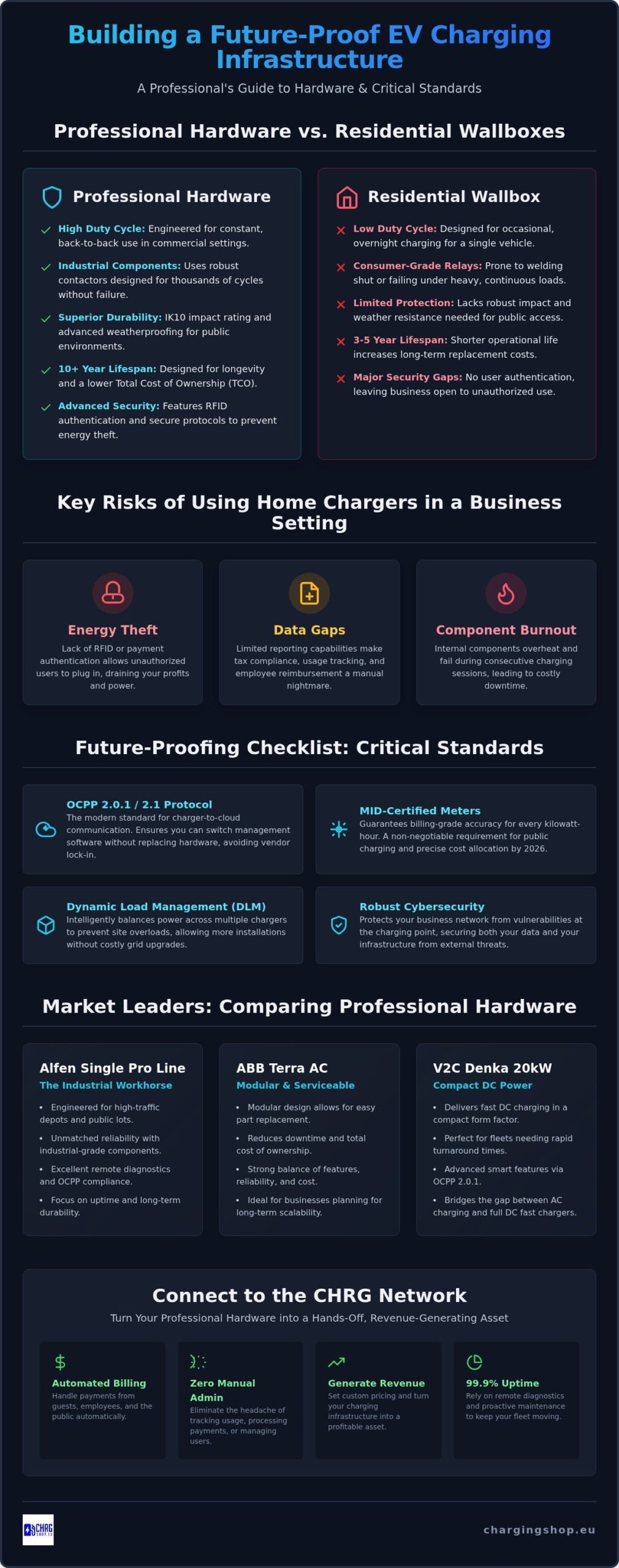
Don’t confuse a home charger with a business solution. While a residential unit might charge one car overnight, professional ev charging hardware is engineered for high-duty cycles and multi-user environments. It’s the difference between a domestic toaster and a commercial kitchen oven. Pro-grade units handle constant, back-to-back sessions without breaking a sweat. They utilize industrial contactors designed for thousands of cycles. Consumer wallboxes often rely on cheaper relays that can weld shut under heavy, continuous loads. If your charger fails because it couldn’t handle the heat, your fleet stops moving.
Reliability also depends on physical protection. Professional assets require an IK10 impact rating and superior weatherproofing. These units live in public car parks and fleet depots. They face rain, snow, and accidental knocks from drivers. Choosing pro-grade gear shifts your focus from the initial purchase price to the Total Cost of Ownership (TCO). A cheaper home unit might save you money on day one, but the cost of downtime and early replacement will quickly erode those savings. High-performance hardware, especially when utilizing the Combined Charging System (CCS) for fast DC delivery, ensures your infrastructure stays operational for years. This is about protecting a long-term investment, not just ticking a box.
Why ‘Home’ Chargers Fail in Commercial Settings
Domestic chargers are not built for the heat generated by constant use. During consecutive charging sessions, internal temperatures skyrocket. This leads to thermal throttling or complete hardware failure. Security is another massive gap. Without professional features, your business faces several risks:
- Energy Theft: Lack of RFID authentication allows unauthorized users to plug in and drain your profits.
- Data Gaps: Limited reporting capabilities make tax compliance and employee reimbursement a manual nightmare.
- Component Burnout: Consumer-grade relays aren’t rated for the 10 to 12 hours of daily operation required by fleets.
You need clear logs and secure access, not just a basic mobile app. Home units lack the communication protocols required for complex data reporting. If you can’t track every kilowatt for tax purposes, you’re losing money every time a vehicle plugs in.
The Duty Cycle Advantage of Industrial Hardware
Invest in longevity. A consumer wallbox typically lasts 3 to 5 years under light use. Industrial hardware targets a 10+ year lifespan even in high-traffic zones. This durability comes from modular design. Take the Abb terra ac series, for example. It allows for easier part replacement, meaning you don’t scrap the whole unit if one component fails. Professional EVSE is a business-critical asset requiring 99.9% uptime. It’s about keeping your fleet moving and your guests happy without constant maintenance calls. Choose hardware that scales with your ambition, not equipment that caps your growth.
Critical Standards: OCPP, MID Meters, and Smart Management
Buying the wrong hardware today creates a legacy problem for tomorrow. In 2026, the baseline for professional ev charging hardware has shifted toward total interoperability and rigorous data accuracy. You cannot afford to be locked into a single software provider. If your hardware doesn’t support open standards, you’re stuck with whatever fees and features that vendor dictates. High-performance infrastructure must adhere to established federal EV charging standards to ensure long-term utility and compliance with modern uptime requirements.
Smart management goes beyond simple connectivity. Dynamic Load Management (DLM) is now a requirement for any multi-unit deployment. It prevents site-wide power outages by balancing the load across all active stations. This allows you to install more chargers without paying for expensive grid upgrades. Security is equally vital. As these units become more interconnected, they become targets. Professional EVSE must include robust cybersecurity features to protect your business network from vulnerabilities at the charging point.
OCPP 1.6J and 2.0.1: Future-Proofing Your Fleet
OCPP is the language your charger speaks to the cloud. While OCPP 1.6J remains common, the industry has moved to OCPP 2.0.1 and 2.1 for enhanced security and smart charging features. This protocol is your insurance policy. It allows you to switch your management software without replacing your physical stations. Units from Alfen and V2C excel here, offering remote diagnostics and firmware updates that keep your hardware current. For a deep dive into managing these assets, check out our CHRG Network access for EV stations guide. It explains how to maintain 99.9% uptime through proactive cloud monitoring.
MID Meters: Billing Employees and Guests Legally
If you plan to charge for electricity, a standard internal meter isn’t enough. You need hardware that complies with the Measuring Instruments Directive (MID). As of March 2026, Directive (EU) 2026/706 has updated these precision and certification standards. Standard meters lack the certified accuracy required for financial transactions, which can lead to legal disputes or tax issues. The Alfen Single Pro Line 22kW integrates these meters directly into the chassis for seamless, legally compliant reimbursement. Pair this with RFID cards to track individual user consumption with surgical precision. It’s the most efficient way to handle guest billing or employee home-charging payouts. If you’re ready to secure your setup, consider a personalised charging offer tailored to your specific site requirements.
The Big Three: Comparing Alfen, ABB, and V2C for Professional Use
Selecting the right professional ev charging hardware is a strategic decision that impacts your daily operations and long-term ROI. According to the Global EV Outlook, EV sales are projected to hit 23 million units in 2026, representing nearly 28% of the global car market. This volume demands infrastructure that is both scalable and reliable. Alfen, V2C, and ABB dominate the market because they solve different professional pain points, from aesthetic guest charging to high-speed fleet turnover. Choosing between 22kW AC and 20kW DC depends entirely on your vehicles’ dwell time and your site’s electrical capacity.
Alfen Single Pro Line 22kW: The Reliable All-Rounder
Alfen remains the Dutch “Gold Standard” for a reason. Their hardware is built for heavy smart grid integration and absolute reliability. The Single Pro Line features a full-color 3.5-inch display. This isn’t just for show; it’s a tool for providing clear user instructions and displaying your company branding. It’s the ideal choice for office buildings and premium residential complexes where the user experience matters as much as the power delivery. For a deep dive into its technical specs, read our Alfen Single Pro Line 22kW Review.
V2C Denka: 20kW DC Fast Charging in a Compact Frame
V2C has disrupted the market with the Denka series. While most businesses default to 22kW AC, a 20kW DC station often provides a better ROI for quick-turnaround fleets. DC charging bypasses the vehicle’s onboard converter, delivering power directly to the battery. This ensures consistent speeds regardless of the car’s AC limitations. The Denka delivers this speed without the massive installation complexity or grid strain of 50kW+ units. It fits into standard spaces while providing the fast top-ups your drivers need. Learn more about these high-speed options in our 40kW DC Wallbox Guide.
ABB Terra AC: The Global Standard for Safety
ABB is synonymous with industrial-scale reliability. The Terra AC series is engineered to protect your property and your users from every possible electrical fault. It comes with built-in surge, overcurrent, and ground fault protection as standard. This modular architecture makes it a favorite for large-scale deployments where maintenance speed is critical. ABB’s value proposition is industrial-grade safety for every driveway. If you’re managing a massive rollout across multiple sites, this is the hardware that keeps your liability low and your uptime high. Check out our ABB Terra AC 22kW Charger Guide for the full breakdown.
Planning for Scale: From Single Sockets to Multi-Unit Fleets
Scaling a business charging network requires more than just adding sockets. You need a system that grows without breaking your grid or your budget. Use the “Hub and Spoke” model to manage your infrastructure. In this setup, one master unit communicates with the cloud and directs multiple satellite units. This reduces communication fees and simplifies data management across your entire site. For high-traffic areas, cable management is a non-negotiable requirement. Use retractors and heavy-duty pedestals to keep cables off the ground. This prevents trip hazards and protects your professional ev charging hardware from being run over by distracted drivers.
Maximize your parking footprint by choosing dual-socket units. These allow two vehicles to charge from a single pedestal, effectively doubling your capacity without doubling the physical space required for installation. If your facility utilizes solar arrays, ensure your hardware supports PV integration. Modern professional units can prioritize solar energy in real-time. This significantly boosts your ROI by using free, on-site power rather than drawing expensive energy from the grid during peak hours. It’s the most efficient way to lower your operational costs while hitting sustainability targets.
Managing Power Constraints with Load Balancing
Your site’s electrical capacity is a hard limit that can stall your expansion. Static load balancing sets a fixed cap for each charger, but dynamic load balancing (DLM) is the gold standard for commercial environments. DLM monitors total site consumption and shifts power to the chargers only when the building’s demand is low. The V2C Trydan 22kW excels here, handling real-time grid adjustments with surgical precision. This technology lets you avoid expensive transformer upgrades by using smart hardware scheduling to fill the gaps in your power profile. It ensures your professional ev charging hardware operates at peak efficiency without risking a site-wide blackout.
User Access Control: RFID vs. App-Based Authentication
Control who plugs in and how they pay. RFID cards offer simplicity and offline reliability, making them the perfect choice for underground garages where cellular signals often fail. For guest charging or public-facing assets, use QR codes and mobile apps. These allow for instant payments and data capture without the need to issue physical cards. Many professional units, like those from Alfen, offer white-labeling opportunities. You can put your business logo directly on the charging screen to reinforce your brand. Ready to build a scalable network? Get a personalised charging offer today and secure the right hardware for your fleet’s future.
Secure Your Infrastructure: Why Professional Hardware Needs the CHRG Network
Buying professional ev charging hardware is a major milestone, but hardware alone is just a dormant asset. You need a centralized brain to manage users, power, and payments. The CHRG Network serves as this hardware-agnostic management layer. It bridges the gap between your physical stations and your business operations. Whether you’ve deployed Alfen, ABB, or V2C units, this platform provides a unified dashboard to control every socket from a single screen. It’s about turning a row of chargers into a smart, manageable ecosystem.
Automated billing is the biggest win for your operations team. Stop wasting hours on manual spreadsheets and reimbursement claims. The network handles the financial heavy lifting, allowing you to generate revenue from guest charging without any manual admin. You can set custom pricing models in seconds. Offer discounted rates for employees while maximizing profit from visitors. Real-time monitoring ensures you identify hardware faults before a driver even arrives at the station. This proactive approach maintains your reputation for reliability and ensures your 99.9% uptime targets remain a reality, not just a goal.
Automated Reporting for Tax and Sustainability
Stay compliant without the stress. The CHRG Network generates monthly energy reports that align perfectly with your ESG (Environmental, Social, and Governance) goals. Tracking your carbon offset becomes a simple, click-of-a-button process. For your financial team, simplified VAT handling for commercial sessions removes the complexity of multi-user billing. You don’t have to worry about the math; the system does it for you. You can export all data directly into your existing fleet management software. This ensures your charging data isn’t siloed but integrated into your broader business intelligence for better decision-making.
Get Your Personalized Charging Offer
Every business site has unique power limits and infrastructure challenges. Bulk hardware orders shouldn’t be based on generic pricing. They need a tailored strategy to ensure the best possible ROI. Charging Shop facilitates this by analyzing your site-specific requirements before you commit to a purchase. We help you select the right mix of AC and DC units based on your actual electrical capacity and fleet turnover needs. Don’t leave your infrastructure to chance or settle for off-the-shelf solutions that don’t fit your scale. Request your Personalized Charging Offer today and build a future-proof network that works as hard as you do.
Deploy Your Scalable Charging Infrastructure Today
Success in the 2026 EV market depends on equipment that works as hard as your business. You’ve seen the difference industrial components make. Don’t settle for residential units that can’t handle high-duty cycles. By choosing professional ev charging hardware from leaders like Alfen, ABB, and V2C, you secure a reliable asset that meets the latest MID and OCPP 2.1 standards. This ensures your billing is accurate, your data is secure, and your network is ready for the massive global shift toward electric mobility.
We are your authorized distributor for premium hardware with full CHRG Network integration support. Whether you need the compact DC power of a V2C Denka or the industrial safety of an ABB Terra AC, we provide the personalized commercial quotes needed for a high ROI. Stop managing chargers manually. Start automating your revenue and reporting today.
Shop the Professional EV Hardware Collection and take control of your fleet’s future. Your high-performance infrastructure is just one click away.
Frequently Asked Questions
What is the difference between AC and DC professional hardware?
AC hardware is the standard for long-dwell locations like office car parks. It relies on the vehicle’s onboard converter to turn power into battery energy. DC hardware, such as the V2C Denka 20kW, bypasses this converter to deliver power directly to the battery. This allows for significantly faster charging speeds. AC is more cost-effective for all-day parking, while DC is the superior choice for fleets requiring rapid vehicle turnover.
Why is OCPP compliance important for my business?
OCPP compliance prevents expensive vendor lock-in. professional ev charging hardware that supports OCPP 1.6J or 2.1 allows you to switch your management software without replacing your physical charging stations. This flexibility ensures your infrastructure remains future-proof. You can adopt new billing features or management tools as they hit the market. It protects your capital investment by ensuring your hardware never becomes a “brick” if a software provider changes their terms.
Do I need a MID-certified meter for my office charging station?
Yes, you need a MID-certified meter if you plan to charge guests for electricity or reimburse employees for home charging. MID certification is a legal requirement for any financial transaction based on energy consumption. Standard internal meters lack the precision and legal backing required for tax-compliant billing. Units like the Alfen Single Pro Line 22kW integrate these certified meters to ensure every kilowatt is tracked with surgical accuracy for your financial records.
Can I manage different brands of chargers on the same network?
You can manage multiple brands simultaneously if they are all OCPP-compliant. Hardware-agnostic platforms like the CHRG Network allow you to mix Alfen, ABB, and V2C units within a single dashboard. This unified approach prevents fragmented data and allows your team to monitor uptime and payments across your entire footprint. It gives you the freedom to choose the best hardware for specific site needs without complicating your back-end operations.
How does dynamic load balancing protect my building’s power supply?
Dynamic load balancing monitors your building’s total energy consumption in real-time. If your facility’s power demand spikes due to air conditioning or machinery, the system automatically throttles the charging stations to prevent a blackout. This technology allows you to install more professional ev charging hardware without paying for expensive grid upgrades. It ensures your vehicles charge at the maximum safe speed possible based on the available power at any given moment.
Is professional EV hardware waterproof for outdoor installation?
Professional units are engineered for the toughest environments. Most carry an IP54 or IP55 rating for weatherproofing and an IK10 rating for impact resistance. This means they are fully protected against rain, snow, and dust, as well as physical tampering or accidental knocks. They are built to live in open-air car parks and high-traffic fleet depots. Unlike residential wallboxes, they utilize industrial-grade housings that resist UV damage and extreme temperature fluctuations over time.
How do I set up billing for employees who charge at the office?
The most efficient method is using RFID authentication paired with a management network. Assign each employee a unique RFID card to track their individual energy usage. The CHRG Network can then automate the billing process based on your specific company policy. You can offer free charging as a perk or set a discounted rate. The system generates all the necessary reports for your payroll or accounting department, removing the need for manual data entry.
What is the typical lifespan of a professional-grade wallbox?
You should expect an operational lifespan of 10 to 15 years from high-quality professional hardware. These units use industrial-grade contactors and modular internal components that are designed for high-duty cycles. Unlike consumer models, they are built to be serviced rather than replaced. Regular firmware updates delivered via the cloud keep the hardware current with the latest vehicle protocols. This long-term durability ensures a much better return on investment for your business infrastructure.
