
 Deutsch
 Dansk
Dansk Suomi
Suomi Latviešu
 Lietuvių
 Norsk bokmål
 polski
 Русский
 Svenska
No products in the cart.
Uncategorized
20kW DC Wallbox Price: The 2026 Business Guide to Fast Charging ROI
28
Aug
Aug
The cheapest charging solution often ends up as the most expensive mistake for a growing business. You’ve likely seen the bottleneck already. Vehicles sit for hours at slow AC points while potential revenue drives right past your door. Understanding the 20kW DC wallbox price is no longer just about the initial hardware cost. It’s about calculating the value of fast turnover and site efficiency. If you want to bridge the gap between sluggish AC charging and the massive infrastructure requirements of ultra-fast stations, the 20kW DC segment is your “Goldilocks” solution for 2026.
You want faster vehicle turnover and a clear investment map without the technical headache. We agree that the move to DC should be profitable, not confusing. This guide delivers the facts on technical advantages and the revenue potential of high-performance units like the V2C DENKA. You’ll learn how to transform your parking lot into a reliable revenue stream using the CHRG Network for automated billing. We also break down how to maintain a manageable hardware footprint while maximizing your power output. Get ready to future-proof your commercial EV infrastructure with confidence.
Key Takeaways
- Identify why 20kW DC charging is the strategic “sweet spot” for short-stay commercial locations like hotels and retail centers.
- Calculate the true 20kW DC wallbox price by factoring in hardware costs and the significant savings on electrical grid upgrades.
- Compare real-world performance metrics between DC and AC units to see how fast turnover improves customer satisfaction and site efficiency.
- Leverage the CHRG Network management platform to automate billing and transform your charging station into a consistent revenue source.
- Evaluate the professional features of the V2C DENKA to ensure your infrastructure is compact, intelligent, and ready for 2026.
Why 20kW DC is the Strategic Choice for Business Charging
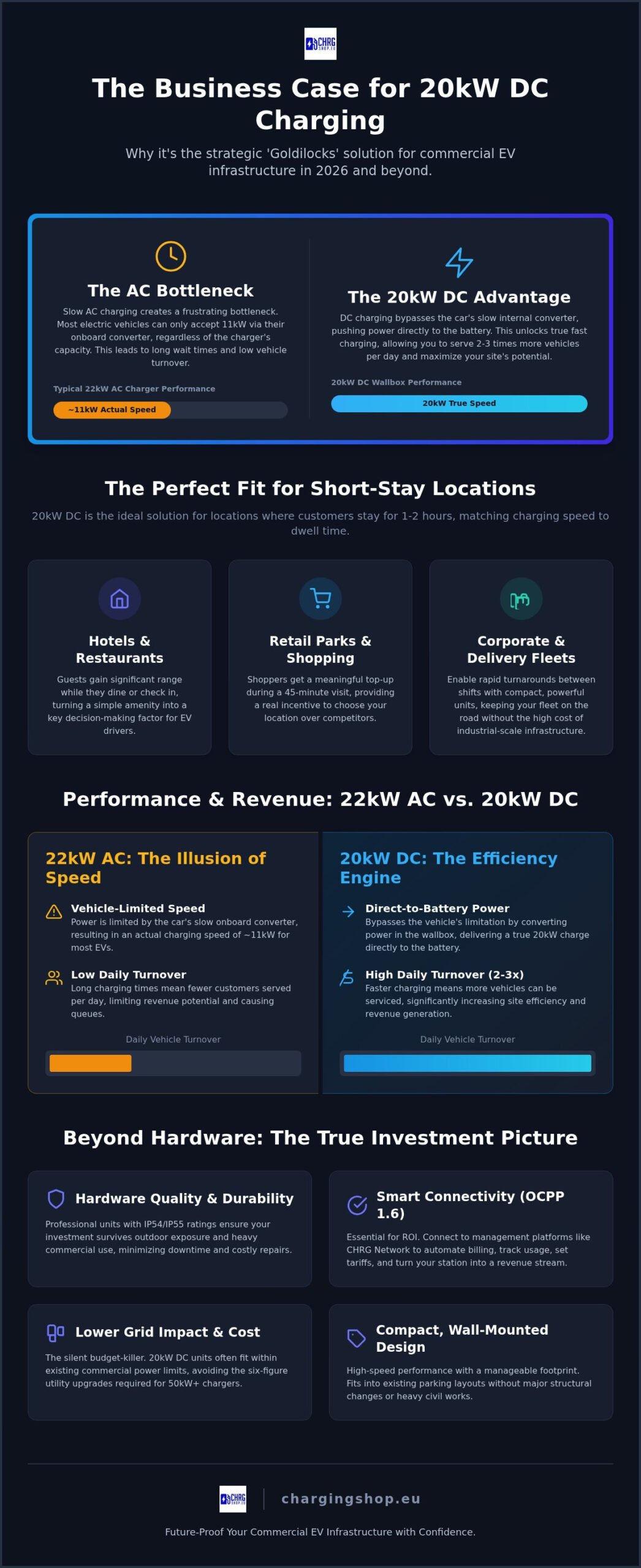
Standard AC charging is hitting a wall. Most electric vehicles can only accept 11kW via AC, regardless of your charger’s capacity. This creates a massive gap between what you offer and what the car can actually take. A 20kW DC system solves this. It bypasses the vehicle’s internal converter and pushes power directly into the battery. When you look at the 20kW DC wallbox price, you aren’t just buying hardware. You’re buying the ability to charge two or three times as many cars per day compared to standard AC posts.
Space is a premium asset for any commercial property. Massive charging towers require heavy civil works and dedicated concrete pads. Wall-mounted DC hardware offers a different path. These units provide high-speed performance with a manageable footprint. They fit into existing parking layouts without major structural changes. By 2026, EV drivers will demand faster speeds for short-stay stops. Investing in 20kW technology now ensures your property remains a destination rather than a backup option.
Defining the 20kW DC Wallbox Segment
AC chargers rely on the car’s onboard inverter to convert electricity. This process is slow and limited by the vehicle’s hardware. DC wallboxes handle the conversion internally. They deliver direct current straight to the battery for immediate results. To run these units, you need a stable 3-phase power supply and CCS2 compatibility. 20kW DC acts as the essential bridge between slow home charging and massive highway hubs.
Ideal Scenarios for 20kW Fast Charging
Success in EV infrastructure depends on matching charging speed to dwell time. If your customers stay for one to two hours, 20kW is the “Goldilocks” solution. Consider these high-value applications:
- Hotels and restaurants: Guests can gain significant range while they dine or check in. It turns a simple meal into a logistics win for the driver.
- Retail parks: Shoppers want a meaningful top-up during a 45-minute visit. AC charging is too slow to be a draw, but 20kW provides a real incentive to choose your location.
- Corporate fleets: Delivery vans and service vehicles need rapid turnarounds between shifts. Compact units like the V2C DENKA keep your fleet moving without the high 20kW DC wallbox price associated with industrial-scale infrastructure.
Don’t let slow hardware limit your business potential. Focus on turnover and site efficiency to maximize your return on investment.
Breaking Down the 20kW DC Wallbox Price and Investment
Investing in fast charging involves more than a single transaction. You’re looking for a balance between speed, durability, and site capacity. While entry-level units might seem attractive, the 20kW DC wallbox price reflects the quality of internal components and power modules. High-performance hardware reduces downtime and prevents the “blackout” scenarios common with cheaper, uncertified alternatives. You need hardware that works every time a customer plugs in.
Smart features aren’t just extras; they’re essential for ROI. Units equipped with OCPP 1.6 allow you to connect to management platforms like the CHRG Network. This integration lets you track usage, set tariffs, and automate billing without manual intervention. Look at the efficiency ratings too. High-efficiency hardware ensures that more power reaches the vehicle battery and less is wasted as heat. This directly impacts your monthly utility bills and long-term profitability.
Hardware Price Drivers in 2026
Build quality determines your long-term success. Look for IP54 or IP55 ratings to ensure your investment survives outdoor exposure and heavy commercial use. Single connector models are standard, but dual connectors add flexibility at a higher initial cost. Choosing a V2C DENKA 20kW DC Wallbox pays off through superior durability and intelligent power management. It’s built for the rigors of a professional environment where reliability is non-negotiable.
Installation and Grid Considerations
Grid upgrades are the silent budget killers of EV infrastructure. Moving to 50kW or 150kW often requires a new substation or expensive transformer work. 20kW DC units frequently fit within existing commercial power limits. You get fast charging without the six-figure utility bills. Always conduct a professional site survey before you commit. This ensures your local grid can handle the load. When calculating your Total Cost of Ownership (TCO) over five years, factor in maintenance and software fees. Smart units allow for seamless billing integration, turning an expense into a revenue-generating asset.
Efficiency matters during every minute of operation. Units with low standby power consumption save money every hour they aren’t in use. If you’re unsure which hardware fits your specific site requirements, request a Personalised Charging Offer to clarify your investment path and avoid overspending on unnecessary infrastructure.
20KW DC vs. 22kW AC: Performance and Revenue Potential
Speed sells. If you’re weighing the 20kW DC wallbox price against a standard AC unit, you have to look at the turnover stats. AC charging is a slow burn. DC is a strategic strike. Most modern electric vehicles come with a hidden bottleneck: their onboard AC charger. Even if you install a 22kW AC post, the car often limits the intake to just 11kW. This means your “fast” AC charger is actually running at half speed. A 20kW DC unit bypasses this limitation entirely. It delivers power directly to the battery, ensuring the car actually receives the speed you’re paying for.
Revenue depends on throughput. In a high-traffic commercial setting, you can’t afford to have a single vehicle occupying a bay for six hours. Faster charging means more customers per day. It means shorter wait times and higher satisfaction. Drivers looking for a “convenience” top-up will choose a 20kW DC site over a slow AC point every time. It’s the difference between a meaningful range boost and a negligible trickle charge.
Speed Comparison: Range Added Per Hour
To understand the ROI, look at the charging times for a standard 60kWh battery. The numbers don’t lie. Because most EVs are limited to 11kW on AC, a 20kW DC wallbox is effectively twice as fast as a 22kW AC unit.
| Charger Type | Effective Power | 0-80% Charge Time |
|---|---|---|
| Standard AC Wallbox | 11kW (Vehicle Limit) | ~4.5 Hours |
| 20kW DC Wallbox | 20kW (Direct) | ~2.4 Hours |
| Industrial DC Station | 50kW (Direct) | ~1.0 Hour |
DC hardware also offers better technical reliability for the vehicle. By handling the power conversion inside the wallbox, you reduce the heat and stress on the car’s internal systems. It’s a cleaner, more efficient way to move energy while maintaining a manageable 20kW DC wallbox price compared to ultra-fast highway hubs.
Commercial Impact of Faster Charging
Premium EV drivers prioritize their time. They look for locations that offer reliable, fast-turnover hardware. By installing 20kW DC units, you position your business as a high-tier destination. You reduce bay congestion and ensure that your infrastructure is actually being used, not just occupied. This is critical for retail parks and restaurants where customer stay-time is usually under two hours. You want them to leave with a full battery and a positive impression of your brand.
Management is the final piece of the puzzle. You need a way to turn those charging sessions into actual bank deposits. Integrating your hardware with CHRG Network access for EV stations allows for seamless user billing and real-time monitoring. You set the price, the network handles the transaction, and you watch the ROI grow. It’s a professional, automated solution for a fast-moving market.
Maximizing ROI: Monetizing Your 20kW DC Charging Point
Hardware costs are just the starting point. To justify the 20kW DC wallbox price, you need a clear strategy for recouping that capital. Don’t just give away electricity. Set a tariff that covers your energy costs plus a “convenience fee” for the fast turnaround. DC charging is a premium service. Users expect to pay more for speed than they would at a slow AC post. This margin is where your ROI lives.
Managing payments manually is a logistical nightmare. Use the CHRG Network management platform to automate everything. It handles the billing, processes the transactions, and deposits the revenue directly into your account. This turns your parking lot into a passive income stream. High-visibility also drives utilization. List your station on global charging maps like PlugShare or Google Maps. More eyes on your location mean more sessions per day. Also, check for regional tax incentives or grants. Many governments in 2026 still offer significant rebates for commercial DC infrastructure, which slashes your effective 20kW DC wallbox price significantly.
Setting Up Your Billing Infrastructure
OCPP 1.6 is your insurance policy. It’s the industry standard that lets you switch management software without replacing your hardware. This prevents vendor lock-in. For user access, RFID cards are perfect for staff or repeat hotel guests. Apps are better for one-time retail shoppers. The path to profit is simple. Install certified DC hardware. Connect to a management network via Ethernet or 4G. Set your price per kWh or per minute. Open for business and track your first revenue collection in real-time.
Attracting and Retaining Customers
Strategic pricing can drive other business goals. A hotel might offer free charging as a “loss-leader” to secure a room booking. A retail park might offer the first 15 minutes free to get people through the doors. Security is also paramount. In public-facing locations, you need a secure EV charging station that resists tampering and vandalism. Reliable hardware keeps your uptime high and your reputation solid. Use data analytics from your management platform to see when your chargers are busiest. If you’re always full at peak times, consider a demand-based surcharge to manage bay turnover and boost ROI.
Ready to start? Get a custom quote for your commercial site and see how fast you can hit break-even.
The V2C DENKA: The Professional Choice for 20kW DC Charging
You don’t just need a charger; you need a reliable business partner. The V2C DENKA is the hardware that turns your ROI calculations into reality. While the market is flooded with generic units, the V2C DENKA is engineered specifically for commercial durability. It combines a compact form factor with a high-performance output that keeps your bays moving. When you evaluate the 20kW DC wallbox price, look beyond the digital screen. Look at the stainless steel housing and the IP54 rating. This unit survives harsh outdoor environments while maintaining its sleek, professional appearance. It’s a statement piece for your property that says you’re ready for the future.
Connectivity is the backbone of any managed station. The DENKA doesn’t compromise here. It features integrated Wi-Fi, Ethernet, and 4G options as standard. This ensures your billing data reaches the CHRG Network without interruption. Whether you’re setting up a single point at a boutique hotel or a fleet hub at a corporate office, this hardware adapts to your site’s specific infrastructure. It’s a plug-and-play solution for businesses that value time as much as money. You get technical precision without the complexity.
Why the V2C DENKA Stands Out
Efficiency is where the DENKA truly wins. It boasts a rating of up to 96%. This means less wasted energy and lower monthly operating costs for your business. Most DC chargers are bulky and require significant wall space. The DENKA uses its compact dimensions to fit into tight parking layouts where other 20kW units simply won’t work. It’s the agile choice for urban commercial properties. For a deeper look at how it stacks up against the competition, check out our V2C Denka vs Alpitronic HYC50 comparison guide. It highlights why the DENKA often provides a better 20kW DC wallbox price to performance ratio for small-to-medium enterprises.
Ordering and Support from Charging Shop
Charging Shop simplifies the entire procurement process. We offer fast global shipping for hardware-only orders, ensuring your project stays on schedule. Beyond the hardware, you gain access to our technical support team and seamless CHRG Network subscriptions for automated billing. We understand that every site has unique power constraints and commercial goals. Don’t guess which configuration you need. Request a Personalised Charging Offer today to get a tailored breakdown of the best hardware for your location. Upgrade your business charging infrastructure now and secure your spot in the 2026 EV market.
Future-Proof Your Commercial Infrastructure for 2026
The transition to electric mobility is accelerating. Sitting on the sidelines with slow AC charging will cost you customers and revenue. You now understand how the 20kW DC wallbox price translates into a strategic business advantage. By bypassing vehicle onboard limits and avoiding massive grid upgrade fees, you secure a high-performance solution that fits your existing site without the technical headache of industrial-scale hardware. It’s the most efficient way to bridge the gap between slow charging and high-cost infrastructure.
Reliability is your most valuable asset. Choosing professional hardware like the V2C DENKA ensures your infrastructure handles the heavy demands of commercial use. Couple this with the CHRG Network for automated billing, and you’ve turned a parking bay into a self-sustaining profit center. As an authorized V2C distributor, Charging Shop is ready to facilitate your upgrade with global shipping and expert support. We include CHRG Network management to ensure your ROI starts growing from the first session.
Don’t wait for your competition to set the standard. Secure your location’s future as a preferred charging destination. Get your personalized 20kW DC Wallbox quote today and start maximizing your site’s potential. Your path to professional EV charging starts here.
Frequently Asked Questions
How much does a 20kW DC wallbox typically cost in 2026?
Hardware costs for these units vary based on build quality, IP ratings, and integrated connectivity options. You should view the 20kW DC wallbox price as a multi-year investment in site turnover rather than a one-time expense. Premium units often include features like 4G modules and OCPP compliance as standard. For a precise figure tailored to your business requirements, request a personalized offer to see how the hardware fits your budget.
Do I need a special permit to install a 20kW DC charger for my business?
Permit requirements depend entirely on your local municipality and the existing electrical capacity of your property. In many regions, adding a 20kW load requires a formal notification to the grid operator, though it typically avoids the heavy industrial permitting needed for 50kW+ stations. Always consult a certified commercial electrician to review your site’s compliance with local building codes. They’ll ensure your installation meets safety standards without triggering unnecessary regulatory delays.
Can a 20kW DC wallbox charge two cars at the same time?
This depends on the specific hardware configuration you choose. Most compact 20kW units are designed with a single CCS2 connector to maximize charging speed for one vehicle at a time. While some dual-connector models exist, they would split the 20kW output between two cars, resulting in much slower charging times. For high-traffic areas, it’s often more efficient to install multiple single-connector units to maintain consistent fast-charging performance for every user you serve.
What is the difference between a 20kW DC wallbox and a 22kW AC wallbox?
The primary difference lies in where the power conversion happens. A 22kW AC wallbox sends alternating current to the vehicle, which then converts it using an onboard charger often limited to 11kW. A 20kW DC wallbox converts the power internally and sends direct current straight to the battery. This makes the DC unit effectively twice as fast for most modern EVs, significantly increasing your bay turnover and improving the overall customer experience at your location.
Is a 20kW DC charger fast enough for a highway service station?
A 20kW unit is ideal for locations where drivers stay for 60 to 90 minutes, such as restaurants or retail hubs. For highway service stations where drivers expect a full charge in under 30 minutes, you’d typically look at 50kW or 150kW ultra-fast stations. However, 20kW units serve as excellent secondary chargers for highway sites to accommodate longer-stay visitors or delivery fleets that don’t require the highest speeds but still need a reliable DC boost.
What electrical supply is required for a 20kW DC fast charger?
You need a stable 3-phase electrical supply to support the power demands of a 20kW DC fast charger. Most commercial properties already have this infrastructure in place, which is why the 20kW DC wallbox price is so attractive compared to higher-power units. Your electrician will need to verify your circuit breaker capacity and ensure the wiring can handle the continuous 20kW load. This setup avoids the massive grid upgrades often required for industrial-scale hubs.
How do I bill my customers for using my 20kW DC charging station?
Billing is automated through management software that connects to your hardware via the OCPP protocol. By using a platform like the CHRG Network, you can set custom tariffs, track energy usage, and process payments from drivers via mobile apps or RFID cards. The system handles the financial transactions and deposits the revenue directly into your business account. This automated approach eliminates manual oversight and ensures your charging station functions as a reliable, hands-off profit center.
Does the V2C DENKA support the latest OCPP 1.6 and 2.0.1 standards?
The V2C DENKA is fully compatible with the OCPP 1.6-J standard, ensuring seamless integration with most global management platforms. This compatibility allows you to monitor your station remotely and manage billing without being locked into a single software provider. While OCPP 2.0.1 is the newer standard, 1.6 remains the industry benchmark for commercial reliability in 2026. This flexibility ensures your hardware stays relevant as software technology and billing requirements continue to evolve over the coming years.
