
 Deutsch
 Dansk
Dansk Suomi
Suomi Latviešu
 Lietuvių
 Norsk bokmål
 polski
 Русский
 Svenska
No products in the cart.
Uncategorized
V2C Trydan vs Myenergi Zappi: The Best Solar EV Charger?
23
Jul
Jul
Is the industry’s biggest name still the smartest buy for your solar setup? You might think the most famous brand is the safe bet, but the hardware landscape has shifted. Choosing the wrong unit means fighting with inverter incompatibility or paying for a complex, expensive installation you just don’t need.
You want to squeeze every kilowatt of surplus energy from your panels without the headache of a clunky interface. This V2C Trydan vs My Energy Zappi: two solar friendly chargers – comparison which is more universal easier to install and App user friendly settles the debate for 2026. You’ll discover which charger offers the best universal integration, the fastest setup times, and the most responsive mobile experience for daily use.
Stop guessing and start charging. We’re breaking down the technical specs and real-world performance to show you which solar-optimized powerhouse leads the pack in efficiency. It’s time to future-proof your home with the right tech today.
Key Takeaways
- Identify the specific charging modes that allow you to run your EV purely on sunshine without pulling a single watt from the grid.
- Compare the internal hardware and safety features that make one unit significantly faster and cheaper for your electrician to install.
- Read our V2C Trydan vs My Energy Zappi: two solar friendly chargers – comparison which is more universal easier to install and App user friendly to decide which brand fits your home’s tech stack.
- Explore how voice control and real-time cloud updates transform your smartphone into a high-performance energy command center.
- Get the final 2026 verdict on which charger provides the most future-proof 22kW performance for modern residential solar systems.
The Solar Superstars: Why V2C Trydan and Zappi Lead the Market
Solar charging is the ultimate goal for any eco-conscious driver. It transforms your home into a private fuel station that runs on free, renewable energy. Instead of sending your excess solar power back to the grid for a minimal credit, these smart chargers divert that surplus directly into your vehicle’s battery. This process is known as solar-friendly charging, and it’s the most efficient way to maximize your return on investment for PV panels.
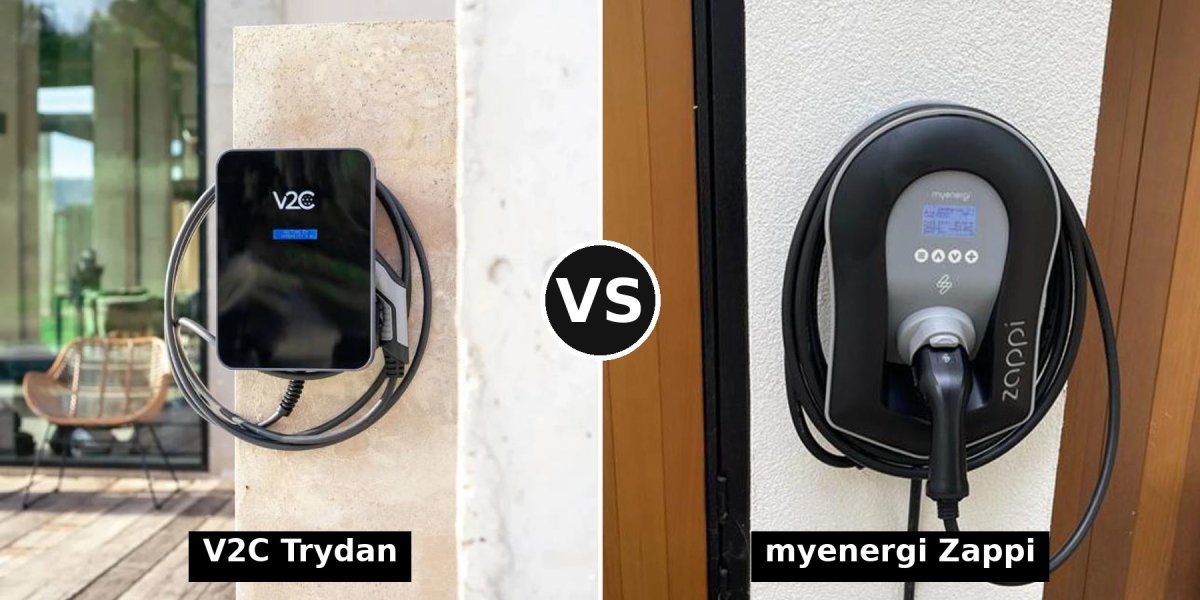
Myenergi Zappi is the veteran in this space. It pioneered the concept of eco-charging years ago, building a massive following with its reliable hardware and dedicated solar modes. However, the market has evolved. V2C Trydan has emerged as the high-performance challenger, focusing on deep software integration and "Inverter-Direct" communication. In 2026, the industry is moving away from physical hardware clamps. Modern setups prefer digital handshakes between the charger and the solar inverter via WiFi or Ethernet, reducing hardware failure points and improving data accuracy. This V2C Trydan vs My Energy Zappi: two solar friendly chargers – comparison which is more universal easier to install and App user friendly will show you which approach fits your home best.
The Core Philosophy: Surplus Management
Precision is everything when you’re trying to balance home energy use with car charging. Both chargers monitor your home’s "surplus" in real-time. If your solar panels produce 5kW and your house only needs 2kW, these smart units see that 3kW difference and push it into your EV. This requires sophisticated dynamic load balancing. This technology protects your main fuse from tripping while ensuring you never pull expensive energy from the grid unnecessarily. Standard chargers are blind to these fluctuations. They simply pull a fixed amount of power, often wasting your solar generation or forcing you to buy grid electricity when you don’t need to. Investing in a solar-optimized unit ensures every ray of sunshine is put to work.
V2C vs Zappi: A Quick Spec Overview
Choosing between these two often comes down to your property’s electrical capacity. While the Zappi is a robust choice for standard 7kW single-phase homes, the V2C Trydan 22kW is the flagship for those with three-phase power. It provides the headroom needed for future-proofed homes and faster charging cycles. Build quality is high on both sides, utilizing durable polycarbonate housings designed to withstand outdoor elements. Understanding the broader EV charging station infrastructure helps you realize why these two brands lead the pack. They aren’t just plugs; they are intelligent energy managers. For a technical deep dive into the 22kW model’s capabilities, check out our comprehensive V2C Trydan 22kW guide to see how it integrates with your specific smart home ecosystem.
Solar Optimization: Balancing Surplus and Grid Reliance
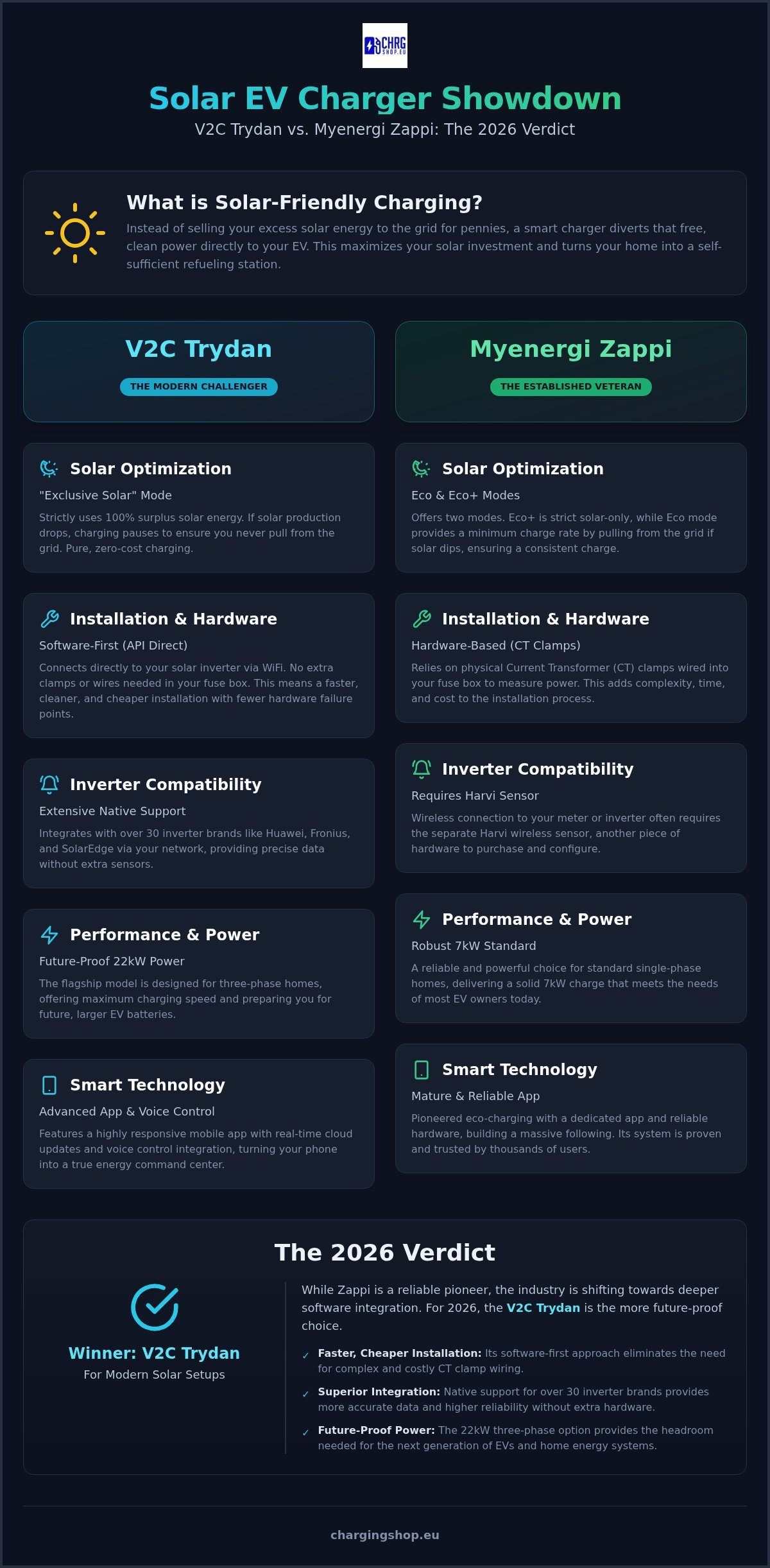
Both chargers aim for the same goal: zero grid reliance. But they take different paths to get there. Zappi uses Eco and Eco+ modes to manage your surplus. Eco mode keeps a minimum charge rate by pulling from the grid if clouds roll in. Eco+ is stricter; it stops the charge entirely if solar production drops below a specific threshold. V2C Trydan simplifies this with its "Exclusive Solar" mode. This mode ensures you never pay a cent for electricity when charging, purely utilizing the power of the sun.
This V2C Trydan vs My Energy Zappi: two solar friendly chargers – comparison which is more universal easier to install and App user friendly highlights a massive technical divide. Zappi relies on physical Current Transformer (CT) clamps to measure power flow. These require extra wiring and physical space in your consumer unit. V2C Trydan uses software APIs to talk directly to your inverter. It’s cleaner, faster, and eliminates hardware failure points. If you’re planning to take advantage of subsidies for EV chargers, choosing a unit with high-efficiency solar tracking is a smart move for your long-term ROI.
Inverter Compatibility
V2C Trydan supports over 30 inverter brands natively. Whether you have a Huawei, Fronius, or SolarEdge system, Trydan connects via your home network. Zappi often requires a Harvi wireless sensor to bridge the gap between your meter and the charger. While Harvi is reliable, it’s another piece of hardware to buy and configure. For complex setups with multiple inverters, the software-first approach of V2C is often more stable and easier to troubleshoot remotely.
Dynamic Power Adjustment
Response time is critical. If you turn on a high-drain appliance like a kettle or oven, the charger must throttle down instantly. Both units excel here, but V2C’s digital handshake is often more precise than Zappi’s analog clamp readings. This precision prevents house blackouts during peak solar hours when your home load fluctuates. For those managing larger residential arrays or light commercial sites, the CHRG Network provides the robust backend support needed to monitor multiple units without a hitch. You can find the latest V2C hardware ready for immediate dispatch to upgrade your home setup.
Hardware & Installation: Which is More Universal?
Hardware choice isn’t just about the box on your wall. It’s about how much your electrician charges you for labor and how well the unit survives different earthing systems. Both units offer robust electrical protection, but they approach the "universal" label differently. V2C Trydan comes out of the box with integrated RCD Type B and DC leakage detection. This means your installer doesn’t need to fit expensive external protection in your consumer unit. Zappi also includes PEN fault protection, eliminating the need for an earth rod in most UK and European installations. However, the physical footprint and internal layout tell a different story for the person doing the work.
Aesthetics matter on a modern driveway. Zappi has a distinctive, curved look that many homeowners recognize instantly. V2C Trydan opts for a sleeker, more industrial design with a high-contrast display that is easier to read in direct sunlight. Beyond looks, the internal build quality of the Trydan focuses on modularity. This V2C Trydan vs My Energy Zappi: two solar friendly chargers – comparison which is more universal easier to install and App user friendly reveals that Trydan’s open architecture is designed for 2026 standards, making it a more versatile pick for various home layouts. Research into the environmental and grid benefits of solar EV charging proves that hardware reliability is the foundation of any sustainable energy ecosystem.
The Electricians Verdict
Electricians are shifting toward V2C for one main reason: time. Zappi’s internal wiring is notoriously "fiddly" due to its compact space and the requirement for physical CT clamp connections. If you want wireless solar sensing with Zappi, you have to buy and configure the "Harvi" sensor, adding another layer of complexity. V2C Trydan uses a streamlined terminal block that gives the installer plenty of room to work. It also features built-in OCPP 1.6J. This protocol is the industry gold standard, allowing you to connect your charger to different management platforms or smart home hubs without proprietary lock-in.
Universal Connectivity
Connectivity is where the Trydan pulls ahead in the "universal" race. It features an external Wi-Fi antenna that significantly improves signal strength in garages or driveways with thick walls. You also get native Ethernet and Bluetooth support. Zappi uses a proprietary radio frequency to talk to its accessories. While this is reliable, older Zappi models required a separate "Hub" for internet access. V2C Trydan is a dream for power users. It integrates seamlessly with Home Assistant and other open-source platforms, giving you total control over your energy data without relying on a single manufacturer’s cloud server.
App Interface & User Experience: Managing Energy on the Go
Smart hardware needs a smart interface. If your app lags, you’ll miss those peak solar windows. V2C Cloud and the Myenergi app are the two heavyweights here. V2C Cloud is built for speed. It offers real-time data updates that reflect your solar production and car battery status without the annoying refresh delays found in older platforms. You get a snapshot of your energy health the second you open the app.
When looking at this V2C Trydan vs My Energy Zappi: two solar friendly chargers – comparison which is more universal easier to install and App user friendly, the winner often depends on your existing smart home setup. V2C leads the way in integration. It’s one of the few chargers that works natively with Alexa and Google Home. You can literally tell your house to start a solar-only charge while you’re making coffee. Zappi lacks this direct voice control, forcing you to use their proprietary app for every adjustment. V2C also excels at managing off-peak tariffs, allowing you to automate your charging to hit the lowest energy prices with a single tap.
The V2C App Experience
The V2C interface provides a crystal-clear visualization of your energy flow. You see exactly how much power comes from your panels versus the grid in a clean, animated graphic. The "Next Trip" feature is a standout. You tell the app when you need to leave and how much range you want. It does the math to prioritize solar while ensuring you’re ready to go. For families with multiple EVs, the multi-user management allows everyone to track their own charging sessions and costs separately.
Zappi’s Energy Ecosystem
Zappi shines if you own other Myenergi products. It talks to Eddi for hot water diversion and Libbi for home battery storage. This creates a cohesive ecosystem. However, there is a learning curve. The app is feature-rich but can feel cluttered for non-techies. It provides excellent real-time notifications and error reporting, so you’re never left wondering why a charge stopped. It’s a powerful tool, but it requires a bit more "tinkering" to get the most out of it compared to V2C’s streamlined approach.
Remote firmware updates keep both units smart in 2026. These updates happen over the air, adding new features and improving solar tracking algorithms without you lifting a finger. If you want a charger that blends into your digital life, explore our V2C inventory to find your perfect match and start saving on every charge.
Final Verdict: Which Solar Charger Should You Buy?
The choice between these two powerhouses isn’t about which one works, it’s about which one works for your specific lifestyle. If you value a tech-forward approach with seamless smart home integration and a painless setup process, the V2C Trydan is the clear winner. It’s built for the modern user who wants control via Alexa or Google Home. On the other hand, stick with the Myenergi Zappi if your home is already filled with Eddi or Libbi devices. Staying within a single ecosystem has its perks for data consistency, but you’ll sacrifice the open-source flexibility and streamlined installation that V2C provides.
In terms of long-term value, the V2C Trydan offers a better ROI for the average homeowner. By eliminating the need for extra hardware like the Harvi sensor and using direct API communication, you save on both initial hardware costs and professional installation fees. This V2C Trydan vs My Energy Zappi: two solar friendly chargers – comparison which is more universal easier to install and App user friendly proves that software-driven hardware is the future of home energy. Don’t settle for a system that relies on aging analog clamps when you can have a digital-first solution that grows with your smart home.
Comparison Summary
- Solar Accuracy: V2C Trydan. Its direct inverter integration provides more precise surplus tracking than physical CT clamps.
- App UX: V2C Trydan. The interface is faster, supports voice commands, and offers cleaner data visualization for families.
- Installation Ease: V2C Trydan. Electricians prefer the spacious terminal blocks and the lack of complex external sensors.
| Feature | V2C Trydan | Myenergi Zappi | Verified? |
|---|---|---|---|
| Max power | 7.4 kW (1P) / 22 kW (3P) | 7,4 kW / 22 kW (3P) | ✅ Both |
| Solar surplus mode | "Exclusive Solar" — 100% sun-only charging | Eco (min. rate, grid top-up) / Eco+ (stops if solar drops) | ✅ Both |
| Solar measurement method | -Physical CT clamps (3psc included in price)- or Direct to inverter via Wifi (no CT clamps needed) – or via Wifi with Shelly 3EM or HomeWizzard (P1) | Physical CT clamps (3 included); Harvi accessory for wireless | ✅ Both — this is V2C’s core differentiator |
| Named compatible Wifi inverter brands | Wifi connectivity: GoodWe, Fronius, Huawei, Ingeteam, Kostal, SMA, SolarEdge, SolaX, Sungrow, Victron, ZCS Azzuro, Enphase, Sofar + Shelly/Wibeee metersWired inverters (RJ45): DYE, Solis, Growatt, Azzurro, Sofar | No option for Wifi to inverter compatibility | ✅ V2C list confirmed |
| Dynamic load balancing | Yes | Yes | ✅ Both |
| RCD/leakage protection | AC 30mA / DC 6mA | Built-in RCD, PEN fault protection, surge protection | ✅ Both |
| Enclosure rating | IP54 / IK10 | IP65, impact-resistant | ✅ Both |
| Connectivity | WiFi, Bluetooth, optional 4G SIM (PRO) | WiFi + Ethernet standard (latest gen) | ✅ Both |
| Voice control | Alexa | No info found | ✅ V2C only |
| Chat-based control | Telegram bot (V2C Bot) | No info found | ✅ V2C only |
| Home automation | Home Assistant integration | Reddit forums | ✅ V2C confirmed |
| OCPP support | OCPP 1.6 JSON | OCPP 1.6 JSON | ✅ Both |
| Open API | Yes | Not specified | ✅ V2C confirmed |
| Ecosystem integration | — | Eddi (hot water), Libbi (home battery) | ✅ Zappi confirmed |
| Multi-user management | Per-user session tracking (V2C Cloud) | Not specified | ✅ V2C confirmed |
| Tesla-specific integration | Trydan option available with TeslaButton to open car socket | — | ✅ V2C confirmed |
| Display | 2.6" TFT + physical buttons | Screenless (GLO) or LCD (2.1) — two variants | ✅ Both |
| Manufacturing origin | Spain | UK | ✅ Both EU |
| Typical price (found) | ~€599–790 | ~€829 (socket)–879 (tethered) | ✅ |
Next Steps for Your Home
Ready to maximize your solar investment? You can order your V2C Trydan 22kW today and start charging with pure sunshine. Choosing a high-performance wallbox is the single most effective way to lower your total cost of EV ownership. It turns your car into a mobile battery for your home’s green energy.
Stop overpaying for grid power during peak hours. Our team at Charging Shop is ready to help you finalize your setup. Contact us now to get a personalised charging offer tailored to your specific solar array and vehicle needs. Upgrade your driveway with the smartest tech on the market and take full control of your energy future.
Future-Proof Your Home Energy Today
Choosing the right hardware is the difference between fighting your charger and letting it run on autopilot. V2C Trydan’s software-first approach eliminates the need for complex physical sensors, while the 22kW capacity ensures you’re ready for the next generation of EVs. You’ve seen the data. This V2C Trydan vs My Energy Zappi: two solar friendly chargers – comparison which is more universal easier to install and App user friendly makes it clear that digital integration is the superior path for 2026. It saves you money on installation and gives you total control via voice and cloud apps.
You’re ready to stop paying for grid power. Get the hardware that makes it happen. As an official V2C partner, we offer expert technical support and fast global shipping to ensure a seamless transition. Shop the V2C Trydan 22kW at Charging Shop and join the thousands of homeowners already saving on every mile. Your greener, smarter driveway is just one click away. Start maximizing your solar investment right now.
Frequently Asked Questions
Does V2C Trydan require a separate hub for solar integration?
No, the V2C Trydan doesn’t require any extra hubs or bridges to manage your solar power. It connects directly to your inverter using your home’s WiFi or Ethernet network. This software-first design eliminates the need for additional hardware like the Myenergi Hub. It simplifies your setup and keeps your installation costs lower by using a digital handshake instead of physical components.
Can Myenergi Zappi charge at 22kW on a three-phase supply?
Yes, you can get a 22kW version of the Myenergi Zappi for three-phase properties. You must ensure you purchase the specific three-phase model and that your home’s electrical infrastructure can handle the load. This power level allows you to charge significantly faster than a standard 7kW unit. Always have a qualified professional check your fuse capacity before you commit to a 22kW wallbox installation.
Which charger is better for Tesla integration?
V2C Trydan offers superior integration for Tesla owners. It communicates directly with the Tesla vehicle via API to manage charging states and unlock the port without extra hardware. While Zappi works well with any EV, it lacks this specific car-to-charger software link. If you want the most seamless experience for your Tesla, the Trydan provides a level of control that most competitors can’t match.
Do I need an internet connection for solar charging to work?
You need a local network connection for the V2C Trydan to talk to your inverter. Zappi can function offline if you use physical CT clamps for measurement, but you’ll lose app control and updates. An active internet connection is highly recommended for both. It ensures you get the latest firmware and can monitor your V2C Trydan vs My Energy Zappi: two solar friendly chargers – comparison which is more universal easier to install and App user friendly performance in real-time.
Is the V2C Trydan compatible with all solar inverters in 2026?
The V2C Trydan is compatible with over 30 major inverter brands in 2026, including Huawei, SolarEdge, and Fronius. It uses open software protocols to maintain this broad compatibility. Even if you have an older or rare inverter without a digital interface, the Trydan can still use physical clamps. This versatility ensures it works with almost any solar array currently on the market.
What happens if my solar production is lower than the minimum charging rate?
Charging will automatically pause or draw the difference from the grid based on your chosen mode. EVs need at least 1.4kW to start a charge. If your panels produce less than this, V2C’s "Exclusive Solar" or Zappi’s "Eco+" modes will stop the session. This prevents you from buying expensive grid power. The session resumes instantly as soon as the sun provides enough surplus energy again.
Can I use both chargers with a home battery system?
Yes, both chargers integrate with home battery storage systems. You can set priorities to decide whether the car or the home battery gets the solar surplus first. Zappi works within the Myenergi ecosystem to manage this. V2C Trydan uses its intelligent software to monitor the battery level, ensuring your car doesn’t drain your home’s backup power during the night or peak hours.
Which app is easier to use for non-technical family members?
The V2C Cloud app is the winner for simplicity and ease of use. It features a clean, graphic-heavy interface that clearly shows where your energy is coming from. Zappi’s app is very powerful but can feel cluttered with too many technical menus for some users. In the V2C Trydan vs My Energy Zappi: two solar friendly chargers – comparison which is more universal easier to install and App user friendly, V2C is the better choice for daily family management.
