
 Deutsch
 Dansk
 Suomi
 Latviešu
 Lietuvių
 Norsk bokmål
 polski
 Русский
 Svenska

No products in the cart.
Uncategorized
Cloud Managed EV Chargers: The Complete 2026 Professional Infrastructure Guide
12
Oct
Oct
What if your chargers could report activity and operate as one network instead of functioning as isolated hardware? That’s the shift behind cloud managed ev chargers: connected infrastructure can give operators a central view of charging activity, energy use, and billing. But does that visibility justify a software subscription? It’s a fair question, especially when you’re managing multiple charge points and want hardware that can keep pace as your needs change.
You don’t need more complexity. You need control, useful operating data, and a practical way to grow. This guide explains how chargers connect to a cloud platform, what to assess before choosing a system, and how centralized management can support billing and dynamic load management.
We’ll cover connectivity, interoperability, cybersecurity, and how open protocols can reduce vendor lock-in. You’ll also see how Charging Shop brings together professional charging hardware and CHRG Network access for remote monitoring and automated billing. Use this guide to plan a coordinated charging network around your operational needs.
Key Takeaways
- Understand how cloud managed ev chargers connect hardware to a central platform, and what that changes for day-to-day operations.
- See how real-time monitoring and dynamic load balancing can help operators manage charger performance and site power demand.
- Compare local, cloud, and hybrid control approaches to plan for connectivity interruptions and operational needs.
- Match charging requirements to professional hardware options, including 22kW AC and 20kW DC chargers.
- Explore how CHRG Network access can bring station management together with remote monitoring and automated billing.
What are Cloud Managed EV Chargers and Why Do They Matter?
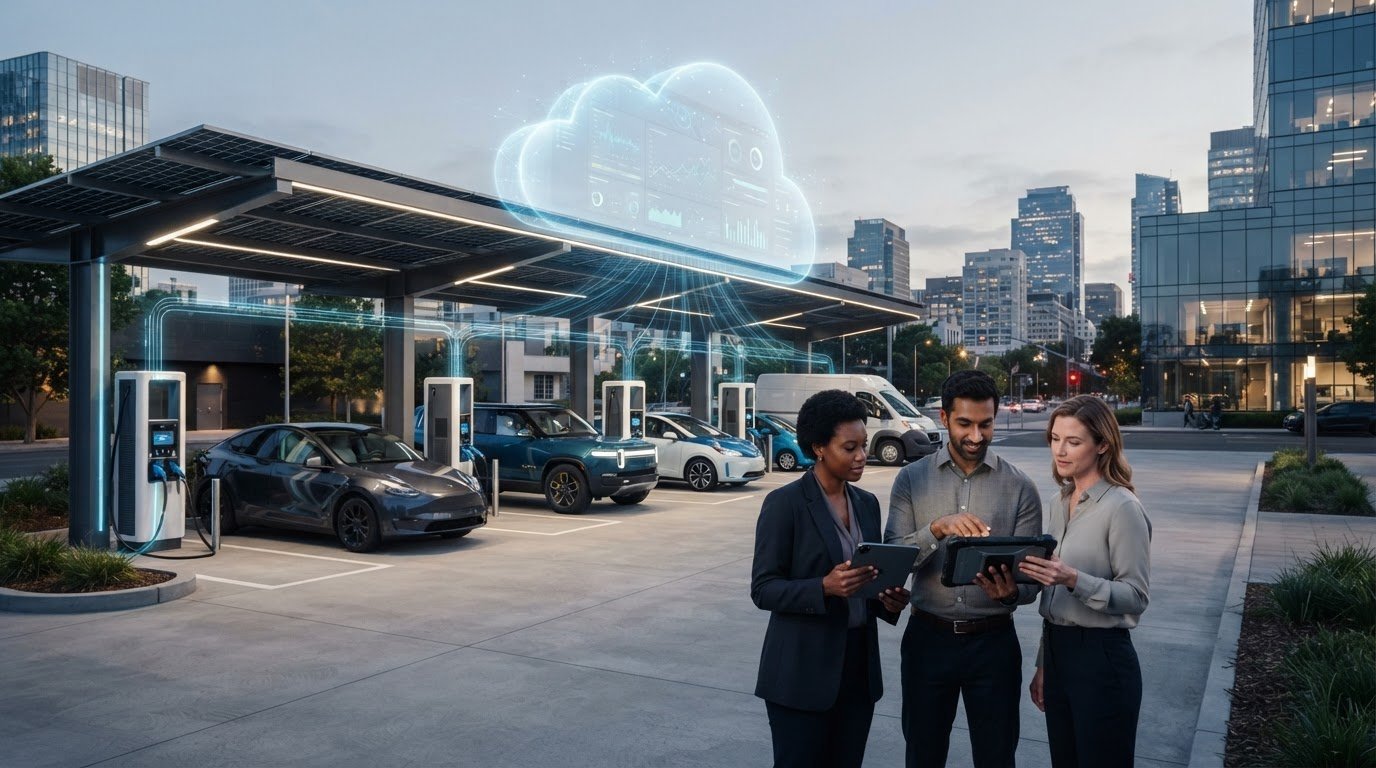
A cloud-managed charger connects to a central software platform over the internet. Instead of treating each charging point as a separate device, operators can use the platform to view station status, manage access, track sessions, and organize billing across a site or network. This makes charging an operational system, not just a hardware purchase.
A standalone charger can deliver power, but usually offers less remote visibility and centralized administration. That may work for a single private unit. It becomes harder when several drivers share chargers across a workplace, property, fleet, or public site. Cloud managed ev chargers let operators manage connected assets through one interface, depending on the charger’s capabilities and its connection to the platform.
The Cloud Service Provider (CSP) operates the backend platform that communicates with chargers and supports operator and driver workflows. Depending on the system, that can include station monitoring, session records, user access, and billing data. The CSP sits between charging hardware and the services that rely on it, so connectivity, compatible protocols, and cybersecurity all matter. For background on the security of cloud-managed EV charging infrastructure, consider how the backend handles authentication, payments, and operational data.
“Connected” describes a charger’s ability to communicate. “Managed” is about what operators can do with that connection: coordinate multiple stations, understand usage, and support billing and energy-management processes. A connection alone is not a management strategy.
The Core Technology: Internet Connectivity and APIs
Chargers can connect through Wi-Fi, wired Ethernet, or cellular networks such as 4G or 5G LTE. Ethernet can suit fixed sites with network infrastructure; Wi-Fi can use an existing local network, while cellular connectivity can provide another option where wired access is impractical. Site conditions and platform requirements shape the choice.
An API lets a charger platform exchange operating and transaction data with compatible billing or building management systems. When evaluating an integration, identify the specific information and actions you need, then confirm that both systems support them.
The Death of the Standalone Charger
With local-only control, staff may need to handle more tasks at the charger itself, from checking sessions to resolving access issues. That can become cumbersome at multi-user sites, where records and user administration need to stay coordinated. Cloud management centralizes those workflows and can make adding stations simpler, without requiring every unit to be managed in isolation.
Hardware can also fall out of step with changing software needs. Over-the-air updates can help where the charger and provider support them, but update capability shouldn’t be assumed for every model. Pair suitable hardware with a management platform and interoperable communication standards to give operators more flexibility as their network grows.
How Cloud Management Transforms EV Infrastructure Performance
A connected charger is only the starting point. Operational value comes from using its data to spot issues, coordinate power, and manage access. A cloud platform can show station status and session information in one place, helping an operator distinguish an individual charger problem from a wider site issue. Remote diagnostics may also allow an operator to investigate or reset a unit without dispatching a technician, when the charger and platform support those controls.
At a shared site, Dynamic Load Balancing (DLB) helps distribute available electrical capacity across active chargers. Rather than allowing every unit to draw its maximum at once, a management system can adjust charging power according to configured site limits and current demand. This can help avoid exceeding the site’s available capacity and make better use of it. The exact behavior depends on compatible hardware, metering, configuration, and the platform.
OCPP Compliance: The Universal Language of the Cloud
Open Charge Point Protocol (OCPP) gives chargers and management platforms a shared way to communicate. It’s an important interoperability consideration, but support for a protocol version alone doesn’t guarantee that every feature works across every device and platform. OCPP 1.6 remains widely deployed and supports functions such as remote operations and smart charging. OCPP 2.0.1 adds a device model, security profiles, and support for ISO 15118 Plug & Charge. Compare the versions and platform role in this CHRG Network Access guide.
Firmware, Access, and Day-to-Day Control
Firmware updates can deliver security fixes and add or improve functions, but availability depends on the charger, its manufacturer, and the management setup. Remote delivery can simplify updates for supported devices; it isn’t a universal promise of automatic updates. Define who approves updates and when they’re scheduled so maintenance fits site operations.
User access control turns charging from an open outlet into a managed service. Depending on the system, drivers may authenticate with an RFID card or mobile app, while operators assign access and associate sessions with users or accounts. That creates a clearer basis for managing shared use and billing. For cloud managed ev chargers, pair access rules with reliable session records and a clear process for handling exceptions.
Predictive Maintenance and Remote Troubleshooting
Cloud data can reveal recurring faults, communication dropouts, or unusual changes in charger behavior. These signals can help operators prioritize investigation, but they don’t prove hardware failure is imminent. Remote checks and resets can resolve some problems without an on-site visit; faults requiring physical inspection still need hands-on attention. Any operational savings depend on the site, issue mix, and support model.
Charging Shop offers professional chargers alongside CHRG Network access for station management.
Local vs. Cloud Control: Solving the Connectivity Dilemma
What happens if the internet connection drops? Cloud management depends on connectivity for remote visibility and platform-based functions, but that doesn’t always mean charging must stop. The answer depends on what the charger can do locally, what information it can store, and how the system is configured. Plan for connection loss before it happens, not during a busy charging period.
Local control keeps defined functions at the site, so they may continue without an active connection to the cloud. It can reduce dependence on internet response times, but offers less remote oversight and can make multi-site administration harder. Cloud control centralizes monitoring and management, making it easier to oversee distributed assets. It relies on a working connection, and communication delays can affect cloud-dependent actions. Hybrid control combines local operating rules with cloud-based oversight, balancing continuity with centralized management when supported by the charger and platform.
Use this framework: prioritize local capabilities when charging must continue through an outage; prioritize cloud control when remote monitoring, coordinated management, or centralized records are central to operations; consider hybrid control when you need both site-level resilience and network-wide visibility. The right design depends on the consequences of downtime, the reliability of the site connection, and which functions need to keep running offline.
The “Always-On” Myth: Fallback Strategies
Some systems can cache authorization data locally, allowing previously approved RFID cards to work during a temporary outage. That behavior isn’t universal, and offline charging may not support every billing, access, or reporting function. Define what the charger should allow, restrict, or record while disconnected, then test the fallback process as part of commissioning and operations planning.
A secondary 4G or 5G connection can provide another route to the management platform if a primary connection fails, but only where the hardware and network setup support it. Don’t assume that a named charger includes cellular failover. The Alfen Single Pro Line 22kW review gives product-specific context for evaluating a professional charging unit alongside its management requirements.
Security and Data Privacy in the Cloud
Cloud access adds operational convenience, but it also creates more connected systems to secure. Look for encrypted communications between the charger and platform, controlled user permissions, strong account security, and a clear process for software updates. Keep charging equipment on appropriately segmented networks where practical, and limit access to the people and systems that need it. These safeguards reduce exposure; they don’t eliminate cybersecurity risk.
Data handling matters, too. Charging sessions may involve driver identifiers, payment details, or usage records. For systems operating in the EU, assess GDPR responsibilities, data retention, and who can access personal information. If local data residency rules apply to your organization or location, make storage and processing location part of the platform assessment rather than assuming all cloud services handle data the same way.
For operators balancing remote oversight with local resilience, CHRG Network access can be part of a professional hardware-and-management setup. Cloud managed ev chargers work best when connectivity, offline behavior, and security controls are considered together.

Selecting the Right Hardware for Cloud Integration
Choose hardware and cloud software as one operating system. Start with the job each charger must do: serve vehicles parked for longer periods, support faster turnaround, or provide charging across a shared site. Then compare power type, rated output, network compatibility, access control, metering, and the management functions your operation needs. A charger’s maximum output alone won’t tell you whether it fits your network.
AC hardware suits sites where vehicles can remain connected during working hours or overnight. DC hardware can support faster charging needs, but the right choice depends on vehicle compatibility, site capacity, and operating patterns. For multi-brand networks, interoperable management can help avoid tying every station to one manufacturer’s ecosystem. Charging Shop offers 22kW AC options from V2C and Alfen, a 20kW DC wallbox from V2C, and ABB Terra AC alongside CHRG Network access.
Top AC Picks: V2C Trydan and Alfen Single Pro Line
The V2C Trydan 22kW and Alfen Single Pro Line 22kW are AC options to consider for homes, small businesses, workplaces, and other professional settings. Their shared rated output makes them easy to compare on power, but assess connectivity and cloud functions using each model’s technical documentation and the intended management platform. Explore the V2C Trydan 22kW charging guide for product context.
For a higher-traffic office, focus on how the charging setup will support shared access, session records, and site-level power management. Don’t assume that chargers with the same output offer identical communications or integrations. Match the connection method and supported management functions to your site’s network design and software requirements.
DC Power: V2C Denka and ABB Terra AC Solutions
The V2C DENKA 20kW DC Wallbox is a DC option for sites that prioritize quicker vehicle turnover. Compare its intended use with expected dwell times and available site power. The business guide to DC wallbox charging provides additional context on DC deployments. ABB Terra AC belongs in a separate AC comparison; evaluate its specific configuration and rated output from product documentation rather than treating it as a DC charger.
Billing needs deserve equal attention. A MID meter can provide measured energy data for charge-session billing where that level of metering is required. Check how the meter’s readings reach the management platform and appear in transaction records. Don’t assume that cloud connectivity alone provides billing-grade measurement, or that every hardware configuration includes a MID meter.
Charging Shop offers V2C, Alfen, and ABB hardware, with CHRG Network access for professional station management. Compare options and review the ABB Terra AC charging guide as part of your shortlist. For cloud managed ev chargers, align hardware capability, metering, and platform functions before scaling. Explore professional charging hardware and CHRG Network access.
The CHRG Network: Scaling Your Managed Infrastructure
Hardware gets charging started. A management layer helps turn multiple chargers into an operating network. CHRG Network provides professional station management with remote monitoring and automated billing. Its hardware-agnostic approach gives operators flexibility across supported equipment, which can be useful when planning multiple sites or connecting charging assets from different manufacturers.
Start with the operating model, not just the charger count. Decide who will use each station, how you want to recover energy costs, and what information your team needs to oversee sessions. A personalised charging offer can help align hardware and network access with your business setup, whether you’re planning a workplace, shared property, or charging site.
Monetizing Your Assets: From Cost Center to Profit Center
Revenue starts with a clear charging policy. Define whether employees, residents, visitors, or members of the public can use each station, and establish the pricing approach for each group. For example, a workplace might handle employee charging differently from public access. Set those rules before opening access, then make sure your billing workflow reflects them. Available tariff options depend on the platform configuration.
Automated billing can reduce manual administration by organizing session charges for processing and reporting. For multi-unit apartments, it can help simplify the work of tracking shared charging sessions and allocating charges among residents. Agree internally on how usage is assigned and reviewed, so operators can reconcile charging activity with the property’s billing process. Don’t treat charging revenue as automatic profit: account for energy, operating expenses, and the access policy when assessing the business case.
Fleet and Multi-Station Management
As a network grows, a single management layer can make remote oversight more practical than handling each station separately. CHRG Network supports professional station management and remote monitoring. Operators can use charging activity and network information to guide operational decisions; available data and reporting formats depend on the system. For sustainability or ESG reporting, identify the measures your organization needs and how they’ll be recorded before setting reporting expectations.
Move from hardware purchase to network operation with a clear sequence:
- Define the use case. Map locations, users, access rules, and charging needs.
- Select suitable hardware. Choose equipment that fits the site and your intended management approach.
- Arrange network access. Pair the charging setup with CHRG Network access for professional station management.
- Set operating and billing processes. Establish how charging activity will be monitored, billed, and reviewed.
- Plan for growth. Keep future locations and equipment in view as you build out the network.
Cloud managed ev chargers work best when hardware, management access, and billing processes are planned together. Ready to plan your network? Get a Personalized Charging Offer from Charging Shop.
Build Your Charging Network for What Comes Next
Your infrastructure decisions shape how easily your operation can adapt to new users, sites, and energy needs. Treat cloud managed ev chargers as a platform for growth: choose hardware and management access that support the way you plan to operate, then expand with a clear view of access, billing, and performance.
Charging Shop brings professional charging hardware together with CHRG Network access for station management. Its range includes V2C, Alfen, and ABB chargers. Start with a setup that fits your business, then plan how you’ll manage access, billing, and performance as your network grows.
Start with the network you want to create, not just the first charger you need. Explore your options and take the next step toward connected, professionally managed charging.
Explore Cloud-Ready EV Chargers at Charging Shop.
Frequently Asked Questions
Do cloud managed EV chargers require a monthly subscription fee?
Not always, because pricing depends on the charging network and services you choose. Some providers charge recurring access or software fees; others may use transaction fees or different pricing structures. Compare what the plan covers, such as station monitoring, billing tools, and user access, rather than looking only at the subscription amount. Charging Shop provides access to the CHRG Network, with access fees applying to the network service.
Can I use any cloud management software with my OCPP-compliant charger?
No, OCPP support doesn’t guarantee that every charger will work with every platform or support every feature. Compatibility can vary by protocol version, implementation, and platform configuration. For example, a charger and platform may communicate for basic operations but differ in support for a specific billing or smart-charging function. Compare the exact model, protocol version, and required features before building a system around them.
What happens to my EV charger if the cloud service provider goes out of business?
The charger may still provide basic charging, but continued operation and access to cloud-dependent features depend on its design and the service agreement. Before deployment, understand who controls the hardware configuration, how charging records can be exported, and whether another platform can take over. OCPP can support interoperability, but it doesn’t guarantee a seamless migration. Keep operational records and a transition plan, especially for revenue-generating sites.
Is a cloud-managed charger more secure than a locally controlled one?
Neither approach is automatically more secure. Cloud systems add internet-connected accounts and services to protect, while local systems still need secure physical access, network controls, and maintenance. Review authentication, encryption, software-update practices, user permissions, and incident procedures for the complete setup. For example, separating chargers from sensitive business systems can limit exposure if one part of the network is compromised.
How much data does a cloud-managed EV charger consume per month?
There isn’t one reliable monthly figure for every charger. Data use depends on how often it reports, the number of charging sessions, diagnostic detail, and whether updates are downloaded over the connection. A site with frequent sessions or large update files may use more data than a lightly used installation. If using a metered cellular plan, review actual consumption after activation and set a suitable data allowance.
Can I manage chargers from different brands under one cloud platform?
Yes, a platform can manage different brands if it supports those charger models and their implemented communication features. OCPP can help enable cross-brand communication, but it doesn’t make every feature universally compatible. Before combining equipment, map the functions you need, such as user authorization or session reporting, to each charger and platform pairing. This helps identify differences before they affect daily operations.
Do I need a special internet connection for a commercial cloud-managed station?
Usually, you need a dependable connection that meets the charger and platform’s requirements, not a dedicated connection by default. Ethernet, Wi-Fi, or cellular service may suit different sites. Consider signal quality, network access rules, and what happens if the primary connection fails. For a commercial location, coordinate network settings with the organization’s IT team and avoid exposing charger equipment unnecessarily to internal systems.
How does cloud management help with solar panel integration?
Cloud management can help coordinate charger demand with solar generation when the chargers, energy meters, solar equipment, and platform support the required data exchange and controls. For instance, an energy-management system may use generation and site-load information to adjust charging power. The platform alone doesn’t create solar integration, so confirm the complete system’s compatibility and decide whether your priority is using onsite generation, limiting grid demand, or both.
