
 Deutsch
 Dansk
 Suomi
 Latviešu
 Lietuvių
 Norsk bokmål
 polski
 Русский
 Svenska

No products in the cart.
Uncategorized
Business Case for Workplace EV Charging: Costs and Value

25
Oct
Oct
A charger count alone won’t make the investment case. The business case for workplace EV charging depends on matching equipment to parking time and electrical capacity, then weighing setup and operating costs against employee benefits, potential charging revenue, and available incentives. A typical 4-8-hour workplace layover can add approximately 24-115 km of driving range, depending on the charging equipment.
It’s reasonable to focus on upfront costs, especially when electrical upgrades could affect the project budget. But a business case for workplace EV charging also depends on how often stations will be used, who will access them, and how charging supports your goals.
This guide covers the practical setup decisions, cost factors, and ways incentives or charging revenue may affect the calculations. It also shows how employee needs and future demand fit into the assessment, so you can weigh potential value against operating constraints.
Key Takeaways
- Match charger type and capacity to how long employees, visitors, and customers typically park.
- Include electrical capacity, future demand, and station-sharing policies in your setup plan.
- Compare free, paid, and subscription access models to see how charging could support operating costs.
- Build a realistic project budget by accounting for equipment, electrical work, permits, and relevant incentives.
- Assess employee value and sustainability goals alongside utilization, maintenance, and potential revenue.
Charging setup considerations such as parking duration and electrical capacity
For US workplaces, Level 2 AC chargers often balance cost and performance for employees parked throughout the workday. Operating and maintenance costs vary with charger type, port count, and station numbers, so include servicing in the operating budget.
Grid capacity, charger reliability, and cybersecurity all need consideration. Plan capacity with the utility, maintain equipment, and control access to connected systems. A business case for workplace EV charging should account for these operating needs, not just the initial equipment purchase.
Parking Duration and Charging Capacity
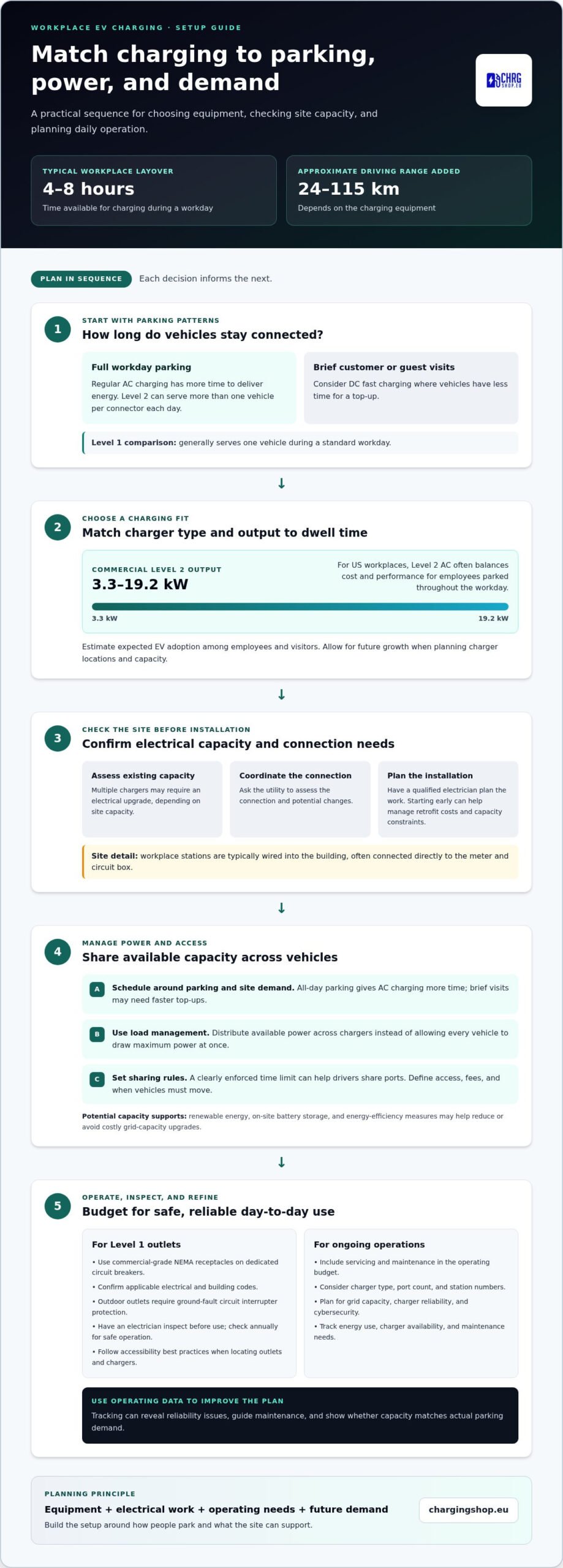
Parking duration is how long vehicles remain connected, while electrical capacity limits how much charging a site can support. Both shape charger selection and future expansion. A typical 4-8-hour workplace layover can add approximately 24-115 km of driving range, depending on equipment. Each Level 2 connector can serve more than one vehicle per day, while Level 1 generally serves one vehicle during a standard workday.
Commercial Level 2 output ranges from 3.3 to 19.2 kW. Workplaces with full-day parking may provide a full charge through regular AC charging. Locations serving brief customer or guest visits may suit DC fast charging. Estimate expected EV adoption among employees and visitors, then allow for growth when planning charger locations and capacity.
Electrical capacity requires a site-specific assessment. Workplace stations are typically wired into the building, often connected directly to the meter and circuit box. Adding multiple chargers may require an electrical upgrade, depending on the site’s existing capacity. Ask the utility to assess the connection and potential changes, and have a qualified electrician plan the installation. Starting early can help manage retrofit costs and address capacity constraints.
Energy Management and Electricity Costs
Energy management coordinates charging demand with available building power and electricity costs. It matters because charging alongside other building loads can strain capacity or raise operating expenses. Renewable energy, on-site battery storage, and energy-efficiency measures may help reduce or avoid costly grid-capacity upgrades.
Plan charging schedules around parking patterns and site demand. When employees park all day, AC charging has more time to deliver energy; brief visits may require faster top-ups. A clearly enforced time limit can help share ports among drivers. Load management can distribute available power across chargers instead of letting every vehicle draw maximum power at once.
For Level 1 outlets, confirm commercial-grade NEMA receptacles connect to dedicated circuit breakers and meet applicable electrical and building codes. Outdoor outlets require ground-fault circuit interrupter protection. Have an electrician inspect receptacles before use, then check them annually for safe operation. Follow accessibility best practices when locating outlets and chargers.
Track energy use, charger availability, and maintenance needs once the system is running. These measures can reveal reliability issues, guide maintenance, and show whether capacity matches actual parking demand. Strengthen the business case for workplace EV charging by including servicing, energy management, and future demand in the operating plan.
Brand sustainability and employee satisfaction
Workplace charging connects employee convenience with a visible investment in EV infrastructure. Its value depends on how well the program meets staff needs and supports sustainability goals.
Employee Benefits and Workplace Charging
Workplace EV charging gives employees access to a charger where they park during the workday. This can make EV ownership more practical for staff who do not have reliable access to charging at home.
Set clear rules for access, fees, and sharing before opening stations. For example, a workplace can define who qualifies, when a vehicle must move, and whether charging is free or paid. In 2016, 80% of workplaces participating in the US Department of Energy’s Workplace Charging Challenge offered free charging. That example shows one approach, not a requirement for every employer.
Shape the benefit around employees’ actual needs. A workplace with limited parking turnover may prioritize regular staff, while a shared office can allocate access across shifts. Clear policies explain how charging works and help prevent disputes over charging spaces.
Sustainability Goals and Brand
Workplace charging can support a sustainability strategy by making EV use more convenient for employees. Visible infrastructure may also strengthen brand credibility by demonstrating practical support for lower-emission travel, rather than relying on messaging alone.
Set a clear purpose for the program. A company might aim to support employee EV adoption, provide charging at key locations, or integrate charging into broader transport plans. Track station use and employee participation to see whether the program meets those aims. Charging access alone does not prove a particular emissions result, so base claims on measured outcomes.
Government incentives may influence how a business develops charging infrastructure, but employee value and brand goals are separate considerations. Describe the program accurately: explain who can use it, how access is managed, and what the organization aims to achieve. Specific, measured statements build more trust than broad sustainability claims.
Attraction, Retention, and Charging Options
Charging access may help attract and retain employees who value practical support for EV ownership. The benefit it provides depends on commuting patterns, parking access, and employees’ access to charging at home.
Workplace charging differs from home reimbursement: employees charge at the worksite, while reimbursement covers eligible charging elsewhere. Home reimbursement may support staff with home chargers, while public charging reimbursement can help cover charging on the road. Each approach needs a clear policy for eligibility and expenses.
Compare options by employee access, administrative effort, and alignment with your sustainability goals. A blended policy can support employees who charge at work and those who rely on home or public charging. For a tailored view of charging arrangements, explore a Personalised Charging Offer as one possible next step.
Charging revenue from employees, visitors, and public access
Charging revenue depends on who can use each station, how long vehicles stay, and how prices are set. Set access rules to reflect employee parking, visitor demand, and any plans for public use.
Charging Access and Pricing Models
An access model defines who can charge, when they can connect, and what they pay. It matters because employee convenience, visitor access, and revenue goals may compete for the same stations.
Businesses can set prices per kWh to recover costs over time. Base the EVSE price on the parking model and the charging service users receive.
Estimate utilization before treating charging fees as meaningful revenue. One study’s average observed utilization was 120 charging visits per month per station. Treat that figure as an example, not a forecast for every location.
Management Software and Tariffs
Charging management software organizes station access, usage records, and tariffs. It matters because clear rules make it easier to distinguish employee sessions from visitor or public charging.
Set separate access groups and pricing rules where your business model calls for them. For example, employees could pay a workplace rate while visitors pay a per-kWh tariff. Review session data to see whether stations serve their intended users and pricing reflects parking duration. A pilot that starts with free charging and later switches to paid access is one possible model.
Accessibility belongs in the site plan, not as an afterthought. Workplace charging projects may need to meet ADA accessibility requirements. California’s 2019 Green Building Standards Code, Chapter 11B Section 821, defines three accessible EV space types: van, standard, and ambulatory. Accessible spaces affect layout, circulation, signage, and how drivers reach charging equipment.
Permits and approvals can also shape project scope. Commercial installations may involve local electrical and safety codes, zoning approvals, and utility interconnection processes. Include those steps in the schedule and budget. A 50 kW DC fast charger may serve quick-turnover locations differently from employee parking, so match charger use, site rules, and access design before setting tariffs.
Public access can extend charging availability beyond employees, but it changes operating needs. Consider how open access affects parking turnover, station availability, and revenue collection. A Santa Monica sample DC fast charger recorded 1,500 visits over a two-year period, illustrating how location and nearby activity can influence use.
Installation costs, permits, and incentives
Installation budgets depend on more than charger hardware. Electrical work, utility connections, permits, and available incentives can all affect the investment.
Installation Costs
Installation costs cover the work required to make charging stations ready for use. The site’s power supply and layout can change the project scope.
Map the distance from proposed charger locations to the electrical panel or power source. Longer runs can require more electrical work. Include equipment, wiring, utility connection, and any capacity upgrades in the project estimate. Level 2 AC and DC fast charging can also require different electrical arrangements, so match the design to parking patterns and expected use.
Include permitting in the project plan. Commercial EV charging installations may involve local electrical and safety code compliance, zoning approvals, and utility interconnection processes. These requirements can affect scope and timing. Early coordination helps align site design, electrical work, and the utility connection before installation begins.
Ask the utility to assess what the existing electrical connection can support and what changes may be needed. Have a qualified electrician plan the electrical work. If grid capacity is limited, renewable energy, on-site battery storage, and energy-efficiency measures may help reduce or avoid costly upgrades.
Government Incentives and Commercial Rebates
Government incentives and commercial rebates may offset eligible project expenses. They can change how much a business needs to fund directly.
In the United States, eligible commercial electric vehicle supply equipment projects can receive tax credits of up to 30% of project costs under the Inflation Reduction Act. The National Electric Vehicle Infrastructure (NEVI) formula program, Section 30C alternative fuel infrastructure tax credits, and state clean-fuel grants are also identified as potential incentives for charging deployment.
Incentives have eligibility conditions, so define the project scope before including them in financial projections. Separate equipment, electrical work, and utility upgrades in the budget. This breakdown helps match expenses to relevant support programs and identify costs that fall outside an incentive.
Keep the timeline in view. Permits, zoning approvals, and utility interconnection all affect when a project can proceed. A grant or tax credit supports the business case only if the planned installation and eligible expenses meet its terms. Record application requirements, deadlines, and award conditions alongside the project schedule.
Compare the budget before and after potential incentives, then assess whether the remaining investment fits your workplace goals. Include electrical capacity, future expansion, and operating needs. A Personalised Charging Offer can help shape a charging setup around your business requirements, without treating incentives as guaranteed revenue.
Building a workplace EV charging business case
A strong investment case connects workplace charging infrastructure to business goals, operating costs, and measurable use. Weigh employee value alongside station utilization and financial returns.
Business Benefits of Workplace Charging
Workplace charging is an investment in employee access and business infrastructure. Its value may extend beyond charging revenue to employee experience and EV adoption.
Workplaces are the second-most popular charging location for electric vehicle drivers. Employees with access to workplace charging have been estimated to be 20 times more likely to drive an EV than employees without access. Use these findings as context, then assess local staff demand and parking patterns.
Build the case around your organization’s desired outcomes. A site might prioritize employee access, attract EV-driving customers, or support sustainability commitments. Choose measures for each goal, such as station use for access or employee participation for adoption. Charger installation alone does not prove business impact.
Include charging operations in the financial model. Account for electricity, maintenance, station management, and any electrical upgrades. Maintenance needs depend on charger type, port count, and the number of stations. Also budget for the resources needed to keep chargers available and manage access policies.
Compare owning chargers with charging-as-a-service models. These arrangements may let businesses install stations with little or no upfront cost. That changes the investment profile, but operating responsibilities and commercial terms still affect overall value. Compare each model with your site’s expected use and your capacity to manage the program.
Payback Period and Return on Investment
Payback measures how long it takes investment returns to offset initial costs; ROI compares value with investment. Both matter because low utilization can extend payback, even when chargers support employee or customer goals.
A Netherlands case study modeled a two-year payback at 20% utilization, without photovoltaic power or battery storage. Treat this as a specific scenario, not a universal forecast. Utilization, equipment, energy costs, and revenue model all affect results.
Use a consistent analysis period. One profitability tool assumes a technology lifespan of 10 years and calculates net present value over the same period. The study uses a 10% discount rate in charger cost and payback calculations. These assumptions help compare future benefits with current investment, but the inputs must reflect the proposed site.
Model employee-only access, visitor charging, and public use. Compare expected sessions, charging revenue, operating expenses, maintenance, and potential incentives. Test lower utilization as well as your planned case. A useful business case shows which factors drive returns and which benefits remain valuable beyond direct revenue.
Charging Shop: V2C Trydan 22kW
Charging Shop helps businesses compare EV charging hardware and find an option aligned with their workplace plans. The V2C Trydan 22kW, V2C DENKA 20kW DC Wallbox, and Alfen Single Pro Line 22kW offer distinct equipment options to consider alongside site requirements and charging demand.
Choose equipment based on intended use, parking patterns, and the charging setup for your site. If you’re weighing equipment needs against investment goals, a Personalised Charging Offer can help tailor the options to your project.
Explore Charging Shop’s workplace charging solutions and request a Personalised Charging Offer to plan your setup.
Turn Your Workplace Charging Plan Into Action
Turn your business case for workplace EV charging into a decision your team can act on. Assign an internal owner, agree on what success looks like, and keep project priorities visible throughout planning. This gives the team a clear point of coordination as equipment choices, access policies, and daily responsibilities take shape.
Before moving ahead, align the people responsible for facilities, finance, and employee experience. Give each team a shared view of the project goals and decision criteria. This keeps future discussions focused on workplace needs rather than disconnected equipment preferences.
Charging Shop offers the V2C Trydan 22kW, V2C DENKA 20kW DC Wallbox, and Alfen Single Pro Line 22kW. A Personalised Charging Offer can help frame equipment choices around your project requirements.
Bring your priorities to the next discussion. Contact Charging Shop to discuss workplace charging and move your plan forward with confidence.
Frequently Asked Questions
How much do workplace EV charging stations cost to purchase and install in the U.S.?
Installed cost depends on charger type, equipment quantity, electrical work, and the distance between charging locations and the power source. A site with existing capacity and short cable runs has different infrastructure needs from one requiring panel work or utility upgrades. Build a site-specific budget with separate allowances for hardware, electrical construction, permitting, utility work, and ongoing maintenance. This shows what drives the investment without relying on a generic estimate.
What federal tax credits, grants, and utility rebates are available for workplace EV charging in 2026?
In the U.S., eligible commercial electric vehicle supply equipment projects can receive tax credits of up to 30% of project costs under the Inflation Reduction Act. Potential support also includes the National Electric Vehicle Infrastructure formula program, Section 30C alternative fuel infrastructure tax credits, state clean-fuel grants, and utility incentives. Program eligibility and covered expenses vary. Map each funding option to the project’s location, equipment, and installation scope before including it in projections.
How can employers estimate employee demand and charger utilization?
Estimate demand by combining employee interest with practical travel and parking patterns. Use a staff survey to ask about current or planned EV use, home charging access, commuting needs, and preferred charging days. Compare responses with available parking and work schedules, then model different participation levels. After launch, review station sessions and energy use regularly. This operating data can help refine access rules and determine whether sustained demand supports adding ports.
How do utility rates, demand charges, and managed charging affect workplace charging costs?
Utility tariffs determine how electricity use is billed, while demand charges can make simultaneous high-power charging an important cost factor. Managed charging can stagger or limit charging sessions to align demand with building capacity and lower-rate periods. For example, Southern California Edison’s TOU-EV-3-A schedule identifies noon to 6 PM as an on-peak period. Compare the site’s tariff and charging schedule together to understand their effect on operating expenses.
What steps should a business take to plan, install, and operate workplace EV charging?
Start by defining users, parking patterns, access rules, and project goals. Assess the site’s electrical capacity, then coordinate utility requirements, permits, and code compliance. Select equipment for expected use and arrange installation with a qualified electrician. Before stations open, set user access, pricing, and rules for moving vehicles. During operation, track energy use, station availability, and maintenance needs, then adjust capacity and rules as demand develops.
What are the ongoing operating and maintenance costs for workplace EV chargers?
Operating costs vary with charger type, the number of chargers, and port count. Include servicing, energy management, and maintenance in the budget.
