
 Deutsch
 Dansk
Dansk Suomi
Suomi Latviešu
 Lietuvių
 Norsk bokmål
 polski
 Русский
 Svenska
No products in the cart.
Uncategorized
Alfen vs Schneider EV Charger: The 2026 Professional Hardware Showdown
08
Sep
Sep
The most reliable brand in your electrical cabinet might actually be the wrong choice for your 2026 EV infrastructure. When comparing the Alfen vs Schneider EV charger, most buyers assume they’re just choosing between two high-quality boxes. That’s a mistake. Selecting the wrong hardware today leads to software dead ends and expensive grid upgrades tomorrow. You need a solution that balances raw industrial power with the data-driven intelligence required for modern fleet management.
You’re likely worried about future-proofing your investment against shifting regulations or the complexity of managing multiple charging points. It’s a valid concern. This guide cuts through the technical fluff to compare these European giants head-to-head. You’ll learn which hardware offers the best software integration, how to prevent grid overload during peak hours, and which unit delivers the highest ROI for your specific setup. We’ll break down the Alfen Eve series against the Schneider Charge Pro to find your perfect match. From MID-certified meters to ISO 15118 readiness, we’ll ensure your choice stays relevant long after the initial installation. Stop guessing and start building a high-performance charging network that scales with your business.
Key Takeaways
- Identify the core technical strengths of each brand to match your specific 2026 infrastructure requirements.
- Navigate the Alfen vs Schneider EV charger landscape to secure a future-proof solution with seamless software integration.
- Master advanced load balancing techniques that prevent grid overload and eliminate the need for costly electrical panel upgrades.
- Compare professional configuration tools to ensure a rapid, friction-free deployment for your home or business fleet.
- Leverage management layers like the CHRG Network to maximize the performance of your chosen hardware.
Alfen vs Schneider: Defining the 2026 EV Charging Landscape
By 2026, European infrastructure has matured into a high-stakes battle between precision engineering and industrial scale. Choosing between an Alfen vs Schneider EV charger isn’t just about picking a plastic box for your wall. It’s a strategic decision about how you’ll manage energy for the next decade. These two brands dominate the market because they’ve solved the reliability gap that plagued earlier generations. Alfen remains the specialist, focusing purely on smart energy solutions. Schneider Electric is the global titan, using its massive electrical legacy to simplify complex rollouts. As EV charging station technology evolves, the distinction between a simple plug and an intelligent energy node becomes critical for your ROI.
The Alfen Philosophy: Smart Grids and Data
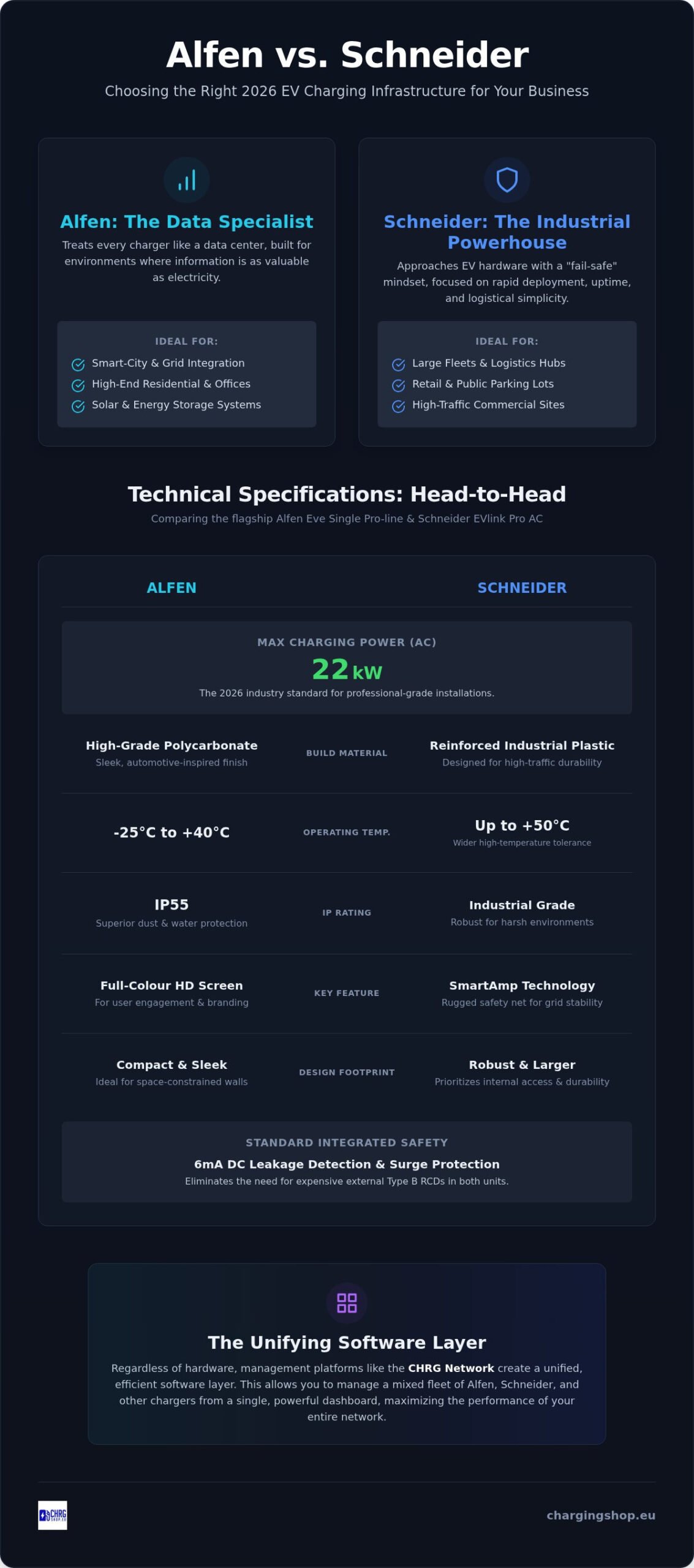
Alfen treats every charger like a data center. The Alfen Single Pro Line 22kW is their flagship for a reason. It’s built for environments where information is as valuable as electricity. This unit doesn’t just charge a car; it communicates with smart buildings and energy storage systems to optimize every watt. The integrated full-colour HD screen is a game-changer for user engagement. It provides clear, real-world data to drivers while offering businesses a professional platform for branding or instructions. If your project requires deep integration with solar arrays or complex grid management, Alfen is the surgical tool you need. It’s the proactive choice for those who want to see exactly what’s happening across their network in real-time.
The Schneider Philosophy: Industrial Scale and Simplicity
Schneider Electric approaches EV hardware with a “fail-safe” mindset. Their legacy in circuit breakers and industrial switchgear informs every inch of the Schneider Charge and EVlink Pro AC series. In July 2026, the launch of the Schneider Charge Pro reinforced their focus on rapid, industrial-scale deployment. They understand that for large fleets, installation time is a massive cost driver. Their hardware is designed for speed. It features intuitive internal layouts that general electricians can configure without specialized training. Schneider’s “SmartAmp” technology provides a rugged safety net, ensuring that even the largest charging hubs don’t compromise the local grid. It’s the “set and forget” solution for managers who prioritize uptime and logistical simplicity over granular data tweaking.
Your choice depends on your operational goals. Alfen wins in smart-city projects and high-end residential setups where data is king. Schneider dominates in logistics hubs and retail parking where reliability at scale is the only metric that matters. To bridge the gap, many professionals utilize the CHRG Network to manage this hardware, ensuring that regardless of the brand, the software layer remains unified and efficient. Don’t settle for a generic solution. Align your hardware with your long-term energy strategy.
Technical Specifications: Charging Power and Build Quality
Power delivery is the ultimate benchmark in the Alfen vs Schneider EV charger debate. By 2026, 22kW AC charging has become the standard for professional-grade installations. This output provides the necessary speed for modern EVs with high-capacity batteries. According to the Global EV Outlook, the demand for high-performance AC infrastructure is surging as battery capacities increase. Alfen utilizes high-grade polycarbonate for a sleek, automotive-inspired finish. Schneider relies on reinforced industrial plastics designed for high-traffic durability. Both manufacturers offer socket and tethered options, providing the flexibility needed for private driveways or public parking hubs. Safety is integrated at the core. Every unit features 6mA DC leakage detection and surge protection as standard, eliminating the need for expensive external Type B RCDs.
Comparing the Flagships: Alfen Single Pro vs Schneider EVlink
The Alfen Single Pro Line 22kW build quality stands as the gold standard for 2026, balancing aesthetic elegance with extreme internal durability. It operates seamlessly between -25°C and +40°C with an IP55 rating, offering superior protection against dust and water ingress. The Schneider EVlink Pro AC matches this power output but targets a broader temperature range, functioning up to +50°C. While both units support 3-phase charging at 32A, the Schneider hardware is slightly more robust in its physical footprint. Alfen remains more compact, making it the preferred choice for space-constrained office walls or premium residential garages. Explore our full range of high-performance hardware to see these specs in detail.
Hardware Reliability and Component Lifespan
Schneider Electric holds a clear advantage in high-duty cycle environments. Their hardware leverages decades of industrial switchgear expertise, meaning the internal contactors are built for thousands of cycles without degradation. It’s the “heavy-duty” option for 24/7 commercial use. Alfen counters this with a brilliant modular design. If a single component fails, it’s often replaceable without scrapping the entire unit. This circular approach extends the hardware lifespan significantly. In 2026, both brands offer competitive warranty terms, but Schneider’s global support network provides a safety net for international fleet managers. Alfen’s specialized focus ensures they remain at the cutting edge of component efficiency. Choose Schneider for raw endurance; choose Alfen for a repairable, high-tech investment.
Smart Features: Load Balancing and Network Integration
The real winner in the Alfen vs Schneider EV charger debate is determined by the software brain. In 2026, smart features are mandatory for avoiding grid overload and high utility fees. Active Load Balancing is your first line of defense. Both brands monitor your building’s total energy draw in real-time. If your office machinery or home appliances spike, the chargers automatically throttle down to prevent fuse trips. This proactive energy management saves you thousands in potential infrastructure upgrades. Both manufacturers have embraced OCPP 2.0.1 compliance, ensuring their hardware integrates with any back-end management software you choose.
Future-proofing is a major concern for 2026 buyers. Vehicle-to-Grid (V2G) readiness is no longer a luxury. Alfen leads this transition with hardware that is fully ISO 15118 compliant, allowing for bidirectional energy flow. While the hardware is vital, the management layer is what drives ROI. Utilizing CHRG Network access for EV stations provides the essential oversight needed for multi-brand environments. It simplifies billing, user access, and remote troubleshooting across your entire fleet. Don’t let your hardware operate in a vacuum; connect it to a network that maximizes its value.
Alfen Smart Charging Network (SCN)
Alfen’s Smart Charging Network (SCN) is a breakthrough for multi-unit developments. It allows up to 100 charging points to ‘talk’ to each other without requiring a central master unit. This decentralized approach means there is no single point of failure. If one charger goes offline, the rest of the network continues to balance the load perfectly. It’s the ideal choice for office car parks where reliability is non-negotiable. SCN also excels at solar integration, allowing you to prioritize charging during peak PV production hours to minimize grid reliance.
Schneider EcoStruxure and Load Management
Schneider Electric leverages its EcoStruxure platform to provide facility-wide energy visibility. This is an industrial-grade solution. It doesn’t just manage chargers; it manages the entire site’s energy profile. Schneider makes load shedding simple for large-scale industrial operations. When heavy plant equipment starts up, the EV chargers respond instantly to protect the site’s power quality. User authentication is equally streamlined. Drivers can start sessions via RFID, the dedicated app, or the latest “Plug & Charge” protocols. Schneider’s system is built for high-traffic environments where speed and security are the top priorities.
Installation and Maintenance: Which is Easier to Deploy?
Deployment speed is a hidden cost in every infrastructure project. When evaluating the Alfen vs Schneider EV charger, you must look beyond the hardware price. Schneider Electric designed its 2026 lineup for high-velocity rollouts. They prioritize the installer’s experience because labor hours often dictate the total project budget. Alfen takes a different route. They focus on configuration depth, allowing you to fine-tune the hardware for highly specific grid constraints. Maintenance is equally critical. Remote diagnostics and automated firmware updates ensure your network stays operational without constant on-site visits.
The Installer’s Perspective
Schneider units feature spacious internal layouts that simplify wiring. This design choice reduces the risk of errors and cuts installation time per station. It’s the preferred choice for contractors managing hundreds of units. Alfen’s hardware is more compact but offers unmatched flexibility for complex electrical environments. Use the MyEve app for rapid commissioning. It allows you to adjust parameters like phase rotation and current limits with surgical precision. While Schneider wins on physical speed, Alfen wins on digital adaptability. Explore our professional charger collection to find the right fit for your site.
Managing Your Assets in 2026
Successful fleet management requires a unified view of your hardware. In 2026, cyber threats are more sophisticated, making regular firmware updates non-negotiable. Both brands offer robust remote monitoring, but managing them in silos is inefficient. Integrating your hardware with CHRG Network allows you to oversee Alfen and Schneider units from a single dashboard. This centralization simplifies troubleshooting and ensures all units receive critical security patches simultaneously. You’ll reduce downtime and eliminate the need for manual intervention at each charging point. Focus on systems that provide high-visibility data without the administrative friction.
Total Cost of Ownership (TCO) is the ultimate metric for 2026. Consider how much you’ll save on labor with Schneider’s fast-mount systems versus the long-term energy savings from Alfen’s precise load management. Both brands offer professional-grade reliability, but your deployment timeline should dictate your final choice. Schneider is built for the sprint; Alfen is built for the marathon. Align your choice with your operational capacity to ensure a seamless rollout.
The Verdict: Choosing Your Infrastructure Partner
The Alfen vs Schneider EV charger debate concludes with a simple question: do you value granular data or industrial scale? Both brands have secured their dominance in the 2026 market by eliminating the reliability issues of the past. Alfen remains the premier choice for those who view energy as a digital asset. Their hardware is a sophisticated node in a smart grid. Schneider Electric is the powerhouse for those who need rugged, fail-safe infrastructure that deploys at lightning speed. Your choice dictates how your business or home interacts with the energy transition for the next decade. Don’t just buy a charger; invest in a partner that aligns with your technical capacity.
Best for Premium Homeowners and Tech-Savvy Offices
The Alfen Single Pro Line 22kW is the undisputed leader for high-end user experiences. It’s the right choice for office buildings and residential projects where aesthetics and information matter. That integrated HD screen isn’t just a luxury; it’s a communication tool that increases property value. It provides clear instructions to guests and showcases your commitment to cutting-edge tech. Alfen’s digital suite ensures you’re ready for V2G and complex solar balancing. It’s a proactive investment for the data-driven manager who wants total control over every kilowatt.
Best for Industrial Sites and Large Public Fleets
Schneider Electric owns the high-traffic, industrial landscape. Their hardware is built to survive the rigors of logistics hubs and public parking decks. If your facilities team already uses Schneider switchgear, the integration is seamless. You’ll benefit from a unified electrical ecosystem that simplifies maintenance and spare parts management. Schneider focuses on uptime and logistical simplicity above all else. It’s the “workhorse” solution that keeps your fleet moving without requiring constant software tweaking. Ready to upgrade your site? Get a personalized charging offer today to see how Schneider can streamline your 2026 rollout.
If you’re still undecided between these two giants, consider the “Third Way.” The ABB Terra AC 22kW charger provides an exceptional middle ground. It balances industrial-grade build quality with a highly versatile software stack. Many professionals choose ABB when they need Schneider’s ruggedness but want a more flexible management experience. Whatever your final decision, ensure you’re utilizing the CHRG Network to keep your hardware connected and secure. Stop comparing specs in a vacuum and start building the network your fleet deserves.
Secure Your 2026 Energy Strategy
Choosing between the Alfen vs Schneider EV charger comes down to your specific operational priorities. If you need a data-centric, premium interface that integrates seamlessly with smart grids, Alfen is your winner. For those managing rugged industrial sites where rapid deployment and raw reliability are the only metrics that matter, Schneider Electric remains the global powerhouse. Both brands offer professional-grade 22kW performance that eliminates the hardware bottlenecks of the past.
Don’t let technical indecision stall your fleet’s progress. Whether you choose the Alfen Single Pro Line or a versatile alternative like the Abb terra ac, the right management layer is essential. We provide the hardware and the software required to keep your network running at peak efficiency. It’s time to stop comparing specs and start building a high-performance charging network that delivers real ROI.
Upgrade your charging infrastructure with Charging Shop today. As an authorized Alfen and ABB distributor, we offer global shipping on premium hardware alongside integrated CHRG Network management. Take control of your infrastructure and ensure your charging setup is future-proof. We’re here to help you lead the energy transition with confidence.
Frequently Asked Questions
Is Alfen more expensive than Schneider in 2026?
Alfen typically positions itself as a premium, data-heavy investment compared to Schneider’s high-volume industrial pricing model. While upfront costs vary based on specific configurations, Alfen’s hardware includes advanced features like full-colour HD screens as standard. Schneider aims for a lower total cost of ownership by simplifying the installation process and reducing labor hours. You’re paying for Alfen’s specialized software ecosystem versus Schneider’s massive manufacturing scale.
Do Alfen chargers support solar integration better than Schneider?
Alfen offers more granular solar integration through its Smart Charging Network and ISO 15118 compliance. This allows for precise bidirectional energy management and prioritization of self-generated green energy. Schneider utilizes its EcoStruxure platform to manage solar on a facility-wide level, which is excellent for industrial sites. However, Alfen’s focus on smart grid communication often makes it the superior choice for dedicated residential or office solar arrays.
Can I manage Alfen and Schneider chargers on the same network?
Yes, you can manage both brands simultaneously by utilizing the CHRG Network Access. This software layer acts as a universal management tool, allowing you to oversee an Alfen vs Schneider EV charger setup from a single dashboard. It eliminates the need for multiple proprietary apps and simplifies billing for mixed fleets. Centralizing your data ensures that load balancing and user access remain consistent across your entire charging infrastructure.
Which charger is easier for a residential electrician to install?
Schneider hardware is generally regarded as easier for general electricians to install due to its spacious internal layout and intuitive wiring points. They design their units to minimize labor hours, which is a significant advantage for large-scale deployments. Alfen units are more compact and require a more tech-savvy approach to configuration via the MyEve app. While Charging Shop doesn’t provide installation, we ensure all hardware comes with clear technical documentation for your local contractor.
Are Alfen and Schneider chargers OCPP 2.0.1 compliant?
Both manufacturers have prioritized OCPP 2.0.1 compliance in their 2026 hardware lineups. This open standard ensures that your chargers aren’t locked into a single software provider. It allows for advanced features like improved security, better diagnostics, and support for complex smart charging profiles. Choosing OCPP-compliant hardware from Alfen or Schneider protects your investment by ensuring compatibility with future network management updates and third-party software layers.
What is the primary difference between Alfen Single Pro Line and Schneider EVlink?
The primary difference lies in the user interface and data depth. The Alfen Single Pro Line 22kW features a professional HD screen and a focus on smart grid integration. It’s a high-tech communication node. The Schneider EVlink series prioritizes industrial-grade durability and mechanical reliability. While Alfen targets data-driven environments, Schneider focuses on high-traffic locations where uptime and simple, rugged operation are the most critical metrics for success.
Does Schneider offer a 22kW home charger similar to the Alfen Single Pro?
Schneider offers 22kW performance through its EVlink Pro AC range, which competes directly with the Alfen Single Pro Line 22kW. While their residential-specific models often cap at lower amperages in certain markets, their professional AC lineup delivers the full 22kW required for rapid charging. Schneider’s solution is often more rugged, whereas Alfen provides a more refined aesthetic and a superior digital display for premium residential garages.
How do I choose between Alfen and an alternative like the ABB Terra AC?
Choosing between Alfen and the Abb terra ac depends on your need for versatility versus specialization. The ABB Terra AC is an excellent middle ground, offering professional-grade build quality with a highly flexible software stack. It’s often the preferred choice for those who find Schneider too industrial and Alfen too data-intensive. We stock all three brands to ensure you get the exact hardware performance your 2026 charging project demands.
