
 Deutsch
 Dansk
 Suomi
 Latviešu
 Lietuvių
 Norsk bokmål
 polski
 Русский
 Svenska

No products in the cart.
Uncategorized
EV charger with dynamic power sharing and how it works

03
Nov
Nov
More EV chargers don’t have to mean higher power demand at once. An EV charger with dynamic power sharing adjusts how available electrical capacity is divided among active charging sessions, helping keep total demand within a site’s limit. When fewer vehicles are charging, each active charger can receive a larger share.
This matters when a home, workplace, or apartment building has limited electrical capacity. Adding chargers without managing their combined demand can strain the existing supply, while power sharing can make better use of it. Depending on the property’s capacity and charging needs, it may also reduce the need for electrical upgrades.
This guide explains how load sharing works, how dynamic allocation responds as vehicles plug in and out, and how it can help manage peak demand. You’ll also learn why overnight parking provides time to spread charging and what to consider when deciding whether this approach suits your site.
Key Takeaways
- Learn how site-wide load management balances charger demand against the electrical capacity available to a property.
- See how charging speed can adjust during busy periods, then rise as other building loads or charging sessions ease.
- Understand why charger count, electrical service capacity and resident charging patterns shape what a site can support.
- Explore how longer parking windows, such as overnight stays, can make shared charging capacity more useful.
What is EV Charger Load Sharing?
EV charging load management distributes available electrical capacity among charging stations while keeping total demand within a site limit. For example, a building controller can reduce charger output when other building loads rise.
Site Capacity and Electrical Limits
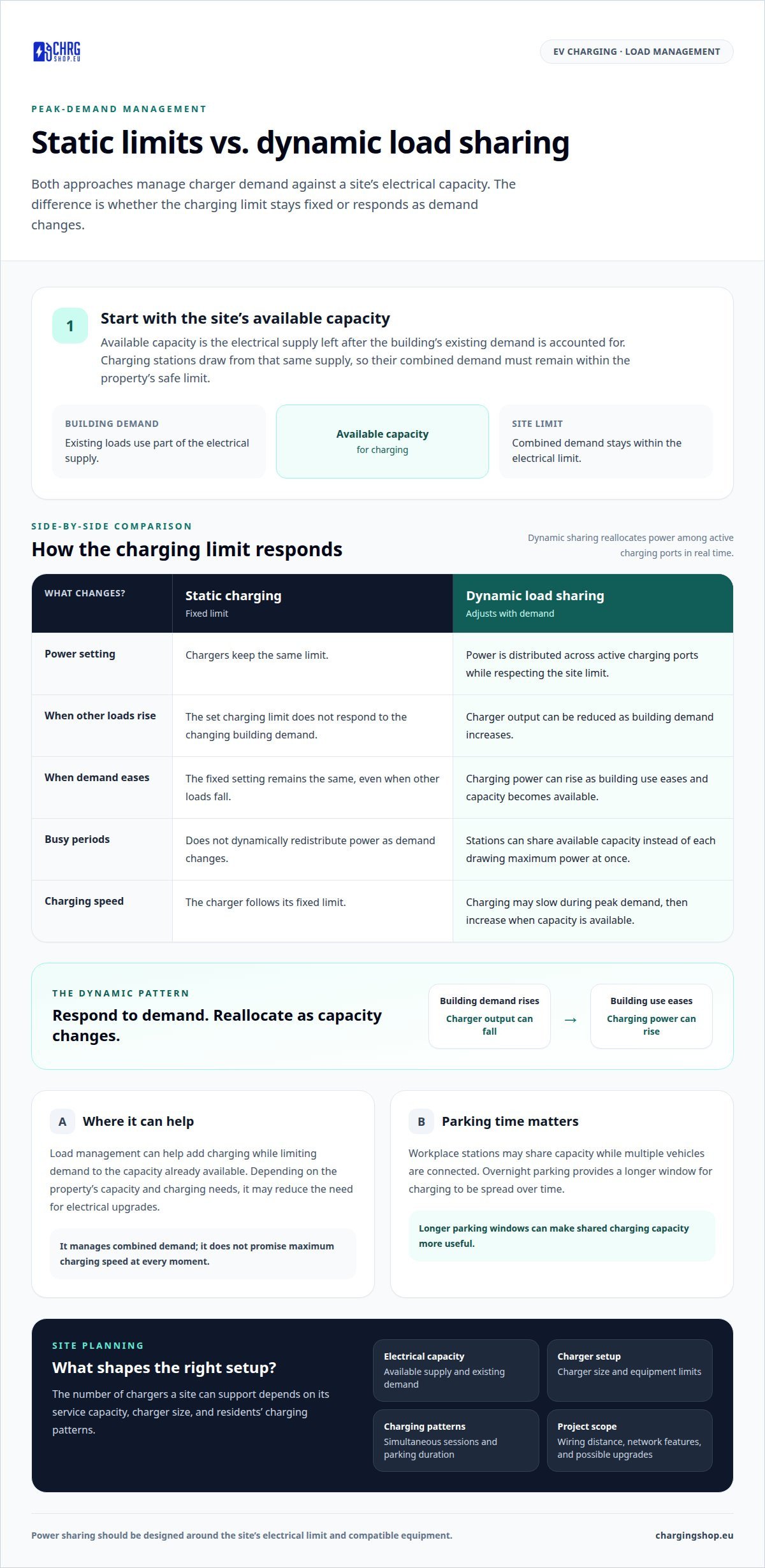
Site capacity is the electrical supply available after accounting for the building’s existing demand. Charging stations draw from that same supply, so their combined demand must stay within the property’s safe limit. Load-management software can monitor active charging and allocate power accordingly. In a multifamily building, the number of chargers the site can support depends on its service capacity, charger size, and residents’ charging patterns.
Capacity planning also accounts for equipment limits and future adoption. Evaluate a Nexus Distributed Charger against its rated capacity and the site’s electrical limit, rather than assuming it can deliver full output to every vehicle at once. This comparison helps establish whether the planned stations can be served through power distribution or whether infrastructure upgrades need consideration.
Sub-Panel Capacity Management
An EV charging sub-panel supplies branch circuits to chargers downstream from a building’s main electrical panel. Managing its capacity means accounting for the connected chargers and limiting their combined demand to the available supply. This is particularly important when several stations share a sub-panel: power allocation can adjust charging output instead of assuming every charger can draw maximum power at once.
Some multifamily layouts provide an individual circuit for each charger while a controller enforces a site-wide cap. This separates circuit connections from overall capacity management. A site assessment can establish whether the existing electrical system can support the planned stations and whether upgrades are needed.
US codes and utility rules: EV charger power sharing must comply with electrical codes adopted in the installation’s jurisdiction and applicable utility service requirements. Because requirements vary by location, system design must account for local rules.
Supported chargers: Dynamic load balancing requires chargers and a controller designed to communicate and adjust output. Confirm that the selected equipment supports coordinated power allocation. Compatibility depends on the specific system.
Installation: Installation involves assessing site capacity, selecting compatible equipment, and configuring load limits. An electrician should handle the electrical work and ensure the installation follows local requirements.
Limitations and safety: Power sharing can slow charging when demand reaches the site cap. Compatibility depends on the charger, controller, and communications support. Correct configuration must keep total demand within the electrical limit.
Electrical upgrade avoidance and peak-demand management
Load management can limit charging demand to the electrical capacity available at a site. This can help add charging without expanding the supply and adjust charging speed during busy periods.
Static and Dynamic Charging Management
Static charging uses a fixed limit, while dynamic management adjusts power distribution as building demand changes. The difference matters when equipment such as HVAC raises demand during a charging session.
With static settings, chargers keep the same limit even when other loads fall. Dynamic load sharing can reduce charger output as demand rises, then restore power when building use eases. At a workplace, stations can share available capacity instead of each drawing maximum power at the same time. Charging may slow during peak periods, but overnight parking provides a longer window.
Home and Grid Load Management
Whole-home load management accounts for EV charging alongside household equipment, helping keep combined demand within the electrical system’s capacity. When assessing a PowerSmart-style approach, consider how it accounts for other loads, such as heating or air conditioning.
Real-time monitoring can reduce charger output when building demand increases, then raise it as capacity becomes available. This helps manage local grid load by limiting combined demand during busy periods. At home, the practical benefit is coordinated power use, not a promise of maximum charging speed at every moment.
Choosing a Power-Sharing Charger
Choose a dynamic charger by matching its load-management capabilities to your electrical system, charging locations, and expected use. For a home with one vehicle, whole-home demand matters. At a business, simultaneous charging sessions and parking duration are more important.
Compare the charger’s communication requirements with those of the controller and any existing equipment. Then map the site’s available capacity and the loads that may overlap with charging. This helps identify a system that can manage demand as use changes. A Personalised Charging Offer can help match charger selection to your home or business needs.
Dynamic Power-Sharing Costs
Total cost depends on wiring distance, the number of chargers, network features, and whether electrical upgrades are needed. A short wiring route and an existing system with spare capacity create different project requirements from a site that needs new infrastructure.
Compare the full project scope, not just the charger. Account for equipment, wiring, controller requirements, and any necessary electrical work. A site assessment can establish whether load management suits the available capacity and which factors affect the overall cost.
What is Dynamic Power Sharing?
Dynamic power sharing divides a fixed supply among active EV charging ports in real time. As drivers plug in or finish charging, the system reallocates available power while respecting the site’s capacity.
Power Allocation Across Charging Ports
A controller distributes electricity across charging ports according to how many vehicles are charging. When other ports are idle, one vehicle can use a larger share of the available power.
For example, one driver charging alone may receive 100% of available power; with four active chargers, each may receive 25% in an equal-split arrangement. The exact allocation depends on the system’s settings and active demand. Intelligent distribution helps stations share capacity without assuming every port can draw its maximum at once.
Allocation Between Charging Sessions
Dynamic allocation adjusts power as charging sessions start and stop, so a vehicle’s share can change during its stay. This is useful in apartment buildings, where residents may arrive and leave at different times.
When one vehicle finishes charging, its unused share can become available to other active ports. When several drivers charge at once, the system divides the supply across those sessions. The charging rate still depends on available capacity and what each vehicle can accept. A networked controller can coordinate stations so power allocation follows current use rather than a fixed split.
For residents, fairness means applying the same site limit consistently, not promising identical charging speeds every time. A shared pool lets more vehicles connect, while the power available to each depends on simultaneous demand.
Required Hardware and Circuit Compatibility
Dynamic power sharing requires chargers and control equipment that can coordinate output. Some system designs also use a meter or current transformers to measure electrical demand. The components needed depend on the system architecture, making compatibility among the measurement device, controller, and chargers essential.
Yes, multiple chargers can share one electrical circuit when the system controls current and the installation is designed for that arrangement. Sharing can reduce wiring needs when ports are close and vehicles stay parked long enough to charge. The circuit’s limit still governs total power, and charger controls must prevent combined demand from exceeding it.
Future role of dynamic power sharing in EV charging
As EV use grows, charging infrastructure needs to serve more vehicles without assuming every station can draw maximum power at once. Dynamic allocation lets a site share available capacity among connected chargers. For example, an apartment building can plan for several residents to charge while the system distributes power according to active sessions and the site limit.
Overnight parking makes this approach especially practical. A vehicle parked for several hours can charge over a longer window, allowing shared capacity to be spread across the night rather than concentrated at one moment. At a workplace, the same principle can make use of hours when fewer cars are plugged in. The charging experience depends on arrival times, parking duration, and how many vehicles charge together.
For property owners, the long-term value lies in planning charging as part of the whole electrical system. Assess existing capacity, estimate likely charging demand, and use load management to coordinate stations. If demand grows, consider how additional ports fit within that capacity before planning infrastructure upgrades. The number of vehicles the site can support still depends on service capacity, charger size, and usage patterns.
Connected charging systems can make power allocation more responsive to changing use. When one driver finishes, available power can be redistributed to vehicles still charging. When sessions overlap, the system can manage output against the shared limit. This makes charging capacity more usable, but it doesn’t increase the electrical supply or guarantee the same charging speed for every vehicle.
For your next planning step, compare expected parking patterns with available electrical capacity, then explore a personalised charging solution for your requirements.
Charging Shop: V2C Trydan 22kW
Charging Shop offers the V2C Trydan 22kW alongside options for different charging requirements. Match your choice to the site’s electrical capacity, expected charging use, and whether you need a solution for residential or commercial settings.
The range also includes the V2C DENKA 20kW DC Wallbox and Alfen Single Pro Line 22kW. These model names and power ratings help you compare options, but charger selection should also account for the wider charging system and how you plan to manage demand. For help aligning those requirements with a suitable option, consider a Personalised Charging Offer.
Explore Charging Shop’s charging options at chargingshop.eu.
Plan Your Charging System for What Comes Next
Plan beyond the first charger. A useful charging strategy accounts for where and when drivers park, when vehicles need power, and how demand may change as more charging points are added. An EV charger with dynamic power sharing can support that plan by adapting power allocation to active use, while remaining within the site’s electrical capacity.
Before choosing equipment, outline your charging goals and the conditions it must meet: available capacity, expected charging sessions, and compatibility between chargers and control equipment. This gives you a clearer basis for comparing options. Whether power sharing can avoid an electrical upgrade depends on the site’s capacity and demand.
Ready to connect your requirements with suitable charging equipment? Contact Charging Shop about EV charging. Take the next step with a plan built around how you’ll actually charge.
Frequently Asked Questions
What is dynamic power sharing for EV chargers and how does it work?
An EV charger with dynamic power sharing adjusts charging output across active ports as sessions change. A controller manages each port within the site’s configured electrical limit. In a shared garage, when one resident finishes charging, capacity can become available to vehicles still connected. The system manages the available supply; it doesn’t increase the property’s electrical service.
How much can dynamic power sharing reduce electrical panel upgrade costs?
There is no fixed cost reduction. Savings depend on whether load management avoids an upgrade and what the site would otherwise require. An existing panel with enough capacity for managed charging may avoid additional infrastructure work. The result depends on electrical service capacity, charger size, wiring needs, and simultaneous demand. If the existing supply can’t support the planned charging load, power sharing alone won’t remove that constraint.
How does dynamic power sharing compare with scheduled charging and static load management?
Scheduled charging sets charging times, static load management applies a fixed power limit, and dynamic sharing adjusts output as demand changes. For example, a vehicle can be scheduled to charge overnight while a fixed limit keeps its charger below a chosen maximum. Dynamic management can respond if other charging sessions start or stop during that window. Depending on the charging system, these approaches can also be combined.
